← Back to Insights
Aclymate Team
March 11, 2026

Sustainable fashion refers to clothing that is designed, sourced, manufactured, and distributed in ways that minimize environmental impact while ensuring responsible labor practices across the supply chain. For apparel brands and manufacturers, sustainable fashion means managing the entire lifecycle of a garment, from raw material production to manufacturing, logistics, consumer use, and end‑of‑life recycling.
The global apparel industry is one of the largest manufacturing sectors in the world, supporting millions of jobs and complex international supply chains. Today, sustainability has moved beyond marketing and become a core responsibility of sourcing, operations, and supply‑chain teams that must understand the environmental footprint of every product. Apparel production carries significant environmental impacts, including high water and energy use, greenhouse‑gas emissions, and growing volumes of textile waste.
Because of these impacts, retailers, regulators, and consumers are increasingly demanding greater transparency and environmental responsibility from fashion brands and apparel manufacturers. Leading companies such as Patagonia, Stella McCartney, and Adidas have already invested heavily in sustainable materials, supply‑chain transparency, and circular product initiatives, demonstrating that sustainability can drive both innovation and long‑term brand differentiation. This shift is accelerating the adoption of sustainable fashion practices across the industry.
For apparel companies, sustainability is no longer just a marketing message. It is becoming a core operational capability tied to supply‑chain management, regulatory readiness, and long‑term brand competitiveness.
Sustainable fashion is the practice of managing the environmental and social impact of clothing across the entire apparel supply chain, from raw material production to manufacturing, logistics, consumer use, and end‑of‑life recycling. For apparel brands and manufacturers, sustainability has become an operational discipline that involves measuring emissions, improving supply‑chain transparency, adopting lower‑impact materials, and building credible sustainability reporting programs. Companies that invest early in sustainability infrastructure can reduce risk, meet retailer requirements, and build long‑term competitive advantage in a rapidly evolving industry.
In practical terms for apparel companies, sustainable fashion is the practice of managing the environmental and social impact of clothing across the entire supply chain—from raw materials and textile production to manufacturing, logistics, and end‑of‑life reuse or recycling.
For apparel brands and manufacturers, sustainable fashion means managing the entire lifecycle of a garment. This lifecycle begins with raw material sourcing—such as cotton farming or synthetic fiber production—and continues through textile manufacturing, dyeing and finishing processes, garment assembly, packaging, logistics, retail distribution, and ultimately the reuse, recycling, or disposal of the product at the end of its life.
Instead of focusing only on style, speed, and cost, sustainable fashion requires apparel companies to ask deeper operational questions. Executives must understand where materials originate, how much water and energy their factories consume, what emissions are generated across the supply chain, whether suppliers operate responsibly, and how product design choices affect waste and product lifespan.
For apparel companies, sustainability ultimately becomes a supply‑chain management discipline that balances environmental impact, operational efficiency, and brand value.
The apparel industry operates one of the most complex global supply chains of any consumer sector, spanning farms, mills, chemical processors, factories, and international logistics networks. Environmental impact emerges at multiple stages across this system, particularly in material production, textile processing, and transportation. Textile manufacturing and global logistics generate substantial carbon emissions, while cotton farming and textile dyeing consume enormous quantities of water. Dyeing and finishing processes can introduce chemicals that harm ecosystems when not managed responsibly, and the combination of overproduction and discarded clothing creates millions of tons of textile waste each year. Because of these impacts, apparel companies are increasingly expected to measure and reduce their environmental footprint.
Large retailers and global apparel brands are now requiring detailed sustainability data from the manufacturers in their supply chains. Apparel suppliers are increasingly asked to report metrics such as carbon emissions, energy consumption, water usage, material sourcing practices, and environmental certifications as part of supplier onboarding and annual compliance reviews. Retail buyers are using this sustainability data to compare vendors and select manufacturing partners that align with their environmental commitments. As sustainable fashion becomes a priority for global brands, manufacturers that cannot provide credible sustainability metrics risk losing contracts or being excluded from preferred supplier programs.
Modern apparel supply chains span multiple countries, factories, and material suppliers, making transparency across the production network increasingly important. Retailers, regulators, investors, and consumers now expect apparel brands to disclose where products are made, how materials are sourced, and what environmental impacts occur throughout production. This growing demand for supply‑chain transparency is forcing fashion companies to collect sustainability data from suppliers and document environmental performance across the lifecycle of a garment. As a result, sustainable fashion is evolving into a data‑driven supply‑chain management discipline that helps apparel companies improve accountability, manage risk, and maintain trust with customers and partners.
Understanding the scale of the fashion industry’s environmental impact helps explain why sustainable fashion has become a priority for apparel brands, retailers, and regulators. Several widely cited industry studies highlight the magnitude of fashion’s environmental footprint.
The global fashion industry is estimated to generate around 8–10% of total global greenhouse‑gas emissions, making it one of the most carbon‑intensive consumer industries. Textile production also consumes enormous quantities of water. Producing a single cotton T‑shirt can require over 2,500 liters of water, roughly the amount a person drinks over several years.
Textile waste is another major challenge. The fashion industry produces tens of millions of tons of textile waste every year, much of which ends up in landfills or is incinerated. At the same time, less than 1% of clothing materials are recycled into new garments, meaning most fibers are used only once before disposal.
From a climate perspective, most of fashion’s environmental impact occurs outside the direct operations of brands. Studies estimate that 70–90% of emissions in apparel supply chains occur in Scope 3 activities, including raw material production, textile manufacturing, dyeing facilities, and third‑party garment factories.
Because of these statistics, sustainability is rapidly moving from a voluntary initiative to a core operational priority for apparel brands and manufacturers worldwide.

While sustainability strategies vary across companies, most sustainable fashion programs focus on five core pillars.
Material selection is one of the biggest drivers of environmental impact in fashion. Many apparel brands are shifting toward lower‑impact materials such as organic cotton, recycled polyester, hemp, Tencel or lyocell, and fibers produced through regenerative agriculture practices. These materials help reduce water consumption, decrease pesticide use, and lower the overall carbon footprint of clothing production. As a result, material innovation and sourcing strategies are becoming a major competitive area for apparel brands seeking to build more sustainable product lines.
Sustainable apparel manufacturing focuses on reducing environmental impact in production facilities and throughout industrial operations. Many companies are improving energy efficiency, transitioning factories to renewable energy, reducing water consumption, minimizing chemical usage, and improving waste management practices across their production lines. Manufacturers are also pursuing environmental management certifications such as ISO 14001 and similar standards to demonstrate responsible operations and continuous environmental improvement.
Sustainable fashion also requires responsible labor practices across the supply chain. Apparel brands increasingly audit suppliers to verify safe working conditions, fair wages, responsible labor policies, and compliance with international labor standards. Ethical sourcing programs help companies ensure that factories and material suppliers operate responsibly while protecting workers across global manufacturing networks. Because of this, ethical labor oversight has become a critical element of modern sustainability programs in the fashion industry.
Circular fashion focuses on designing products that reduce waste and extend product life. Apparel companies are increasingly designing durable garments, enabling repair and resale programs, incorporating recycled materials into new products, and supporting textile recycling systems that keep materials in use longer. The goal is to move away from a traditional linear model of production, sale, and disposal and toward a circular model where products are reused, repaired, and recycled as part of a continuous resource loop.
One of the most important developments in sustainable fashion is the ability to measure environmental impact across the supply chain. Apparel companies are increasingly expected to track carbon emissions, energy consumption, water usage, and supplier environmental performance in order to understand the true footprint of their products. This process is commonly called carbon accounting and involves collecting sustainability data from operations, factories, and supply chain partners. By measuring emissions across textile production, garment manufacturing, logistics, and supplier operations, companies can identify reduction opportunities and report sustainability progress credibly.
Sustainability certifications help apparel brands demonstrate credible environmental and social practices. Many retailers and global brands rely on these frameworks when evaluating suppliers.
Some of the most important certifications in the apparel industry include:
Global Organic Textile Standard (GOTS)
A leading certification for organic fibers that verifies environmental and social standards across the textile supply chain.
OEKO‑TEX® Standard 100
Certifies that textiles are free from harmful substances and safe for human use.
Bluesign®
Focuses on responsible chemical management and sustainable textile production processes.
Higg Index (Sustainable Apparel Coalition)
A widely used sustainability measurement framework for apparel brands and manufacturers that evaluates environmental and social impacts.
Fair Trade Certified™
Ensures fair wages and ethical labor practices across supply chains.
For apparel manufacturers, participating in these certification systems helps build credibility with retailers and consumers while demonstrating measurable sustainability progress.
For apparel brands and manufacturers, sustainable fashion is not just a philosophy—it requires measurable data across the supply chain. Companies increasingly track environmental metrics to understand the true impact of their products and to demonstrate progress to retailers, regulators, and consumers.
The most common sustainability metrics used in the apparel industry include carbon emissions, energy consumption, water usage, chemical management, and waste generation. Many brands measure these metrics across every stage of production, including raw material sourcing, textile manufacturing, dyeing and finishing, garment production, packaging, and logistics.
Carbon measurement is often the starting point because it provides a clear view of climate impact. Apparel companies typically measure emissions across three categories known as Scope 1, Scope 2, and Scope 3 emissions. Scope 1 includes emissions from company‑owned facilities. Scope 2 includes emissions from purchased electricity and energy. Scope 3 emissions occur across the broader supply chain, including textile mills, factories, transportation, and product disposal.
To manage these metrics, many apparel companies now use sustainability or carbon accounting platforms. These systems allow brands to collect environmental data from suppliers, calculate emissions across the value chain, and generate sustainability reports required by retailers, investors, and regulatory frameworks.
By measuring environmental performance, apparel companies can identify reduction opportunities, improve operational efficiency, and demonstrate credible progress toward sustainability goals. Measurement ultimately turns sustainable fashion from a vague concept into a structured operational program for managing environmental impact across global apparel supply chains.
Understanding sustainable fashion is easier when compared with fast fashion, the dominant model that has shaped the apparel industry over the past two decades.
Fast fashion focuses on producing large volumes of inexpensive clothing as quickly as possible in order to respond to changing trends. While this model increases speed and lowers prices, it often creates significant environmental and social impacts.
Sustainable fashion takes a different approach by prioritizing environmental responsibility, ethical sourcing, and long‑term product value.
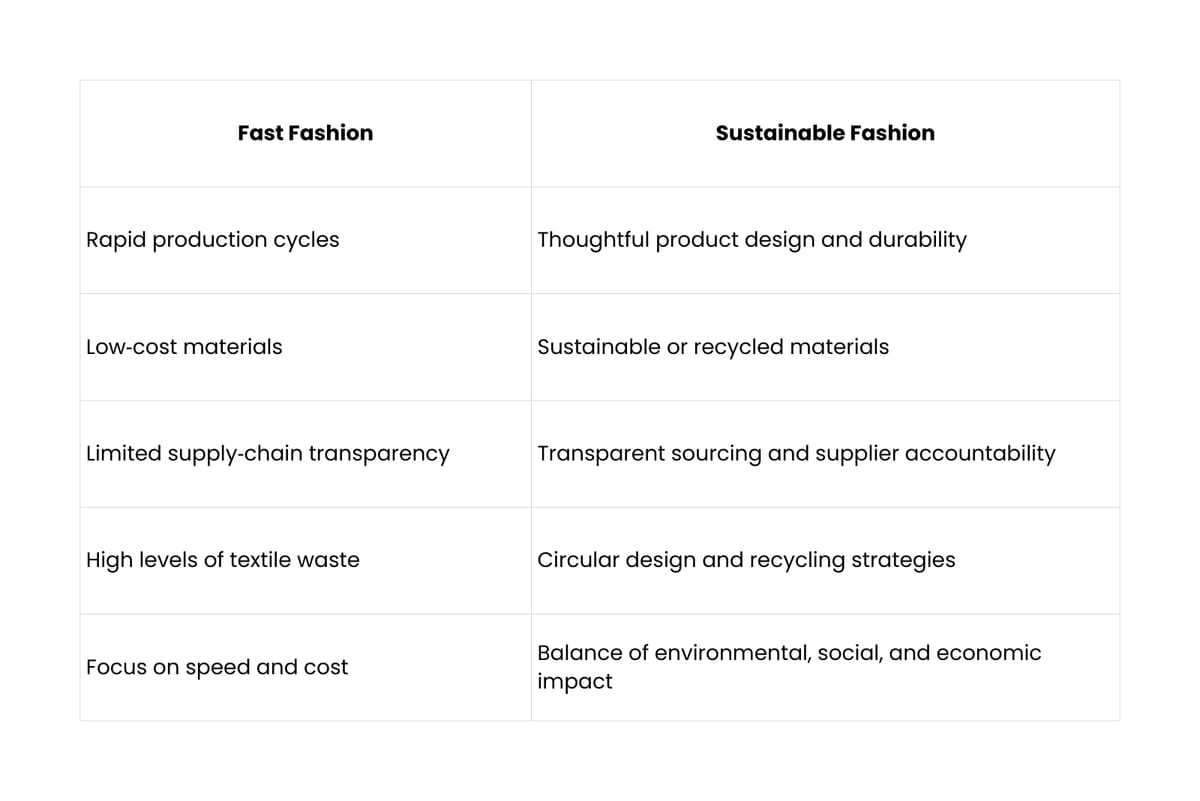
For apparel brands and manufacturers, the shift toward sustainable fashion represents a move from volume‑driven production to responsible and efficient supply‑chain management.
Companies that successfully make this transition can improve brand reputation, reduce operational waste, and build stronger long‑term relationships with retailers and consumers.
To understand why sustainability measurement is so important, it helps to visualize the typical lifecycle of a garment.
Most of the environmental impact occurs across a complex global supply chain:
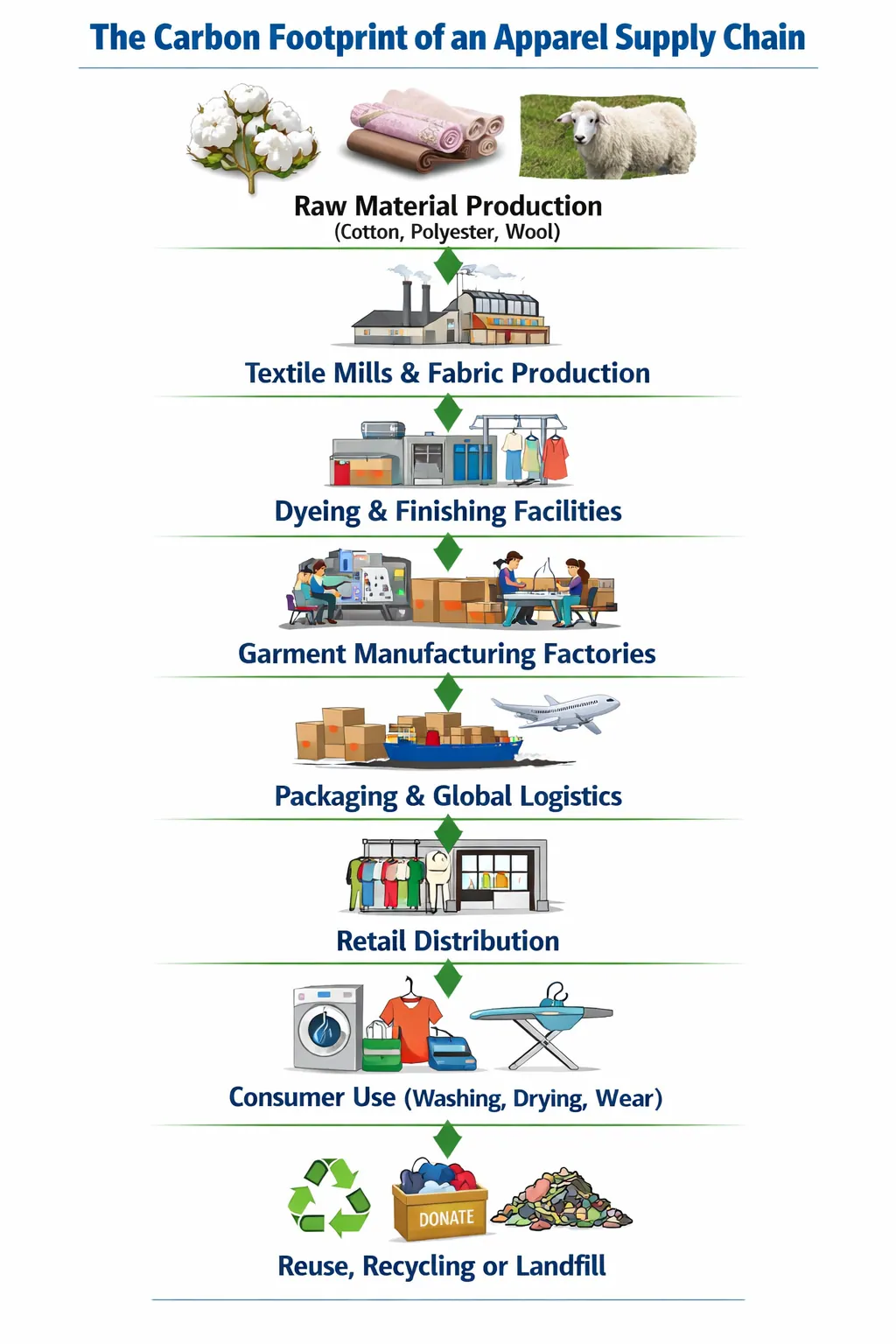
Each stage contributes to a garment’s total environmental footprint through energy use, water consumption, chemical processing, and carbon emissions.
For most apparel companies, the majority of emissions occur in supplier operations and material production, which fall into Scope 3 emissions.
This is why sustainability measurement tools and carbon accounting platforms are becoming essential for managing fashion supply chains.
For apparel brands and manufacturers, sustainability is not only an environmental responsibility—it is also a strategic business advantage.
Major retailers and global brands increasingly require sustainability reporting from suppliers.
Manufacturers that can provide verified environmental data are better positioned to secure long‑term partnerships.
Many sustainability initiatives improve operational efficiency.
For example, initiatives that reduce energy consumption in factories, optimize material usage, and minimize production waste can significantly lower operating costs over time. Many manufacturers discover that sustainability improvements—such as energy efficiency upgrades or waste reduction programs—produce measurable financial savings alongside environmental benefits.
Sustainability has become an important differentiator for fashion brands.
Companies that demonstrate measurable sustainability progress often strengthen their reputation with consumers, retail buyers, investors, and regulators. In an industry where brand perception and supplier credibility are critical, transparency about environmental performance can become a powerful competitive advantage.
New regulations are emerging around climate disclosures and supply chain sustainability.
Companies that already measure their environmental footprint will be far better prepared to comply with these evolving requirements.
Sustainability is rapidly becoming a baseline expectation for the apparel industry.
Brands that invest early in sustainable supply chains will have a significant advantage as standards and regulations continue to expand.
One of the most important sustainability challenges in the apparel industry is Scope 3 emissions.
Scope 3 emissions include indirect emissions that occur throughout a company’s value chain. In fashion, these emissions often represent 70–90% of a brand’s total carbon footprint.
In the apparel industry, Scope 3 emissions typically arise from activities such as raw material production—including cotton farming or synthetic fiber manufacturing—along with textile mills, dyeing facilities, third‑party garment factories, packaging suppliers, international transportation networks, and even the washing, drying, and disposal of garments by consumers.
Because these emissions occur outside a company’s direct operations, they can be difficult to measure.
However, apparel brands are increasingly expected to collect sustainability data from suppliers and partners. Many companies now use carbon accounting platforms to gather this information and produce credible sustainability reports.
Despite growing interest in sustainability, most apparel companies face one major obstacle:
Measuring environmental impact across complex global supply chains.
A single garment may involve:
Much of the environmental impact occurs in Scope 3 emissions, which come from suppliers and logistics partners.
Because of this complexity, many apparel companies are adopting sustainability software platforms that help them:
These tools allow companies to transform sustainability from a vague initiative into a structured operational program.

Most fashion companies begin their sustainability journey with four foundational steps that help them understand and manage their environmental impact.
The first step is measuring the company’s carbon footprint across operations and the supply chain. This includes emissions from company facilities, manufacturing operations, energy usage, transportation networks, and supply chain partners such as textile mills and garment factories. Establishing a clear baseline allows apparel companies to understand where emissions occur and which parts of the supply chain contribute most to their environmental impact.
Once emissions are measured, companies can identify opportunities to reduce environmental impact across their operations and supplier networks. Many apparel companies focus on improving energy efficiency in factories, engaging suppliers to reduce emissions, adopting more sustainable materials, and optimizing logistics and transportation. These initiatives not only reduce environmental impact but can also improve operational efficiency and reduce costs.
As sustainability expectations increase, apparel brands must also develop the ability to report their environmental performance. Many organizations now publish sustainability reports aligned with recognized frameworks such as the GHG Protocol and CDP, while also participating in certification programs and retailer sustainability initiatives. Building strong reporting capabilities allows companies to communicate progress credibly to retailers, investors, regulators, and consumers.
After establishing measurement and reporting systems, companies can set long‑term sustainability goals that guide their strategy. Many apparel brands are committing to net‑zero emissions targets, science‑based climate goals, and sustainable sourcing initiatives that transform their supply chains over time. These commitments signal leadership, provide direction for operational improvements, and help companies align with the evolving expectations of the global apparel industry.
For many years, sustainability in fashion was treated primarily as a branding or marketing initiative. Companies promoted eco‑friendly materials, limited collections, or recycling programs, but often lacked the operational data needed to understand the true environmental footprint of their products.
Today that perspective is changing rapidly. Apparel executives increasingly recognize that most environmental impact occurs far upstream in the supply chain—within cotton farms, textile mills, dyeing facilities, and third‑party manufacturing partners. Because of this, sustainability has evolved into a data and supply‑chain management challenge rather than a simple product attribute.
To manage sustainability effectively, apparel companies must collect environmental data from dozens or even hundreds of suppliers across multiple countries. This includes information about energy consumption, emissions, water use, chemical management, and material sourcing practices. Without reliable data from suppliers, brands cannot accurately measure their carbon footprint or report sustainability progress to retailers, investors, and regulators.
As a result, many apparel companies are investing in carbon accounting systems, supplier data platforms, and sustainability reporting tools that allow them to measure environmental impact across the entire lifecycle of a garment. These systems transform sustainability from a vague aspiration into a structured operational capability that supports better decision‑making, risk management, and long‑term supply‑chain resilience.
This shift explains why sustainable fashion is increasingly managed by operations, sourcing, and supply‑chain teams rather than marketing departments. In the modern apparel industry, sustainability is becoming a core part of how companies design products, select suppliers, and manage global manufacturing networks.
Sustainable fashion is rapidly becoming the new operating model for the apparel industry. As one sustainability executive recently noted, "Sustainable fashion is not just about materials or marketing claims—it is about understanding the full environmental footprint of a garment and managing it across a global supply chain."
Over the next decade we will likely see:
Companies that invest early in sustainability infrastructure will be better positioned to compete in this evolving landscape.
Sustainable fashion represents a fundamental shift in how apparel companies design, source, and manufacture clothing.
For brands and manufacturers, sustainability is no longer optional—it is becoming a core part of supply‑chain management and business strategy.
Companies that build credible sustainability programs today will be better positioned to:
If your apparel company is beginning its sustainability journey, the first step is measuring your environmental impact.
Carbon accounting platforms can help apparel brands track emissions, simplify reporting, and build credible sustainability programs across complex supply chains.
Learn how Aclymate helps apparel companies measure, reduce, and report their carbon footprint.
Sustainable fashion means designing and producing clothing in ways that reduce environmental impact while ensuring responsible labor practices. For apparel companies, this includes managing sustainable materials, ethical sourcing, efficient manufacturing, and transparent supply chains.
Retailers, regulators, and consumers increasingly expect transparency about environmental impact and labor practices. Manufacturers that cannot provide sustainability data may risk losing contracts or falling behind competitors.
The largest environmental impacts include carbon emissions, water consumption, chemical pollution from textile processing, and textile waste generated by global clothing production.
Scope 3 emissions are indirect emissions that occur across the supply chain, including raw material production, textile manufacturing, transportation, and product disposal. These emissions typically make up the majority of a fashion company’s carbon footprint.
Most companies begin by measuring their carbon footprint, engaging suppliers, improving manufacturing efficiency, adopting sustainable materials, and implementing sustainability reporting systems.
Get Aclymate's practical sustainability content delivered weekly.

AI is transforming carbon credit verification through satellite monitoring, automated analysis, and anomaly detection. But can technology solve the voluntary carbon market’s credibility problem? Discover the limitations of AI verification and how businesses can evaluate carbon credits while keeping emissions reductions ahead of offsetting.
Read Article

AI is creating new opportunities for businesses, but it also comes with an environmental cost. Carbon offsets can help address some of those emissions, but businesses need to understand what they are offsetting, how offsets work, and why measuring and reducing emissions should come first.
Read Article
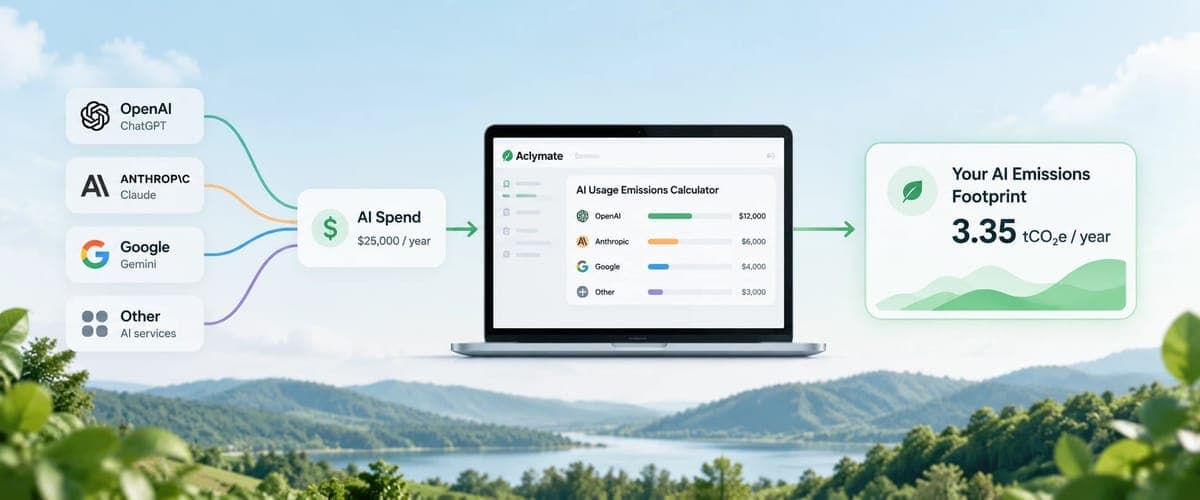
AI carbon emissions are becoming a new consideration for companies adopting ChatGPT, Claude, Gemini, Copilot and other artificial intelligence tools. Here’s how Aclymate estimates the carbon emissions from a company’s AI usage today—and how we expect the methodology to improve as AI providers release better usage and emissions data.
Read Article
Talk with a Sustainability Expert, see a demo, or start free to put the Aclymate platform and experts to work for your team.