← Back to Insights
Aclymate Team
March 6, 2026
Climate responsibility has become a core part of modern business strategy.
Governments are introducing stricter climate disclosure regulations. Investors now evaluate ESG performance before allocating capital. Large corporations increasingly require suppliers to report emissions data before signing contracts.
At the center of these efforts is carbon accounting, which measures the greenhouse gases a company produces through its operations and value chain. Most businesses follow the standards established by the Greenhouse Gas Protocol, which categorizes emissions into three groups:
For many organizations, Scope 3 represents the largest portion of their total emissions.
Understanding these categories helps companies prioritize actions that actually reduce business carbon footprint rather than simply offset it.
Understanding carbon accounting frameworks helps businesses measure emissions and develop practical strategies to reduce their carbon footprint.
Before reducing emissions, businesses must understand where they come from.
Carbon measurement typically includes:
Platforms like Aclymate help companies collect operational data and convert it into CO₂e emissions. This provides a clear baseline and highlights the largest sources of impact.
Without measurement, reduction efforts often miss the areas that matter most.
Energy consumption is one of the most direct ways businesses can reduce emissions.
Practical energy improvements include:
Many companies also purchase renewable energy or install solar panels to reduce Scope 2 emissions.
Energy efficiency improvements often produce immediate cost savings while lowering environmental impact.
Business travel can contribute significant emissions, especially for companies with global teams or frequent client travel.
Businesses reduce travel emissions by:
These adjustments reduce emissions while often lowering travel expenses.
Supply chains are frequently the largest contributor to a company’s carbon footprint.
Businesses reduce supply chain emissions by:
Many companies now require suppliers to disclose emissions data as part of procurement processes.
These efforts reduce Scope 3 emissions while strengthening supply chain transparency.
Waste contributes to emissions throughout production, transport, and disposal.
Businesses can reduce waste by:
Circular economy strategies help companies keep materials in use longer and reduce both waste and emissions. Organizations like the Ellen MacArthur Foundation have helped advance these approaches worldwide.
Employees play an important role in reducing emissions.
Businesses can encourage sustainable practices by:
Employee engagement strengthens sustainability culture and often leads to new ideas that improve efficiency and reduce emissions further.
After implementing reduction strategies, many companies neutralize remaining emissions through carbon offset projects.
Offsets often support initiatives such as:
When used responsibly, offsets help balance unavoidable emissions while companies continue reducing their footprint over time.
It is important to verify offset projects and follow recognized accounting standards when claiming carbon neutrality.
A mid-sized technology company conducted a carbon audit and discovered that the majority of its emissions came from three sources:
By transitioning to renewable electricity, reducing air travel, and optimizing its cloud infrastructure, the company reduced its total emissions by more than 30 percent within two years.
This example highlights how targeted strategies can significantly reduce business carbon footprint.
Reducing emissions begins with clear data and a realistic strategy. Many businesses want to improve sustainability but struggle with where to start, how to measure emissions accurately, and which actions will have the greatest impact.
This is where Aclymate helps bridge the gap between measurement and real-world carbon reduction.
The platform combines automated carbon accounting software with expert guidance so companies can move from raw data to meaningful action.
The first step to reduce business carbon footprint is understanding where emissions originate.
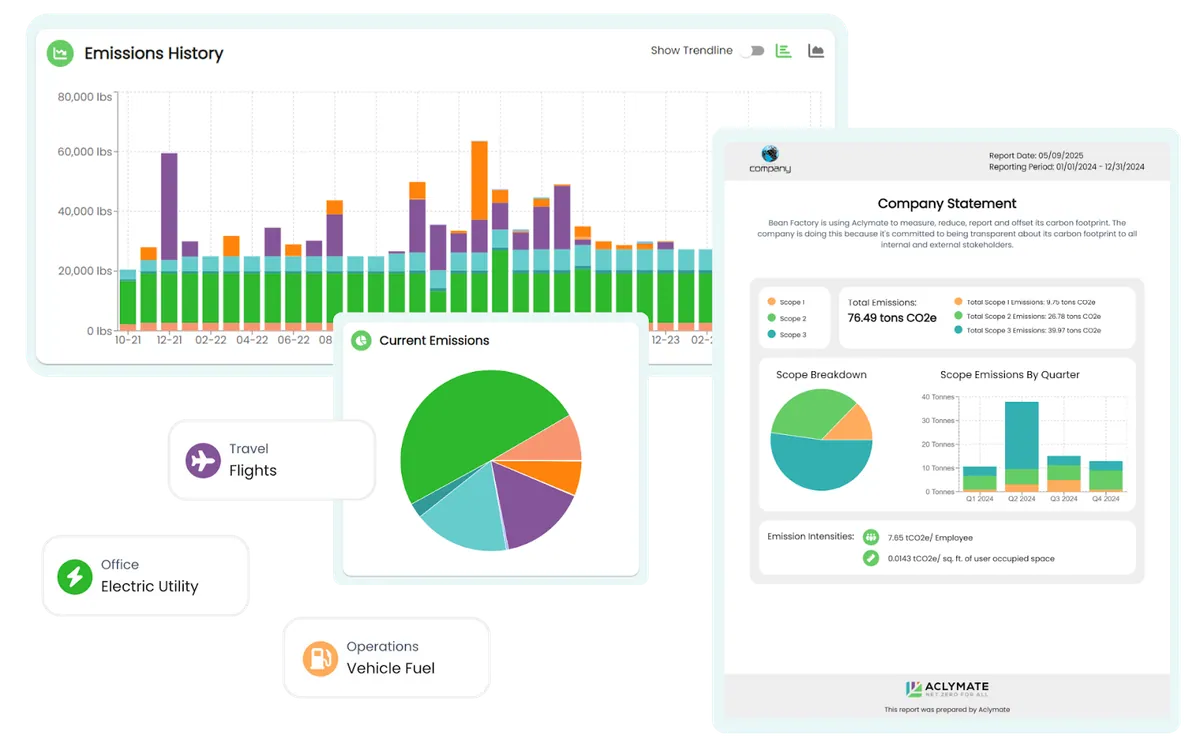
Aclymate simplifies this process by collecting operational and financial data and converting it into CO₂e emissions using methodologies aligned with the Greenhouse Gas Protocol.
The platform helps companies measure emissions across:
This full Scope 1, Scope 2, and Scope 3 coverage allows businesses to see their complete emissions profile rather than partial estimates.
Once emissions are measured, the next step is identifying which areas produce the largest impact.
Aclymate’s analytics highlight emission hotspots so companies can prioritize the changes that will deliver the greatest reductions. Instead of guessing which initiatives matter most, businesses can focus on high-impact areas such as energy use, supplier choices, or transportation.
Reducing emissions requires more than measurement. Businesses need a clear plan.
Aclymate supports organizations in developing practical reduction strategies, including:
These improvements help companies achieve steady, measurable emissions reductions over time.
For businesses pursuing carbon neutrality, Aclymate supports a structured approach:
This ensures sustainability claims are backed by credible data and recognized methodologies.
Many companies want to reduce emissions but do not have an internal sustainability department.
Aclymate combines its software with climate experts who help interpret emissions data, recommend reduction initiatives, and support reporting requirements.
This hybrid model allows organizations to build a credible sustainability strategy without hiring a large ESG team.
As climate disclosures become more common, documentation and transparency are increasingly important.
Aclymate generates structured sustainability reports that support:
These reports help companies demonstrate measurable progress while maintaining transparency with stakeholders.
Reducing emissions is not only about environmental responsibility. It improves operational efficiency, strengthens brand credibility, and prepares companies for evolving climate regulations.
Businesses that start measuring and reducing emissions today will be better positioned for the future.
If your organization is ready to take the next step, Aclymate provides a platform that automates carbon accounting, identifies reduction opportunities, and supports long-term sustainability strategy.
Explore the resources available at aclymate.com to learn how your company can measure, reduce, and report emissions more effectively.
Energy efficiency upgrades, switching to renewable electricity, and reducing business travel are often the fastest ways to reduce emissions.
Electricity use, transportation, manufacturing processes, and supply chains are typically the largest contributors. Scope 3 emissions from suppliers often represent the majority of total emissions.
Yes. Even smaller operational improvements such as energy upgrades, remote work policies, and waste reduction initiatives can significantly lower emissions.
Businesses collect operational and financial data and convert it into greenhouse gas emissions using standardized methodologies such as those from the Greenhouse Gas Protocol.
No. Offsets are generally used to balance unavoidable emissions after reduction strategies have been implemented. The priority should always be reducing emissions first.
Get Aclymate's practical sustainability content delivered weekly.

Learn how to calculate an event carbon footprint in 4 steps: set the boundary, gather activity data, apply emission factors, and total it. Includes an example.
Read Article

An event carbon footprint is the total emissions from travel, lodging, venue energy, food, and waste. See which sources matter most and why.
Read Article

AI is transforming carbon credit verification through satellite monitoring, automated analysis, and anomaly detection. But can technology solve the voluntary carbon market’s credibility problem? Discover the limitations of AI verification and how businesses can evaluate carbon credits while keeping emissions reductions ahead of offsetting.
Read Article
Talk with a Sustainability Expert, see a demo, or start free to put the Aclymate platform and experts to work for your team.