← Back to Insights
Aclymate Team
February 26, 2026
Sustainability reporting is no longer optional. Investors expect climate disclosures. Large buyers now request supplier emissions data. Regulations across multiple regions are formalizing mandatory reporting requirements.
At the center of this shift is one essential tool: the company carbon footprint calculator.
It is the system businesses use to measure greenhouse gas emissions across operations, energy use, and supply chains. Without it, climate commitments remain broad statements. With it, they become measurable, defensible strategies.
This guide explains how a company carbon footprint calculator works, how it aligns with global standards, and how Aclymate supports structured emissions measurement.
A company carbon footprint calculator is a digital platform that converts business activities into greenhouse gas emissions expressed in carbon dioxide equivalents (CO₂e).
It follows internationally recognized accounting standards such as the Greenhouse Gas Protocol, which defines how companies categorize and measure emissions. Many businesses also align with ISO 14064 to ensure consistency and verification readiness.
Unlike consumer calculators, a company-level tool must handle:
For a deeper explanation of carbon accounting fundamentals, see Aclymate’s guide: https://aclymate.com/blog/insights/what-is-a-carbon-footprint-calculator/
A credible company carbon footprint calculator organizes emissions into three scopes defined by the Greenhouse Gas Protocol.
Scope 1 includes emissions from sources a company directly owns or controls.
Examples:
These emissions are typically calculated using fuel consumption data multiplied by standardized emission factors.
Scope 2 emissions come from purchased electricity, steam, heating, or cooling.
Even though the emissions occur at the power plant, they are attributed to the organization consuming the energy. Calculations use regional grid emission factors published by recognized agencies such as the International Energy Agency.

Scope 3 includes all other indirect emissions across a company’s value chain.
The Scope 3 Standard from the Greenhouse Gas Protocol outlines categories such as:
According to reporting data collected by CDP, Scope 3 emissions frequently represent the largest share of a company’s total footprint.
For practical guidance on measuring Scope 1–3 emissions, visit: https://aclymate.com/climate-education/measure-my-businesss-carbon-footprint/
Most platforms follow a structured four-step process.
Companies gather operational data such as:
Accuracy improves as data becomes more complete and granular.
Emission factors convert business activities into greenhouse gas emissions.
For example:
Authoritative emission factors are published by institutions such as the United States Environmental Protection Agency.
Greenhouse gases vary in warming impact. Methane and nitrous oxide are significantly more potent than carbon dioxide.
Calculators convert all gases into CO₂e using global warming potential values defined by the Intergovernmental Panel on Climate Change. This ensures emissions are standardized and comparable.
A professional company carbon footprint calculator does more than produce totals. It should:
Many companies align disclosures with:
For more on sustainability software and reporting systems, see: https://aclymate.com/blog/insights/best-sustainability-management-software/
Climate transparency is increasingly required across supply chains and capital markets.
Without structured measurement, businesses struggle to:
Measurement strengthens credibility and reduces reputational risk. It also often uncovers cost-saving efficiency opportunities.
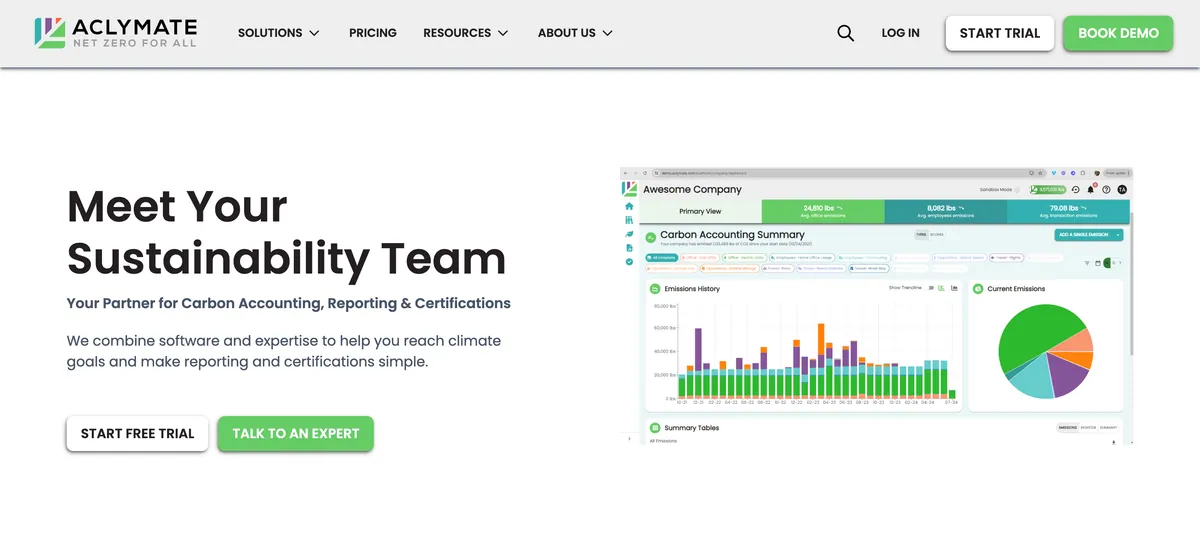
Measuring emissions can feel overwhelming, especially for small and mid-sized businesses without in-house sustainability teams. The challenge is rarely motivation. It is structure and clarity.
Aclymate was designed to remove that friction.
Aclymate walks businesses step by step through emissions data collection aligned with the Greenhouse Gas Protocol.
Instead of complex accounting language, the platform translates emissions categories into practical business inputs such as:
This structured approach reduces errors and improves reporting consistency.
Learn more about carbon footprint calculation here: https://aclymate.com/blog/insights/what-is-a-carbon-footprint-calculator/
Many businesses begin with spreadsheets, which quickly become difficult to manage.
Aclymate centralizes emissions data into a unified system, enabling:
This prepares companies for disclosures aligned with frameworks like Global Reporting Initiative and CDP.
Explore Aclymate’s sustainability platform: https://aclymate.com/blog/insights/best-sustainability-management-software/
Understanding emissions categories is essential for long-term progress.
Aclymate combines carbon accounting tools with climate education resources so teams understand:
Access climate education resources here: https://aclymate.com/blog/climate-education
As climate disclosures become more formalized, documentation must withstand scrutiny.
Aclymate helps generate structured reports that:
Start measuring your business footprint: https://aclymate.com/get-started/
Once emissions are measured, businesses can prioritize high-impact actions such as:
Rather than guessing where to act, companies can focus on the data-driven areas with the highest emissions concentration.
A company carbon footprint calculator transforms sustainability from a broad ambition into a measurable business function.
By aligning with global standards such as the Greenhouse Gas Protocol and using structured tools like Aclymate, businesses gain the clarity needed to report accurately, reduce emissions, and strengthen stakeholder trust.
If you’re ready to move from estimation to structured carbon management, start by establishing your baseline today.
Get your business footprint measured with Aclymate’s free calculator: https://aclymate.com/get-started/
Measurement creates accountability. Accountability drives improvement. And improvement turns climate commitments into measurable results.
A company carbon footprint calculator measures greenhouse gas emissions across Scope 1 (direct), Scope 2 (purchased energy), and Scope 3 (value chain) activities. It converts operational data into CO₂e using standardized emission factors aligned with the Greenhouse Gas Protocol.
Accuracy depends on the quality of input data and the emission factors used. Tools aligned with standards from the Intergovernmental Panel on Climate Change and recognized regulatory bodies provide consistent and defensible calculations. Over time, businesses can improve precision by replacing estimates with supplier-specific data.
Scope 3 often represents the majority of a company’s total emissions, especially in supply-chain-heavy industries. According to CDP reporting insights, value chain emissions frequently exceed operational emissions. Measuring Scope 3 provides a more complete picture of climate impact.
Yes. Even small businesses face supplier reporting requests, investor expectations, or customer sustainability requirements. Establishing a baseline early makes it easier to scale reporting as the company grows.
Most companies measure annually for reporting purposes. However, tracking data quarterly can improve accuracy and help identify trends earlier.
After establishing a baseline, businesses can:
Measurement is the first step. Strategy follows from data.
Get Aclymate's practical sustainability content delivered weekly.

AI is creating new opportunities for businesses, but it also comes with an environmental cost. Carbon offsets can help address some of those emissions, but businesses need to understand what they are offsetting, how offsets work, and why measuring and reducing emissions should come first.
Read Article
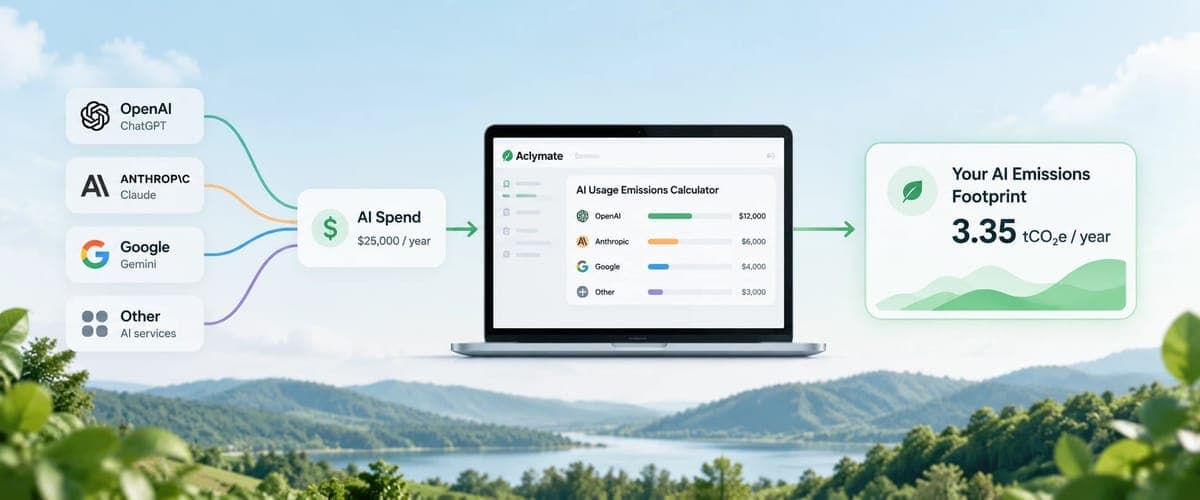
AI carbon emissions are becoming a new consideration for companies adopting ChatGPT, Claude, Gemini, Copilot and other artificial intelligence tools. Here’s how Aclymate estimates the carbon emissions from a company’s AI usage today—and how we expect the methodology to improve as AI providers release better usage and emissions data.
Read Article
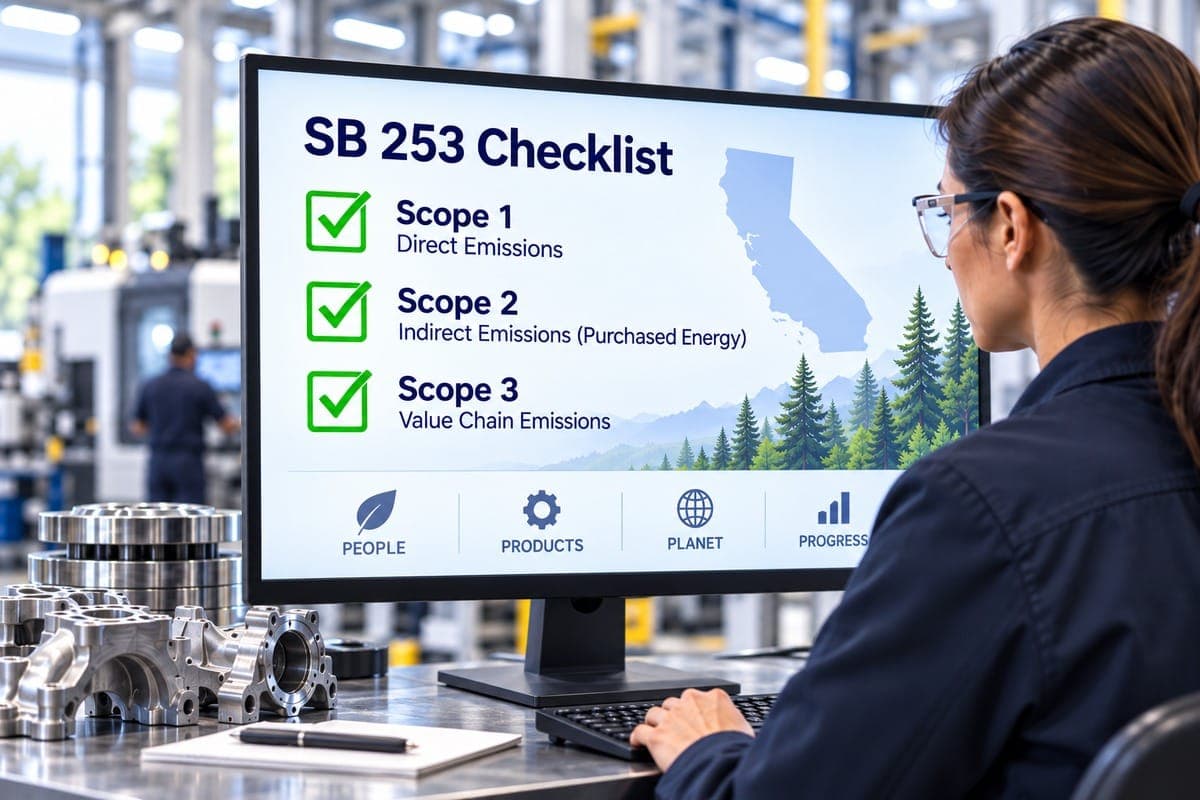
California SB 253 applies to companies over $1B in revenue — but its Scope 3 requirement reaches the automotive suppliers underneath them. What to expect and how to prepare.
Read Article
Talk with a Sustainability Expert, see a demo, or start free to put the Aclymate platform and experts to work for your team.