← Back to Insights
Aclymate Team
February 6, 2026
The term “carbon footprint” is used everywhere, from sustainability reports and investor decks to marketing claims and government policies. Yet many businesses struggle to explain what it actually means in practice. Understanding the carbon footprint definition is not just about terminology. It’s about having a shared foundation for measuring environmental impact, managing climate-related risk, and making informed business decisions.
At its simplest, a carbon footprint measures the greenhouse gas emissions associated with an activity, organization, or product. For businesses, this includes far more than electricity or fuel use. It reflects how a company operates, what it buys, how it transports goods, and how it fits into broader supply chains.
As climate expectations rise, having a clear and accurate understanding of the carbon footprint definition becomes essential for credible reporting and long-term planning.
A carbon footprint is the total amount of greenhouse gases emitted directly and indirectly by an activity, individual, organization, or product. These emissions are expressed in carbon dioxide equivalent (CO₂e), a standardized unit that allows different greenhouse gases to be compared on the same scale.
Greenhouse gases included in carbon footprint calculations typically include:
Each gas has a different global warming potential, which is why they are converted into CO₂e using scientific conversion factors. These factors are defined and maintained by the Intergovernmental Panel on Climate Change (IPCC).
In a business setting, a carbon footprint includes emissions from across the organization and its value chain, not just what happens on-site.
Direct emissions come from sources a business owns or controls, such as:
These emissions result from purchased electricity, heating, cooling, or steam. Even though the emissions occur off-site, they are attributed to the business because the energy is used in its operations.
Value chain emissions often represent the largest portion of a business’s carbon footprint. These include emissions from:
The Greenhouse Gas Protocol, developed by the World Resources Institute (WRI), provides the most widely accepted framework for defining and categorizing these emissions.

Understanding the carbon footprint definition plays a direct role in how businesses plan, operate, and communicate.
Without a shared definition, emissions data becomes inconsistent and unreliable. Clear boundaries ensure emissions are measured using the same assumptions across time periods and business units.
As climate disclosure requirements expand, businesses are increasingly expected to report emissions data that aligns with global standards. A clear definition helps ensure disclosures are consistent and defensible.
Using the term “carbon footprint” loosely or incorrectly can undermine credibility. Businesses that understand the definition are better equipped to communicate accurately and avoid misleading claims.
Emissions are closely tied to energy costs, supply chain exposure, and regulatory risk. Understanding what contributes to your footprint helps identify vulnerabilities and opportunities for efficiency.
According to McKinsey’s sustainability research, companies that integrate climate data into decision-making are better positioned for long-term resilience.
Turning definition into action requires a structured approach.
Businesses gather data related to:
Emission factors convert activity data into emissions. Trusted sources include:
Using standardized emission factors ensures calculations are transparent and comparable.
Most organizations categorize emissions into Scope 1, Scope 2, and Scope 3 to clarify responsibility and identify reduction opportunities.
Even with a clear definition, misunderstandings persist.
Every business generates emissions, regardless of size.
Indirect and value chain emissions often account for the majority of impact.
Estimation is a standard, accepted practice, especially for Scope 3 emissions, as long as methods are transparent.
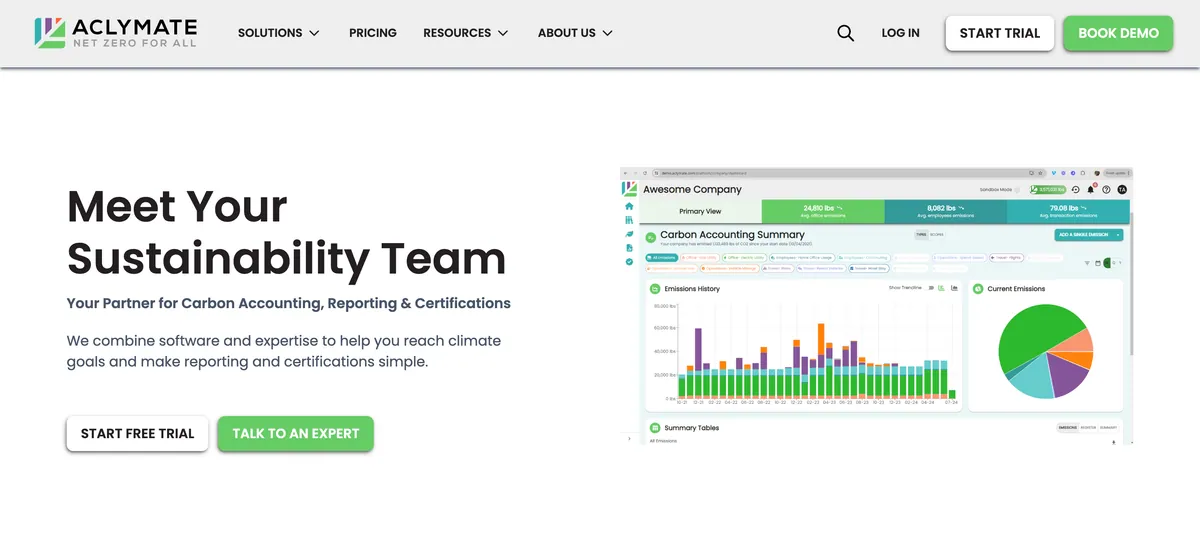
Understanding the carbon footprint definition is only valuable if a business can apply it consistently across operations. Many companies understand the concept in theory but struggle to turn it into accurate, repeatable measurement. Aclymate is designed to bridge that gap by helping businesses translate definitions into practical insight.
Aclymate maps everyday business activities, such as energy use, purchasing, logistics, and travel, to structured emissions categories aligned with recognized carbon accounting frameworks. This allows businesses to work with the carbon footprint definition in a measurable, operational way.
Applying the definition consistently across Scope 1, Scope 2, and Scope 3 emissions is essential for meaningful results. Aclymate organizes data within a clear scope-based structure, ensuring that emissions are measured using consistent boundaries and assumptions.
Aclymate relies on emission factors from reputable scientific sources, including the IPCC and the U.S. EPA. This ensures calculations are grounded in established science and aligned with global standards.
Carbon accounting can feel inaccessible to non-specialists. Aclymate presents emissions data in a clear, business-friendly format that helps teams understand where emissions come from and how different activities contribute to the overall footprint.
Rather than focusing solely on compliance, Aclymate helps businesses connect emissions data to operational decisions. This allows companies to identify high-impact areas, evaluate trade-offs, and prioritize actions that meaningfully reduce emissions.
Aclymate supports ongoing tracking and year-over-year comparison, helping businesses establish baselines and monitor progress over time. This creates a stable foundation for sustainability planning and future reporting needs.
Understanding the carbon footprint definition gives businesses a shared language for sustainability, reporting, and planning. With clear definitions and reliable data, companies can move from awareness to informed action.
If you want to explore how your business can apply this definition in practice, tools like Aclymate help turn concepts into measurable insight and smarter decisions.
A carbon footprint is the total greenhouse gas emissions caused directly and indirectly by an activity or organization.
No. It includes multiple greenhouse gases, all expressed as CO₂e.
CO₂e allows different gases to be compared using a single standardized unit.
Yes. Service businesses generate emissions through energy use, travel, digital infrastructure, and suppliers.
Get Aclymate's practical sustainability content delivered weekly.

AI is creating new opportunities for businesses, but it also comes with an environmental cost. Carbon offsets can help address some of those emissions, but businesses need to understand what they are offsetting, how offsets work, and why measuring and reducing emissions should come first.
Read Article
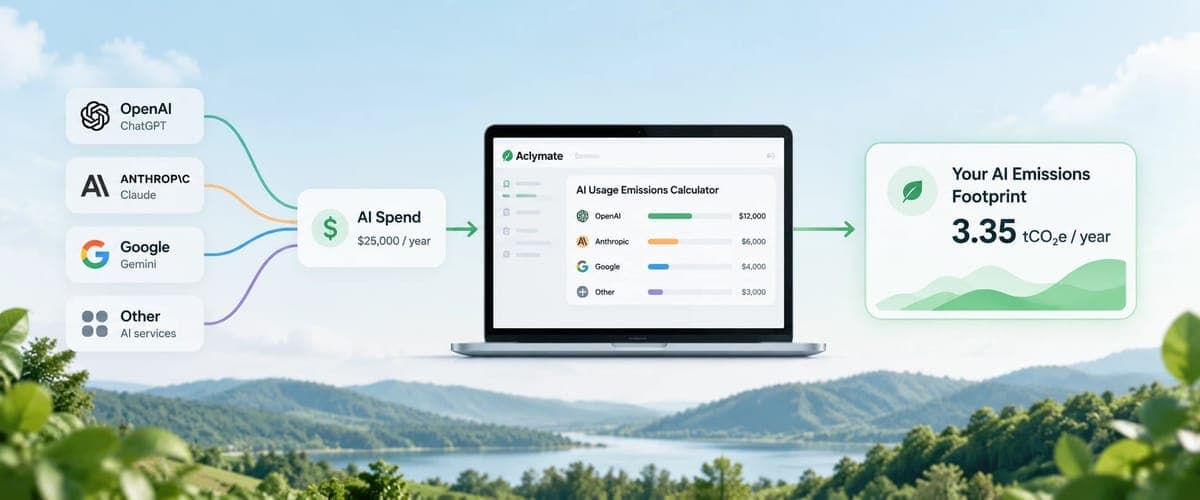
AI carbon emissions are becoming a new consideration for companies adopting ChatGPT, Claude, Gemini, Copilot and other artificial intelligence tools. Here’s how Aclymate estimates the carbon emissions from a company’s AI usage today—and how we expect the methodology to improve as AI providers release better usage and emissions data.
Read Article
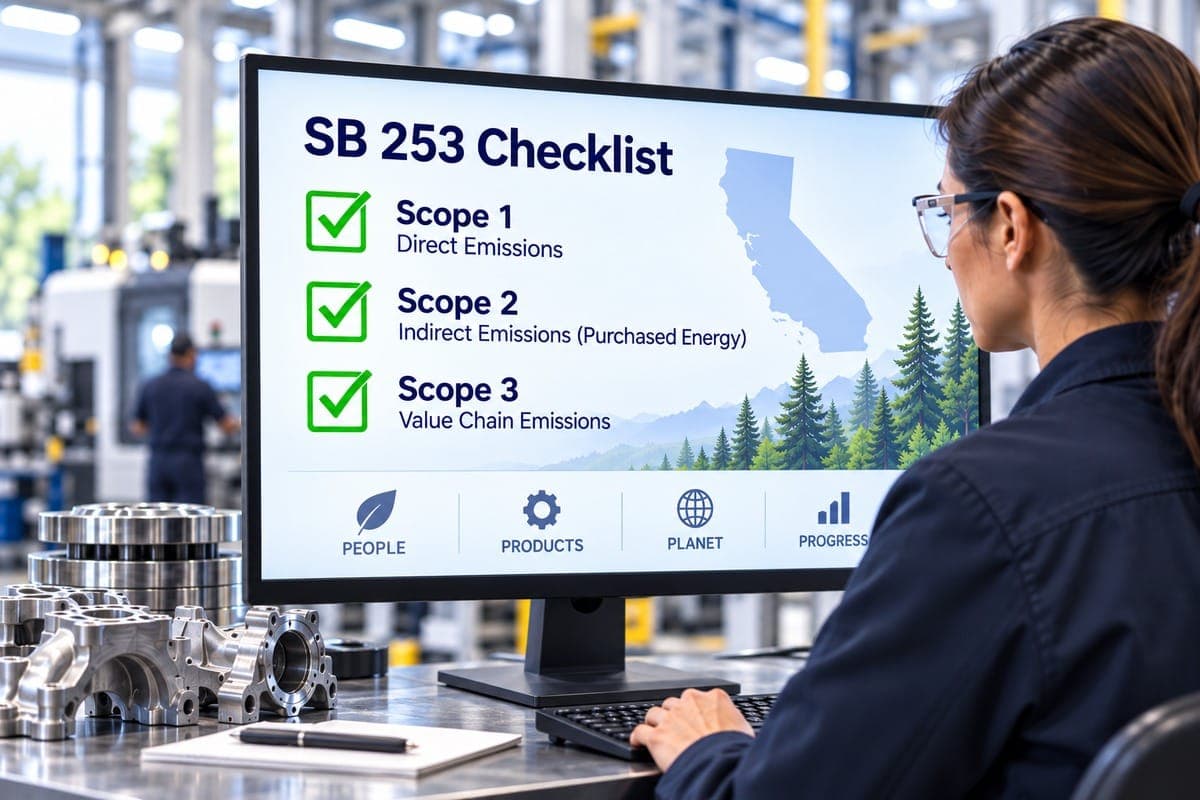
California SB 253 applies to companies over $1B in revenue — but its Scope 3 requirement reaches the automotive suppliers underneath them. What to expect and how to prepare.
Read Article
Talk with a Sustainability Expert, see a demo, or start free to put the Aclymate platform and experts to work for your team.