← Back to Insights
Aclymate Team
September 19, 2026
11 min read
Sustainability in the automotive industry is the work of measuring and reducing the environmental impact of building, moving, and using vehicles — across materials, suppliers, manufacturing, logistics, products, and the vehicle's life on the road.
For most of the last two decades, that work sat with automakers. It is now moving through the entire supply chain.
An OEM sets a carbon reduction target. To hit it, the OEM needs emissions data from its Tier 1 suppliers. Those suppliers need data from Tier 2. Tier 2 needs data from Tier 3 machine shops, material processors, and specialty manufacturers that may have no sustainability department at all.
The result is a two-sided problem that defines automotive sustainability today:
This guide covers both sides. It explains where automotive emissions come from, what OEMs are asking suppliers to produce, how product-level carbon data works, and what a practical program looks like for a company that is not a global automaker.
Automotive sustainability is broader than tailpipe emissions and broader than electrification. It covers the full set of environmental impacts associated with designing, sourcing, building, distributing, using, and eventually recycling a vehicle.
In practice, it spans:
Electrification changes the shape of this picture rather than simplifying it. Removing the tailpipe removes a large share of use-phase emissions, but it increases the relative weight of everything that happens before the vehicle is delivered: battery materials, cell manufacturing, electronics, and the energy behind them.
That shift is one of the main reasons supplier and product-level data has become so important.
Learn more about car sustainability across the automotive value chain →
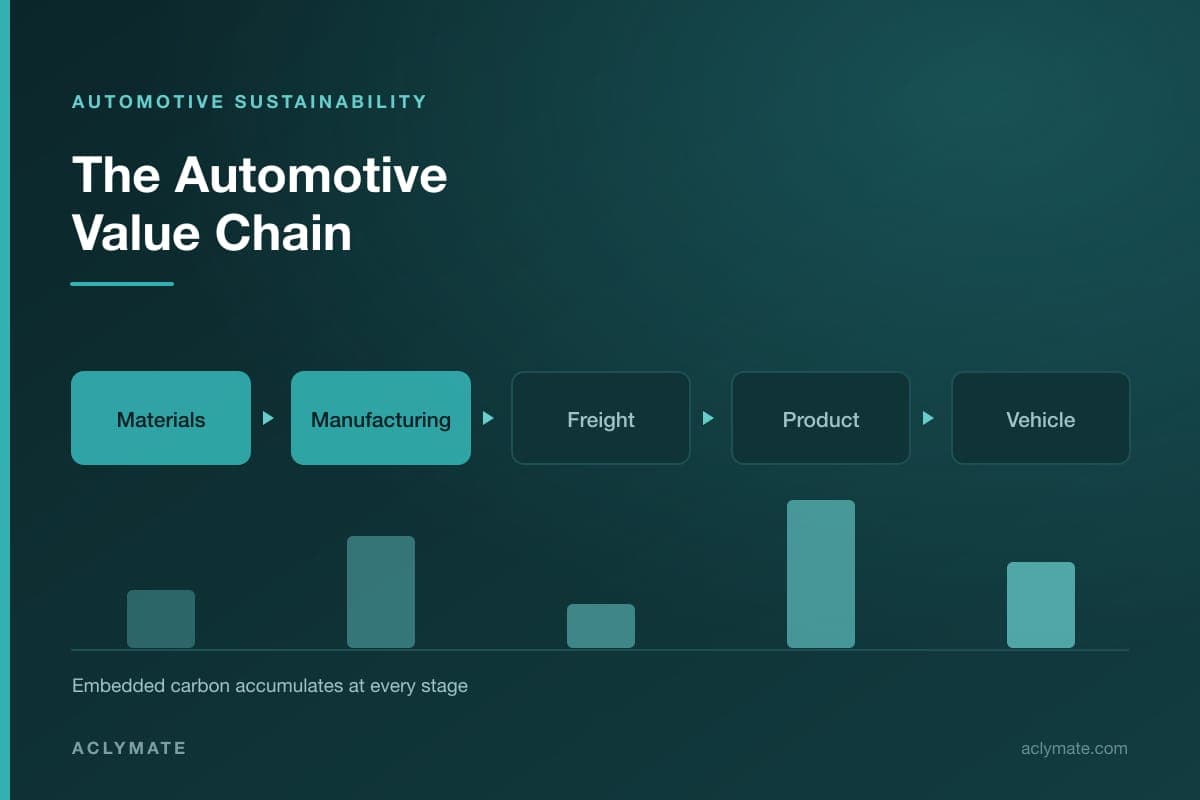
Emissions in automotive follow the value chain: materials and suppliers, then manufacturing, then freight, then the product, then the customer.
Carbon accounting sorts those emissions into three scopes.
Fuel burned on site: natural gas for furnaces and heat treatment, propane for forklifts, diesel for company vehicles, refrigerant leakage.
Electricity, steam, heating, and cooling bought from a utility. For a machining or stamping operation, this is often the largest single line in the inventory.
Everything else: purchased materials and components, inbound and outbound freight, business travel, commuting, waste, and — for an automaker — the fuel or electricity a sold vehicle consumes over its lifetime.
The GHG Protocol defines Scope 3 as indirect emissions across a company's upstream and downstream value chain, and for purchased goods and services that can include the full cradle-to-gate footprint of everything a company buys. GHG Protocol: Scope 3 FAQ
This is why automotive sustainability is a supply chain problem. For most companies in this industry, the majority of the footprint sits outside their own four walls — which means the company that needs the emissions number is rarely the company that holds the data.
There is also a second question, separate from the corporate inventory: what is the footprint of this specific part? That is a Product Carbon Footprint, and it is increasingly what automotive customers actually ask for.
Across the industry, sustainability work tends to fall into a recognizable set of categories:
Most companies do not start all ten at once. The usual sequence is: measure the corporate footprint, find where the emissions actually concentrate, then pick the two or three initiatives that matter for that specific business.
Explore 10 automotive sustainability initiatives →
A handful of changes are reshaping what suppliers and OEMs will be expected to produce:
See the automotive sustainability trends shaping OEMs and suppliers →
Knowing where emissions come from is not the same as being able to manage them. Operationally, automotive companies generally need some combination of:
That last item matters more in automotive than in most industries, because so much of the supply base is made up of companies where sustainability is somebody's fifth priority rather than their job title.
Aclymate covers this as software plus expert services: Navigator for carbon accounting, the Product Footprint Pack for part-level footprints, and Supplier & Scope 3 Data Support for the supplier data work on both sides of the relationship.
Explore sustainable automotive solutions →
OEM sustainability strategy sets the tempo for everyone below it. Broadly, leading automakers are working on:
This is also becoming collaborative rather than purely top-down. Suppliers Partnership for the Environment has developed shared carbon reporting and reduction guidance with input from automakers and suppliers across the industry. Suppliers Partnership: supplier carbon guidance
See what leading sustainable car companies are doing →
Here the perspective flips.
A 90-person machine shop never planned to run a sustainability program. Then a major customer asks for Scope 1 and 2 emissions, a footprint for a specific part number, and a completed sustainability questionnaire — with a due date attached to a quote.
At that point sustainability stops being an environmental initiative and becomes a commercial requirement. The request usually lands on whoever has capacity: the quality manager, the EHS lead, the controller, or the owner.
This applies across the supply base:
The good news is that the first inventory is more tractable than it looks. Utility bills, fuel purchases, and accounting data carry most of what a Scope 1 and 2 footprint needs. The harder part is usually knowing what the customer actually wants and in what format.
Read the automotive supplier sustainability guide →
For suppliers that want help interpreting and answering customer requirements, Aclymate's supply chain sustainability consultants work directly on the request in front of you.
Now flip back to the buyer's side.
An OEM or large Tier 1 may purchase from hundreds or thousands of suppliers. Collecting credible emissions data at that scale runs into predictable problems:
The practical answer is prioritization rather than universal coverage: concentrate real data collection on the suppliers and materials where emissions actually sit, and accept estimates elsewhere until the program matures.
Learn how to manage automotive supply chain sustainability →
Customer requirements vary, but they are assembled from a fairly consistent menu:
The SAQ exists specifically to cut down on duplicated effort — it is a shared assessment used across participating automotive companies, with a lighter version aimed at smaller suppliers. Drive Sustainability: SAQ Toolbox
See the guide to OEM sustainability requirements →
"Reporting" covers four different activities that are easy to confuse:
They draw on overlapping data but have different boundaries, different formats, and different audiences. Treating them as one undifferentiated pile of work is the most common reason suppliers end up rebuilding the same numbers four times a year.
Read the automotive sustainability reporting guide →
Aclymate is built for the two-sided problem this guide opened with — companies that need supplier data, and suppliers that need to provide it.
See how this comes together for the industry on the Automotive & Transportation page.
If a customer request is already on your desk, start by identifying exactly what is being asked for — a corporate inventory, a part-level footprint, or a questionnaire are three different jobs.
If nothing has arrived yet, build the Scope 1 and 2 inventory now. It is the foundation for every other answer, it is the least dependent on anyone else's data, and it is the thing you will wish you had when the first request shows up with a two-week deadline.
Sustainability in the automotive industry means measuring and reducing the environmental impact of building, moving, and using vehicles. It covers materials, supplier emissions, manufacturing energy, freight, product carbon footprints, vehicle use, and end-of-life recycling. It is broader than tailpipe emissions or electrification, because most of a vehicle's footprint is created across the supply chain before the vehicle is ever delivered.
The biggest challenge is data. Most of an automotive company's footprint sits in its supply chain, which means the company that needs the emissions number rarely holds the underlying data. Add thousands of suppliers across multiple tiers, inconsistent calculation methods, low response rates to data requests, and smaller suppliers with no sustainability staff, and measurement becomes harder than reduction.
Automotive supply chain sustainability is the practice of measuring, managing, and reducing emissions across the network of suppliers that produce a vehicle's materials and components. It involves collecting supplier emissions data, calculating product carbon footprints, prioritizing high-impact suppliers, replacing estimates with supplier-specific data, and cascading requirements from OEMs through Tier 1, Tier 2, and Tier 3.
OEMs commonly request Scope 1 and Scope 2 emissions, energy and facility data, Scope 3 information, Product Carbon Footprints for specific parts, reduction targets and plans, an environmental management system such as ISO 14001, a completed Sustainability Assessment Questionnaire or EcoVadis assessment, and supporting evidence such as policies and calculation documentation.
It depends on the customer. Many automotive suppliers are first asked only for Scope 1 and Scope 2 emissions plus a product carbon footprint. Scope 3 requests are becoming more common, particularly for purchased goods and services, because a supplier's Scope 3 includes the materials it buys — which feeds directly into its customer's own Scope 3 inventory.
A Product Carbon Footprint is the greenhouse gas emissions associated with one specific part or component, expressed as kg CO2e per part. For automotive suppliers it is usually calculated cradle-to-gate, covering raw materials, purchased components, inbound freight, manufacturing energy, and scrap, up to the point the part leaves the facility.
The Sustainability Assessment Questionnaire, or SAQ, is a shared supplier assessment developed by Drive Sustainability, a partnership of major global automakers. It covers environmental management, policies, governance, human rights, and health and safety. Because participating customers accept the same assessment, it is designed to reduce duplicated reporting across the supply base.
Start with a Scope 1 and Scope 2 inventory built from utility bills, fuel purchases, and accounting data, since that is the foundation for nearly every request. Then identify precisely what each customer is asking for, because a corporate inventory, a part-level footprint, and a questionnaire are different deliverables. Software plus expert support is usually more practical than hiring sustainability staff.
At minimum, carbon accounting for Scope 1, 2, and 3, and a way to produce Product Carbon Footprints from bills of materials. Beyond that, suppliers benefit from supplier data collection, questionnaire and customer reporting support, data quality tracking, and access to people who can review the work. Many suppliers need expert services alongside the software.
Most begin with spend-based estimates, applying industry-average emissions factors to purchasing data. They then improve accuracy by moving toward activity data such as mass of material purchased, and ultimately toward supplier-specific emissions factors and Product Carbon Footprints from the suppliers themselves. Data quality improves progressively rather than all at once.
Get Aclymate's practical sustainability content delivered weekly.
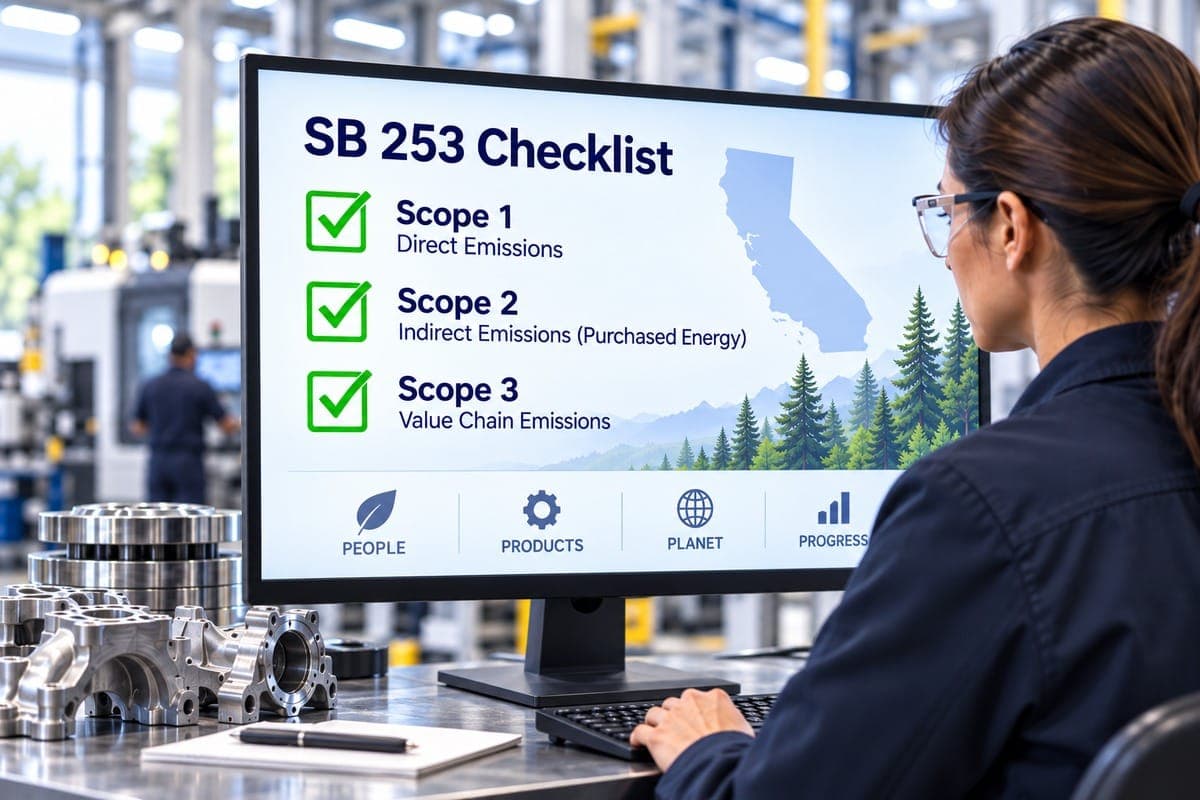
California SB 253 applies to companies over $1B in revenue — but its Scope 3 requirement reaches the automotive suppliers underneath them. What to expect and how to prepare.
Read Article
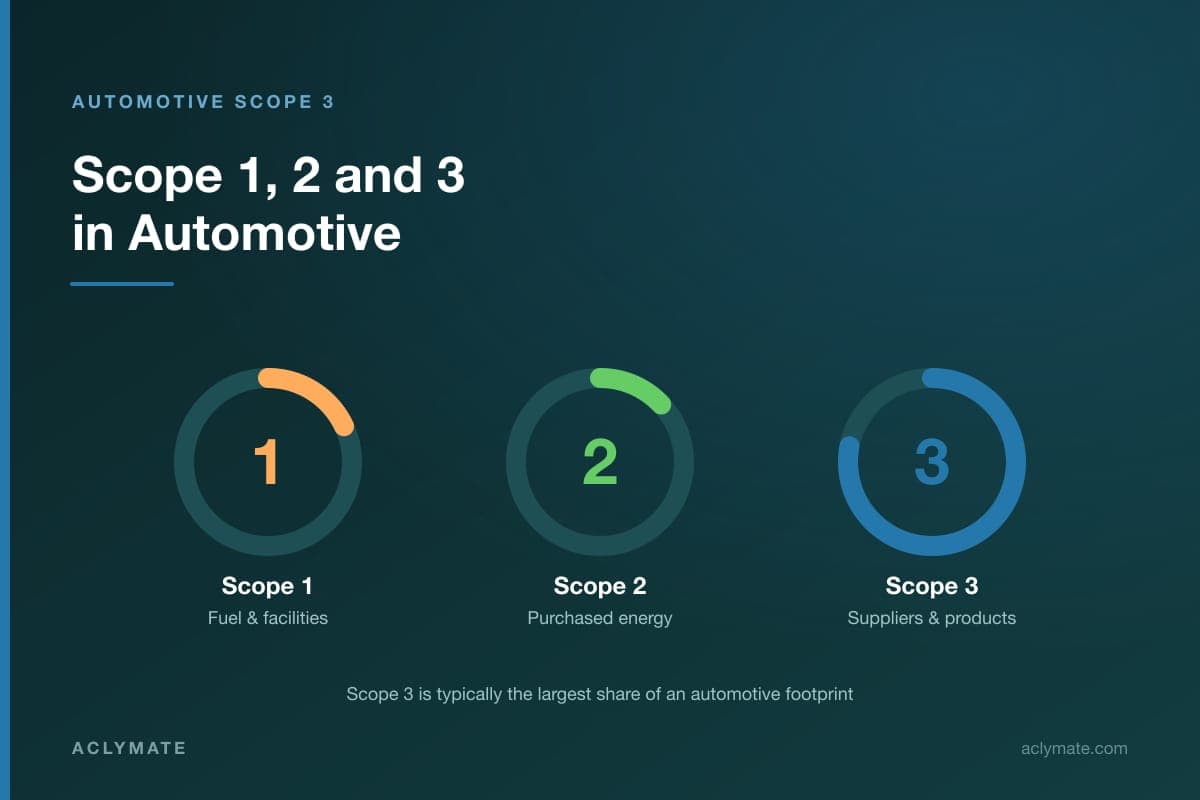
Learn how automotive companies measure Scope 3 emissions, collect supplier data, calculate product footprints, and meet customer reporting requirements.
Read Article
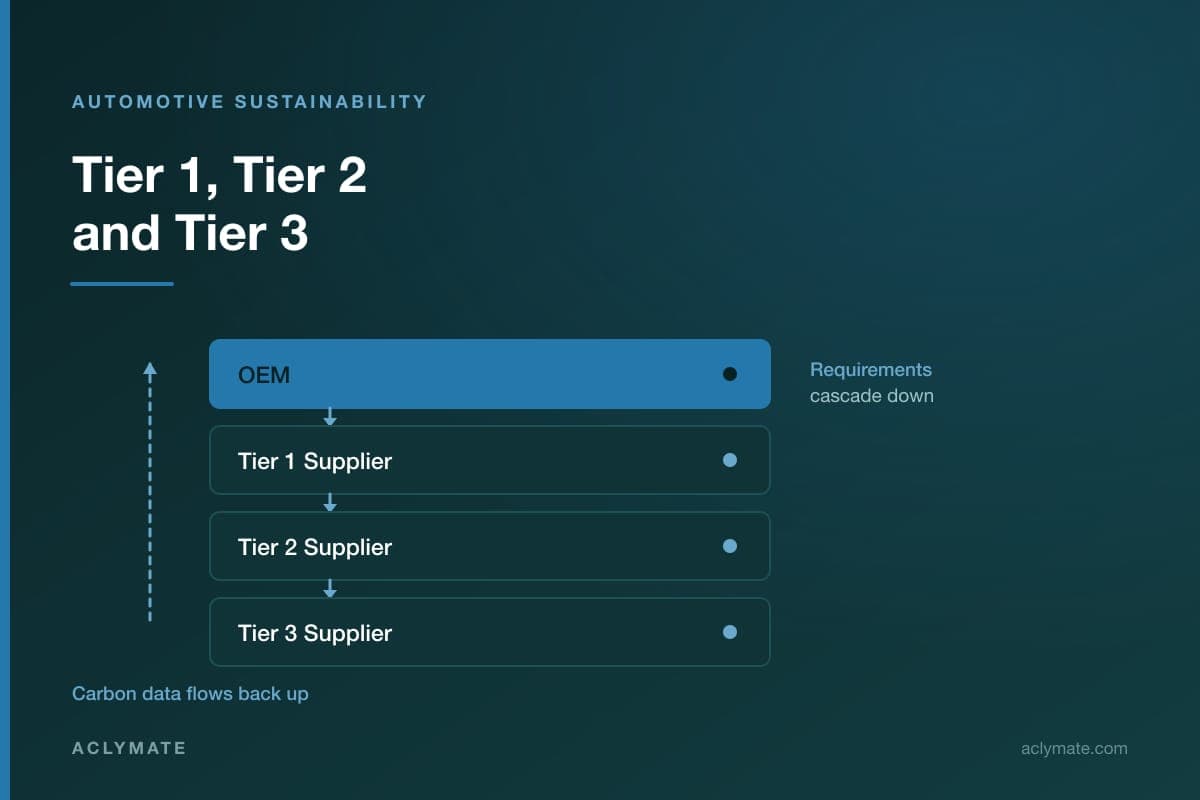
A practical sustainability guide for automotive suppliers covering emissions, Scope 3, customer requests, product footprints, questionnaires, and reporting.
Read Article
Talk with a Sustainability Expert, see a demo, or start free to put the Aclymate platform and experts to work for your team.