← Back to Insights
Aclymate Team
September 21, 2026
10 min read
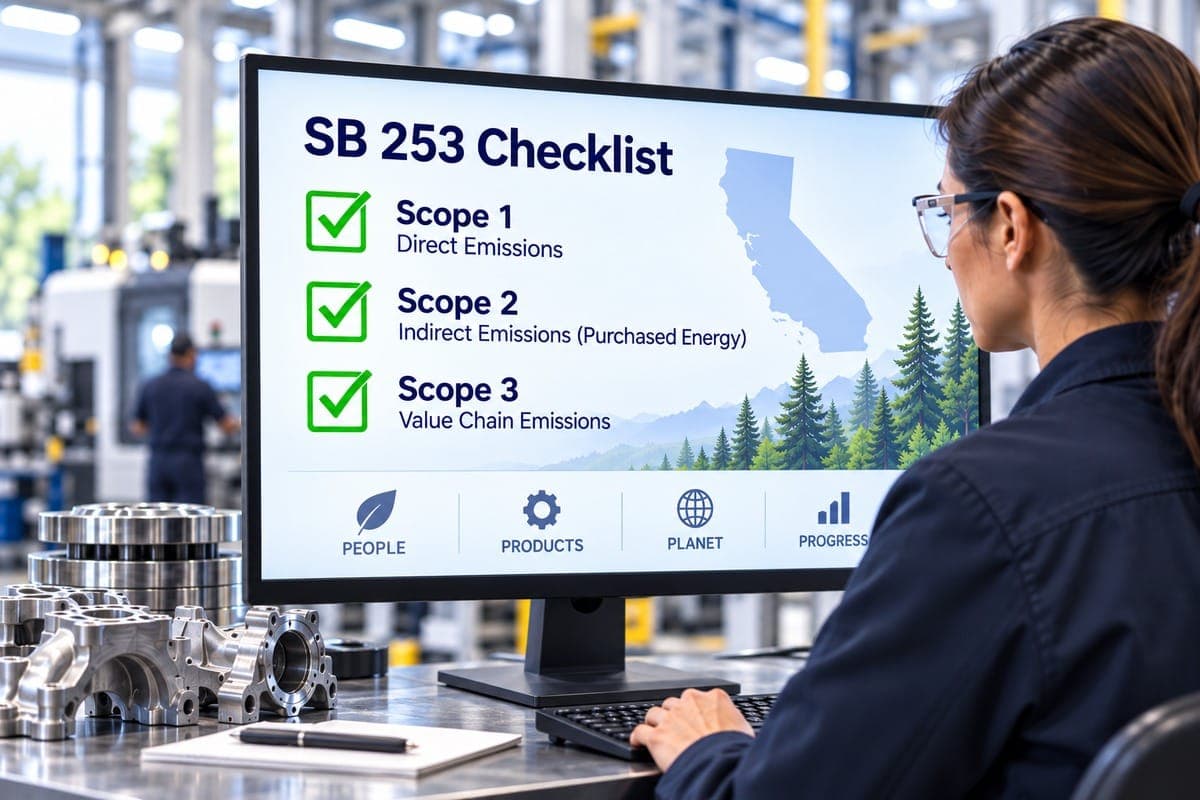
If you supply the automotive industry and someone has mentioned SB 253, the first thing worth knowing is this: the law almost certainly does not apply to your company.
The second thing worth knowing is that it will still generate work for you.
California's Climate Corporate Data Accountability Act applies to companies with more than $1 billion in annual revenue that do business in California. That threshold excludes the overwhelming majority of automotive suppliers — every Tier 3 machine shop, nearly every Tier 2 component manufacturer, and a good number of Tier 1s.
But SB 253 requires covered companies to report Scope 3 emissions. And an automaker's Scope 3 is, in large part, its supply chain.
The obligation lands on your customer. The data has to come from you.
This guide covers what SB 253 actually requires, why the automotive supply base is more exposed than most industries, what your customers are likely to ask for, and what to have ready.
SB 253 requires covered entities to publicly disclose their greenhouse gas emissions, verified and reported to the California Air Resources Board.
Notice how low the California nexus test is. A company with $757,000 of California sales qualifies as doing business there. For a manufacturer of any scale, that is trivially met.
So the real filter is the $1 billion revenue threshold — not geography. Which is exactly why the law captures automakers and large Tier 1s almost completely, while leaving the companies that supply them outside its scope.
SB 253 is still being implemented, and the details have moved more than once. As of September 2026:
Two practical implications follow. First, SB 253 has not been paused — unlike SB 261, it is proceeding. Second, because rulemaking is ongoing and an appellate decision could land at any time, treat any specific date in this article as current-as-of-writing rather than settled. Your customers' compliance teams are tracking this closely; it is reasonable to ask them what they are planning against.
Three features of this industry make the cascade sharper here than almost anywhere else.
California is the largest automotive market in the United States. Every major OEM sells there, far above the nexus threshold, and comfortably clears $1 billion in revenue. There is no meaningful population of automakers that escapes SB 253 on scope. The same is true of most large Tier 1 systems suppliers.
A company that assembles vehicles from thousands of bought-in components holds only a small share of its total emissions inside its own plants. Scope 3 is the majority, and Category 1 — purchased goods and services — is the largest piece of it.
An OEM cannot produce a credible Scope 3 figure from its own records. It has to ask.
CARB has been consulting on how to phase in Scope 3 reporting, and one option under consideration is a sectoral approach that begins with the sectors contributing most to statewide emissions — with transportation named among them.
That is not settled, and it may not be the approach adopted. But it means automotive is a plausible candidate to be early rather than late, which is worth knowing when your customer's timeline seems more urgent than you expected.
Here is the detail most suppliers miss.
Scope 3 reporting begins in 2027 — but on fiscal year 2026 data.
Fiscal 2026 is happening now. The emissions your operation is generating this year, and the materials you are buying this year, are what your customers will be reporting. They cannot go back and collect that retroactively with any credibility.
That is why supplier data requests have accelerated through 2026 rather than waiting for 2027. Your customers are collecting the baseline while the year is still in progress.
If a request has already landed on your desk, this is usually why. See what automotive customers may ask you to provide.
SB 253 does not give your customer authority to compel anything from you — you are not a regulated party. What it does is give them a hard reason to ask, and a deadline of their own.
Expect requests for:
That last pair matters more under a regulatory driver than it did under a voluntary one. When your customer's disclosure carries a $500,000 penalty exposure and eventual third-party assurance, they have to be able to defend the inputs. A number you cannot explain is a number they may not be able to use.
The good-faith safe harbor for Scope 3 disclosures through 2030 is genuinely helpful, and it is worth understanding what it does and does not mean for you.
It means your customer is not expected to produce a perfect supply chain inventory immediately. Estimates and industry averages are acceptable while the data improves.
It does not mean the requests stop. If anything the opposite: the way a company demonstrates good faith is by showing it made a real effort to obtain supplier-specific data. Documented outreach to suppliers is evidence. So the safe harbor rewards asking, and your customers will keep asking.
What it does give you is room. A first-year answer labelled honestly as an estimate is genuinely useful to your customer. "We don't have that" is not.
These two California laws are frequently confused, and they are different in ways that matter.
| SB 253 | SB 261 | |
|---|---|---|
| Revenue threshold | Over $1 billion | Over $500 million |
| What it requires | Greenhouse gas emissions disclosure, Scope 1, 2 and 3 | Climate-related financial risk report |
| Reaches your data? | Yes, through Scope 3 | Indirectly at most |
| Assurance | Expected from 2027 | None |
| Maximum penalty | $500,000 per year | $50,000 per year |
| Enforcement status | Proceeding | Enjoined by the Ninth Circuit in November 2025 |
For a supplier, SB 253 is the one that generates data requests, because it is the one that requires emissions accounting across the value chain. Our guide to SB 261 covers the climate risk side in detail.
None of this requires a sustainability department. It requires a small set of things to exist before someone asks for them.
Suppliers with this in place answer in days. Suppliers without it spend several weeks per request, every time.
It is worth noting that SB 253 is not a separate workstream from everything else your customers are asking about.
The same underlying data — facility energy, emissions by scope, part-level footprints, methodology, evidence — feeds:
Suppliers who build this once and maintain it handle each new requirement as a reformatting job. Suppliers who treat each request as a separate project rebuild the same numbers several times a year, indefinitely.
That is the practical argument for treating this as infrastructure rather than compliance response. See automotive Scope 3 emissions for how the pieces connect.
It is tempting to wait and see whether the courts strike the law down. That is a reasonable thing to watch and a poor thing to plan around, for three reasons.
First, the Ninth Circuit declined to enjoin SB 253 even while pausing SB 261, which is a meaningful signal about how the two are being treated.
Second, your customers are not waiting. Their planning assumption is compliance, and their supplier data programs are running now regardless of how the appeal resolves.
Third, and most importantly, almost nothing you would do to prepare for SB 253 is wasted if it disappears tomorrow. A Scope 1 and 2 inventory, a repeatable product footprint method, and a documented evidence pack are what EU customers, Catena-X, EcoVadis, and the SAQ all require anyway. California is a deadline, not a reason.
Aclymate works both sides of this: companies that need to collect supplier data for their own disclosure, and suppliers that need to produce it.
Software plus expert services, which suits a supply base where most companies will never employ a sustainability specialist.
See the Automotive & Transportation page, or OEM sustainability requirements for the full picture of what customers ask for.
Regulatory details in this article were verified in September 2026. SB 253 rulemaking is ongoing and the Ninth Circuit appeal is undecided, so confirm current requirements with CARB or your customer's compliance team before acting on a specific date.
Usually not directly. SB 253 covers companies with more than $1 billion in annual revenue that do business in California, which excludes most Tier 2 and Tier 3 suppliers and many Tier 1s. However, it requires covered companies to report Scope 3 emissions, and an automaker's Scope 3 is largely its supply chain, so the data requests reach suppliers anyway.
Covered entities must publicly disclose greenhouse gas emissions and report them to the California Air Resources Board. Scope 1 and Scope 2 come first, with Scope 3 following in a later phase. Penalties reach up to $500,000 per entity per year. Assurance requirements are expected to begin with the 2027 reporting cycle.
An entity qualifies if it is organized in California, or if its California sales exceed an inflation-adjusted threshold of roughly $757,000 for 2025, or if California sales represent 25% of total sales. That nexus test is easily met by any manufacturer of scale, so the $1 billion revenue threshold is the real filter.
Scope 3 reporting begins in 2027, based on fiscal year 2026 data. That timing is the reason supplier data requests accelerated during 2026 rather than waiting: fiscal 2026 is the baseline year, and customers cannot credibly reconstruct that data retroactively after the year closes.
No. A First Amendment challenge to both SB 253 and SB 261 is before the Ninth Circuit, argued in January 2026 with a decision pending. The court enjoined enforcement of SB 261 in November 2025 but declined to do the same for SB 253, so SB 253 is proceeding while the appeal is undecided.
SB 253 applies above $1 billion in revenue and requires greenhouse gas emissions disclosure across Scope 1, 2 and 3, with penalties up to $500,000 per year. SB 261 applies above $500 million and requires a climate-related financial risk report, with penalties up to $50,000. For suppliers, SB 253 is the one that generates data requests.
Good-faith Scope 3 disclosures receive a safe harbor through 2030, acknowledging that supply chain data will be imperfect early on. It does not reduce supplier data requests. Demonstrating good faith generally means showing a real effort to obtain supplier-specific data, so documented outreach to suppliers is itself part of the evidence.
Preparing is worthwhile regardless. Customers are planning on compliance and running supplier data programs now. More importantly, almost nothing done to prepare is wasted if the law changes: a Scope 1 and 2 inventory, a repeatable product footprint method, and a documented evidence pack are what CSRD, Catena-X, EcoVadis and the SAQ require anyway.
A Scope 1 and Scope 2 inventory for the most recent full year with a stated boundary and method, a first-pass Scope 3 estimate labelled as spend-based, one documented cradle-to-gate Product Carbon Footprint, data quality labelling on each figure, and a maintained evidence pack covering policies, certifications and methodology.
Get Aclymate's practical sustainability content delivered weekly.
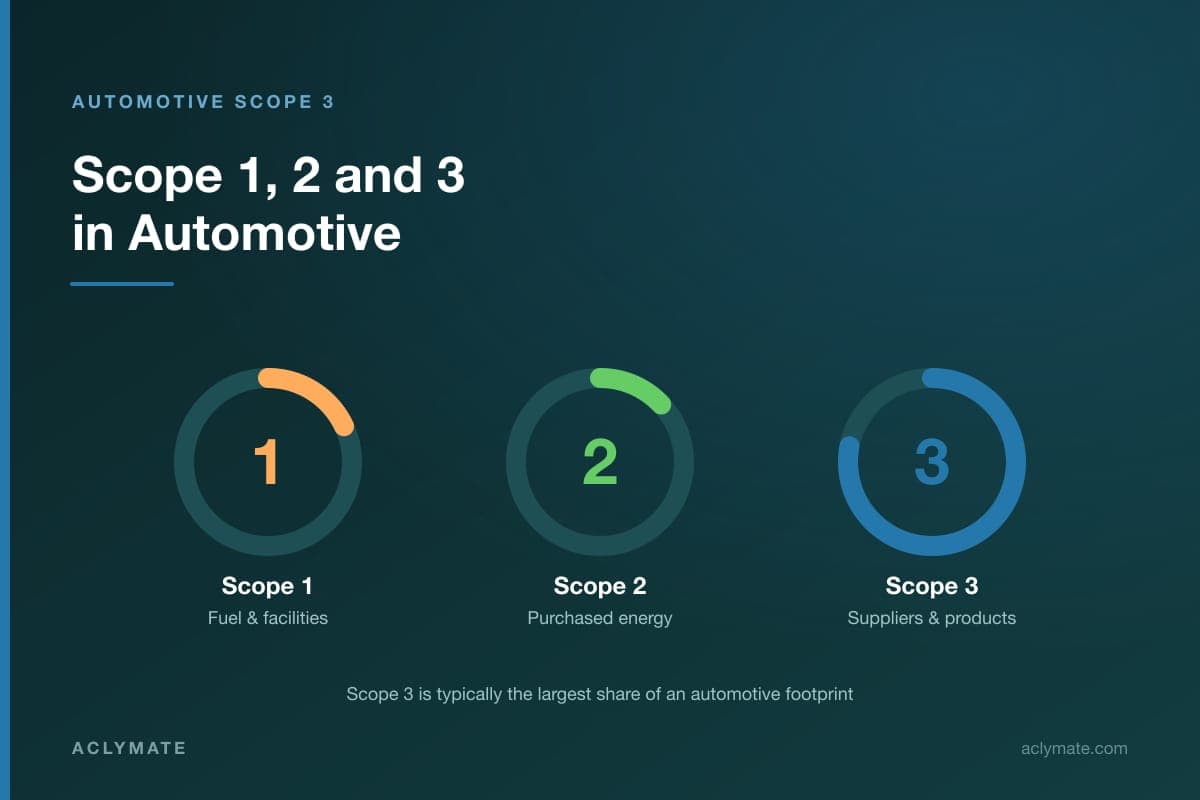
Learn how automotive companies measure Scope 3 emissions, collect supplier data, calculate product footprints, and meet customer reporting requirements.
Read Article
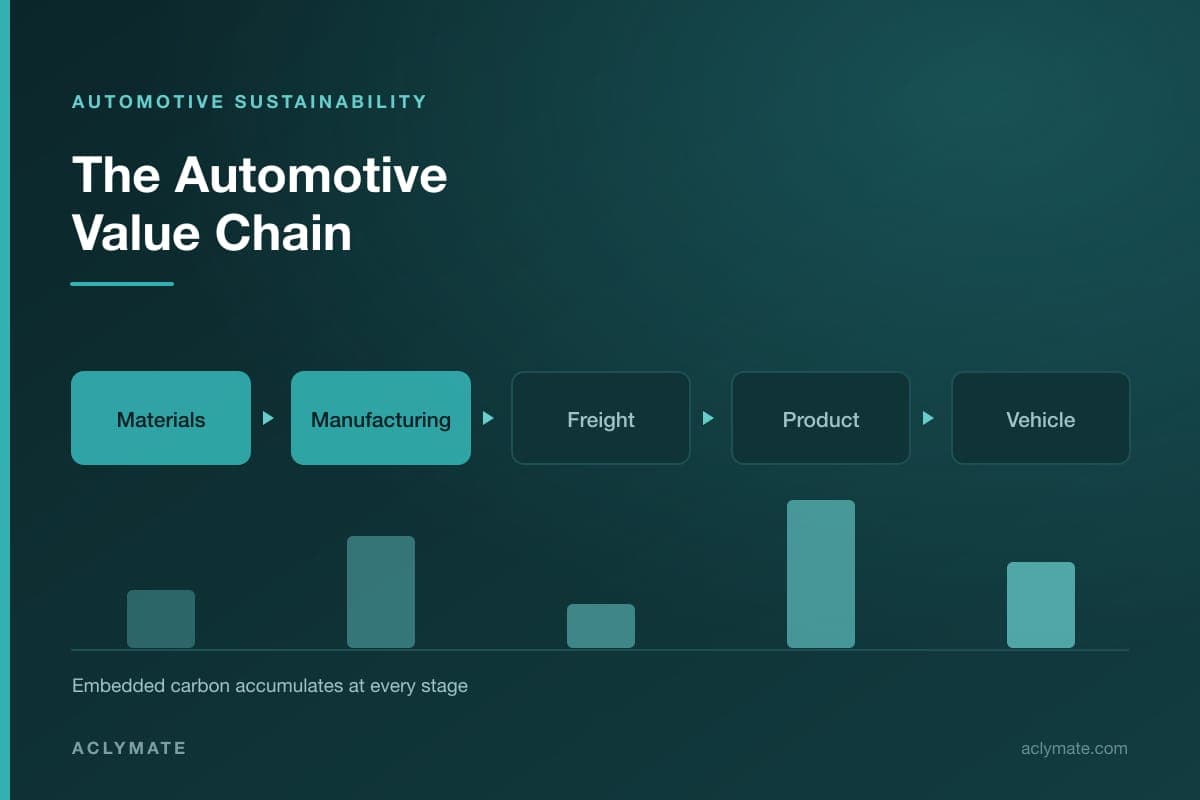
Learn how sustainability is changing the automotive industry, from carbon emissions and supply chains to supplier requirements, product footprints, and reporting.
Read Article
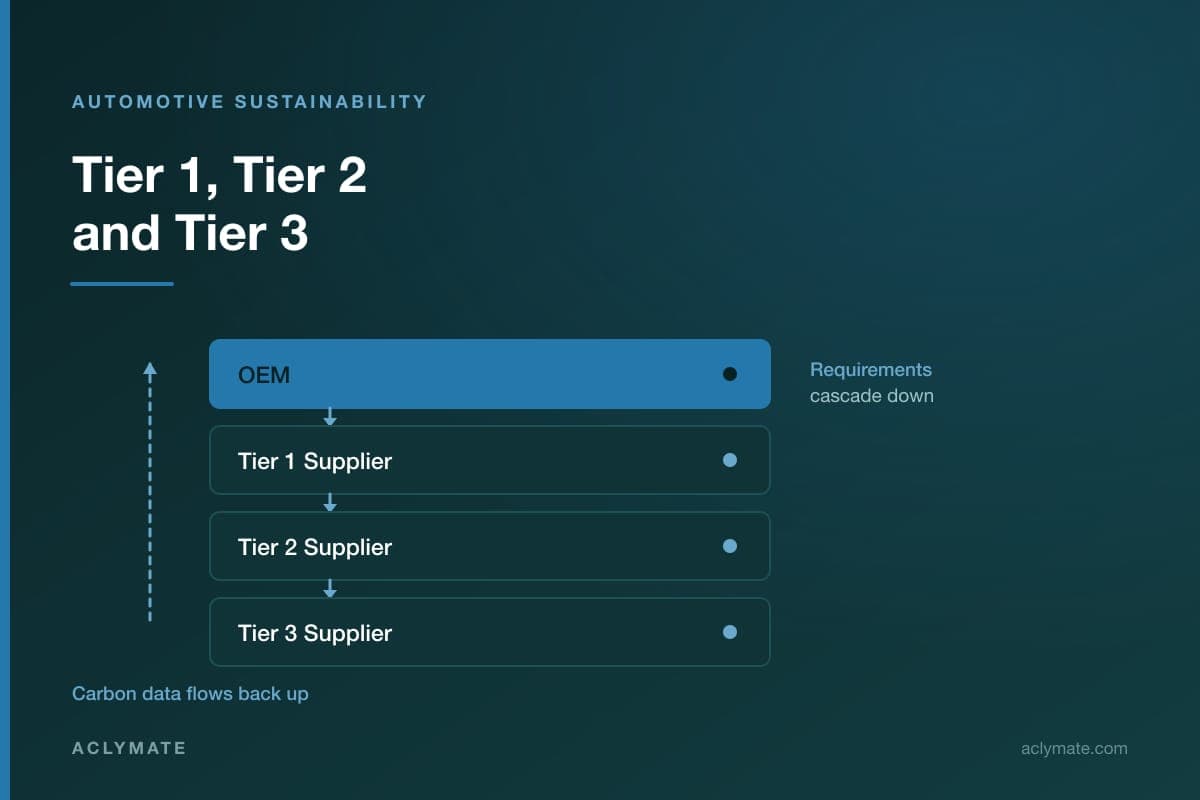
A practical sustainability guide for automotive suppliers covering emissions, Scope 3, customer requests, product footprints, questionnaires, and reporting.
Read Article
Talk with a Sustainability Expert, see a demo, or start free to put the Aclymate platform and experts to work for your team.