← Back to Insights
Aclymate Team
September 19, 2026
10 min read
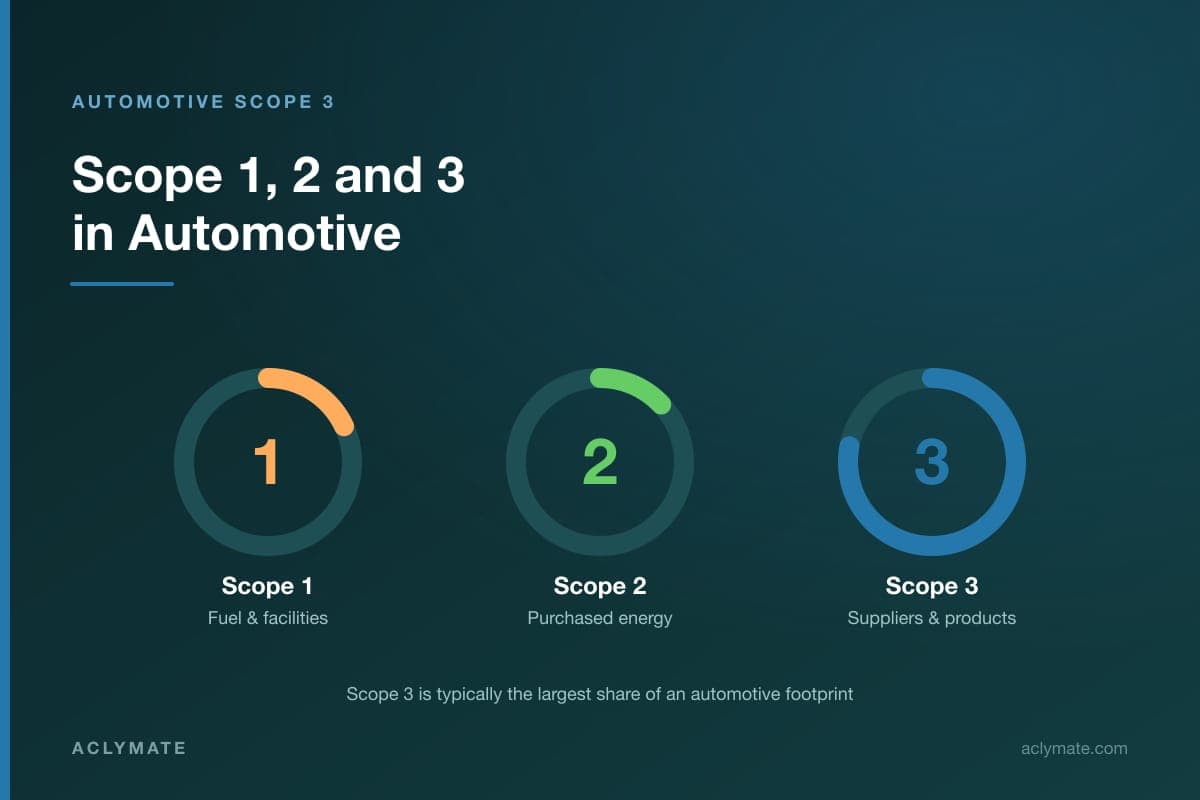
Automotive Scope 3 emissions are the indirect emissions in an automotive company's value chain — purchased materials and components, freight, and for a vehicle manufacturer, the fuel or electricity a sold vehicle consumes over its life.
For most companies in this industry, Scope 3 is the majority of the footprint. It is also the part nobody can measure alone.
A vehicle or commercial truck may contain thousands of components sourced across multiple supplier tiers. The emissions attached to those components occur in facilities the buyer does not own, operated by companies the buyer may never have heard of.
That produces the dynamic that defines automotive Scope 3:
The OEM needs data from Tier 1. Tier 1 needs it from Tier 2. Tier 2 needs it from Tier 3.
And the two-sided reality underneath it: companies need sustainability data from their suppliers, and suppliers need to provide sustainability data to their customers. Most companies in the automotive supply chain are doing both at once.
This guide covers both directions.
Fuel burned in facilities and vehicles you operate: natural gas for furnaces, ovens, and heat treatment; propane for forklifts; diesel and gasoline for fleet vehicles; refrigerant leakage.
Electricity, steam, heating, and cooling bought from a utility. For machining, injection molding, and stamping operations this is often the largest single line in the inventory.
Everything else. In automotive that primarily means:
AIAG identifies supplied materials and parts, transportation, product use, and end-of-life among the principal automotive Scope 3 sources. AIAG: GHG Reporting Work Group
The GHG Protocol defines Scope 3 as indirect emissions across the upstream and downstream value chain, and for purchased goods and services this can include the full cradle-to-gate footprint of everything a company buys. GHG Protocol: Scope 3 FAQ
One distinction worth holding onto: if you are a supplier rather than an OEM, use of sold products is generally not your category. When a customer asks about your Scope 3, they usually mean what you purchase.
Nearly every Scope 3 inventory begins with estimation, because that is the only way to get a complete first picture.
The typical progression:
The structural problem with spend-based data is worth stating plainly: two suppliers charging the same price produce the same calculated emissions, regardless of whether one runs on renewable electricity and the other does not. A spend-based inventory cannot support supplier selection, cannot demonstrate reduction, and cannot reward a supplier that improves.
That is why supplier engagement is the core of any serious automotive Scope 3 program — and why data quality labelling matters as much as the numbers.
Learn what Scope 3 data to collect from automotive suppliers →
Now the other side.
A Tier 2 or Tier 3 manufacturer — a machine shop, a molder, a heat treater — receives an email from a customer's procurement team requesting:
These companies typically have 30 to 300 employees and no sustainability department. The request lands on a quality manager, EHS lead, controller, or owner who already has a full job and has not seen most of these terms before.
They are not resisting. They generally do not know what a good answer looks like — and the cost of a bad answer is now commercial, because carbon is appearing on supplier scorecards.
See what sustainability and carbon data automotive customers may request from suppliers →
Increasingly there is a regulatory driver behind the request as well: California SB 253 requires large companies to report Scope 3 emissions, which for an automaker means supplier data. See what SB 253 means for automotive suppliers →
For suppliers on the receiving end, Supplier & Scope 3 Data Support covers both collecting from your suppliers and packaging what goes to your customers.
Two different questions, frequently confused:
Automotive is moving toward the second, for a practical reason. An OEM buying a bracket does not need the supplier's total annual emissions; it needs the share attributable to that bracket, so it can be added to the vehicle's footprint and compared against an alternative supplier's bracket.
The shift matters for suppliers because the workload scales differently. A corporate inventory is one number per year. Product footprints multiply with part numbers and change whenever a material, supplier, or process changes.
Read the practical guide to automotive Product Carbon Footprints →
A concrete example. A machined aluminum bracket.
The inputs that belong in the footprint:
Conceptually: BOM + materials + supplier data + manufacturing energy + freight = PCF, expressed as kg CO2e per part.
Two details catch people out. Purchased mass matters more than finished mass, because in machining a large share of the billet may become chips — and that material carried a full embedded footprint. And allocating facility electricity to one part requires a defensible basis, such as machine hours or mass processed, rather than revenue share.
See how to calculate the carbon footprint of an automotive part →
Aclymate's Product Footprint Pack connects BOMs, materials, suppliers, transportation, and factors so the calculation is repeatable rather than rebuilt per request.
Cradle-to-gate is the boundary automotive suppliers are most often asked to report against.
It runs: raw material extraction → supplier processing → inbound transportation → your manufacturing → the factory gate.
It stops there. It excludes distribution to the end customer, the vehicle's use phase, and end-of-life.
That boundary exists because it matches what a supplier can actually account for. You know what you bought, what you did to it, and what left your dock. What happens after is your customer's boundary, not yours.
The judgment calls inside it — how to treat scrap, how to allocate shared facility energy, how to handle co-products — are where most methodological disagreement lives.
Learn what belongs in a cradle-to-gate automotive carbon footprint →
In principle, PCF data should compound cleanly: Tier 3 produces a footprint, Tier 2 incorporates it into a component footprint, Tier 1 rolls that into a system, the OEM sees the vehicle.
In practice it mostly does not, because today that data moves as spreadsheets and PDFs attached to email. The consequences:
Catena-X is addressing this directly, developing a harmonized approach for calculating, exchanging, and verifying supplier-specific PCFs across the automotive supply chain so a footprint calculated once can be reused across tiers. Catena-X: Product Carbon Footprint
Learn how Catena-X enables PCF data exchange across automotive supply chains →
Automotive suppliers already report material and substance data through the International Material Data System. Carbon data is beginning to connect to that same workflow.
AIAG describes PCF integration into IMDS as a significant shift, and adds an important caveat: actual PCF calculation requires inputs beyond aggregating supplier-reported values, including the supplier's own internal processing and waste.
That caveat is the practical point. A material data system can carry PCF data, but it cannot generate the parts of the calculation that depend on your own operations — process energy allocation and scrap are still yours to produce.
Understand how PCF reporting is evolving within IMDS →
Automotive customer requirements rarely stop at emissions. They typically extend into:
The Drive Sustainability SAQ is the clearest example of this broader assessment, developed by a partnership of major global automakers so participating companies can use one shared assessment rather than issuing duplicates, with a lighter SME version for smaller suppliers. Drive Sustainability: SAQ Toolbox
Learn what the automotive SAQ asks suppliers and how to prepare →
Add it up. An automotive company may need to manage, simultaneously:
Spreadsheets handle the first round of this. They fail on the second, when a factor updates and forty part footprints need to change, or when a customer asks how a number produced eighteen months ago was derived.
The capabilities worth evaluating: carbon accounting depth, supplier engagement tooling, PCF calculation, product and BOM data handling, reporting formats, data quality tracking, integrations, and access to people who can review the work.
See what to look for in automotive carbon accounting software →
For OEMs and larger manufacturers — collecting and organizing what you need from suppliers:
For suppliers — producing what your customers need:
Aclymate combines software, AI, and sustainability experts, which suits a supply base where most companies will never employ a sustainability specialist.
See the Automotive & Transportation page.
If you are collecting: run a spend-based Scope 3 first to find where emissions concentrate, then request real data only from the suppliers that matter. Universal requests produce universal non-response.
If you are providing: build Scope 1 and 2 now, before a deadline exists. Then produce one documented part footprint. The first is the expensive one, and everything after reuses the method.
Scope 3 emissions are indirect emissions across an automotive company's value chain: purchased materials and components such as steel, aluminum, plastics, electronics and batteries, inbound and outbound freight, and for vehicle manufacturers the fuel or electricity a sold vehicle consumes over its lifetime. For most automotive companies Scope 3 is the majority of the total footprint.
Most commonly Scope 1 and Scope 2 emissions for a full reporting year, energy consumption by facility, information on purchased goods and services, and Product Carbon Footprints for specific part numbers. Customers also frequently ask for reduction targets, a completed sustainability questionnaire, and supporting evidence behind the figures.
It depends on the customer. Many suppliers are initially asked only for Scope 1 and Scope 2 plus a product footprint. Scope 3 requests are increasingly common, usually focused on purchased goods and services, because a supplier's purchased materials feed directly into its customer's own Scope 3 inventory.
It is the greenhouse gas emissions attributable to one specific part, expressed as kg CO2e per part and usually calculated cradle-to-gate. It covers raw materials at purchased mass, purchased components, manufacturing energy allocated to that part, scrap, inbound freight, and packaging, up to the point the part leaves the supplier's facility.
Cradle-to-gate covers emissions from raw material extraction through supplier processing, inbound transportation, and your own manufacturing, ending at the factory gate. It excludes distribution to the end customer, the vehicle use phase, and end-of-life. It is the boundary automotive suppliers are most often asked to report against.
Catena-X is an automotive industry initiative developing a harmonized approach for calculating, exchanging, and verifying supplier-specific Product Carbon Footprints across the automotive supply chain. Its purpose is to let a footprint calculated once at one tier be reused at the next, rather than recalculated or re-requested in a different format at every level.
PCF data is beginning to connect to the IMDS workflow that automotive suppliers already use for material and substance reporting. However, AIAG has been clear that calculating a PCF requires inputs beyond aggregating supplier-reported values, including the supplier's own internal processing energy and waste, which the system cannot generate.
The Sustainability Assessment Questionnaire is a shared supplier assessment developed by Drive Sustainability, a partnership of major global automakers. It covers environmental management, policies, human rights, health and safety, business ethics, and supply chain management. Because participating customers accept the same assessment, it reduces duplicated reporting across the supply base.
Start with Scope 1 and Scope 2, which come almost entirely from utility bills, fuel purchase records, and maintenance logs, and can usually be completed in weeks for a single site. Add a first-pass spend-based Scope 3 from purchasing data, labelled as an estimate, then produce one documented part footprint.
Because two suppliers charging the same price produce identical calculated emissions regardless of how they actually operate. A spend-based inventory cannot support supplier selection, cannot demonstrate reduction, and cannot reward a supplier that improves its performance, which is why programs move toward activity data and supplier-specific factors.
Get Aclymate's practical sustainability content delivered weekly.
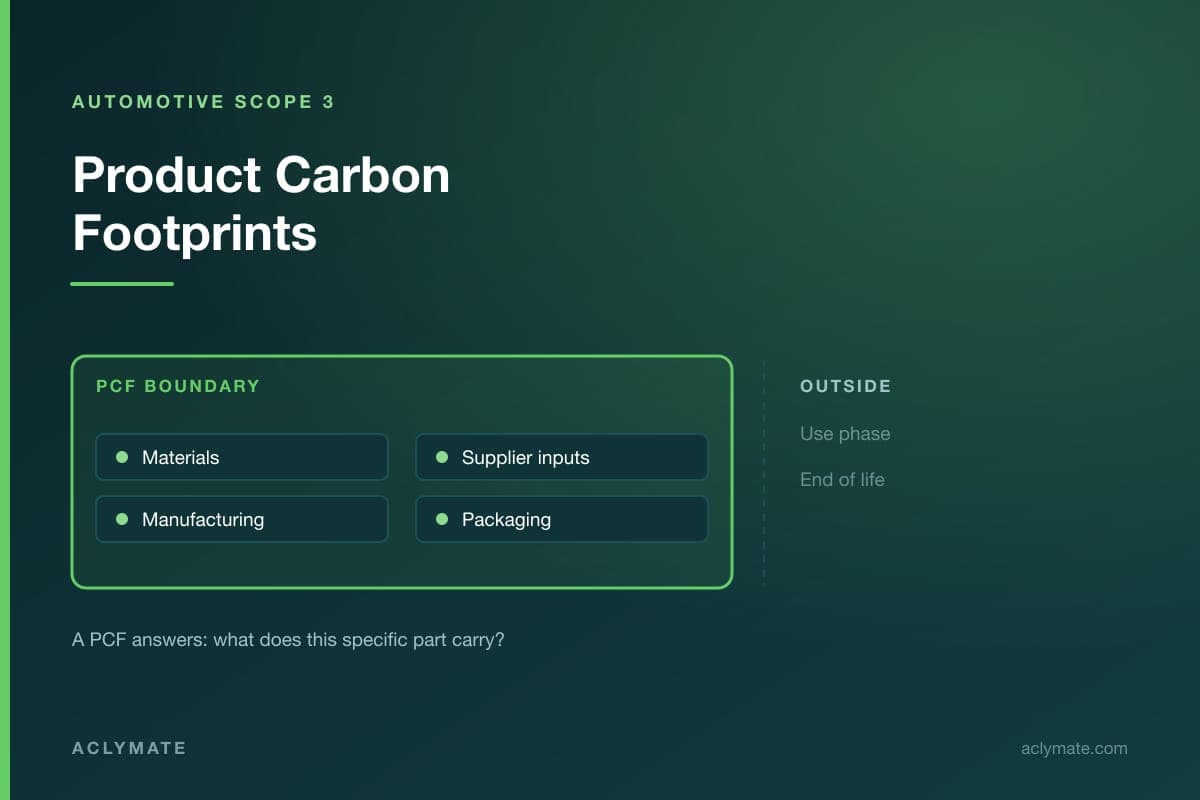
Learn how automotive Product Carbon Footprints measure emissions from materials, suppliers, manufacturing, transportation, and components.
Read Article
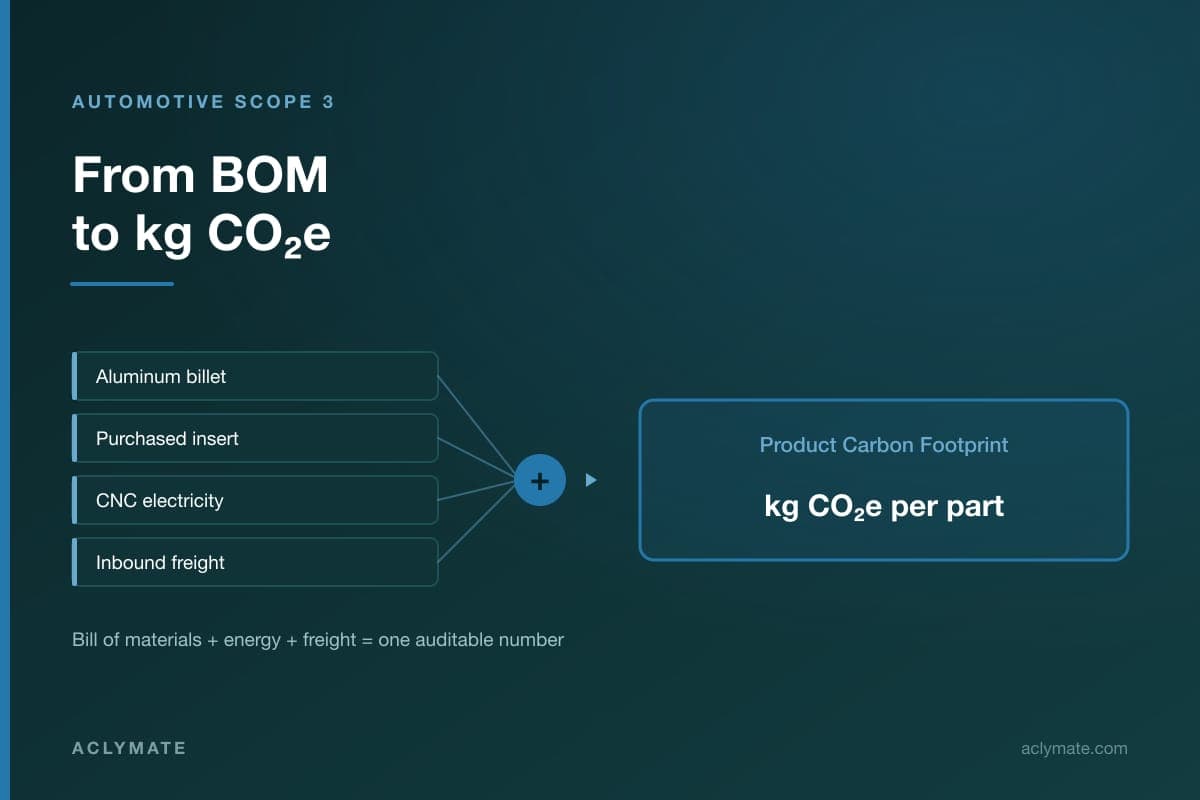
Learn how to calculate the carbon footprint of an automotive part using BOMs, materials, energy, suppliers, manufacturing, and transportation.
Read Article
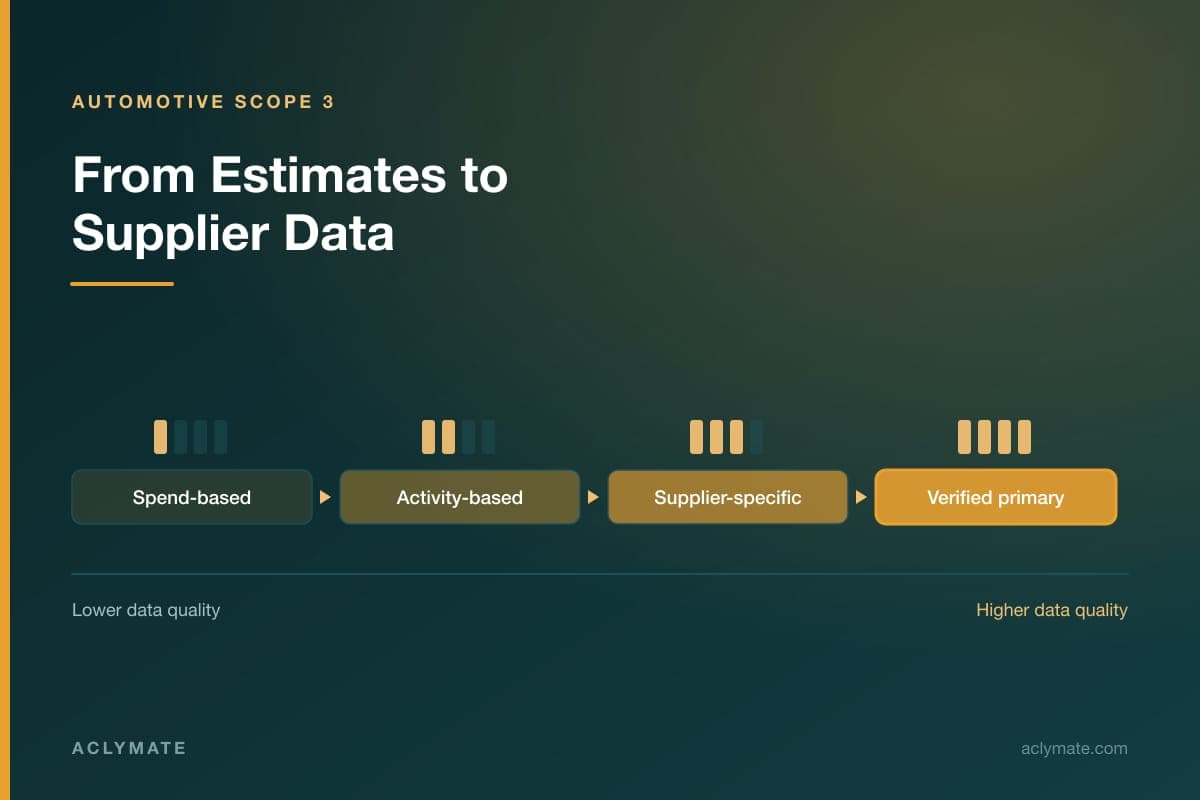
Learn what Scope 3 supplier data automotive companies need, how to collect it, improve data quality, and engage suppliers effectively.
Read Article
Talk with a Sustainability Expert, see a demo, or start free to put the Aclymate platform and experts to work for your team.