← Back to Insights
Aclymate Team
August 24, 2026
7 min read
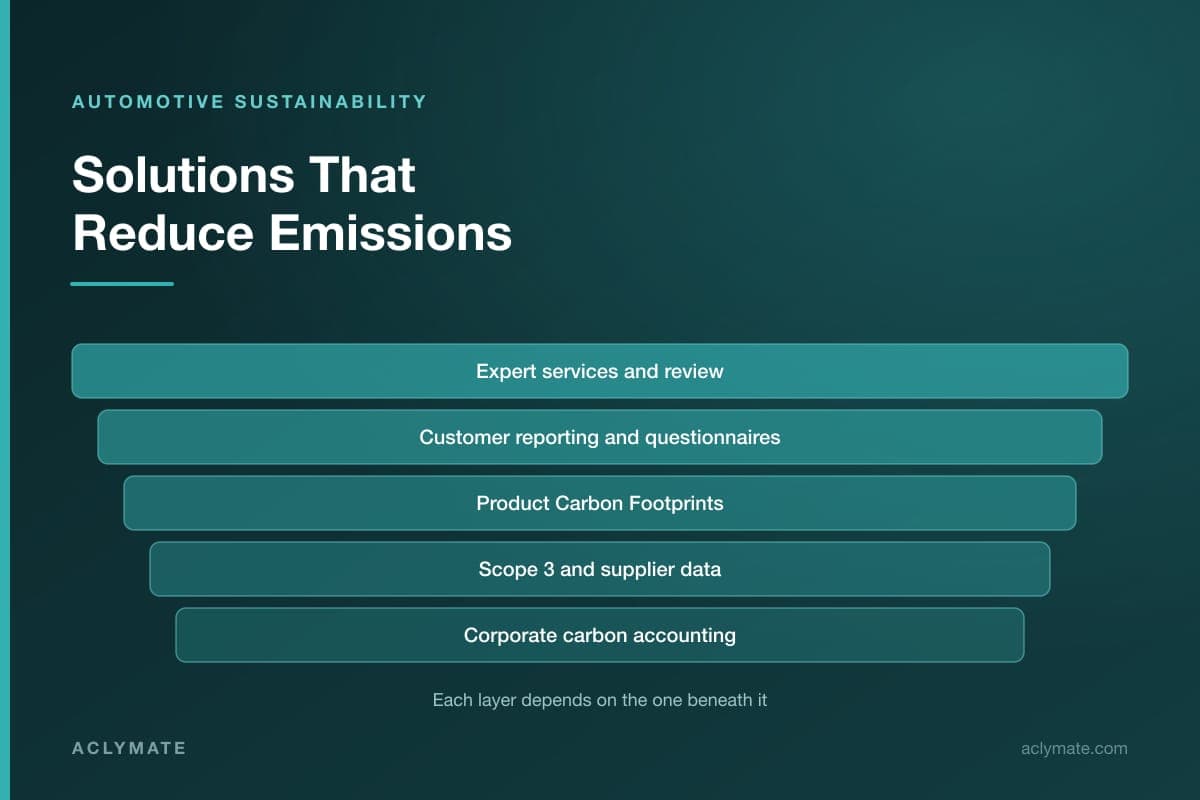
Sustainable automotive solutions are the tools, systems, and services companies use to actually reduce environmental impact — carbon accounting software, supplier data collection, product footprint management, energy programs, sourcing changes, and the expert support that makes them work.
The distinction worth drawing at the outset: a sustainability goal is not a solution. "Reduce emissions 30%" is a target. The solution is the specific capability that lets you measure the baseline, find where the emissions are, act on them, and prove the result to a customer.
This guide covers the capabilities automotive companies actually need, roughly in the order most of them need them.
This is the foundation, because it produces the number everything else is measured against.
Carbon accounting software takes the data a business already generates — utility bills, fuel purchases, purchasing records, freight invoices, travel expenses — and converts it into a Scope 1, 2, and 3 inventory using recognized emissions factors.
What matters in an automotive context:
Aclymate's Navigator handles this for companies without a sustainability team.
Once Scope 3 matters, the constraint stops being calculation and starts being data acquisition.
Collecting supplier emissions data involves work that is more administrative than technical: identifying which suppliers matter, sending requests in a format they can answer, following up, assessing what comes back, and storing it somewhere it can be found next year.
Response rates are the usual failure point. A request sent to 400 suppliers that assumes each already has a carbon inventory will return very little. A prioritized request that explains what is needed and in what units does considerably better.
Supplier & Scope 3 Data Support covers this work directly, on both sides — collecting from your suppliers, and providing to your customers.
Corporate accounting answers a question about the company. Automotive customers increasingly ask about the part.
Product footprint software connects:
And produces a documented kg CO2e per part, usually cradle-to-gate.
The capability that distinguishes real product footprint software from a spreadsheet is what happens on the second request: whether a change to a material factor or a supplier value flows through every affected part automatically, or whether someone rebuilds the calculation.
The Product Footprint Pack is built for this. See also how to calculate a PCF for an automotive part.
Efficiency is the solution category with the most direct payback, because it reduces cost and emissions with the same action.
In automotive facilities the recurring opportunities are compressed air, process heat, equipment scheduling, motors and drives, and cooling systems. None of this requires sustainability expertise to identify — a competent maintenance team usually already knows where the losses are.
What carbon accounting adds is prioritization. Knowing that compressed air accounts for a specific share of facility electricity turns a known annoyance into a funded project.
For companies where purchased materials dominate the footprint, sourcing is where the largest reductions live.
Practically this means:
This requires procurement to have carbon data at the point of decision, which is a systems problem as much as a sourcing one.
Material substitution changes a product's footprint structurally rather than incrementally.
Common directions in automotive: recycled aluminum and steel, electric-arc-furnace steel, recycled polymers, bio-based interior materials, and reducing material use through design.
The honest constraint is qualification. A material change in automotive is an engineering change requiring validation and customer approval, which is why these usually land with new programs rather than in running production. The useful preparation is having the footprint model that can quantify the benefit before the engineering work starts.
Automotive materials often move through several facilities before becoming a finished part, and each leg carries emissions.
Options include mode shift from truck to rail on longer lanes, load consolidation, regional sourcing, reducing expedited and air freight, and carrier selection on fleet efficiency.
Expedited freight is worth singling out. It is nearly always the symptom of an upstream quality or scheduling failure, which means reducing it is both an emissions project and an operations project with a shared business case.
Measurement produces numbers. Management produces progress.
Sustainability management covers the layer above carbon accounting: targets, initiatives, owners, timelines, progress tracking, and the reporting that comes out of it. For a company running several initiatives across facilities, this is the difference between a program and a collection of good intentions.
Aclymate One and sustainability management software cover this layer.
The final category is producing the output someone else asked for.
In automotive that usually means:
These draw on the same underlying data but differ in boundary, format, and audience — which is why suppliers who treat them as one undifferentiated task end up rebuilding the same numbers repeatedly.
Reporting support and EcoVadis consulting cover this work. See also automotive sustainability reporting.
This belongs on the list because in automotive it is frequently the binding constraint.
A large share of the automotive supply base consists of companies with 30 to 300 employees and no sustainability staff. For them, the hard part is rarely operating software. It is knowing what a customer's request actually means, what boundary to use, whether an answer is defensible, and what to do when the request contains a term nobody at the company has seen before.
Software plus expert services addresses that directly, which is the model Aclymate runs: the platform does the calculation, and supply chain sustainability consultants work the actual request alongside you.
A workable sequence for most automotive suppliers:
For the full picture, see sustainability in the automotive industry, and automotive sustainability initiatives for the programs these solutions support.
Aclymate brings these capabilities together as software plus expert services, built for automotive companies that need real capability without building a sustainability department.
See the Automotive & Transportation page, or compare capabilities in automotive carbon accounting software.
Sustainable automotive solutions are the tools, systems, and services companies use to reduce environmental impact: carbon accounting software, supplier emissions collection, product footprint management, energy efficiency programs, sustainable sourcing, lower-carbon materials, transportation optimization, sustainability management software, reporting support, and expert services.
Carbon accounting, because it produces the baseline everything else is measured against and reveals where emissions actually sit. The exception is an open customer request with a deadline, which takes priority regardless of what the inventory says, since that work has commercial consequences attached to it.
What happens on the second request. A spreadsheet produces one calculation. Product footprint software retains the bill of materials, emissions factors, supplier values, and process energy allocations, so that when a material factor or supplier number changes, every affected part updates rather than being rebuilt by hand.
Because much of the automotive supply base consists of companies with no sustainability staff. For them the difficulty is rarely operating software. It is interpreting what a customer's request means, choosing the right boundary, judging whether an answer is defensible, and handling terminology nobody at the company has encountered before.
It provides prioritization. Maintenance teams usually already know where energy losses are, such as compressed air leaks or poor equipment scheduling. Carbon accounting quantifies what share of facility electricity each represents, which turns a known annoyance into a project with a business case attached to it.
It is practical but slow, because a material change in automotive is an engineering change requiring validation and customer approval. Substitutions such as recycled aluminum or electric-arc-furnace steel usually land with new vehicle programs rather than running production. Having a footprint model that quantifies the benefit before engineering work starts is the useful preparation.
Expedited and air freight carry a heavy per-unit emissions penalty, and they are nearly always the symptom of an upstream quality or scheduling failure. That makes reducing them both an emissions project and an operations project, sharing a single business case, which is unusual among sustainability initiatives.
Carbon accounting produces the numbers: a Scope 1, 2, and 3 inventory built from operational data. Sustainability management sits above it and handles targets, initiatives, owners, timelines, progress tracking, and reporting. For a company running several initiatives across multiple facilities, the management layer is what turns measurement into progress.
Get Aclymate's practical sustainability content delivered weekly.
Explore automotive sustainability initiatives for reducing emissions, improving supplier performance, measuring product footprints, and meeting environmental goals.
Read Article
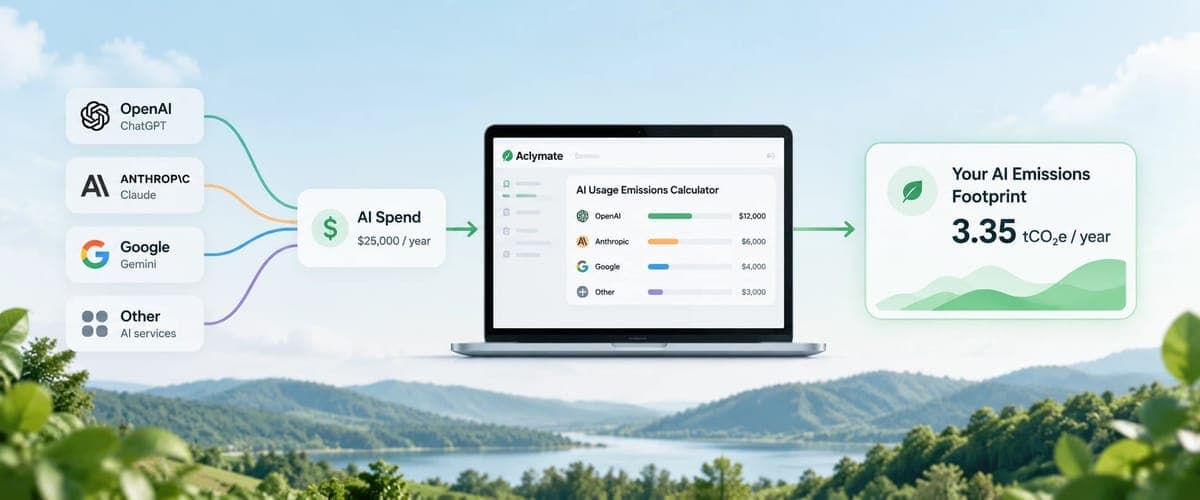
AI carbon emissions are becoming a new consideration for companies adopting ChatGPT, Claude, Gemini, Copilot and other artificial intelligence tools. Here’s how Aclymate estimates the carbon emissions from a company’s AI usage today—and how we expect the methodology to improve as AI providers release better usage and emissions data.
Read Article
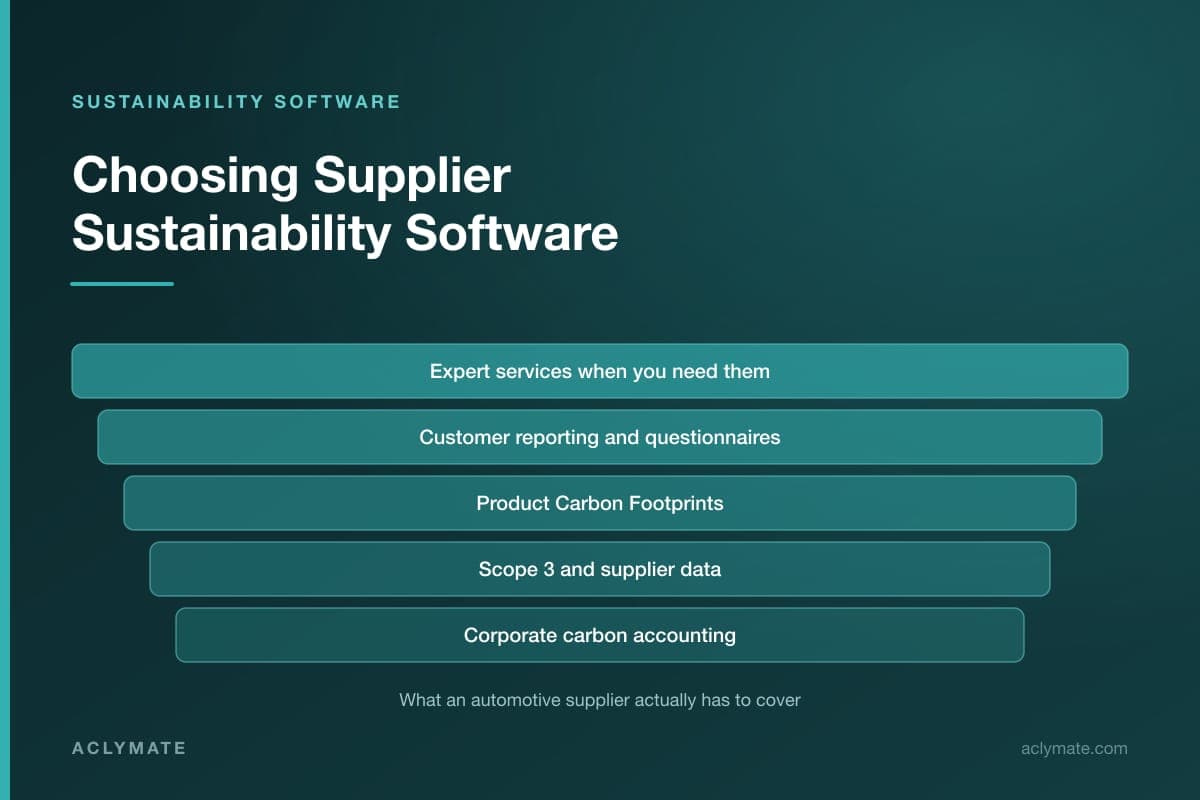
Learn how to choose automotive sustainability software for carbon accounting, Scope 3 supplier data, product footprints, customer reporting, and sustainability management.
Read Article
Talk with a Sustainability Expert, see a demo, or start free to put the Aclymate platform and experts to work for your team.