← Back to Insights
Aclymate Team
September 15, 2026
7 min read
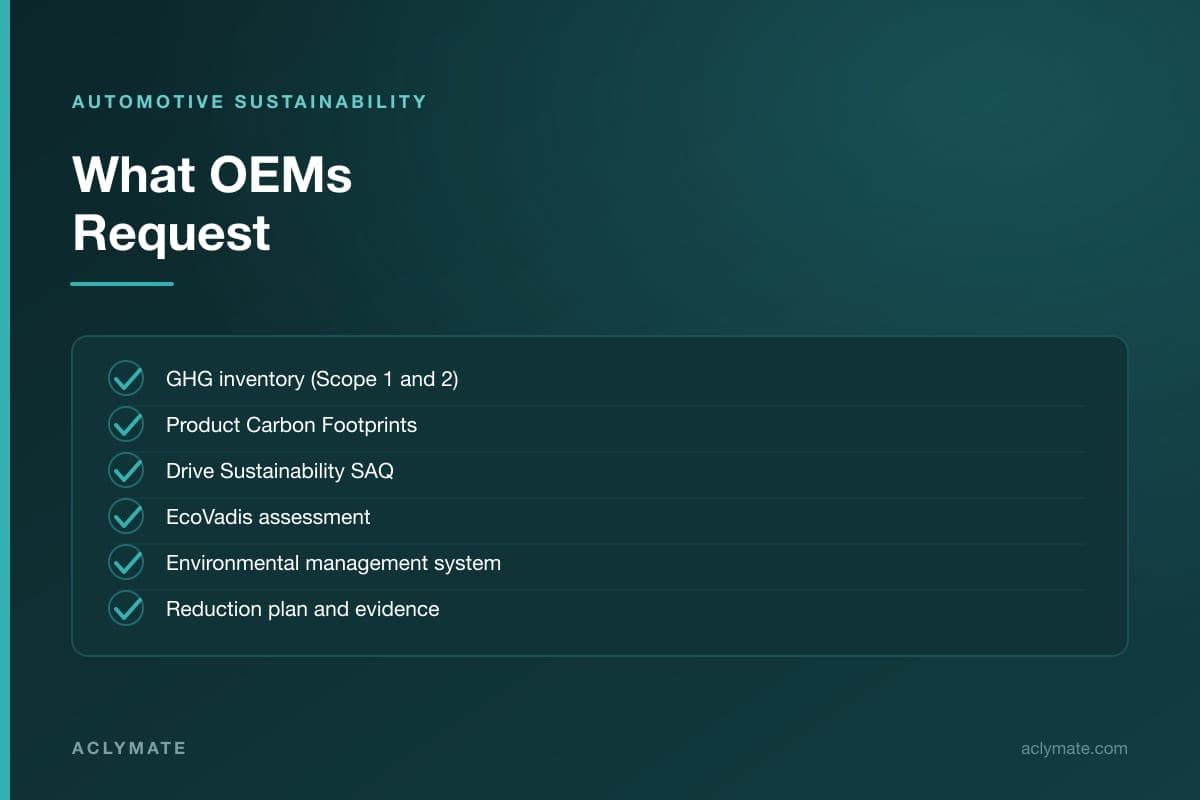
OEM sustainability requirements are the sustainability and emissions information automotive manufacturers ask their suppliers to provide — typically a carbon inventory, product-level footprints, a completed assessment, evidence of an environmental management system, and a credible reduction plan.
Requirements differ by customer, but they are assembled from a fairly stable menu. This guide goes through each item: what it is, what a good answer looks like, and what suppliers most often get wrong.
It helps to understand the mechanism, because it explains why the requests keep getting deeper.
An automaker that assembles vehicles from thousands of purchased components holds only a small share of its total footprint inside its own plants. The rest is Scope 3 — and most of that is purchased goods.
An OEM cannot reduce or credibly report Scope 3 without supplier data. So the requirement moves to Tier 1. Tier 1 faces the same arithmetic and moves it to Tier 2. Tier 2 moves it to Tier 3.
Two consequences follow. The requests will not stop, and they will get more specific — from policy questions, to company emissions, to footprints for individual part numbers.
Some of that pressure is now regulatory rather than voluntary. California SB 253 requires large companies to disclose Scope 3 emissions, and an automaker's Scope 3 is its supply chain. See what SB 253 means for automotive suppliers.
The most common opening request is your greenhouse gas inventory.
Direct emissions from fuel you burn: natural gas for furnaces, ovens, and heat treatment; propane for forklifts; diesel and gasoline for company vehicles; refrigerant leakage.
Evidence: gas bills, fuel purchase records, fleet fuel data, refrigerant maintenance logs.
Purchased electricity, steam, heating, and cooling. For machining, molding, stamping, and similar operations this is often the largest line.
Evidence: electricity bills. Note whether you are reporting location-based or market-based — if you buy renewable energy, customers will want to know which basis the number uses.
Most often purchased goods and services, because your suppliers' emissions feed your customer's inventory too. Also freight, travel, commuting, and waste.
A first-pass spend-based estimate is an acceptable starting point. What matters is stating clearly that it is an estimate and on what basis.
Common mistake: reporting a single number with no boundary. A customer needs to know which sites, which period, which scopes, and what method. A number without that context cannot be used in their inventory.
Some customers ask for underlying energy consumption rather than, or alongside, calculated emissions — kWh of electricity, therms of gas, by site and by period.
This is usually because they want to apply their own emissions factors consistently across the supply base, or because they are tracking energy intensity rather than absolute emissions.
Keep the raw consumption data, not just the converted result. It gets asked for.
This is the requirement that most often catches suppliers out, because it is structurally different from a corporate inventory.
A PCF asks what emissions are attached to a specific part number, usually cradle-to-gate: raw materials through your manufacturing, up to your dock.
It requires:
AIAG provides PCF education aimed specifically at automotive suppliers that have been asked for this data or expect to be. AIAG: Product Carbon Footprint
Common mistake: allocating facility energy by revenue share. It is quick and it is difficult to defend. Allocation by machine hours, mass processed, or cycle time holds up considerably better.
See how to calculate a PCF for an automotive part, and the Product Footprint Pack.
Beyond carbon, most customers want a broader picture: environmental management, policies, governance, human rights, health and safety, and how you manage your own suppliers.
Some customers use their own format. Increasingly they use a shared one, which is better for everybody.
The Sustainability Assessment Questionnaire was developed by Drive Sustainability, a partnership of major global automakers, specifically to standardize supplier sustainability assessment and reduce duplicative reporting across participating companies. There is also a lighter SME version aimed at smaller suppliers. Drive Sustainability: SAQ Toolbox
It covers company information, management systems, environment, labor and human rights, health and safety, business ethics, and supply chain management.
Common mistake: treating it as a form to fill in. The SAQ is evidence-led — answering that you have an environmental policy without attaching it generally does not count. Assembling documentation is usually more work than answering the questions, and it is worth starting there.
See the SAQ guide.
Some automotive customers require an EcoVadis assessment instead of or alongside the SAQ. EcoVadis produces a scorecard across environment, labor and human rights, ethics, and sustainable procurement that customers can view directly.
Like the SAQ, the score reflects what you can evidence rather than what you do. A company with genuinely good practices and poor documentation scores badly.
EcoVadis consulting covers preparation and submission.
Many customers expect an environmental management system, frequently ISO 14001 certification.
Where certification is not required, customers usually still want to see the substance: an environmental policy, defined responsibilities, objectives, monitoring, and evidence of management review.
If you already hold IATF 16949 for quality, the management-system discipline is familiar — the structure of an EMS will not be unfamiliar territory.
Increasingly customers ask not only what your emissions are but what you intend to do about them.
A credible target has three parts:
The third element is where most supplier targets fail. A percentage with no supporting initiatives does not survive a detailed review, and it is worse than having no target, because it invites scrutiny you cannot satisfy.
It is entirely acceptable to say you are in your first measurement year and will set a target once you have a baseline. That is a better answer than an unsupported number.
Running underneath all of the above: customers increasingly want the working, not just the result.
That means methodology notes, boundary definitions, emissions factor sources and versions, allocation assumptions, and the underlying activity data. Their own public disclosure depends on the quality of what you give them, so they have reason to check.
Practically this favors keeping the inventory in a system that retains its inputs over a spreadsheet someone rebuilds annually.
A realistic order of work:
Suppliers who do this before being asked answer in days rather than weeks, which increasingly matters commercially. See automotive supplier sustainability.
Aclymate is built for suppliers facing these requirements without a sustainability department.
See the Automotive & Transportation page, the wider guide to sustainability in the automotive industry, or automotive sustainability reporting for how these outputs fit together.
They are the sustainability and emissions information automotive manufacturers ask suppliers to provide. Typically this includes a Scope 1 and 2 carbon inventory, Scope 3 information, energy data, Product Carbon Footprints for specific parts, a completed sustainability assessment such as the SAQ or EcoVadis, an environmental management system, reduction targets, and supporting evidence.
Because an automaker holds only a small share of its footprint inside its own plants. Most sits in purchased goods, which is Scope 3, and can only be measured with supplier data. That pressure passes from OEM to Tier 1 to Tier 2 to Tier 3, and progresses from policy questions to company emissions to part-level footprints.
Reporting a single number with no boundary. A customer needs to know which sites are included, which reporting period, which scopes, and what method was used. Without that context the figure cannot be incorporated into their own inventory, so it fails even when the underlying calculation is sound.
Use machine hours, mass processed, or cycle time. Allocating by revenue share is quick but difficult to defend under review, because it assumes energy intensity tracks price, which it usually does not. The allocation method should be documented alongside the result, since customers increasingly ask how it was derived.
No. It is evidence-led. Answering that your company has an environmental policy without being able to attach the policy generally does not count. For most suppliers, assembling the supporting documentation takes more time than answering the questions themselves, which is why it is worth starting with the evidence pack.
A measured baseline from a real inventory year, a clearly stated boundary naming the scopes and sites covered, and specific named initiatives that add up to the committed reduction. A percentage with no supporting initiatives invites scrutiny it cannot satisfy, which is worse than having no target at all.
Saying you are in your first measurement year and will set a target once you have a baseline is a legitimate answer, and a better one than an unsupported number. Customers generally distinguish between a supplier that is early and a supplier that is claiming more than it can evidence.
Many customers expect an environmental management system and some require ISO 14001 certification specifically. Where certification is not required, customers usually still want the substance: an environmental policy, defined responsibilities, objectives, monitoring, and evidence of management review. Suppliers already holding IATF 16949 will find the structure familiar.
Methodology notes, boundary definitions, emissions factor sources and versions, allocation assumptions, and the underlying activity data. Their own public disclosure depends on the quality of supplier data, so they have reason to verify. This favors keeping the inventory in a system that retains inputs rather than a spreadsheet rebuilt each year.
Get Aclymate's practical sustainability content delivered weekly.
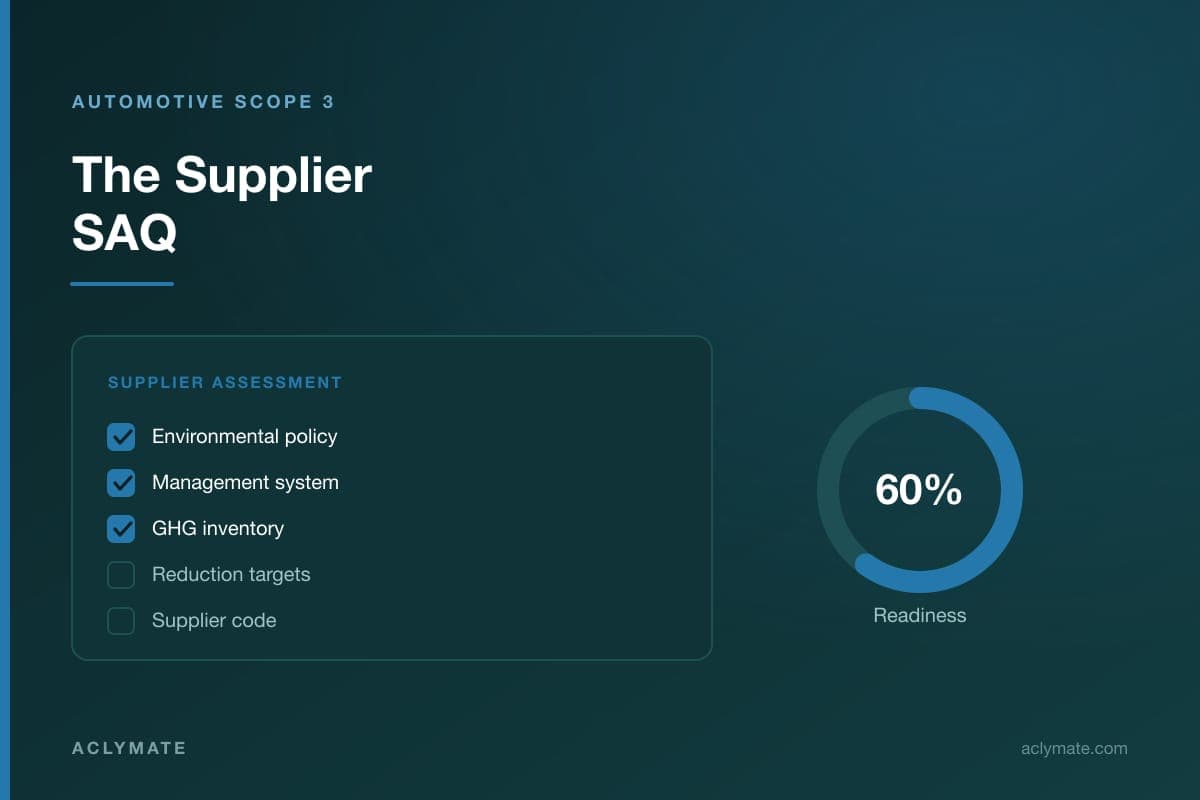
Learn what the automotive Sustainability Assessment Questionnaire asks suppliers, how it is used, and how your company can prepare.
Read Article
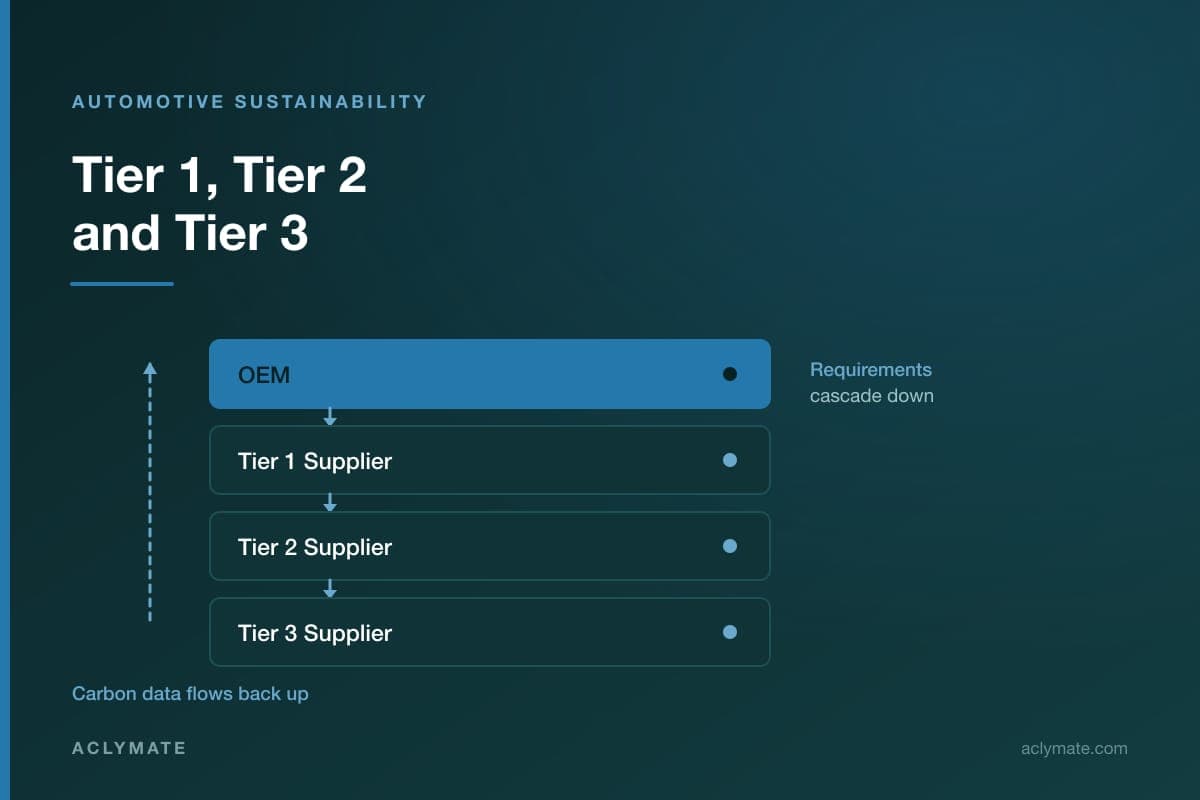
A practical sustainability guide for automotive suppliers covering emissions, Scope 3, customer requests, product footprints, questionnaires, and reporting.
Read Article
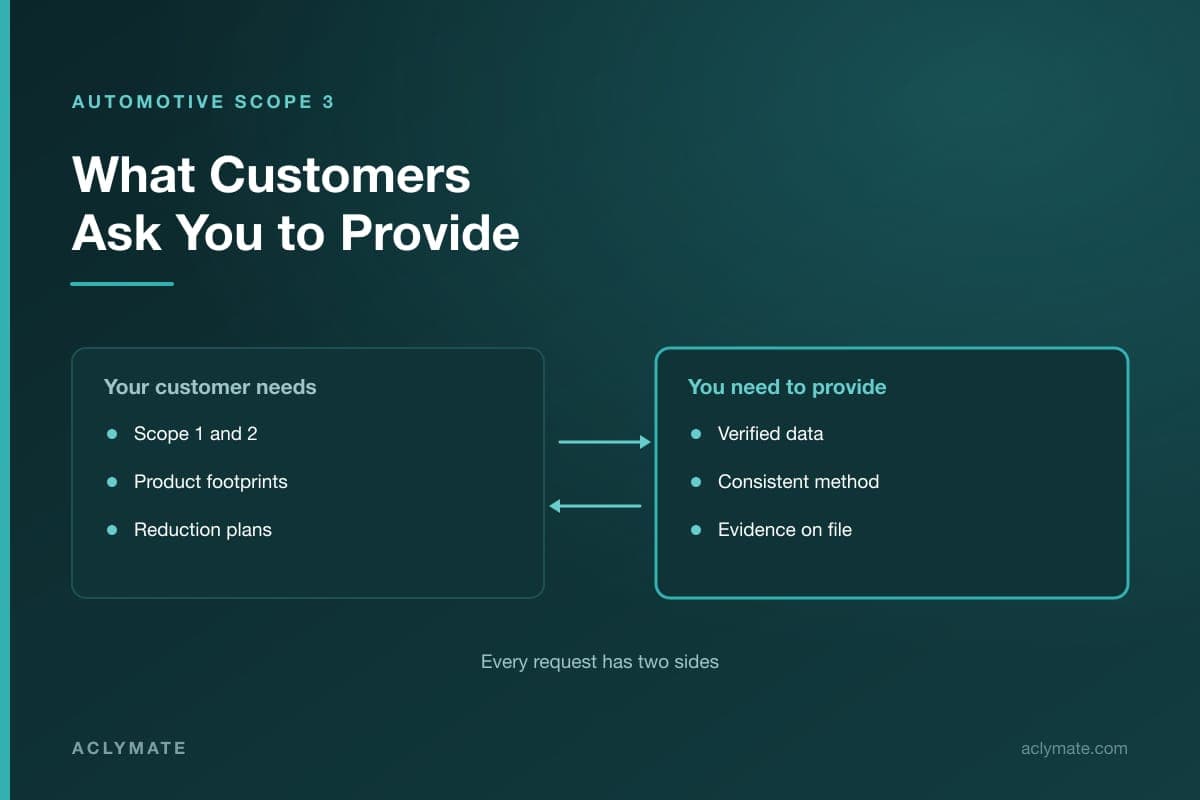
Learn what emissions and sustainability information automotive OEMs and customers may request from suppliers and how to prepare.
Read Article
Talk with a Sustainability Expert, see a demo, or start free to put the Aclymate platform and experts to work for your team.