← Back to Insights
Aclymate Team
September 7, 2026
8 min read
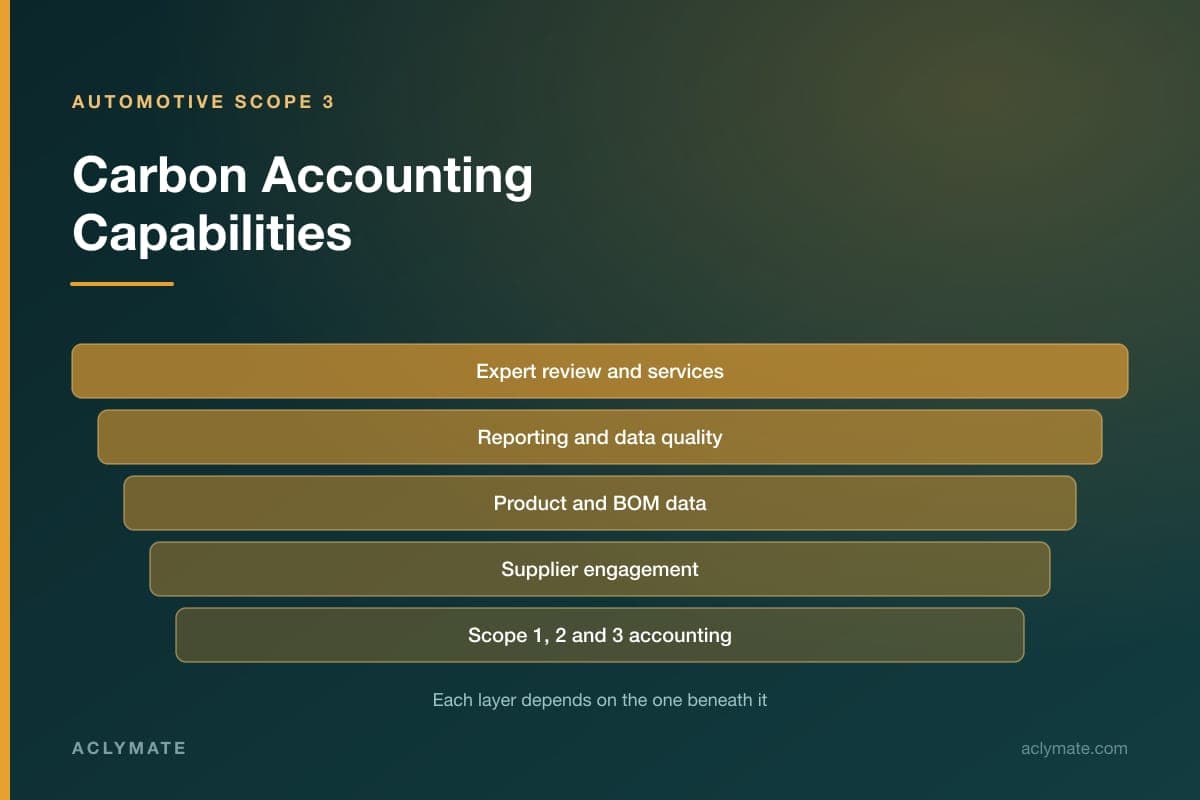
Most carbon accounting software can produce a Scope 1 and 2 inventory. That is not the part automotive companies struggle with.
The automotive-specific requirements are elsewhere: supplier data at scale, part-level footprints built from bills of materials, customer reporting in someone else's format, and a supply base where most companies have no sustainability staff.
This guide covers the capabilities that actually differentiate software for automotive use, and how the requirements differ between a large manufacturer and a mid-sized supplier.
The baseline. Software should build a Scope 1, 2, and 3 inventory from operational data — utility bills, fuel purchases, purchasing records, freight, travel — using recognized emissions factors.
What to check beyond the basics:
This is the first real differentiator.
For an automotive company, purchased goods and services usually dominates the footprint. Software that treats Scope 3 as a spend-multiplication feature will not survive contact with a customer's questions.
What depth looks like:
The test question: can it show which suppliers account for the largest share of Scope 3, and let you upgrade just those from estimates to primary data? If not, you cannot run a prioritized supplier program. See Scope 3 supplier data.
Scope 3 becomes a data acquisition problem quickly, and acquisition is mostly administrative rather than computational.
Capabilities that matter:
That last metric is more useful than response rate. Good data from suppliers representing most of your emissions beats mediocre data from everyone.
Supplier & Scope 3 Data Support covers this as a service where the internal capacity does not exist.
The second major differentiator, and the one that most cleanly separates general-purpose carbon software from automotive-capable software.
A PCF is not a scaled-down corporate inventory. It requires:
The decisive question is what happens on update. When an emissions factor changes or a supplier provides a real number, does every affected part recalculate, or does someone rebuild forty spreadsheets? That difference is the entire value proposition.
See automotive Product Carbon Footprints and the Product Footprint Pack.
PCFs depend on material data that already exists in your ERP or MRP system.
Re-keying bills of materials is the point at which most product footprint programs quietly stop. It is tolerable for three parts and impossible for three hundred.
Look for BOM import, part revision handling, material master mapping to emissions factors, and multi-level BOM support for assemblies.
Automotive suppliers do not report on their own schedule. They report when a customer asks, in the customer's format, against the customer's boundary.
Useful capabilities:
See reporting software for automotive suppliers.
Assessments like the Drive Sustainability SAQ and EcoVadis go beyond carbon into policies, management systems, human rights, and supply chain management. Drive Sustainability: SAQ Toolbox
Software rarely completes these for you, and claims that it does are worth probing. What genuinely helps is having the carbon numbers, methodology, and evidence organized so the assessment becomes assembly rather than research. See the SAQ guide.
Customers increasingly ask not just for numbers but for an indication of how reliable they are.
Software should label each input as measured, supplier-provided, calculated, or estimated, report the primary-data share at inventory and part level, and track data freshness.
Honest labelling scores better with sophisticated customers than uniform confidence. They know what a real first inventory looks like.
PCF exchange is standardizing. Catena-X is developing a harmonized approach to calculating and exchanging supplier-specific footprints across the supply chain. Catena-X: Product Carbon Footprint
The pragmatic requirement today is not a specific integration. It is that your software holds the inputs and can recalculate, rather than storing only final numbers — because when a customer specifies a methodology, you need to recompute, not re-research.
Export should carry full metadata: boundary, declared unit, period, data quality, primary-data share, methodology. A tool producing a bare figure will not fit a standardized exchange. See Catena-X PCFs and IMDS and PCFs.
Worth evaluating specifically rather than accepting as a feature claim.
Where automation genuinely helps: classifying purchasing lines to emissions categories, mapping material masters to factors, extracting data from utility bills and supplier documents, and flagging anomalies between periods.
Where to be cautious: anything that generates a number without showing its basis. If you cannot explain how a figure was derived, you cannot defend it to a customer — and you will be asked.
The useful test: does the automation reduce data entry, or does it replace judgment? The first is valuable; the second is a liability in a context where methodology gets reviewed.
In automotive this belongs in a software evaluation, which is unusual.
The reason is the shape of the supply base. A large share is companies of 30 to 300 people with no sustainability staff. For them the difficulty is rarely operating software — it is knowing what a customer's request means, which boundary applies, whether an answer is defensible, and what to do with unfamiliar terminology.
Software alone does not close that gap. Software plus access to people who have done it before does.
See software versus consulting for automotive suppliers.
The needs genuinely differ.
A large OEM or Tier 1 typically needs supplier engagement at scale, many-site consolidation, deep Scope 3 with category-level analysis, integration with ERP and procurement, governance and audit trails, and assurance readiness.
A mid-sized supplier typically needs a fast first inventory, PCFs for a handful of part numbers, help answering specific customer requests, questionnaire support, and low administrative overhead — because the person operating it has another full-time job.
Buying enterprise software for a 150-person supplier usually produces an expensive system nobody has time to run. Buying a lightweight calculator for a large manufacturer produces a number that will not survive supplier-level scrutiny.
See the Automotive & Transportation page, the pillar guide to automotive Scope 3 emissions, or compare vendors in six platforms compared.
Beyond basic Scope 1 and 2, the automotive-specific requirements are Scope 3 depth with mixed calculation methods, supplier data management at scale, BOM-based Product Carbon Footprint calculation, customer reporting against other people's boundaries, per-input data quality labelling, and access to expert services for interpretation.
What happens on update. When an emissions factor changes or a supplier provides a real number, does every affected part recalculate automatically, or does someone rebuild forty spreadsheets? That difference is the entire value proposition, since factor updates happen annually and supplier data arrives continuously.
Because re-keying bills of materials is where most product footprint programs quietly stop. Manual entry is tolerable for three parts and impossible for three hundred. Look for ERP import, part revision handling, material master mapping to emissions factors, and multi-level BOM support for assemblies.
Deep enough to mix spend-based, activity-based, and supplier-specific methods in one inventory, label data quality per line, replace an estimate with supplier data without rebuilding the category, and show which suppliers drive the largest share. Without that last capability you cannot run a prioritized supplier data program.
Yes. Customers increasingly ask not only for numbers but for an indication of reliability. Software should label each input as measured, supplier-provided, calculated, or estimated, report the primary-data share at both inventory and part level, and track how recently each figure was updated.
Automation genuinely helps with classifying purchasing lines, mapping material masters to factors, extracting data from bills and supplier documents, and flagging anomalies. Be cautious about anything generating a number without showing its basis. The useful test is whether it reduces data entry or replaces judgment — the second is a liability under review.
No. Large manufacturers need supplier engagement at scale, multi-site consolidation, deep Scope 3, ERP integration, and assurance readiness. A mid-sized supplier needs a fast first inventory, PCFs for a handful of parts, customer request support, and low administrative overhead, because whoever runs it has another full-time job.
Because much of the automotive supply base consists of companies with no sustainability staff. For them the difficulty is rarely operating software. It is knowing what a customer's request means, which boundary applies, and whether an answer is defensible. Software alone does not close that gap.
Get Aclymate's practical sustainability content delivered weekly.
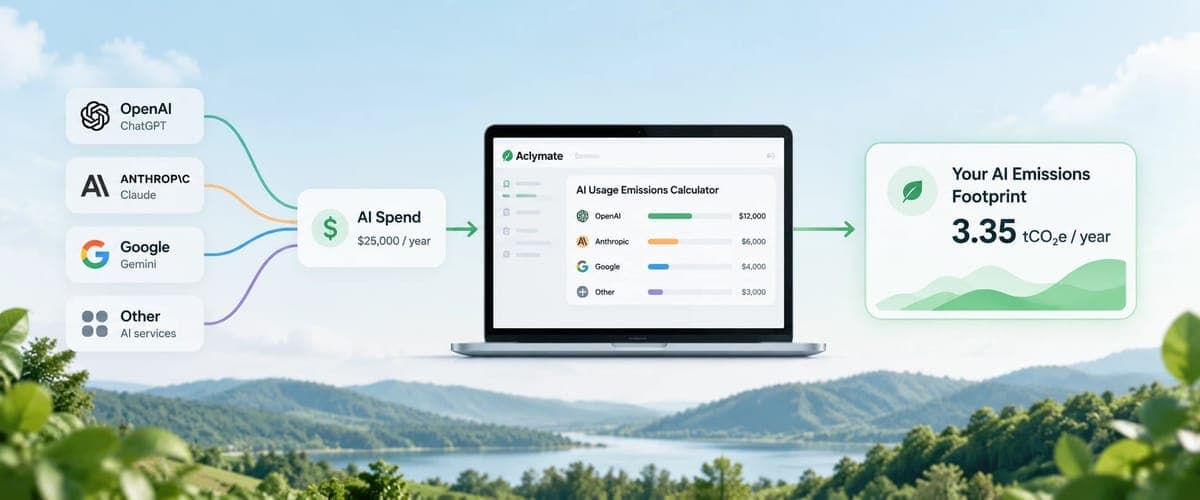
AI carbon emissions are becoming a new consideration for companies adopting ChatGPT, Claude, Gemini, Copilot and other artificial intelligence tools. Here’s how Aclymate estimates the carbon emissions from a company’s AI usage today—and how we expect the methodology to improve as AI providers release better usage and emissions data.
Read Article
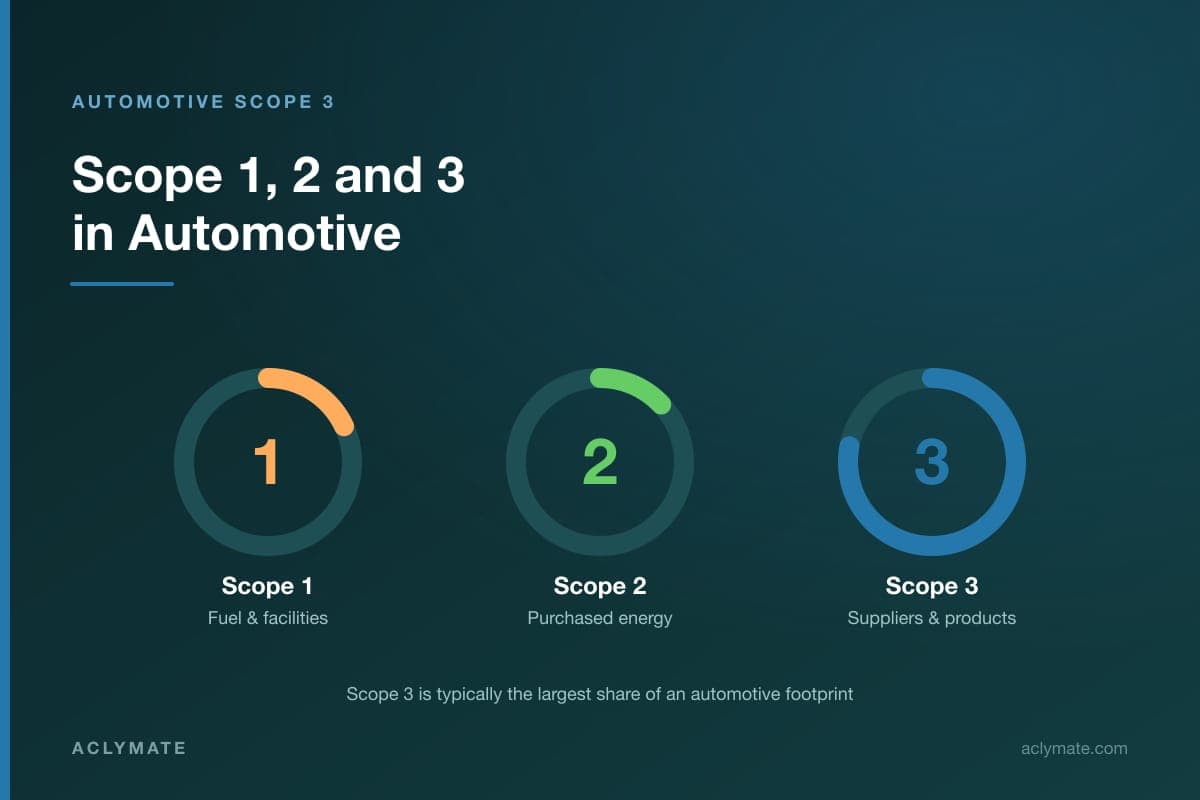
Learn how automotive companies measure Scope 3 emissions, collect supplier data, calculate product footprints, and meet customer reporting requirements.
Read Article
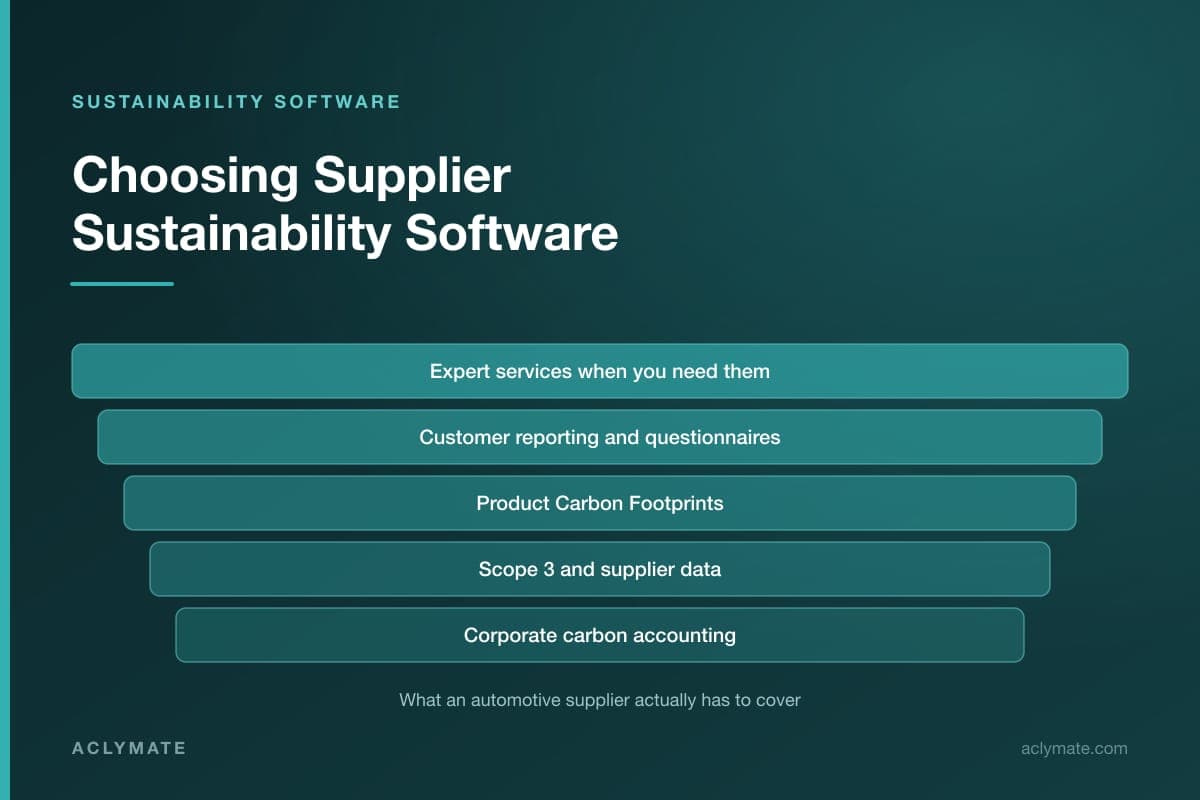
Learn how to choose automotive sustainability software for carbon accounting, Scope 3 supplier data, product footprints, customer reporting, and sustainability management.
Read Article
Talk with a Sustainability Expert, see a demo, or start free to put the Aclymate platform and experts to work for your team.