← Back to Insights
Aclymate Team
September 4, 2026
12 min read
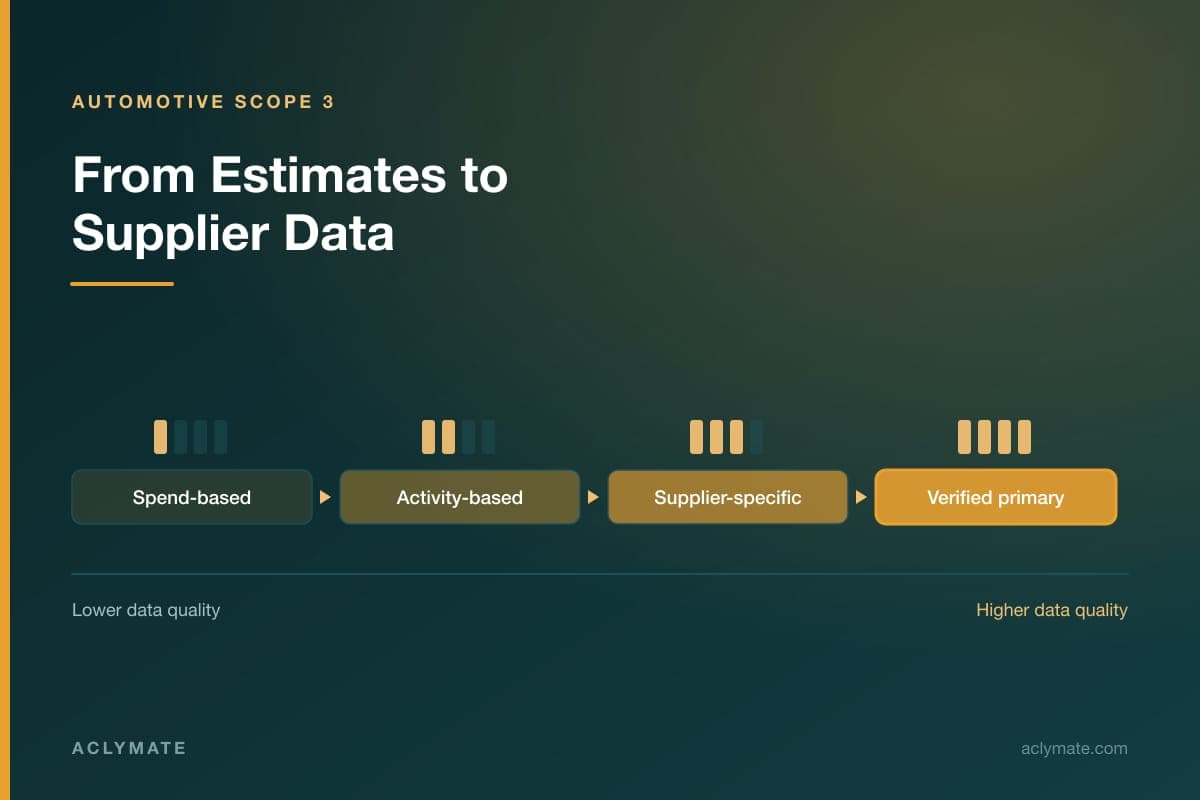
For automotive companies, measuring Scope 3 emissions quickly becomes a supplier-data challenge.
An OEM may purchase thousands of materials, parts, components, and services from Tier 1 suppliers. Those suppliers depend on Tier 2 companies, which may depend on Tier 3 manufacturers, machine shops, material suppliers, and other specialty businesses.
The result is a long chain of emissions — and no single company has all the data.
Automotive companies therefore need a practical approach to Scope 3 supplier data: deciding what information to request, which suppliers to prioritize, how to handle missing data, and how to gradually replace estimates with better supplier-specific information.
The goal should not be perfect data on day one. The goal is to create a repeatable system that gets more accurate as suppliers become more engaged and carbon data becomes more available.
Scope 3 supplier data is sustainability and emissions information obtained from companies in your supply chain to help calculate, understand, and reduce indirect emissions.
For an automotive manufacturer, relevant suppliers can include:
The GHG Protocol recommends that companies seek site-specific energy or emissions data from relevant value-chain partners when practical, starting with priority Tier 1 suppliers. It also recognizes that companies may need to use secondary data when supplier-specific information is unavailable. GHG Protocol: Scope 3 Supplier Data Guidance
That creates an important principle: Scope 3 data collection should be a progression, not an all-or-nothing exercise. A company can begin with estimates and improve its inventory as better supplier information becomes available.
Automotive supply chains are particularly complex.
A finished vehicle can contain thousands of individual parts and materials produced across multiple supplier tiers. Emissions associated with those purchased goods and services generally occur outside the OEM's direct operations.
That makes supplier data important for several reasons.
Industry-average emissions factors can provide a useful starting point, but they do not necessarily reflect the actual performance of a specific supplier.
Supplier-specific data can help replace assumptions with information tied more closely to the products and processes a company actually purchases.
If every steel, aluminum, plastic, or manufactured component is represented by an industry average, it becomes difficult to identify which suppliers are actually improving.
Better supplier data allows procurement and sustainability teams to see where emissions are concentrated and where engagement may produce meaningful reductions.
Automotive companies are increasingly establishing common approaches to supplier carbon reporting and reduction. Suppliers Partnership for the Environment, for example, has developed carbon-reduction KPIs and definitions with input from automakers and suppliers across the industry. Suppliers Partnership: Automotive Supplier Carbon Reporting Guidance
Corporate Scope 3 reporting asks: what emissions are associated with the goods and services our company purchases?
Product Carbon Footprints increasingly ask: what emissions are associated with this specific part or component?
Those questions are closely related, but they require different levels of data.
The answer depends on your goals and the maturity of your suppliers. Requesting everything from every supplier at once is rarely the best approach.
A practical program can progress through several levels.
Start with information needed to identify and segment the supplier:
Much of this may already exist in procurement, ERP, accounting, purchasing, or supplier-management systems. This basic supplier master data provides the foundation for determining which suppliers matter most.
For priority suppliers, ask whether they calculate corporate greenhouse gas emissions. Useful information includes:
For smaller suppliers, the first answer may simply be: "We don't calculate this yet."
That does not mean supplier engagement has failed. It means the next step may be helping the supplier develop a basic corporate carbon footprint.
Automotive companies building supplier-data programs should expect significant differences in carbon-accounting maturity across their supply base. AIAG's Greenhouse Gas Reporting Work Group focuses specifically on increasing supplier awareness around GHG reporting and emissions reduction while sharing OEM and supplier best practices. AIAG: Greenhouse Gas Reporting Work Group
Sometimes it is more useful to collect the underlying activity information than simply ask for a supplier's total carbon footprint. Examples include:
This information can help calculate emissions when the supplier has not yet produced a formal GHG inventory. It can also provide greater transparency into what is driving emissions.
For organizations managing large automotive supplier networks, Aclymate connects this type of supplier information with broader carbon accounting and sustainability workflows through its Automotive & Transportation solutions.
As programs mature, companies may need to move beyond corporate emissions and obtain carbon information about individual products, parts, and components:
This is significantly more detailed than asking a supplier for its Scope 1 and Scope 2 emissions.
Imagine an automotive supplier manufactures ten different products. Its corporate footprint tells you the emissions associated with the overall company or facility. It does not automatically tell you how much carbon is associated with the specific aluminum bracket your company purchases.
That requires product-level accounting.
Automotive initiatives such as Catena-X are working to create common ways to calculate and digitally exchange supplier-specific Product Carbon Footprint data across multiple tiers, with particular emphasis on increasing the share of supplier-specific primary data over time. Catena-X: Product Carbon Footprint Data Exchange
Companies that need to calculate product-level emissions can use Aclymate's Product Footprint Pack to organize products, BOMs, materials, suppliers, transportation, and emissions factors. See also automotive Product Carbon Footprints.
One of the biggest mistakes in Scope 3 supplier engagement is treating every supplier equally.
A company may have thousands of vendors. Some might represent major emissions sources. Others may have little impact on the company's footprint.
A better strategy is to prioritize.
These are the companies with which you have a direct purchasing relationship. They are usually easier to identify and engage because procurement already has contracts, purchase orders, contacts, and spend information.
Prioritization factors can include:
A steel supplier may deserve more attention than an office-products vendor even if both appear in the same purchasing database.
For automotive companies, areas such as steel, aluminum, batteries, chemicals, plastics, castings, forgings, and other energy-intensive products may warrant early attention.
The objective should be to find the intersection of material emissions, business importance, and ability to influence the supplier.
This distinction is fundamental to Scope 3 supplier data.
Secondary data comes from sources other than the specific supplier or process:
Secondary data makes it possible to calculate Scope 3 emissions even when suppliers have provided nothing. That makes it extremely useful for establishing a baseline.
Primary data comes directly from the actual supplier, facility, product, or activity:
Primary data can make emissions calculations more specific and actionable.
The long-term goal should generally be to increase the percentage of important Scope 3 emissions represented by reliable primary information — not necessarily the percentage of suppliers.
That is an important distinction. Obtaining excellent data from the suppliers representing the majority of emissions may create far more value than collecting mediocre data from every vendor.
Missing data is inevitable.
A machine shop with 75 employees may never have calculated its carbon footprint. A Tier 2 manufacturer may calculate corporate emissions but not Product Carbon Footprints. Another supplier may provide information for one facility but not another.
A scalable program needs a hierarchy. For example:
Instead of rejecting incomplete suppliers, calculate what you reasonably can and record the data source and confidence level. Then improve it over time.
That turns Scope 3 from a one-time reporting exercise into an ongoing data-quality program.
Sending a spreadsheet to 500 suppliers is not a supplier-engagement strategy.
Suppliers need to understand:
Smaller companies may need substantially more support than sophisticated Tier 1 suppliers.
The industry's broader sustainability programs already recognize this. Drive Sustainability provides supplier resources and an SME-oriented version of its Sustainability Assessment Questionnaire to help smaller suppliers understand and improve their sustainability practices. Drive Sustainability: SAQ Toolbox for Suppliers
A strong engagement program therefore should not simply say "send us your carbon footprint." It should provide a path for suppliers that do not yet have one.
Consider the situation from the supplier's perspective.
A 150-person precision manufacturer may receive sustainability requests from three different automotive customers. One wants Scope 1 and Scope 2. Another asks for a sustainability questionnaire. Another wants a Product Carbon Footprint.
If every customer uses different definitions, templates, portals, and methodologies, the burden grows quickly.
The better model is to help suppliers establish a reusable sustainability data foundation. Once the supplier has corporate emissions, energy information, product data, documentation, policies, and supporting evidence in place, it becomes much easier to respond to multiple customers.
Aclymate's Supplier & Scope 3 Data Support is designed around both sides of this relationship: helping companies obtain sustainability information from suppliers, and helping suppliers organize and provide information upstream to their customers. See Scope 3 reporting requirements for the supplier's view.
It is tempting to measure supplier engagement with one KPI: percentage of suppliers that responded. That is useful, but incomplete.
Consider tracking:
Those metrics shift supplier engagement from questionnaire completion toward better carbon management.
A practical automotive Scope 3 program can segment suppliers according to maturity.
You don't need every supplier at Level 5. The goal is to move the suppliers responsible for the greatest emissions progressively upward.
The automotive supply chain is too complex to manage supplier carbon information as an annual spreadsheet exercise.
Companies increasingly need a system that connects procurement data, suppliers, emissions, products, reporting, and reduction initiatives.
The process should include:
The objective is not simply to collect more data. It is to collect better data from the suppliers that matter most — and turn that information into better business and sustainability decisions.
Every supplier-data request has two sides.
For an OEM or large manufacturer: I need better carbon information from my suppliers.
For the supplier: My customer needs sustainability information from me.
Successful automotive sustainability programs have to solve both problems.
The buyer needs scalable collection, consistent methodology, good data quality, and visibility. The supplier needs clarity, practical tools, and a reasonable way to calculate and provide what the customer is requesting.
The companies that make this exchange easier for both sides will be in a much better position to move from estimated Scope 3 inventories toward credible, supplier-specific carbon data — and ultimately toward meaningful supply chain emissions reductions.
For the wider picture, see our guide to automotive Scope 3 emissions and automotive supply chain sustainability.
Scope 3 supplier data is sustainability and emissions information obtained from companies in your supply chain to calculate, understand, and reduce indirect emissions. In automotive it can include supplier Scope 1 and 2 emissions, energy and production data, material quantities, transportation details, and Product Carbon Footprints for specific purchased components.
Work through levels rather than requesting everything at once. Start with basic supplier master data such as location, materials supplied, and spend. Then corporate Scope 1 and 2 emissions for priority suppliers. Then supplier-specific activity data such as electricity and production volume. Then product-level carbon data for the components that matter most.
No. Treating every supplier equally is one of the biggest mistakes in Scope 3 engagement. Prioritize by annual spend, purchase volume, material type, estimated carbon intensity, strategic importance, and contribution to estimated Scope 3 emissions. A steel supplier warrants more attention than an office-products vendor even if both sit in the same purchasing database.
Secondary data comes from sources other than the specific supplier, such as industry averages, emissions-factor databases, and spend-based factors. It allows a baseline even when suppliers provide nothing. Primary data comes from the actual supplier, facility, product, or activity, and makes calculations more specific and more actionable.
Aim to increase the percentage of Scope 3 emissions covered by primary data, not the percentage of suppliers. Excellent data from the suppliers representing the majority of emissions creates far more value than mediocre data from every vendor in the purchasing system.
Use a data hierarchy rather than rejecting incomplete suppliers. Prefer supplier-specific verified product data, then supplier product data, then facility or corporate emissions, then supplier activity data, then industry-specific factors, with spend-based estimates as a fallback. Record the source and confidence level for each figure and improve it over time.
Suppliers need to know why the information is being requested, what data is needed, how it will be used, what methodology is acceptable, what deadline applies, what to do if they do not have the information, and where they can get help. Smaller suppliers typically need substantially more support than sophisticated Tier 1 companies.
Response rate alone is incomplete. Better metrics include the share of estimated Scope 3 emissions covered by supplier-specific data, primary-data coverage, product-level coverage for priority components, data completeness including methodology and boundaries, data freshness, and whether priority suppliers are actually reducing emissions.
Five levels: no carbon data; basic corporate Scope 1 and 2; reliable facility or activity data with documented methodology; product-level data with Product Carbon Footprints; and integrated carbon management with repeatable high-quality data and active reduction. Not every supplier needs Level 5 — the goal is moving the highest-emitting suppliers progressively upward.
Get Aclymate's practical sustainability content delivered weekly.
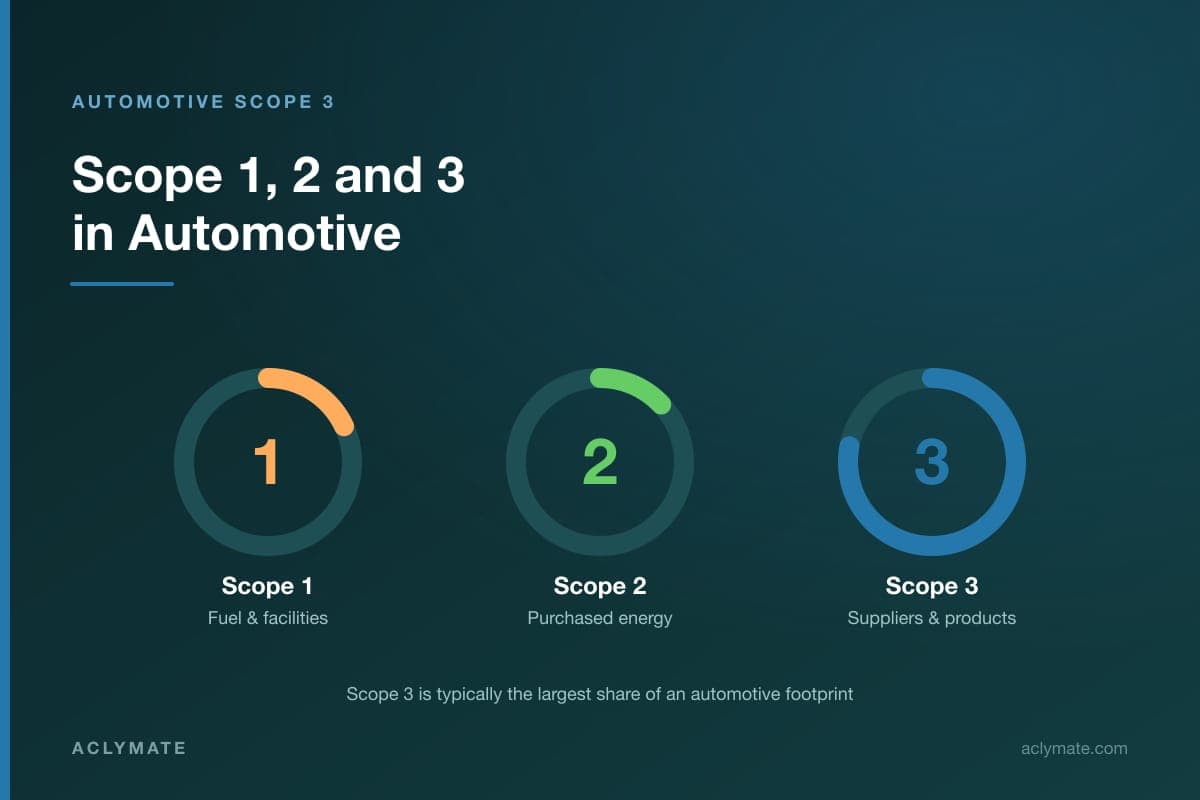
Learn how automotive companies measure Scope 3 emissions, collect supplier data, calculate product footprints, and meet customer reporting requirements.
Read Article
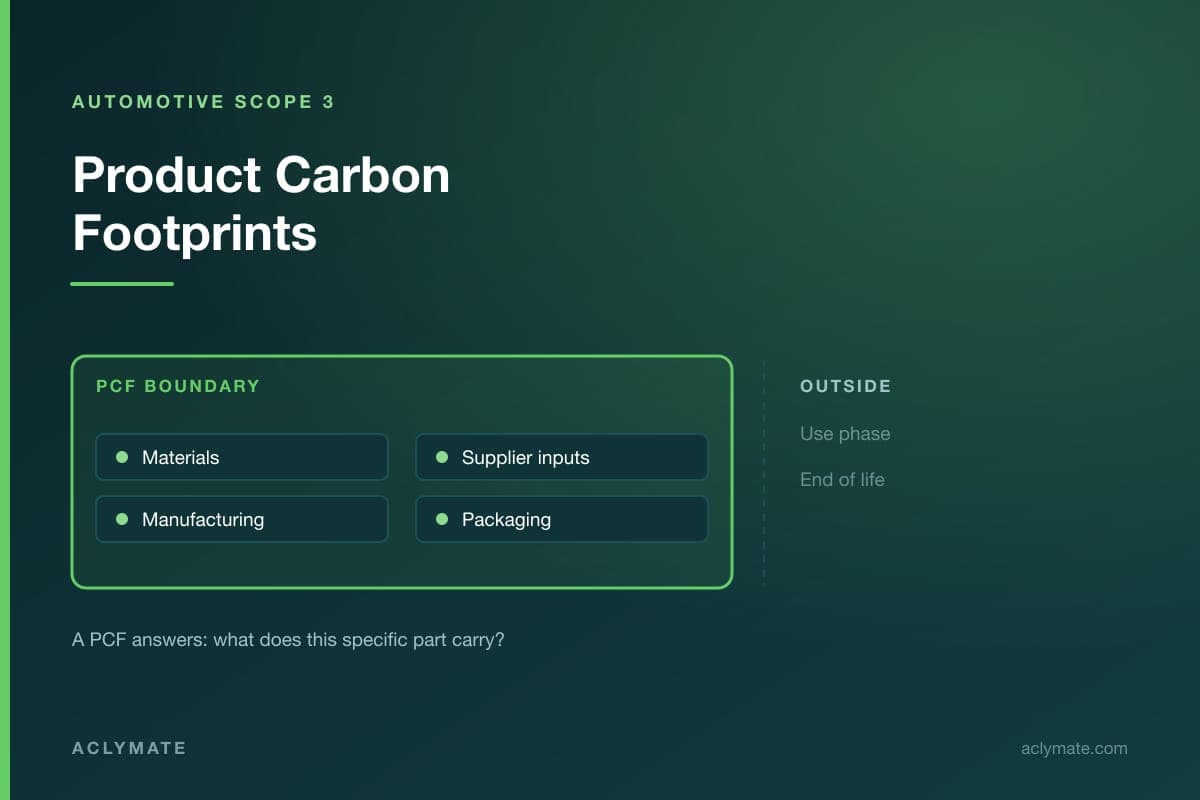
Learn how automotive Product Carbon Footprints measure emissions from materials, suppliers, manufacturing, transportation, and components.
Read Article
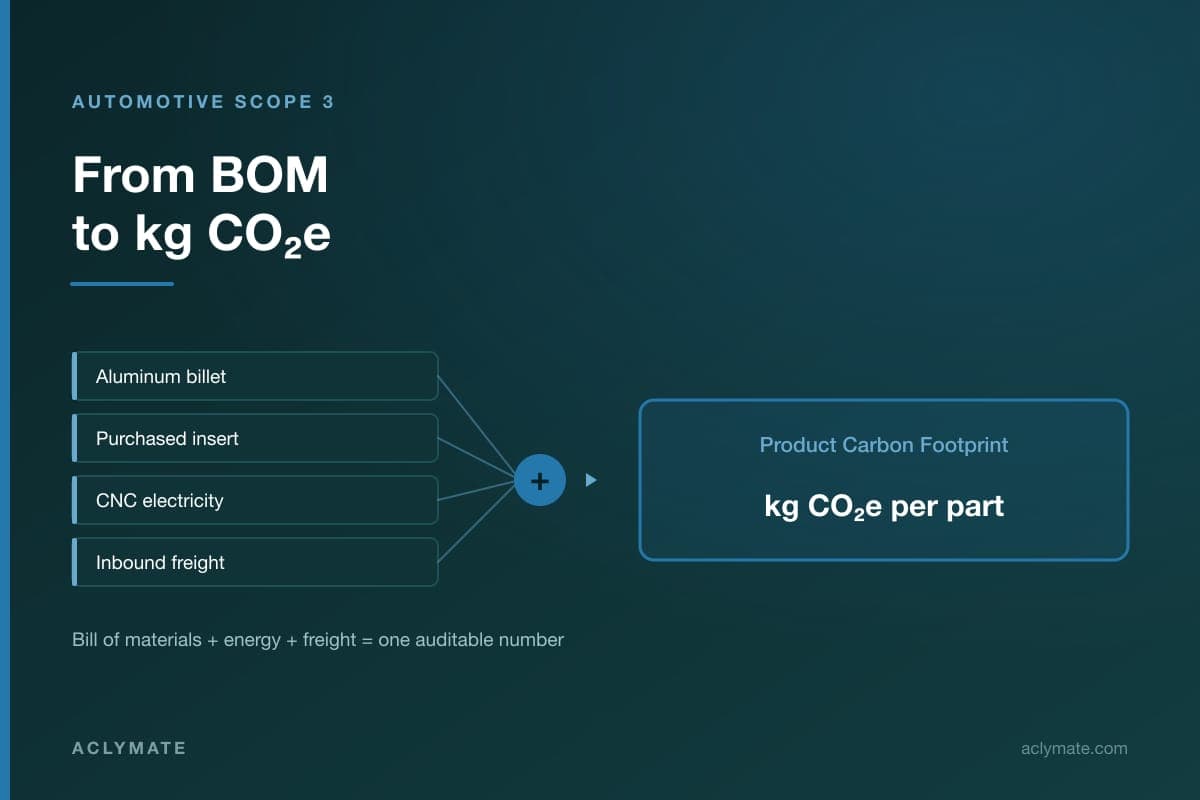
Learn how to calculate the carbon footprint of an automotive part using BOMs, materials, energy, suppliers, manufacturing, and transportation.
Read Article
Talk with a Sustainability Expert, see a demo, or start free to put the Aclymate platform and experts to work for your team.