← Back to Insights
Bill Zujewski
September 24, 2026
14 min read
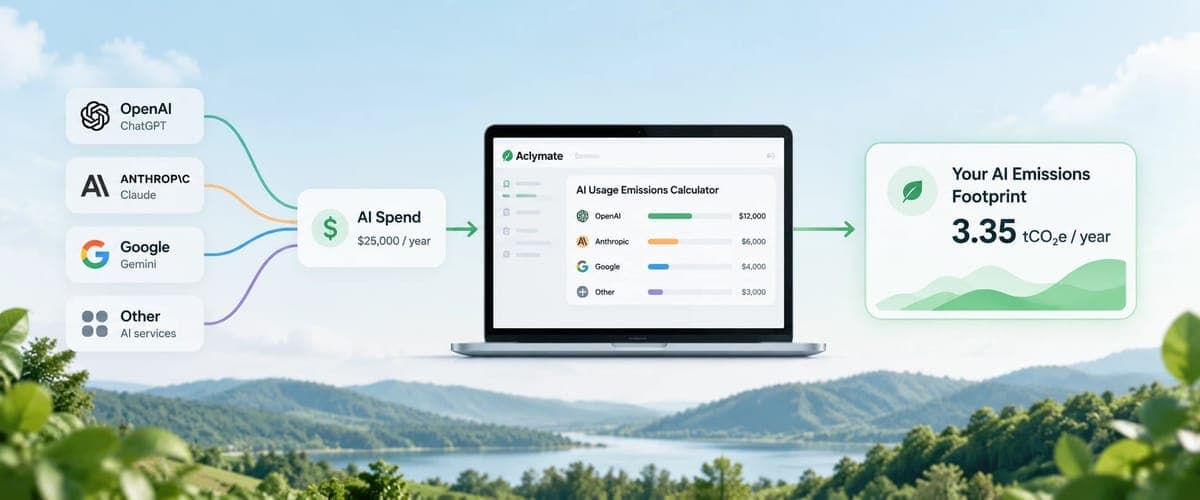
AI carbon emissions are becoming a new consideration for companies adopting ChatGPT, Claude, Gemini, Copilot and other artificial intelligence tools. Here’s how Aclymate estimates the carbon emissions from a company’s AI usage today—and how we expect the methodology to improve as AI providers release better usage and emissions data. Artificial intelligence is becoming part of everyday business. Employees use ChatGPT, Claude and Gemini. Developers build applications with AI APIs. Companies increasingly use AI inside productivity tools, customer service platforms, marketing applications and other software. All of that computing requires energy—and creates carbon emissions. But measuring AI carbon emissions is difficult. AI providers disclose different levels of information, companies often don't know how many tokens their employees consume, and the energy required for AI can vary substantially by model, workload, data center and electricity source. That's why Aclymate created the AI Usage Emissions Calculator: to give companies a simple, transparent starting point for estimating their AI Emissions Footprint using information they are likely to have today. Our methodology is designed to evolve. We start with a spend-based estimate when better activity data isn't available and intend to incorporate token-level usage and provider-reported emissions as those data become more accessible.
AI produces carbon emissions primarily because training and operating AI models requires electricity and physical computing infrastructure. The environmental impact of an AI workload can depend on:
How much carbon emissions come from AI? There isn't one universal number. AI carbon emissions vary based on the model, workload, hardware, data-center efficiency, electricity source and amount of AI activity. A simple text query can have a very different footprint from a complex reasoning request, image generation or video generation. At the company level, scale matters too. A few employees occasionally using generative AI is fundamentally different from thousands of employees, AI agents and customer-facing applications generating millions or billions of tokens. Google provides a useful example of how much these numbers can change as infrastructure becomes more efficient. Google reported that a median Gemini Apps text prompt consumed approximately 0.24 Wh of energy and generated 0.03 grams of CO₂e under its comprehensive production measurement methodology. Read Google's methodology for measuring AI inference. But a per-prompt number doesn't tell a company its annual AI carbon emissions. Businesses need a method for translating their own AI activity into an organizational estimate. For a broader explanation, see Aclymate's How Much Carbon Emissions Come From AI?.
Understanding AI data centers carbon emissions is central to understanding the environmental impact of AI. AI models operate in data centers filled with specialized computing equipment such as GPUs and other accelerators. Those systems consume electricity while training models and responding to user requests—a process known as inference. But the servers themselves aren't the only source of impact. AI data centers also require energy for:
Aclymate's approach follows an important principle of carbon accounting: Don't let the absence of perfect data prevent you from estimating your footprint. Companies routinely estimate emissions when direct measurements aren't available. Business travel may be calculated from miles traveled. Purchased products may initially be estimated from spending. Electricity may be calculated from utility consumption multiplied by an appropriate emissions factor. AI can be approached similarly. Watershed published an open framework for corporate AI emissions measurement developed with researchers from Stanford University and Tsinghua University and with input from organizations including Block and Okta. The Watershed AI Emissions Framework proposes three levels of measurement based on the quality of data available:
Use AI spending when detailed activity data aren't available.
Use actual AI activity—particularly input and output token volumes—and estimate the energy and emissions associated with that activity.
Use emissions and energy information reported directly by the AI or cloud provider. The principle is straightforward: Use the best reliable data available today, then improve the estimate as better data becomes available. That is also the philosophy behind Aclymate's methodology.
For the first version of the Aclymate AI Usage Emissions Calculator, we use a spend-based estimate. We ask companies to estimate how much they spend with major AI providers such as:
The 0.134 kg CO₂e/$ factor isn't an arbitrary estimate of the electricity required to run ChatGPT. It comes from an established type of carbon accounting called environmentally extended input-output analysis, or EEIO. EEIO models connect economic activity—how money moves among industries—with environmental data associated with those industries. This allows carbon accountants to estimate emissions from purchases when physical activity data aren't available. Watershed's AI Emissions Framework maps AI service spending to U.S. Bureau of Economic Analysis sector 518200: Data Processing, Hosting & Related Services. The corresponding 2023 Open CEDA factor used in Watershed's framework is: 0.134 kg CO₂e per U.S. dollar. Watershed recommends this as a default for its lowest-data Spend Tier.
CEDA stands for the Comprehensive Environmental Data Archive. CEDA is a multi-region environmentally extended input-output database used for spend-based carbon accounting. Watershed also makes Open CEDA available under a CC BY-SA license. Open CEDA provides approximately 60,000 emissions factors covering 400 industries across 148 countries and regions. This matters because the factor isn't intended to represent only the electricity consumed by a server. As an EEIO factor, it incorporates upstream supply-chain emissions associated with the sector, including lifecycle impacts such as hardware manufacturing and data-center construction. That makes the calculation broader than simply: AI usage → electricity → CO₂ It is an economic estimate of the emissions associated with purchasing services from the data-processing and hosting sector.
The strength of spend-based accounting is simplicity. Its weakness is precision. The 0.134 kg CO₂e/$ factor represents the average emissions intensity of the broader data-processing and hosting industry. That industry includes everything from web hosting and managed databases to sophisticated AI workloads. It is not an OpenAI-specific, Anthropic-specific or Gemini-specific emissions factor. There is another important issue: Price isn't the same thing as computing activity. An AI company may charge a premium for access to a highly capable model. Two providers could consume similar amounts of electricity while charging customers very different prices. Conversely, providers could subsidize some AI workloads. Therefore: $1 spent on AI does not necessarily correspond to a fixed amount of computing or electricity. Watershed makes this limitation explicit and recommends replacing spend estimates with activity- or provider-level data as better information becomes available. That's why Aclymate doesn't present the spend-based result as an exact measurement. We present it as: An estimated AI Emissions Footprint based on reported AI services spending. It is a starting point. For more about how businesses use estimates and activity data within broader carbon accounting, see Aclymate's Methodology of Carbon Footprint.
Because it's information companies can actually obtain. Ask a CFO, controller or IT leader: "How much did your company spend with OpenAI last year?" There is a reasonable chance they can answer. Now ask: "How many input tokens, output tokens, cached tokens and reasoning tokens did every employee and application consume across every AI model last year?" Most companies cannot answer that yet. A useful sustainability measurement system has to meet companies where their data are today. Aclymate therefore uses spend to provide an accessible first estimate rather than requiring companies to have sophisticated AI telemetry before they can begin measuring. This is consistent with the broader principles of carbon accounting: start with defensible available data, document the methodology and improve data quality over time.
Spend isn't where we expect AI carbon emissions accounting to end. Aclymate is working toward an activity-based approach using AI token consumption. Tokens are attractive because they're already a fundamental unit of AI activity and cost. AI providers increasingly report information such as:
Tokens shouldn't be mistaken for energy. Different models can require dramatically different amounts of computing to process similar quantities of information. Reasoning models can require substantially more computation than smaller models. Image generation, video generation, agentic workflows and multimodal AI introduce additional differences. Even production architecture matters. The long-term goal therefore isn't simply: Count every token and multiply by one universal carbon factor. Instead, Aclymate expects increasingly sophisticated calculations to consider: Provider + Model + Input Tokens + Output Tokens + Workload + Region + Energy Intensity + Electricity Carbon Intensity As reliable data become available, that should produce increasingly useful estimates.
The biggest improvement in AI carbon accounting will occur when the companies operating AI infrastructure provide customers with better first-party energy and emissions data. We're already seeing movement.
Google has published one of the more detailed first-party measurements of production AI inference. In 2025, Google reported that the median Gemini Apps text prompt consumed approximately 0.24 Wh of energy, generated approximately 0.03 grams of CO₂e and consumed approximately 0.26 mL of water under its measurement methodology. Google Cloud is also incorporating AI inference into customer Carbon Footprint reporting and supports programmatic access to carbon data. This is exactly the direction Aclymate wants the market to move.
AWS is moving in a similar direction. In March 2026, AWS launched its Sustainability console, which provides customers with estimated emissions associated with their AWS usage by region, service and emissions scope. AWS also provides customizable reports and API/SDK access, creating opportunities for emissions information to flow directly into corporate sustainability systems. This moves cloud carbon accounting away from generalized industry estimates and toward emissions allocated from a provider's actual infrastructure and operations.
AI model providers are also exposing increasingly detailed usage telemetry even when they don't yet provide complete customer-specific carbon information. That telemetry matters. If Aclymate can obtain actual provider, model and token usage, it provides the activity denominator needed to move beyond spend. As APIs and enterprise administration capabilities mature across OpenAI, Anthropic, Google, Microsoft, AWS and other providers, Aclymate will evaluate opportunities to incorporate those data into increasingly accurate AI carbon emissions calculations.
We see AI carbon emissions measurement evolving through three stages.
Input: AI services spending Calculation: Spend × appropriate EEIO emissions factor Output: Estimated AI Emissions Footprint Confidence: Low This allows almost any company to get started.
Input: AI provider, model, input/output token consumption and other available usage telemetry Calculation: AI activity × appropriate energy-intensity assumptions × data-center efficiency × grid carbon intensity Output: More granular AI Emissions Footprint Confidence: Higher, dependent on data quality This moves the calculation from economic activity toward actual AI consumption.
Input: Customer-specific energy and emissions data supplied by AI and cloud providers Calculation: Provider-specific methodology and actual infrastructure data Output: Provider-attributed AI emissions Confidence: Highest when methodologies and boundaries are transparent and appropriately verified This is where we believe AI carbon accounting should ultimately go.
AI is changing extraordinarily quickly. Models become more efficient. New reasoning and agentic workloads consume more compute. Data centers change hardware. Electricity grids change. Providers procure clean energy. New disclosure standards emerge. A carbon factor that appears precise today may become obsolete surprisingly quickly. That's why Aclymate believes an AI carbon emissions estimate should disclose:
The purpose of Aclymate's AI Usage Emissions Calculator isn't to pretend today's AI emissions data are more precise than they are. It's to make the invisible visible. If your company knows what it spends on AI, you can begin estimating your AI Emissions Footprint today. As token data become available, the estimate can improve. As providers expose customer-specific electricity and emissions information, it can improve again. That progression—from spend estimates to activity data to provider measurements—is already familiar in carbon accounting. The important thing is to start measuring.
Use Aclymate's AI Usage Emissions Calculator to get a directional estimate of the carbon emissions associated with your company's AI usage. Calculate My AI Emissions AI is only one part of your organization's environmental impact. Aclymate can help you understand your broader company carbon footprint across energy, travel, purchasing, operations and your supply chain. Explore My Company's Carbon Footprint
AI produces carbon emissions primarily through the electricity required to train and operate AI models in data centers. Additional emissions can come from data-center cooling and supporting infrastructure, manufacturing GPUs and servers, constructing data centers and other upstream activities. The actual footprint depends heavily on the model, workload, hardware, data-center efficiency and source of electricity.
There is no single number for all AI. AI carbon emissions depend on how much AI is used, which models and workloads are involved, the efficiency of the underlying infrastructure and the carbon intensity of the electricity supplying the data center. At the company level, Aclymate can provide a directional estimate based on AI services spending when more precise activity data aren't available.
AI data centers carbon emissions are the greenhouse gas emissions associated with the computing infrastructure used to train and operate AI systems. They can include emissions from electricity consumption, cooling, supporting infrastructure and the lifecycle impact of manufacturing servers, GPUs and other equipment. Location is important because the carbon intensity of electricity varies significantly across grids.
Companies can start with the best data available. Aclymate's initial methodology uses annual AI services spending multiplied by an appropriate spend-based emissions factor. As better information becomes available, token activity and eventually provider-reported energy and emissions can produce more granular estimates.
Potentially. Token counts provide a measure of actual AI activity, while spending is an economic proxy. However, tokens aren't equivalent to energy: different models and workloads can require very different amounts of computation per token. A robust token-based methodology therefore also needs information about the provider, model, workload, data-center efficiency and electricity source.
For many companies purchasing third-party AI services, associated value-chain emissions may generally fall within Scope 3 Purchased Goods and Services rather than Scope 1 or Scope 2. The appropriate treatment depends on organizational boundaries, the service being purchased and the accounting methodology being followed.
We believe so. Google and AWS are already providing increasingly detailed customer carbon information, while AI providers are exposing better usage and token telemetry. As provider-specific energy, usage and emissions data become available, Aclymate plans to incorporate higher-quality data into its methodology.
Get Aclymate's practical sustainability content delivered weekly.
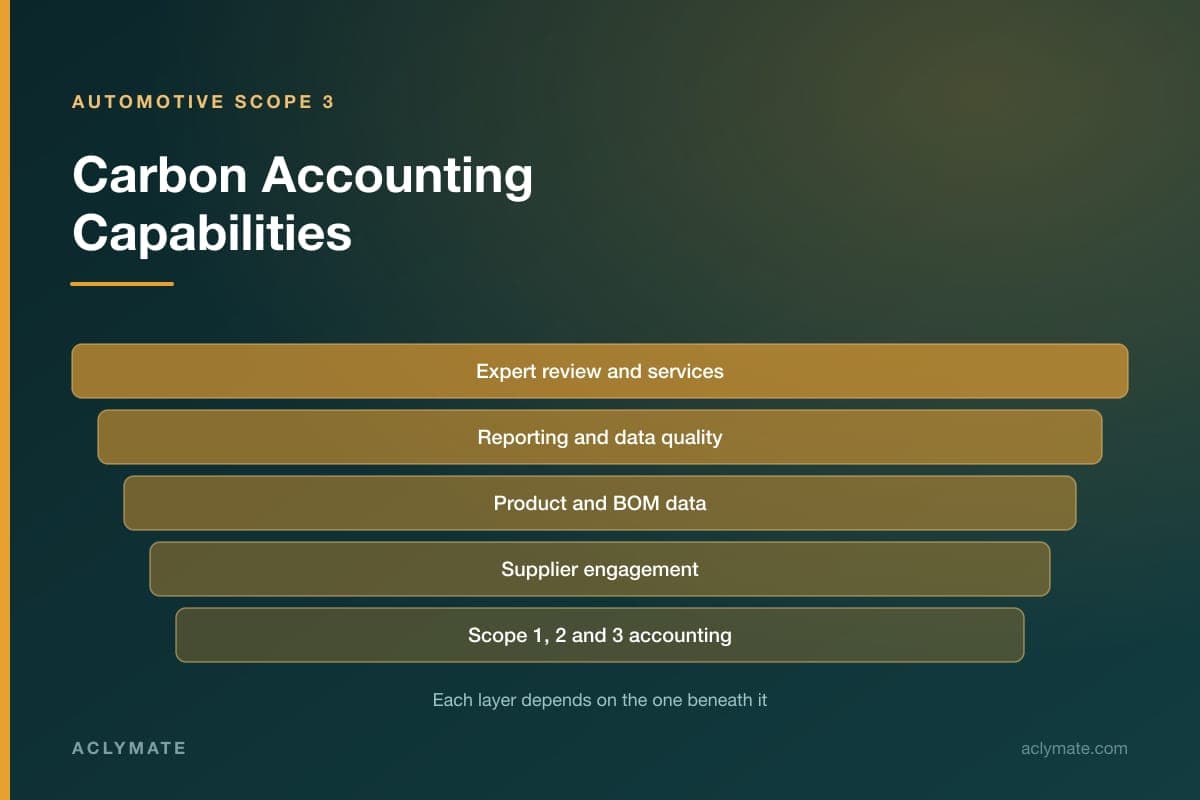
Compare the capabilities automotive companies need for carbon accounting, Scope 3 supplier data, PCFs, reporting, and sustainability management.
Read Article
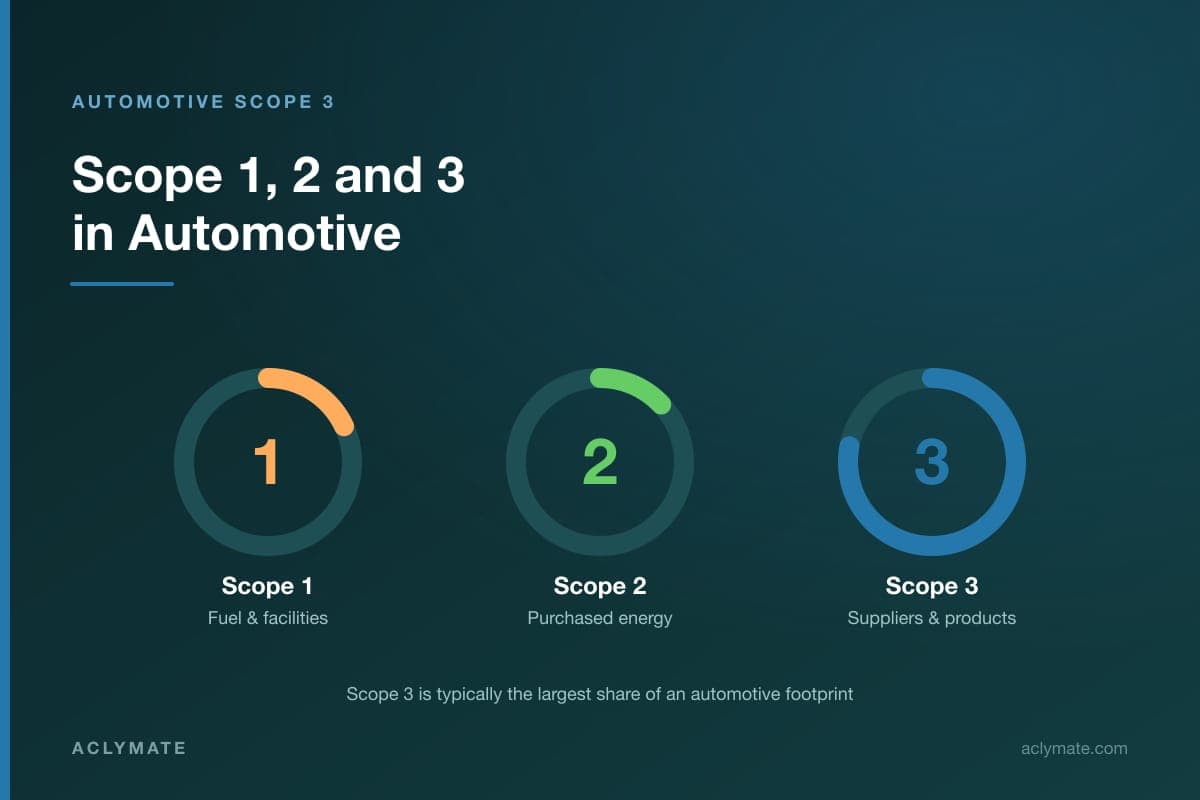
Learn how automotive companies measure Scope 3 emissions, collect supplier data, calculate product footprints, and meet customer reporting requirements.
Read Article
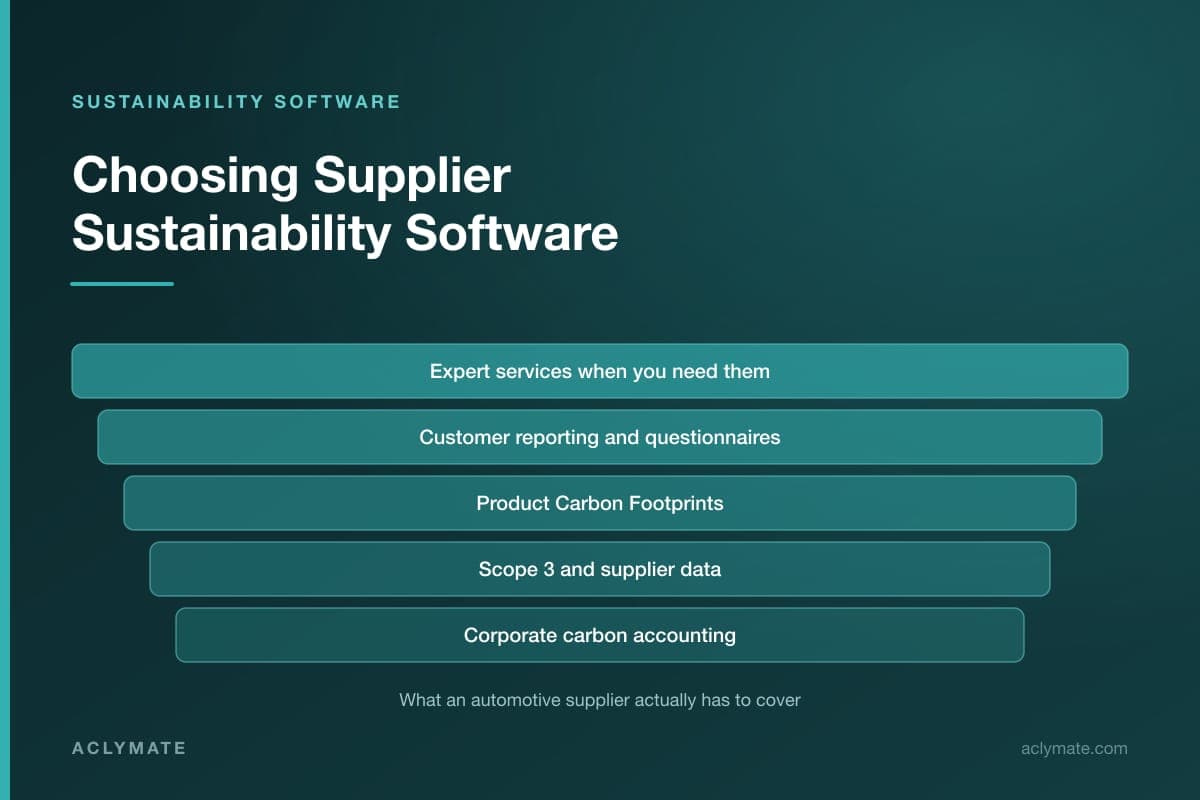
Learn how to choose automotive sustainability software for carbon accounting, Scope 3 supplier data, product footprints, customer reporting, and sustainability management.
Read Article
Talk with a Sustainability Expert, see a demo, or start free to put the Aclymate platform and experts to work for your team.