← Back to Insights
Aclymate Team
August 27, 2026
7 min read
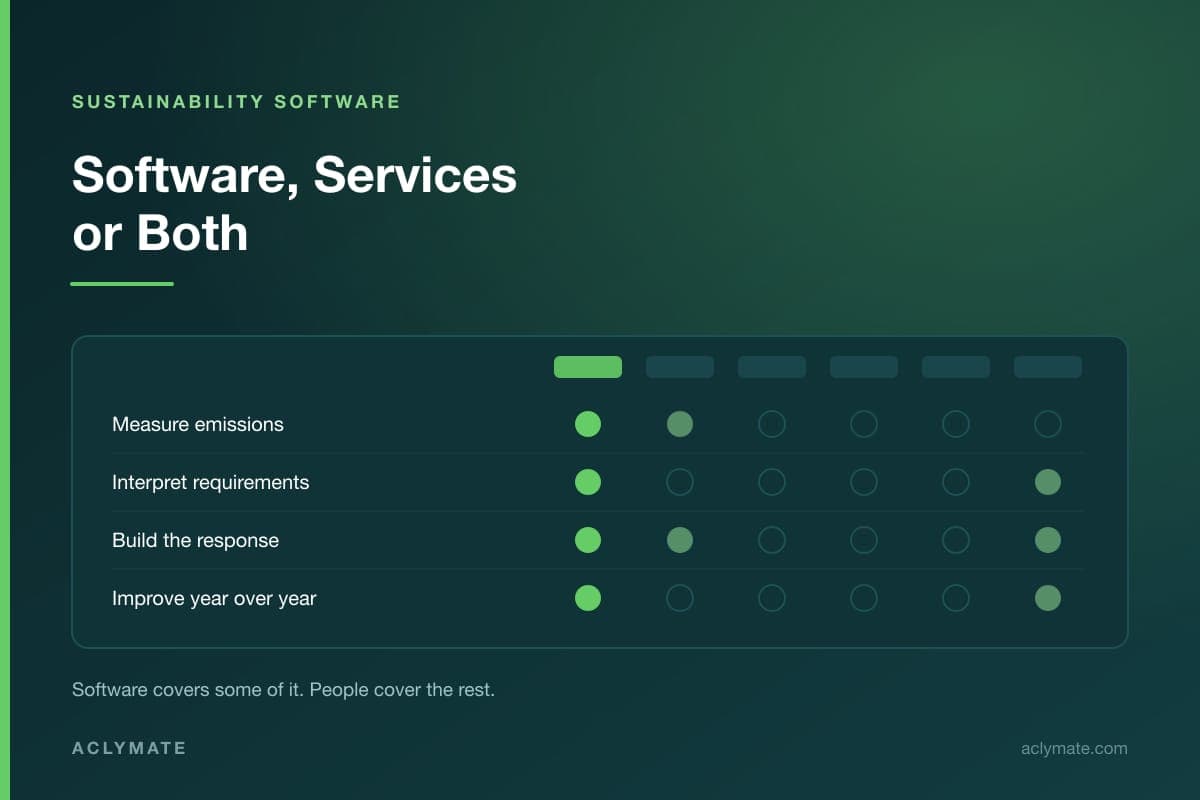
Automotive suppliers facing their first serious sustainability requirements usually frame the decision as software or consulting. Buy a platform, or hire someone who knows how.
It is the wrong frame, and it is worth explaining why rather than just asserting it — because the two options fail in different, predictable ways, and understanding the failure modes tells you what you actually need.
Software is good at the parts of this work that are repetitive, computational, and need to happen the same way every time.
These are genuinely hard to do well in a spreadsheet, and they get harder every year as part numbers and customers accumulate. This is real value.
The failure is specific: software answers how do I calculate this. It does not answer what am I being asked for.
The questions that actually stall automotive suppliers:
None of these are software problems. They are experience problems, and no interface resolves them.
The practical result: a supplier buys a good platform, logs in twice, encounters the first question it cannot answer, and the project stops. The software was not the problem. It was addressing a different bottleneck.
Consulting is good at exactly the things software is not:
For a supplier with no sustainability staff, this is often the binding constraint — the reason work is not happening is that nobody knows what good looks like.
Two failure modes, both common.
The report that ages. A consultant produces an excellent inventory as a deliverable. A year later the numbers are stale, the working lives in a spreadsheet nobody internally can update, and a new customer request arrives with a different boundary. You re-engage, and pay again, for work that should have been an update.
The dependency. Every request routes through someone external. Response times stretch, costs recur, and the capability never moves in-house. For a supplier facing quarterly customer requests, this is expensive in both money and speed.
Neither is a criticism of consultants. It is a structural consequence of buying expertise as a project rather than a capability.
Put plainly:
Software should own the calculation, the data, the factors, the recalculation, the history, and the outputs. Anything that should happen identically every time.
People should own interpretation, methodology decisions, review, unfamiliar requests, and the first instance of anything.
The pattern that works: experts get you through the first cycle and establish the method; software makes every subsequent cycle cheap; experts stay available for the questions that are genuinely new.
That progression matters. The first inventory is hard and the second should not be. The first PCF is expensive and the tenth should be routine. If they are not, either the method was never established or it was never captured in a system.
Year one. An expert helps build the Scope 1 and 2 inventory, sets boundaries, and documents methodology. Software holds it. You produce one PCF together, and the method is recorded rather than living in the consultant's head.
Year two. You refresh the inventory yourself — the structure exists, only the data changes. You produce PCFs for new parts using the established method. You call for help on the EcoVadis assessment, because it is the first one.
Year three. Most requests are handled internally. Expert time goes to genuinely new problems: a customer specifying an unfamiliar methodology, a challenged number, a reduction plan with real targets.
Expert involvement declines while capability rises. That is the outcome to aim for, and it is not what either option delivers alone.
Weight toward expert support when: it is your first inventory or first PCF; a request uses terminology nobody recognizes; a customer has challenged a submission; an assessment is due and nobody has run one; the requirement is unusual; or the person responsible has no capacity and needs the work done rather than enabled.
Weight toward software when: the method is established and the work is recurring; part numbers are multiplying; several customers want different boundaries; factors keep updating; or you need to answer "how was this derived" about something from two years ago.
Most automotive suppliers need both simultaneously, in shifting proportion.
The shape of the automotive supply base is what makes this more acute than in other industries.
A large share is companies of 30 to 300 people — machine shops, molders, stampers, tool and die, heat treaters — where sustainability lands on a quality manager or controller who already has a full job.
These companies cannot justify a sustainability hire. They also cannot afford to route every customer request through an external consultant, because requests now arrive from several customers a year with commercial consequences attached.
Meanwhile the requirements keep deepening. Suppliers Partnership for the Environment has developed shared carbon reporting and reduction guidance with automakers and suppliers, and part-level footprint requests are becoming routine. Suppliers Partnership: supplier carbon guidance
Neither a platform nobody has time to learn nor a consultant on retainer fits that situation well. A combination does.
If you are evaluating either side, these expose the gap:
That last question is diagnostic. A model that costs the same in year three as year one is not building your capability — it is renting you someone else's.
Aclymate combines software with sustainability experts rather than asking suppliers to choose, specifically because the automotive supply base needs both.
AI when you need an immediate answer, software when you need a repeatable process, experts when you need help getting it done.
See the Automotive & Transportation page, the buyer's guide, or the six-platform comparison.
Usually both, in shifting proportion. Software handles calculation, factors, recalculation, history, and outputs — anything that should happen identically every time. People handle interpretation, methodology decisions, review, unfamiliar requests, and the first instance of anything. The two address different bottlenecks and fail in different ways.
Because software answers how to calculate something, not what you are being asked for. The questions that stall suppliers are interpretation questions: which boundary applies, whether an allocation method is defensible, whether an answer is good enough to send. A supplier buys a good platform, hits the first question it cannot answer, and stops.
Two ways. The deliverable ages — a year later the numbers are stale and the working lives in a spreadsheet nobody internally can update. And dependency sets in, where every request routes externally, response times stretch, costs recur, and the capability never moves in-house despite repeated spend.
Expert involvement should decline while capability rises. Year one, experts build the first inventory and establish methodology while software holds it. Year two, you refresh it yourself and call for help on first-time assessments. Year three, most requests are internal and expert time goes to genuinely new problems.
For a first inventory or first Product Carbon Footprint, when a request uses unfamiliar terminology, when a customer has challenged a previous submission, when an assessment is due and nobody has run one before, when the requirement is unusual, or when the responsible person has no capacity and needs the work done rather than enabled.
When the method is established and work is recurring, when part numbers are multiplying, when several customers want different boundaries, when emissions factors keep updating, or when you need to explain how a figure from two years ago was derived. These are all propagation and retention problems, which software solves and people do not.
Because of the supply base. Much of it is companies of 30 to 300 people where sustainability lands on a quality manager or controller with a full job. They cannot justify a sustainability hire, and they cannot route every request through a consultant when requests arrive from several customers a year with commercial consequences.
Ask how cost changes as your capability grows. A model costing the same in year three as year one is not building capability, it is renting you someone else's. Also ask who builds the first inventory, whether you can refresh it yourself, and whether the work stays in a system you can operate.
Get Aclymate's practical sustainability content delivered weekly.
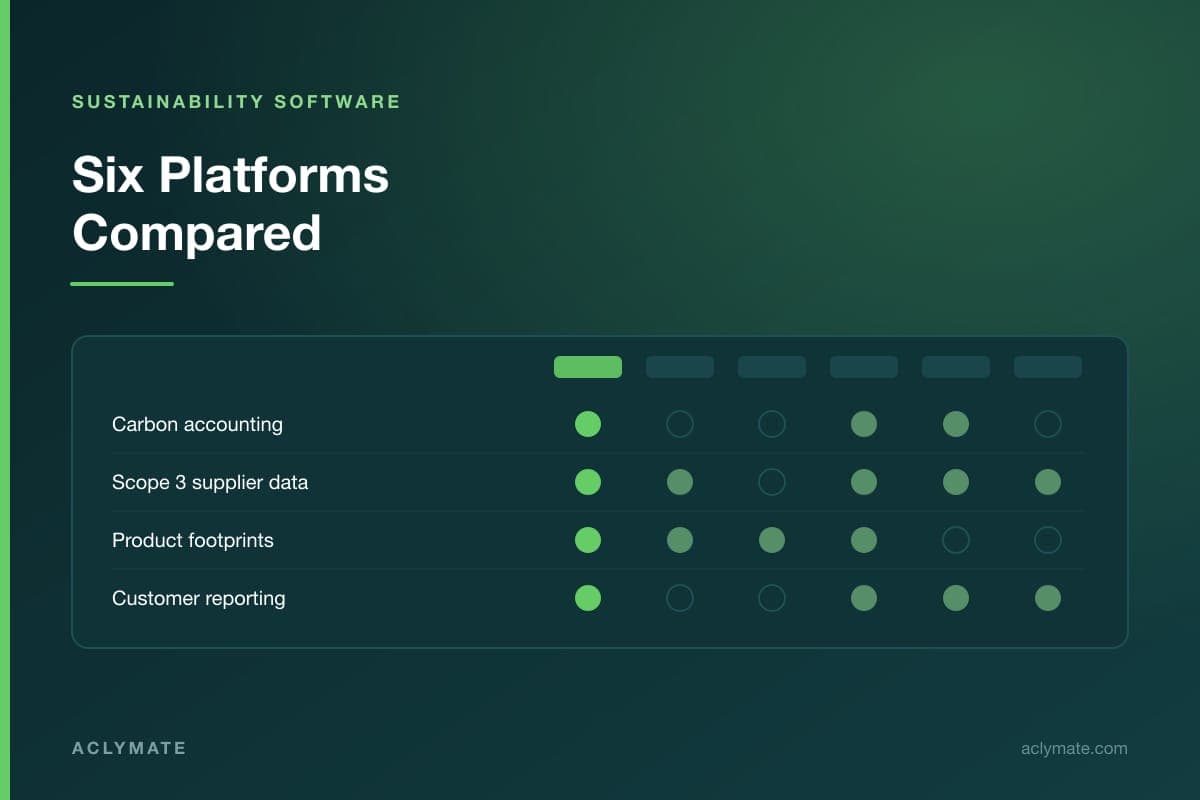
Compare Aclymate, CircularTree, iPoint, Manufacture 2030, Sphera and EcoVadis for automotive supplier sustainability, carbon accounting, Scope 3, PCFs and reporting.
Read Article
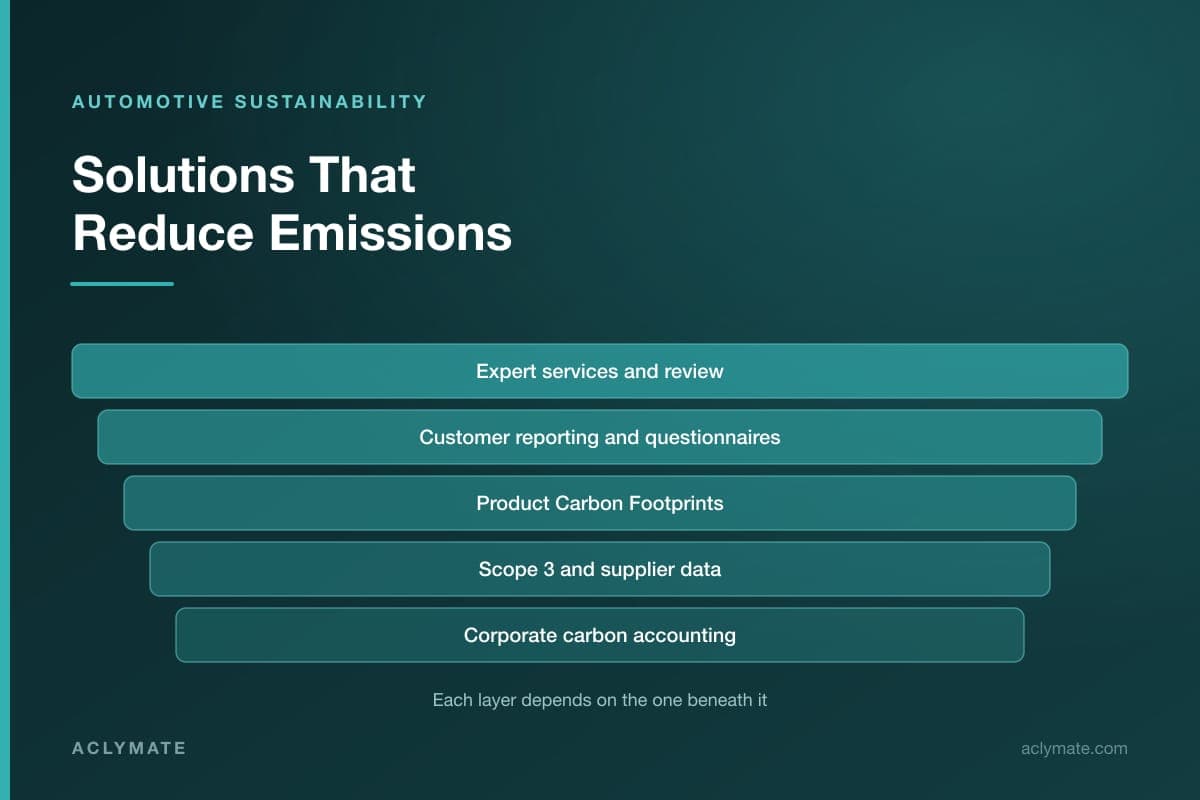
Explore practical automotive sustainability solutions for carbon accounting, Scope 3, supplier data, product footprints, reporting, and emissions reduction.
Read Article
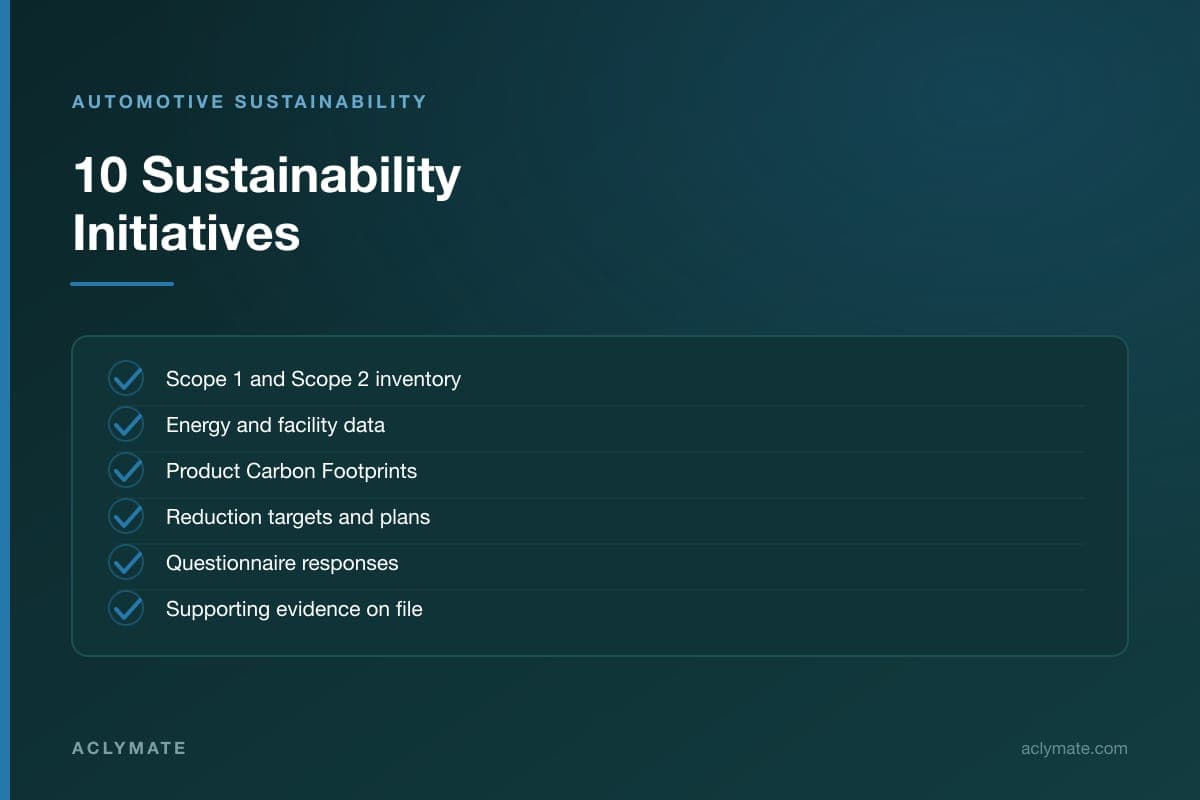
Explore automotive sustainability initiatives for reducing emissions, improving supplier performance, measuring product footprints, and meeting environmental goals.
Read Article
Talk with a Sustainability Expert, see a demo, or start free to put the Aclymate platform and experts to work for your team.