← Back to Insights
Aclymate Team
September 14, 2026
8 min read
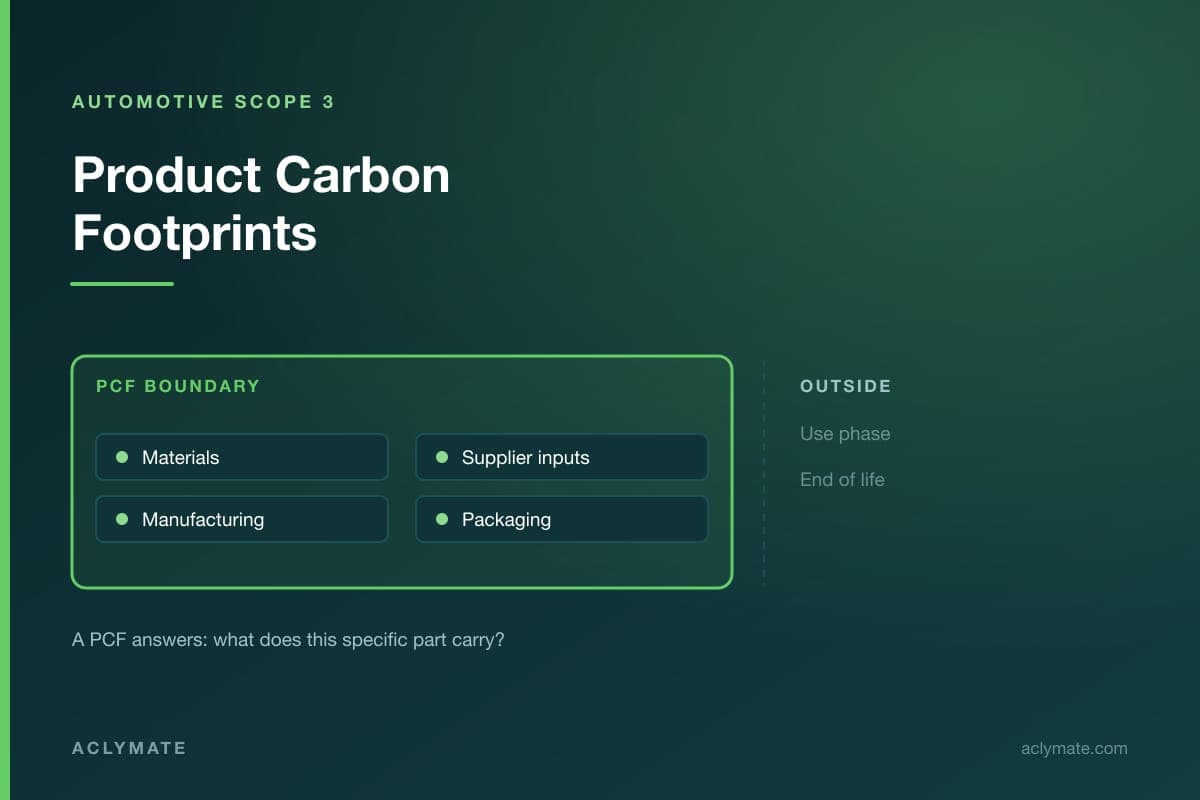
An automotive Product Carbon Footprint is the greenhouse gas emissions attributable to one specific part or component, expressed as kg CO2e per part.
It is not a smaller version of a corporate carbon footprint. It answers a different question, uses different inputs, and creates a different kind of ongoing work — which is why suppliers who treat their first PCF request as "the carbon thing, but for a part" usually get it wrong.
This guide covers what a PCF is, why automotive customers want them, what goes inside the boundary, and what makes one defensible.
A PCF quantifies the greenhouse gas emissions associated with producing a defined quantity of a specific product.
Three elements define it:
A PCF without a stated unit and boundary is not a PCF. It is a number.
The distinction matters enough to be explicit about it.
A corporate footprint asks: what emissions did this company generate during a reporting year? It covers Scope 1, 2, and 3, it is produced annually, and it is one number describing an organization.
A Product Carbon Footprint asks: what emissions attach to this part? It is produced per part number, it changes when materials, suppliers, or processes change, and a supplier shipping 400 part numbers has a potential 400-item workload rather than one.
They also draw on different data. A corporate inventory runs on utility bills and the general ledger. A PCF runs on bills of materials, material masses, process energy allocation, and scrap rates.
One useful consistency check: if you sum the footprints of everything you shipped in a year, plus what you scrapped, the result should be in the same territory as the relevant portion of your corporate inventory. When it is not, one of the two is wrong.
Three reasons, in roughly increasing order of importance to your customer.
Their Scope 3 inventory. An OEM buying your bracket needs the emissions attributable to that bracket, not your company's annual total. A corporate figure cannot be apportioned to a purchase order.
Supplier comparison. Two suppliers quoting the same component with documented cradle-to-gate footprints can be compared on carbon the way they are compared on price. Corporate footprints cannot do this — a large efficient supplier will always look worse in absolute terms than a small inefficient one.
Design decisions. When an engineer considers substituting a material or changing a process, the question is what the carbon difference would be. Only part-level data answers that.
AIAG has built PCF education specifically for automotive suppliers who have received these requests or expect to. AIAG: Product Carbon Footprint
The boundary is the most consequential decision in the calculation, because it determines what is counted.
Cradle-to-gate is the automotive default for suppliers. It runs from raw material extraction, through supplier processing and inbound transportation, through your manufacturing, to the point the part leaves your facility.
It excludes outbound distribution to the end customer, the vehicle's use phase, and end-of-life.
That boundary exists because it matches what a supplier can actually account for. You know what you purchased, what you did to it, and what shipped. What happens afterward belongs to your customer's boundary.
Cradle-to-grave extends through use and disposal. It is relevant for OEMs assessing a whole vehicle, rarely for a component supplier.
The practical rule: report against the boundary your customer specified. If they did not specify, ask, and state clearly which one you used. See cradle-to-gate carbon footprints for the detail.
Materials are usually the largest contributor to an automotive part's footprint, and the place to start.
Two things to get right:
Use purchased mass, not finished mass. A machined part may start as a 4 kg billet and ship at 1.4 kg. The emissions belong to the 4 kg, because that is what was produced and bought. Using finished mass understates the footprint substantially, and it is the most common error in first attempts.
Match the factor to the actual material. Primary aluminum and recycled aluminum have very different carbon intensities. So do blast-furnace and electric-arc-furnace steel. Using a generic "aluminum" factor when you know the grade and source discards the accuracy you could have had.
For purchased components — an insert, a fastener, a sub-assembly — the ideal input is the supplier's own PCF.
In practice, availability varies widely. A hierarchy that works:
Whatever you use, record which level each input came from. Customers increasingly ask what share of a PCF is based on primary data, and Catena-X in particular emphasizes increasing supplier-specific primary data over time. Catena-X: Product Carbon Footprint
This also means you are now on the requesting side of the same problem your customer has. See Scope 3 supplier data.
This is where PCF work gets genuinely difficult, because facility energy has to be allocated to individual parts.
Allocation approaches, roughly best to worst:
Do not forget shared load: compressed air, lighting, HVAC, and process cooling serve every part and need a consistent allocation rule.
Document whichever method you use. When a customer questions a PCF, this is usually the part they question.
Inbound freight belongs in a cradle-to-gate footprint: moving materials and components to your facility.
What you need is mass, distance, and mode. Truck, rail, ocean, and air differ by orders of magnitude per tonne-kilometre, so mode matters far more than precision on distance.
Air freight deserves particular attention. A single expedited air shipment can dominate a part's transportation emissions, which means the footprint of a part can vary between production runs depending on whether something went wrong upstream.
Scrap is frequently underestimated and occasionally decisive.
Material that was purchased, transported, and processed but did not become a product still carried all of those emissions. In a machining operation where a large share of the billet becomes chips, that material can represent a substantial portion of the part's footprint.
Handling it properly means accounting for the full purchased quantity, then deciding how to treat recovered scrap value. Whatever the treatment, apply it consistently and document it — inconsistent scrap treatment is a common source of disagreement between a supplier's number and a customer's expectation.
A PCF is only as useful as its documented reliability. Label each significant input:
Reporting an honest mix scores better with sophisticated customers than presenting everything with uniform confidence. They know what a real first PCF looks like.
What a customer needs alongside the number:
Formats are still fragmented — most PCF data moves as spreadsheets and PDFs. Catena-X is working toward harmonized calculation and digital exchange so a footprint calculated once can travel between tiers rather than being recalculated. See Catena-X Product Carbon Footprints and IMDS and PCFs.
The single most useful thing a supplier can do is build the first PCF as a template rather than a one-off.
That means storing the BOM structure, factors, allocation rules, and freight assumptions in a way that a second part reuses — and so that when an emissions factor updates, every affected part updates rather than needing to be rebuilt.
The first PCF is expensive. The tenth should be routine. If it is not, the method is the problem, not the parts.
Aclymate's Product Footprint Pack is built for this, and PCF services cover the work itself for teams without capacity.
See the pillar guide to automotive Scope 3 emissions, the Automotive & Transportation page, or the step-by-step method in how to calculate a PCF for an automotive part.
It is the greenhouse gas emissions attributable to one specific part or component, expressed as kg CO2e per declared unit. A valid PCF states three things: the declared unit the number refers to, the boundary used — usually cradle-to-gate in automotive — and the result with its methodology and data quality.
A corporate footprint is one annual number describing an organization, built from utility bills and the general ledger. A PCF is a number about a part, produced per part number, updated when materials or processes change, and built from bills of materials, material masses, process energy allocation, and scrap rates.
Because a corporate figure cannot be apportioned to a purchase order. Customers need the emissions attributable to the specific part they buy for their own Scope 3 inventory, they need comparable numbers to evaluate competing suppliers, and engineers need part-level data to assess whether a material or process change actually reduces emissions.
Purchased mass. A machined part may start as a 4 kg billet and ship at 1.4 kg, but the emissions belong to the 4 kg because that is what was produced, transported, and bought. Using finished mass substantially understates the footprint and is the most common error in first attempts.
Best is metering per machine or cell where submetering exists. Next best are machine hours using measured or rated draw, then mass processed where processes are similar, then production volume for a narrow product range. Revenue share is quick but hard to defend, since it assumes energy intensity tracks price.
Because scrapped material was purchased, transported, and processed while carrying all of those emissions, and then did not become a product. In machining operations where much of the billet becomes chips, scrap can represent a substantial share of the part's total footprint, so it cannot be ignored.
Part number and description, declared unit, boundary, reporting period or validity date, kg CO2e per unit, a breakdown by stage covering materials, manufacturing and transport, the share based on primary data, and a methodology note listing emissions factor sources and the allocation approach used.
Sum the footprints of everything shipped in a year, plus scrapped material, and compare against the relevant portion of the corporate carbon inventory. The two should land in similar territory. A large discrepancy means one of the two calculations has a problem, usually in energy allocation or material mass.
Because transport modes differ by orders of magnitude per tonne-kilometre, and a single expedited air shipment can dominate a part's transportation emissions. This means a part's footprint can vary between production runs depending on whether an upstream quality or scheduling problem forced an expedited shipment.
Get Aclymate's practical sustainability content delivered weekly.
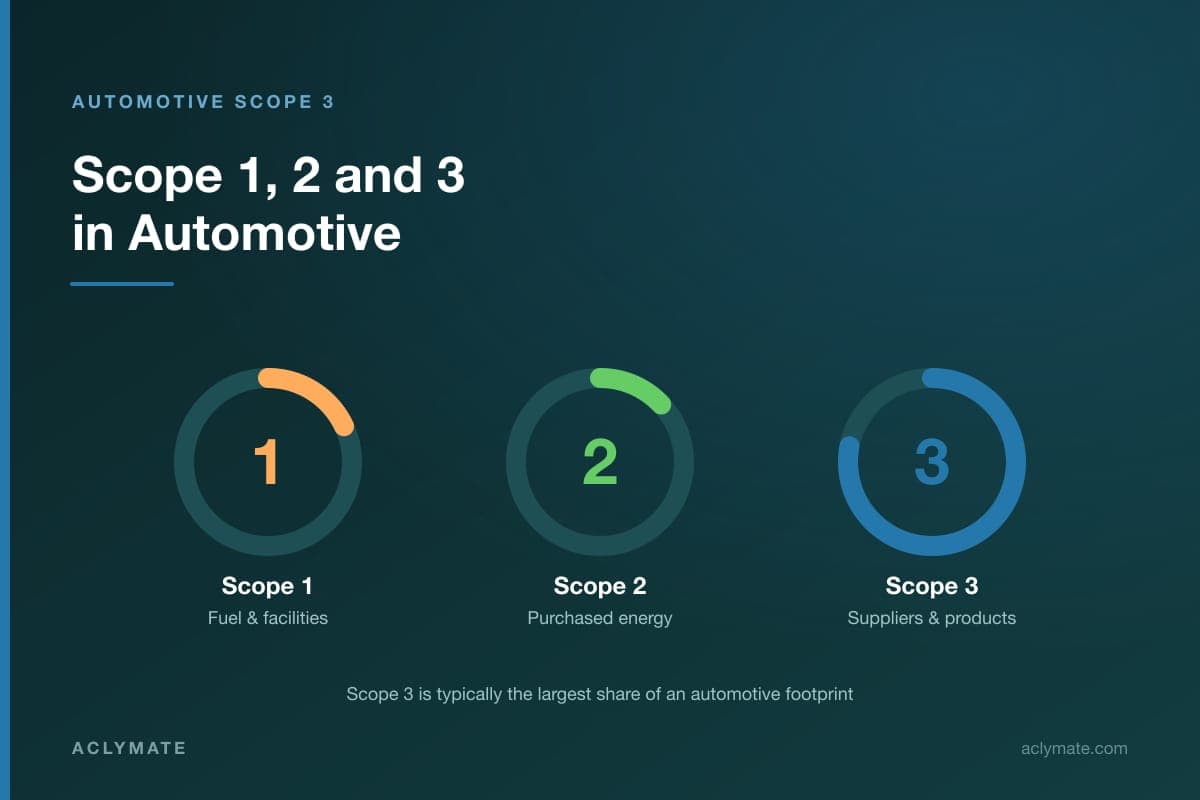
Learn how automotive companies measure Scope 3 emissions, collect supplier data, calculate product footprints, and meet customer reporting requirements.
Read Article
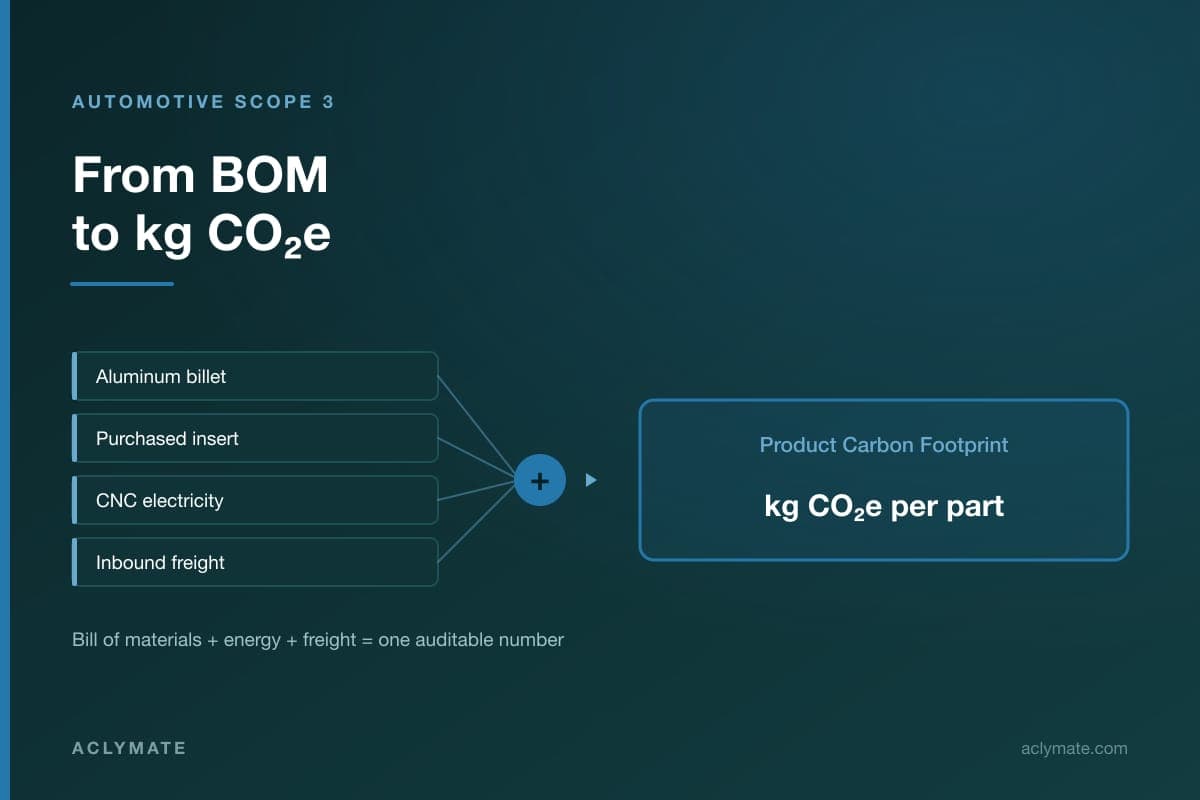
Learn how to calculate the carbon footprint of an automotive part using BOMs, materials, energy, suppliers, manufacturing, and transportation.
Read Article
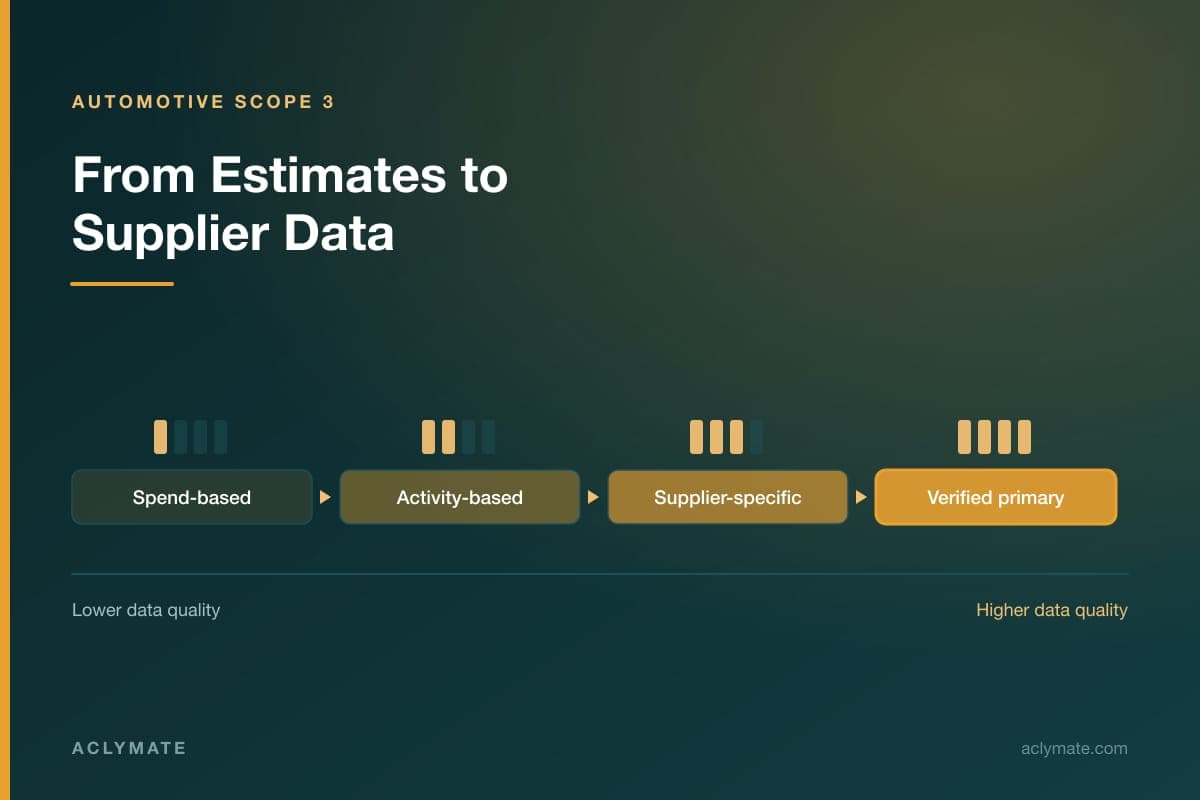
Learn what Scope 3 supplier data automotive companies need, how to collect it, improve data quality, and engage suppliers effectively.
Read Article
Talk with a Sustainability Expert, see a demo, or start free to put the Aclymate platform and experts to work for your team.