← Back to Insights
Aclymate Team
September 1, 2026
7 min read
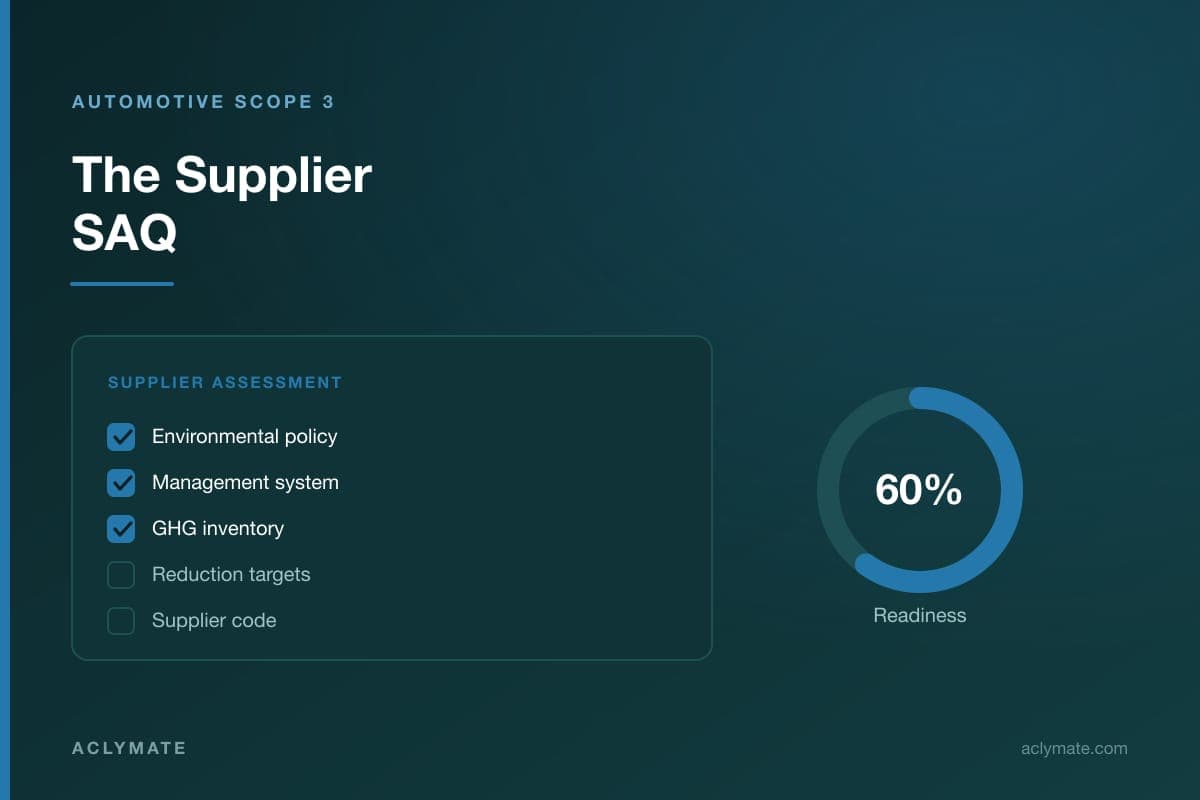
The Sustainability Assessment Questionnaire — the SAQ — is a shared supplier sustainability assessment used across the automotive industry. If a customer has asked you to complete one, this guide covers what it asks, why it exists, and how to prepare without losing a month to it.
The most useful thing to know before you start: the SAQ scores evidence, not intent. Most suppliers approach it as a questionnaire and discover midway that it is really a documentation exercise.
The SAQ is a standardized questionnaire assessing a supplier's sustainability practices across environmental, social, and governance topics.
It is not an audit and it is not a certification. It is a self-assessment supported by uploaded evidence, producing a result your automotive customers can review.
Its distinguishing feature is that it is shared. Multiple automotive customers accept the same assessment, so completing it once can satisfy several relationships rather than one.
The SAQ comes from Drive Sustainability, a partnership of major global automakers working on supply chain sustainability.
It was built explicitly to standardize supplier sustainability assessment and reduce duplicative reporting across participating automotive companies. Drive Sustainability also publishes supplier guidance and a ready-to-use SME version aimed at smaller suppliers. Drive Sustainability: SAQ Toolbox
That origin explains its scope. It is broader than carbon because the automakers behind it are managing supply chain risk across environmental, labor, human rights, and ethics dimensions, not only emissions.
From the buyer's side the logic is simple. A large automotive company may have thousands of suppliers. Assessing each one with a bespoke questionnaire is unmanageable, and every supplier receiving a different form from every customer is an enormous industry-wide waste.
A shared assessment gives buyers comparable results across the supply base and gives suppliers one form instead of twelve.
For suppliers this is genuinely good news, even when the assessment itself is work. The alternative — and the situation many suppliers still face with customers who have not adopted it — is answering the same underlying questions in a different format for each customer.
The assessment spans company information and management systems, environment, labor and human rights, health and safety, business ethics, and supply chain management. Specific content and structure are maintained by Drive Sustainability and change over time, so work from the current version your customer points you to.
This is where most automotive suppliers focus, and it typically touches:
If you have already built a Scope 1 and 2 inventory, much of the carbon portion is answerable. If you have not, this is usually the section that exposes the gap. See automotive supplier sustainability.
Whether you have formal systems with defined responsibilities, objectives, monitoring, and management review — rather than practices that happen to work.
Suppliers already running IATF 16949 for quality will recognize the structure. The discipline transfers directly; it is the subject matter that is new.
Written, approved, dated, and communicated policies across environment, labor, health and safety, and ethics.
The word to notice is written. A company that genuinely treats people well but has never documented a policy scores as though it does not have one.
How you manage your own supply chain: whether you have a supplier code of conduct, communicate expectations, and assess your suppliers.
This catches suppliers by surprise more than any other section. Your customer is not only assessing you — it is checking whether the requirements cascade further down. If you have never sent anything to your own suppliers, this section scores poorly regardless of your own practices.
Emissions data, energy management, reduction activity, and targets. Increasingly the substantive carbon portion rather than a policy question.
Drive Sustainability provides a version aimed at small and medium-sized suppliers, recognizing that a 60-person machine shop cannot reasonably be assessed the same way as a multinational Tier 1.
If you are a smaller supplier, ask your customer which version applies before you begin. Completing the full assessment when the SME version was expected is a considerable waste of effort, and it happens.
The sequence that works, in order:
This inverts how most people approach a questionnaire, and it is the single biggest time-saver. Collect:
Working through this list tells you your likely score before you answer a single question, and shows you exactly which gaps are worth closing first.
Some gaps are structural and take a year. Others are a policy that has never been written down but describes what you already do. Write those before submitting — a few days of drafting can move the result meaningfully.
Scope 1 and Scope 2 for a full reporting year, with boundary and method stated. If you do not have this, it is worth building before submission rather than answering "not calculated." See automotive sustainability reporting.
Do not overclaim. Answers are evidence-backed, and a claim you cannot support is worse than an honest gap — it raises questions about everything else you submitted.
Reassessment comes around. Keep the evidence pack current rather than reassembling it each cycle.
Worth its own section, because it is both a scored item and a lead indicator of what is coming.
The SAQ asks how you manage sustainability in your own supply chain. Practically, a reasonable starting position is:
This is the same pressure you are experiencing, arriving one tier further down. Your suppliers will need lead time, which is an argument for starting earlier rather than when the question is scored.
Supplier & Scope 3 Data Support covers this work.
Some customers require EcoVadis instead of or alongside the SAQ.
They cover similar ground — environment, labor and human rights, ethics, sustainable procurement — and both are documentation-led. The main differences are that EcoVadis is a third-party assessment producing a scorecard used across many industries, while the SAQ is automotive-specific and industry-governed.
The good news is that the evidence pack largely overlaps. Preparing thoroughly for one leaves you substantially prepared for the other. EcoVadis consulting covers that side.
The carbon portion of the SAQ is the part most suppliers cannot answer from existing records, and it is the part Aclymate addresses directly.
See the Automotive & Transportation page, the pillar guide to automotive Scope 3 emissions, or OEM sustainability requirements for how the SAQ fits with everything else customers ask for.
The SAQ is a standardized supplier sustainability self-assessment covering environmental, social, and governance topics, supported by uploaded evidence. It is not an audit or a certification. Its defining feature is that multiple automotive customers accept the same assessment, so completing it once can satisfy several customer relationships rather than one.
Drive Sustainability, a partnership of major global automakers working on supply chain sustainability. It was created specifically to standardize supplier sustainability assessment and reduce duplicative reporting across participating automotive companies. Drive Sustainability also publishes supplier guidance and an SME version aimed at smaller suppliers.
What it can prove. The SAQ is evidence-led, so a company with genuinely good practices but no written, dated, approved documentation scores as though those practices do not exist. This is why assembling the evidence pack before answering questions saves substantial time and produces a better result.
Yes. Drive Sustainability provides an SME version recognizing that a 60-person machine shop cannot reasonably be assessed the same way as a multinational Tier 1. Ask your customer which version applies before starting, since completing the full assessment when the SME version was expected wastes considerable effort.
Environmental, health and safety, ethics, and labor policies, all signed and dated. A supplier code of conduct. ISO 14001, ISO 45001, and IATF 16949 certificates if held. Emissions data with methodology. Energy consumption records. Training records, incident and corrective action records, and management review minutes.
Because your customer is checking whether sustainability requirements cascade further down the chain, not just whether you meet them. If you have never issued a supplier code of conduct or communicated expectations to your own suppliers, this section scores poorly regardless of how good your internal practices are.
Both cover similar ground across environment, labor and human rights, ethics, and procurement, and both are documentation-led. EcoVadis is a third-party assessment producing a scorecard used across many industries, while the SAQ is automotive-specific and industry-governed. The underlying evidence pack overlaps substantially between them.
Answering the questions before gathering evidence. It roughly doubles the work, because answers then have to be revisited when supporting documents turn out not to exist. Working through the evidence list first reveals your likely score in advance and shows exactly which gaps are cheap enough to close before submitting.
Get Aclymate's practical sustainability content delivered weekly.
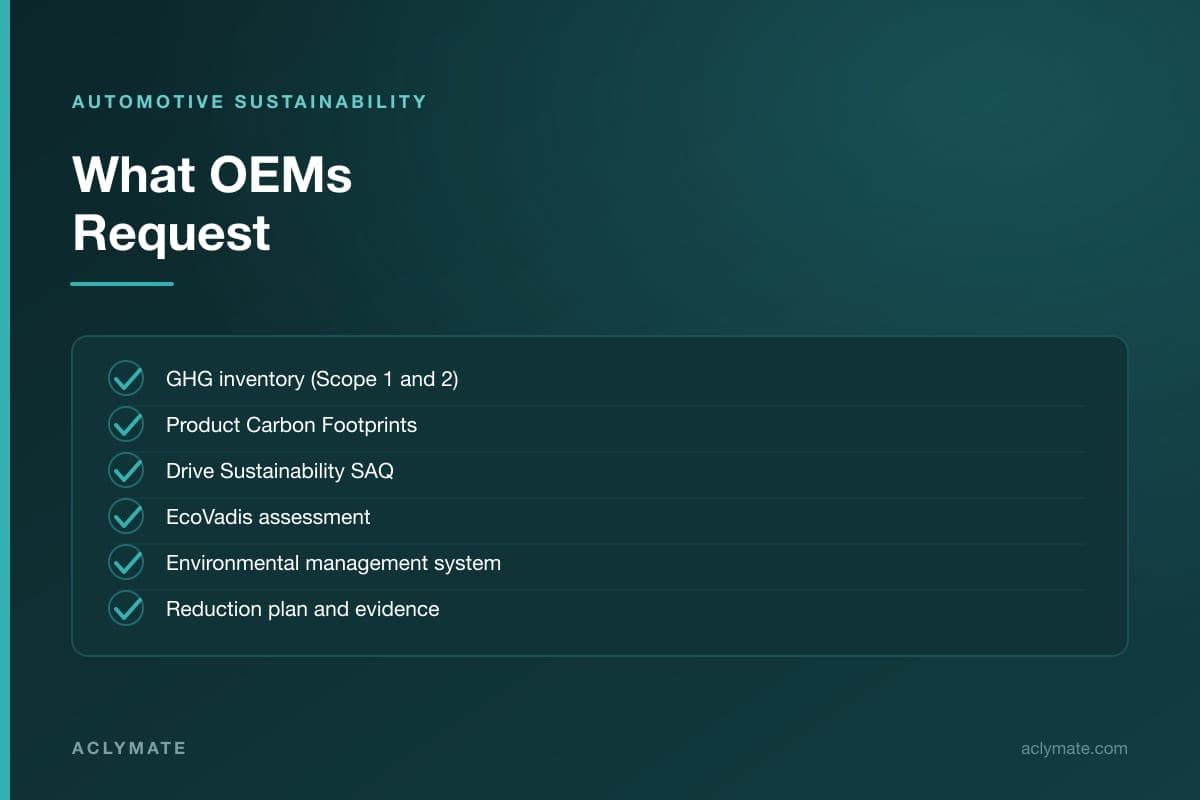
Understand the sustainability information automotive OEMs may request from suppliers, including emissions, PCFs, questionnaires, EcoVadis, and reporting.
Read Article
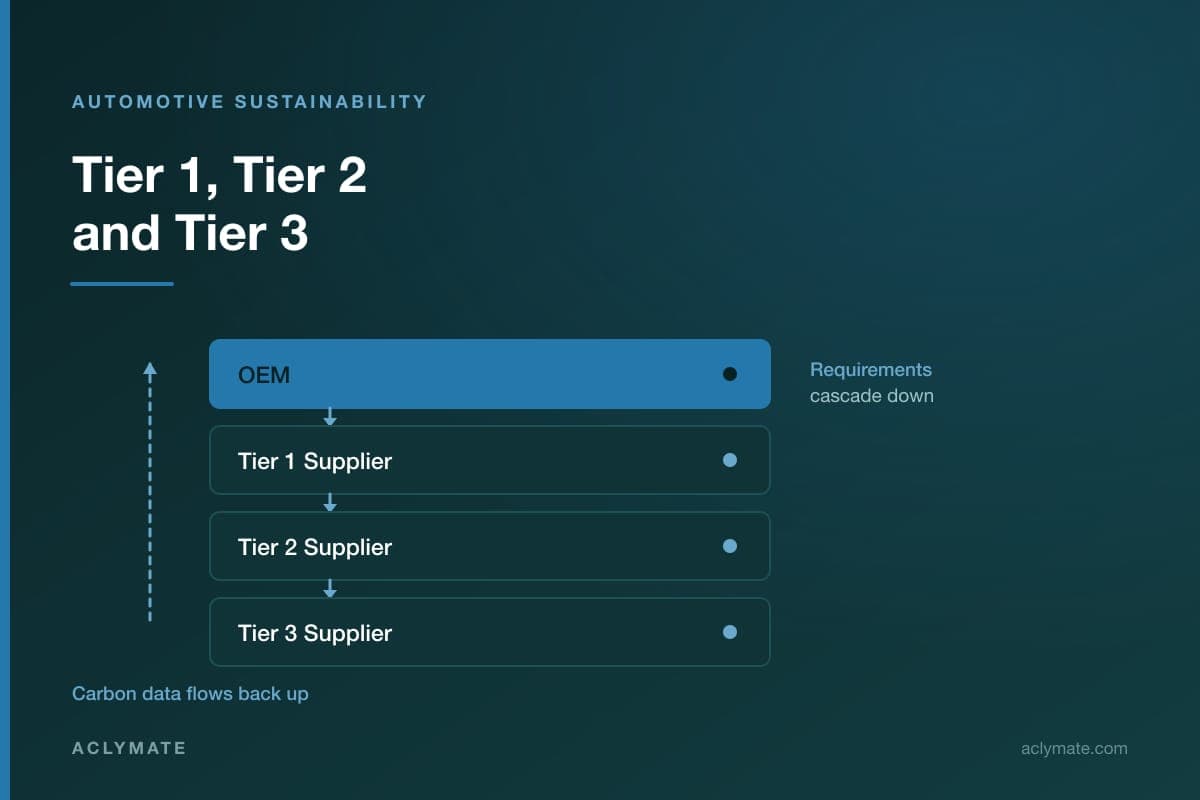
A practical sustainability guide for automotive suppliers covering emissions, Scope 3, customer requests, product footprints, questionnaires, and reporting.
Read Article
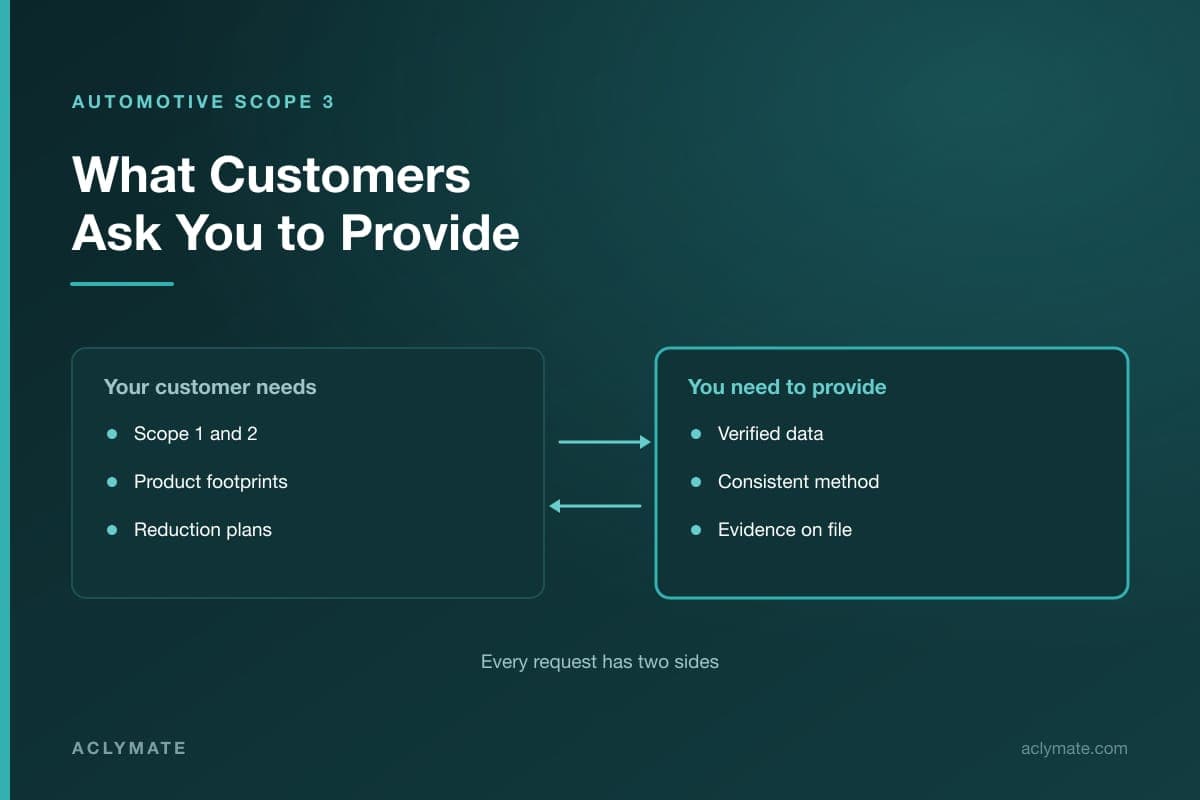
Learn what emissions and sustainability information automotive OEMs and customers may request from suppliers and how to prepare.
Read Article
Talk with a Sustainability Expert, see a demo, or start free to put the Aclymate platform and experts to work for your team.