← Back to Insights
Aclymate Team
August 28, 2026
7 min read
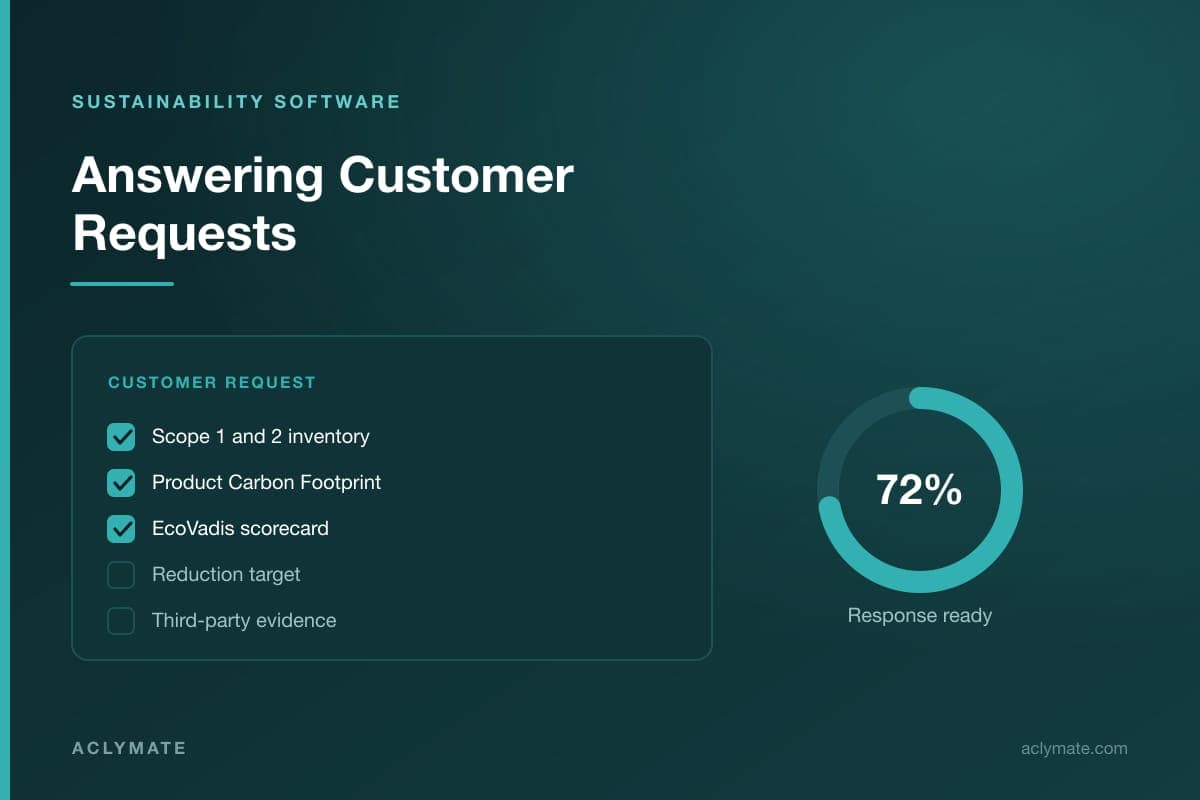
Most sustainability software is built around producing your own report, on your own schedule, in your own format.
That is not the automotive supplier's problem. A supplier reports when a customer asks, against the customer's boundary, in the customer's units, to the customer's deadline — and different customers ask for different things.
This guide covers what reporting software needs to do for that situation, which is a narrower and more specific requirement than "sustainability reporting" generally implies.
Before evaluating software, it helps to separate what looks like one job into four.
They share underlying data but differ in boundary, format, and audience. Software that handles the first well and the other three badly is common, and it is the wrong shape for a supplier — because for most suppliers the other three are the actual workload.
See automotive sustainability reporting for the distinctions in detail.
The single most useful capability.
Customer A wants calendar-year Scope 1 and 2 for the site that makes their parts. Customer B wants fiscal-year data for the whole company, market-based Scope 2, plus purchased goods. Customer C wants a cradle-to-gate footprint for three part numbers.
These are three views of one dataset. Software that can produce them by reconfiguring the boundary turns three weeks of work into an afternoon. Software that stores only finished outputs forces three separate rebuilds.
The requirement underneath this: the system must retain inputs, not just results. Every other capability in this guide depends on it.
Customers ask at different levels of granularity:
Site-level is the one general carbon software most often handles poorly. A multi-site supplier asked "what are the emissions of the plant that makes our component?" cannot answer with a consolidated corporate figure.
A number without context cannot be used by the recipient, because they need to place it inside their own inventory.
Every export should carry:
This is not administrative overhead. Their public disclosure depends on the quality of what you send, so they have reason to check — and increasingly they do.
Assessments and many customer requests are documentation exercises as much as data exercises.
The pack that answers most of what arrives:
The value of holding this in the reporting system rather than a shared drive is that it stays current and versioned. An expired certificate submitted to an assessment is a scored failure, and it is an entirely avoidable one.
Underrated, and cheap to provide.
Customer requests repeat annually, usually with the same boundary and format. Knowing exactly what you sent this customer last year — which sites, which period, which method, which figures — converts an annual research project into an update.
It also protects you. When a customer questions a year-over-year change, being able to show precisely what was submitted previously and why it moved is the difference between a short conversation and a long one.
Be skeptical of software claiming to complete assessments for you.
The Drive Sustainability SAQ and EcoVadis score uploaded evidence across policies, management systems, human rights, health and safety, business ethics, and supply chain management. Most of that is not carbon data and does not live in a carbon tool. Drive Sustainability: SAQ Toolbox
What software realistically contributes:
That is genuinely useful. It is not the same as automated completion, and a vendor implying otherwise is worth pressing on. See the SAQ guide and EcoVadis consulting.
Customers increasingly ask how reliable a figure is, not just what it is.
Label each input as measured, supplier-provided, calculated, or estimated, and report primary-data share. An honest mix is more credible than uniform confidence — a first-year supplier inventory presented as fully measured invites scrutiny it will not survive.
Not assurance-grade governance, which most suppliers do not need. Just the ability to answer: how was this number produced, from what inputs, using which factors, on what date?
The question arrives eighteen months later, usually from a customer, and usually after the person who built the original calculation has moved on. A system that retains inputs answers it in minutes. A spreadsheet does not answer it at all.
Worth stating as a requirement rather than a preference.
At most automotive suppliers, whoever owns sustainability reporting also runs quality, EHS, or finance. Software requiring weekly attention will be abandoned, and an abandoned system is worse than none — because the next request finds stale data that looks current.
Practical markers: data imports rather than manual entry, a refresh cycle measured in hours per quarter, and defaults that are sensible without configuration.
The recurring theme across this cluster, and it applies here specifically.
Reporting questions that stall suppliers are rarely about the software: what boundary does this customer mean, is this answer defensible, should I report the estimate or say we do not have it, how do I explain a number that moved.
For a supplier without sustainability staff, someone to ask is often worth more than a feature. Reporting support and supply chain sustainability consultants cover this.
See the six-platform comparison, the buyer's guide, or the Automotive & Transportation page.
Suppliers do not report on their own schedule or in their own format. A customer asks, against the customer's boundary, in their units and period, to their deadline — and different customers ask for different things. Most sustainability software is built around producing your own report, which is the wrong shape for that.
Recalculation against someone else's boundary without rebuilding the underlying data. Three customers asking for different periods, scopes, sites, and Scope 2 methods are three views of one dataset. Software retaining inputs rather than only finished outputs turns three weeks of work into an afternoon.
Because customers frequently want the emissions of the specific facility that produces their parts, not a consolidated corporate figure. A multi-site supplier cannot answer that question from a company total, and site-level breakdown is the capability general carbon accounting software most often handles poorly.
Reporting period and organizational boundary, scopes and categories included and excluded, the Scope 2 method used, emissions factor sources and versions, and data quality per line. For product footprints, also declared unit, system boundary, primary-data share, and allocation method. Without this the recipient cannot use the number.
No, and claims otherwise are worth pressing on. These assessments score uploaded evidence across policies, management systems, human rights, health and safety, ethics, and supply chain management — most of which is not carbon data. Software realistically contributes the carbon sections, methodology documentation, and an organized evidence pack.
Because requests repeat annually with the same boundary and format, so knowing exactly what was sent last year converts a research project into an update. It also protects you: when a customer questions a year-over-year change, showing precisely what was submitted before and why it moved shortens the conversation considerably.
Because at most automotive suppliers, whoever owns sustainability reporting also runs quality, EHS, or finance. Software needing weekly attention gets abandoned, and an abandoned system is worse than none, since the next request finds stale data that looks current. Look for imports over manual entry and hours per quarter, not per week.
Not assurance-grade governance, which most suppliers do not require. Just the ability to answer how a number was produced, from what inputs, using which factors, on what date. That question typically arrives eighteen months later from a customer, often after the person who built the original calculation has left.
Get Aclymate's practical sustainability content delivered weekly.
Learn what a sustainability consultant does, how they help businesses manage ESG, carbon accounting, reporting, certifications, and sustainability strategy.
Read Article

Learn how an outsourced sustainability department helps growing businesses manage carbon accounting, reporting, certifications, customer requests, and climate strategy.
Read Article
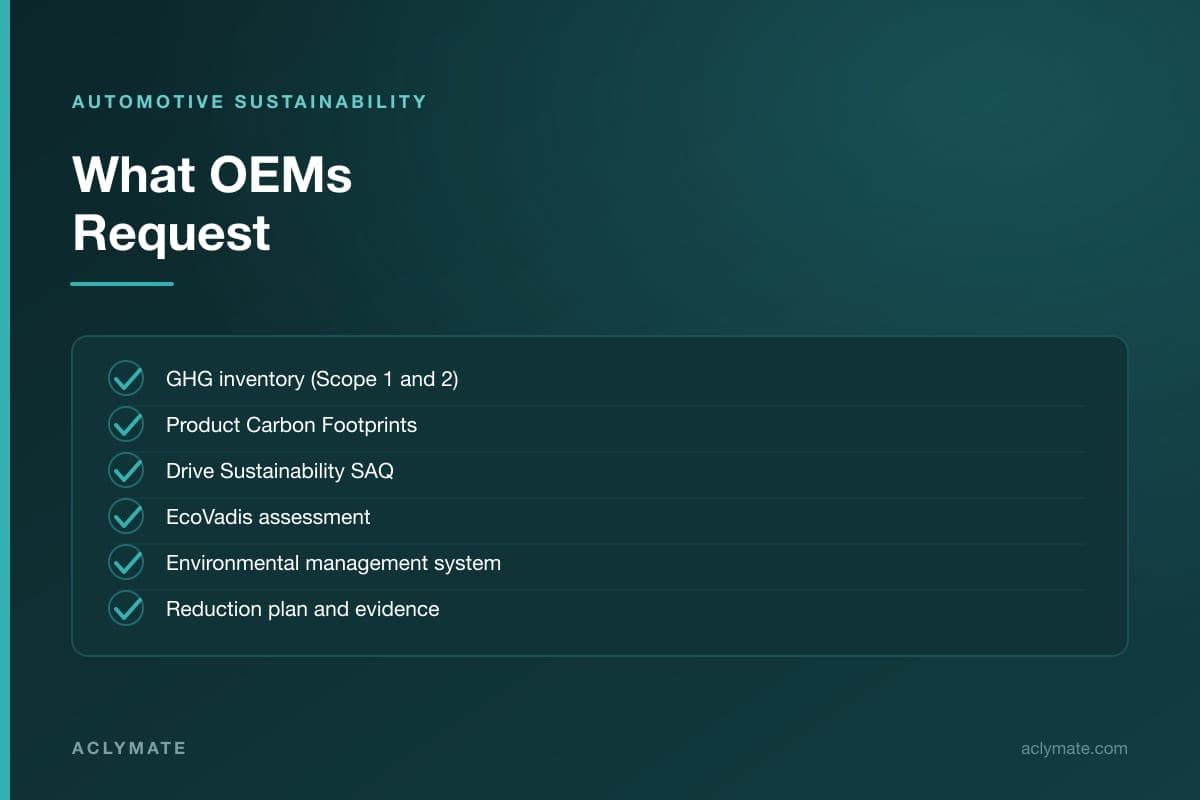
Understand the sustainability information automotive OEMs may request from suppliers, including emissions, PCFs, questionnaires, EcoVadis, and reporting.
Read Article
Talk with a Sustainability Expert, see a demo, or start free to put the Aclymate platform and experts to work for your team.