← Back to Insights
Aclymate Team
September 18, 2026
9 min read
If you supply the automotive industry and sustainability requirements are arriving faster than you can answer them, the question is not which platform has the most features. It is: what kind of software do we actually need?
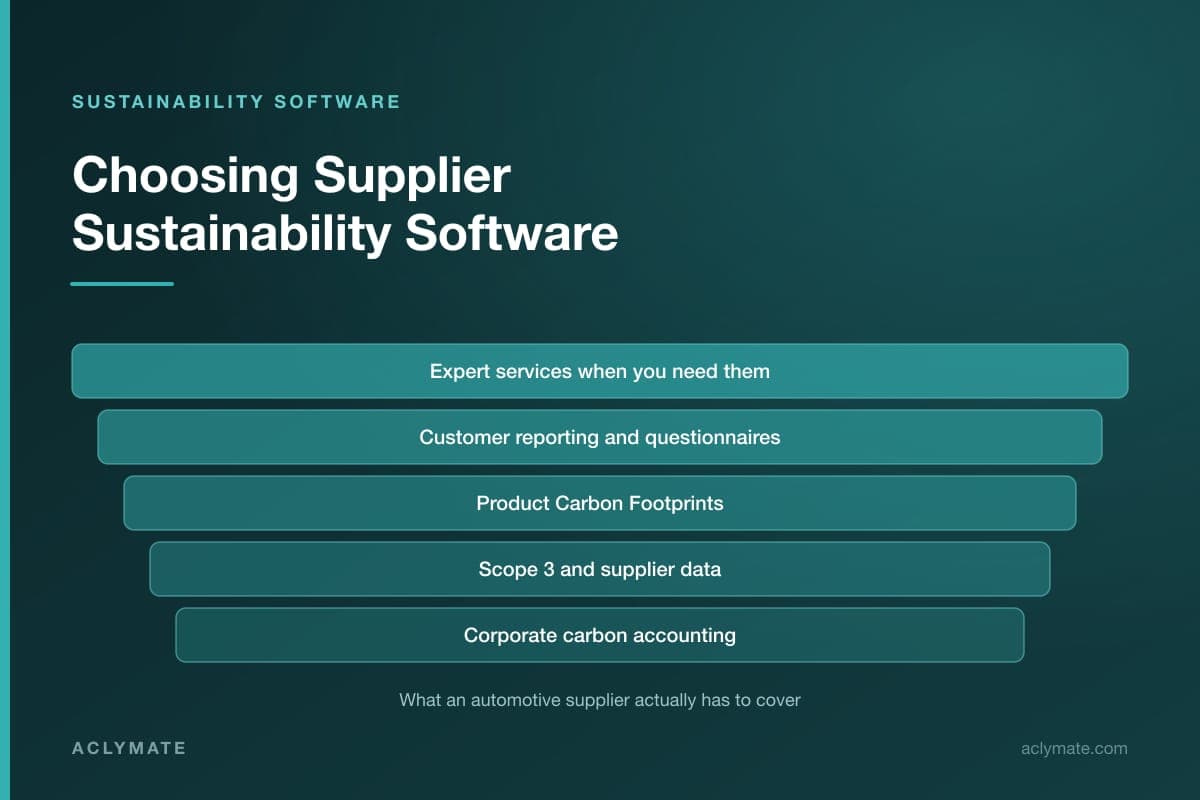
This guide works through that question in six parts — what you have to manage, which capabilities matter, whether you need corporate or product carbon accounting or both, how much Scope 3 capability you need, what customer reporting requires, and when software alone is not enough.
It deliberately does not rank vendors. That comparison sits in six platforms compared. This guide is about defining your requirement before you evaluate anyone against it.
Start by listing what is actually being asked of you, because the answer varies enormously between suppliers and it determines everything downstream.
The common requests:
Two questions sharpen this considerably:
How many customers are asking, and do they want the same things? One customer asking annually is a manageable manual task. Four customers asking for different boundaries in different formats is a systems problem.
Are you being asked about parts, or only about the company? This is the biggest fork in the road. Corporate-only requirements can be met with general carbon accounting software. Part-level requirements cannot.
See OEM sustainability requirements for the detail on each item.
Working from the requirement list, the capability set breaks into five layers.
Scope 1, 2, and 3 from operational data. Multi-site if you run more than one facility. Both location-based and market-based Scope 2 if you buy any renewable energy. Factor versioning, so you can explain a number you reported last year.
BOM-based calculation on purchased mass, configurable boundaries, documented energy allocation, scrap and yield handling, inbound freight.
Somewhere to request, track, validate, and store what your own suppliers send you — because your Scope 3 and your PCFs both depend on it.
Export at company, site, and part level. Recalculation against a customer's boundary. A maintained evidence pack.
Targets, initiatives, owners, and progress — the layer that turns measurement into something you can report as a plan.
One cross-cutting requirement matters more than any individual feature: the system must retain inputs, not just results. Customers ask how numbers were derived, factors update annually, and boundaries differ between customers. Software that stores only outputs forces a rebuild every time any of those happens.
This is the decision that most affects cost and complexity, and it is worth being deliberate about.
Corporate only is sufficient if customers are asking for company emissions, energy data, and questionnaires, and nobody has asked about a specific part number. Plenty of suppliers are still here.
PCF capability is required as soon as a customer asks for a part-level footprint — and the trajectory across the industry is clearly in that direction. AIAG is running PCF education specifically for suppliers who have received these requests or expect to. AIAG: Product Carbon Footprint
Almost everyone eventually needs both, and they should live in the same system. Here is why that matters practically: a good consistency check is that your part footprints, summed across annual volume plus scrap, should land in similar territory as the relevant part of your corporate inventory. If the two are calculated in separate tools with separate factors, you cannot run that check — and you will not notice when one of them is wrong.
The practical advice: if part-level requests have not arrived yet but your customers are OEM-facing, choose something that can add PCF without a migration. Replatforming a year in is expensive.
See PCF software for automotive suppliers.
More important than most suppliers initially expect, for a reason that is easy to miss.
You are not only a supplier. You are also a buyer, and your materials carry embedded emissions that show up in two places: your own Scope 3, and every Product Carbon Footprint you produce.
That means the moment you start doing PCFs, you are on the requesting side of the same problem your customer has. Your primary-data share — a figure customers increasingly ask about — depends on whether your own suppliers can give you real numbers.
What you need:
How much of this you need scales with how much you purchase. A supplier buying a few commodity materials needs less than one assembling purchased components. See Scope 3 software for automotive suppliers.
This is where suppliers lose the most time, and where software help is most uneven.
The structural problem: you do not report on your own schedule or in your own format. A customer asks, with their boundary, their units, their period, and a deadline.
What genuinely helps:
On questionnaires, be skeptical of claims that software completes them. The SAQ and EcoVadis score uploaded evidence across policies, management systems, human rights, and supply chain management — most of which is not carbon data and does not live in a carbon tool. Drive Sustainability: SAQ Toolbox
What software realistically contributes is the carbon section and the organized evidence that turns the assessment into assembly rather than research. See the SAQ guide and reporting software.
The honest framing: software solves calculation. Most automotive suppliers' actual problem is interpretation.
The questions that stall suppliers are not "how do I enter this data." They are:
None of these are software questions. They are experience questions, and a large share of the automotive supply base — companies of 30 to 300 people, with the request sitting on a quality manager's desk — has nobody with that experience in-house.
The case for services is strongest when it is your first inventory or first PCF, when a request uses unfamiliar terminology, when a customer has challenged a previous submission, when an assessment is due and nobody has run one before, or simply when the person who owns this also has a full-time job.
See software versus consulting for automotive suppliers.
Three rough profiles:
Early — one customer, corporate emissions only. You need a straightforward Scope 1 and 2 inventory, a labelled Scope 3 estimate, and an evidence pack. Keep it light, but pick something that can grow.
Active — several customers, PCF requests started. You need corporate and product carbon in one system, supplier data collection, boundary-flexible export, and probably expert help for the first few PCFs. This is where most automotive suppliers currently are.
Mature — many customers, many part numbers, formal targets. You need everything above plus program management, data quality tracking, and the ability to recalculate a whole part portfolio when factors change.
The first two questions separate automotive-capable software from general carbon accounting tools more reliably than any feature list.
Several platforms serve this market from different directions. CircularTree focuses tightly on PCF calculation and Catena-X exchange. iPoint brings deep automotive material compliance and LCA. Manufacture 2030 works on OEM-led supplier decarbonization programs. Sphera offers enterprise-grade LCA and supplier engagement. EcoVadis runs a supplier assessment network. Aclymate combines corporate and product carbon with supplier data, reporting, and expert services for lean teams.
Which fits depends on the requirement you defined above — which is why it is worth defining first.
Read the full six-platform comparison →
Aclymate is built for the middle profile above: suppliers with real requirements arriving, and no sustainability department to meet them.
See the Automotive & Transportation page, or pricing.
Corporate carbon accounting across Scope 1, 2, and 3, BOM-based Product Carbon Footprint calculation, supplier data collection, boundary-flexible customer reporting, and program management. The cross-cutting requirement is that the system retains inputs rather than only results, since customers ask how numbers were derived and emissions factors update annually.
Corporate alone is sufficient if no customer has asked about a specific part number. PCF becomes necessary as soon as one does, and the industry is clearly moving that way. Most suppliers eventually need both, ideally in one system so part footprints can be reconciled against the corporate inventory.
Because it enables a consistency check. Part footprints summed across annual volume plus scrap should land in similar territory as the relevant portion of the corporate inventory. If the two are calculated in separate tools with separate emissions factors, that check is impossible and errors go unnoticed.
More than most expect, because a supplier is also a buyer. Purchased materials appear in your own Scope 3 and in every Product Carbon Footprint you produce. Your primary-data share depends on whether your suppliers can give you real numbers, so the requirement scales with how much you purchase.
Not really, and claims that it can are worth probing. The SAQ and EcoVadis score uploaded evidence across policies, management systems, human rights, and supply chain management, most of which is not carbon data. Software realistically contributes the carbon section and organized evidence that turns the assessment into assembly rather than research.
When the blocking questions are interpretation rather than data entry: what a customer is actually asking for, which boundary applies, whether an allocation method is defensible, and whether an answer is good enough to send. Those are experience questions, and most suppliers under 300 people have nobody with that experience internally.
Two separate automotive-capable tools from general ones: can I see a Product Carbon Footprint built from a bill of materials using purchased mass, and when an emissions factor updates, what happens to parts already calculated? Also ask what an export contains besides the number, and who you talk to for interpretation questions.
Not necessarily buy it, but choose software that can add it without a migration. If your customers are OEM-facing, part-level requests are a matter of when rather than whether, and replatforming a year into a carbon program is considerably more expensive than selecting for it upfront.
Get Aclymate's practical sustainability content delivered weekly.
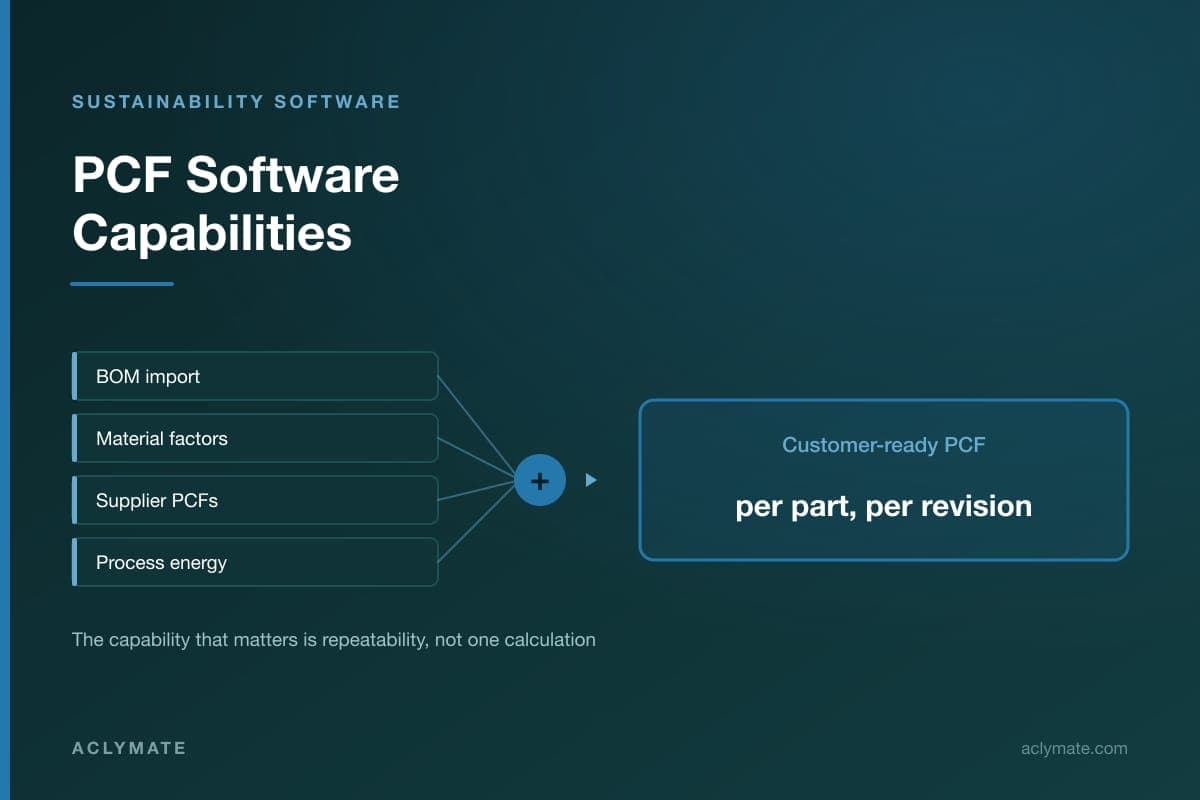
Learn what automotive suppliers should look for in Product Carbon Footprint software, including BOM data, supplier emissions, cradle-to-gate calculations, and customer reporting.
Read Article
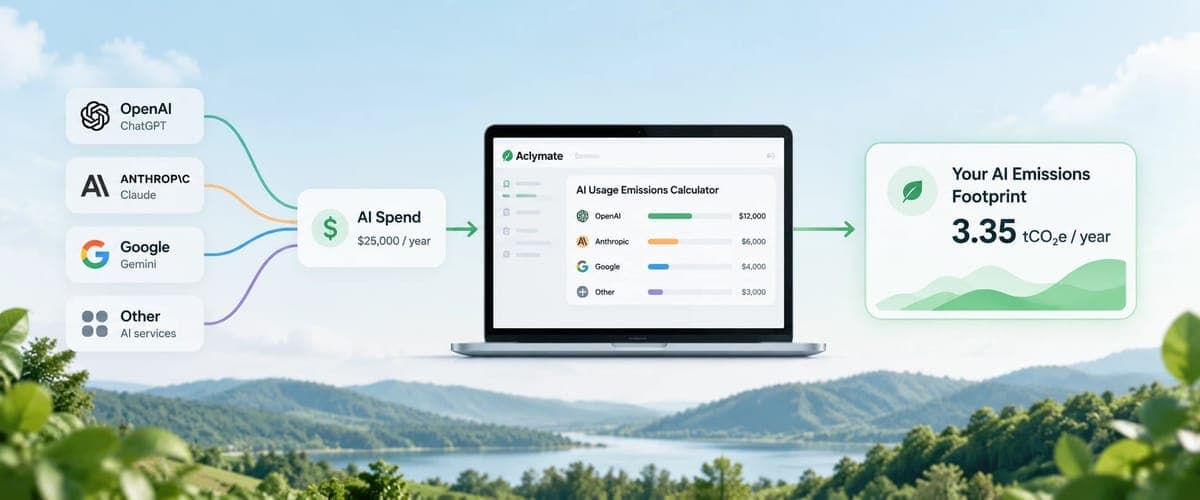
AI carbon emissions are becoming a new consideration for companies adopting ChatGPT, Claude, Gemini, Copilot and other artificial intelligence tools. Here’s how Aclymate estimates the carbon emissions from a company’s AI usage today—and how we expect the methodology to improve as AI providers release better usage and emissions data.
Read Article
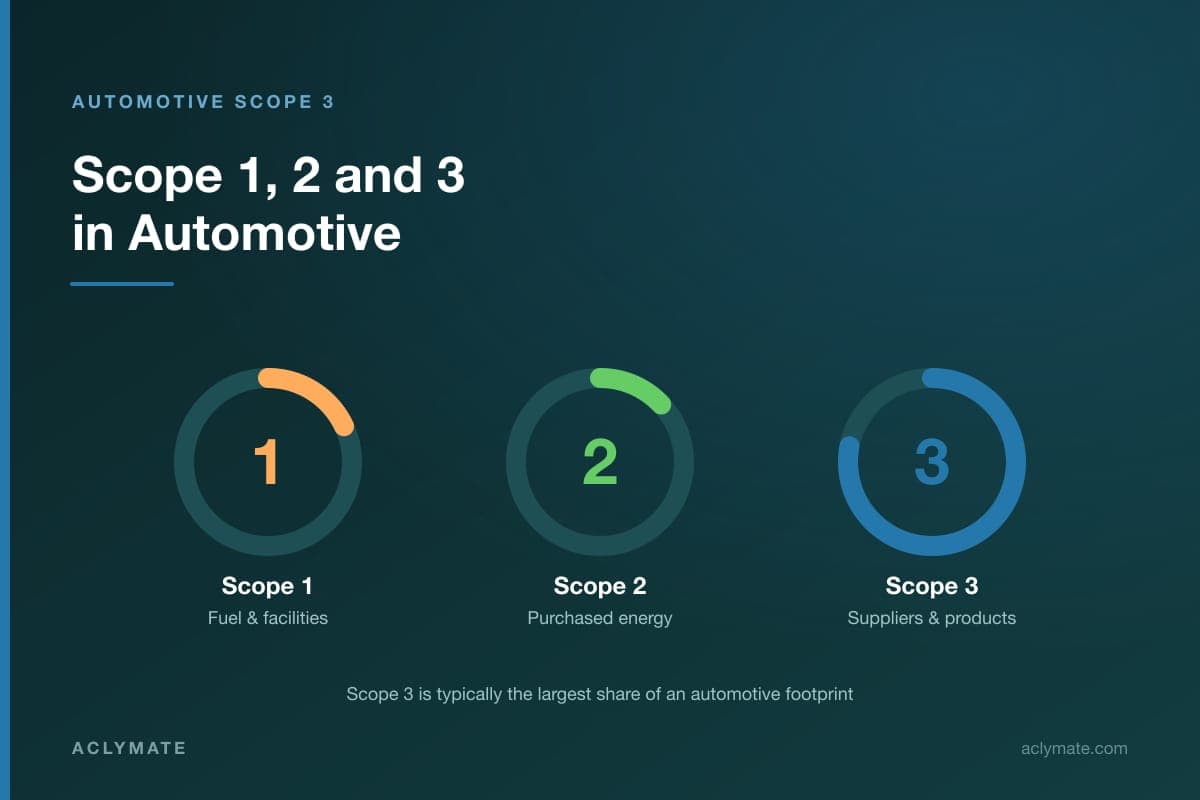
Learn how automotive companies measure Scope 3 emissions, collect supplier data, calculate product footprints, and meet customer reporting requirements.
Read Article
Talk with a Sustainability Expert, see a demo, or start free to put the Aclymate platform and experts to work for your team.