← Back to Insights
Aclymate Team
August 26, 2026
7 min read
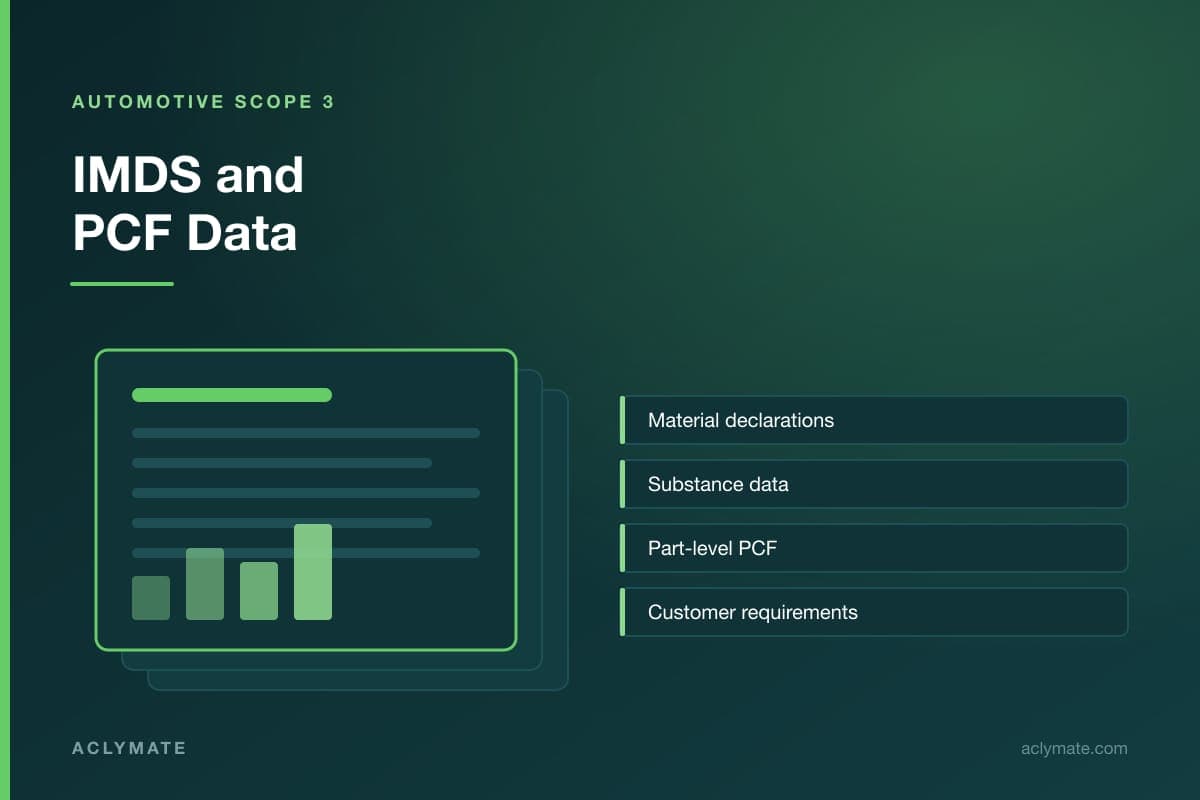
Automotive suppliers have reported material and substance data through IMDS for years. Carbon data is now starting to connect to that same workflow — which raises an obvious and important question.
If you already declare the materials in a part, does the system calculate its carbon footprint for you?
No. And understanding why not is the most useful thing in this article, because it determines what work remains yours.
The International Material Data System is the automotive industry's shared system for reporting the material composition of parts.
Suppliers submit material data sheets describing what a component is made of, down to substance level. Those declarations roll up the supply chain: a Tier 2 supplier's declaration feeds a Tier 1 assembly declaration, which feeds the OEM's view of the whole vehicle.
Its original purpose was regulatory — substance restrictions, recyclability, and end-of-life obligations. It is the established mechanism by which material information already travels between automotive tiers.
Which is precisely why carbon data is being connected to it: the plumbing exists.
The logic is straightforward. A Product Carbon Footprint depends heavily on material composition and mass — and IMDS already carries material composition and mass, declared by the supplier who actually knows it, flowing along the same supplier-to-customer relationships.
Building an entirely separate channel for carbon data would mean recreating a network that already exists and works.
AIAG has been working to help suppliers understand the relationship between PCF data and IMDS, and describes PCF integration as a significant shift for the industry. AIAG: Product Carbon Footprint
Material data gets you part of the way to a footprint, and it is worth being precise about which part.
What material data provides:
What it does not provide:
That third point is the one that catches suppliers out. A material declaration says the bracket contains 1.4 kg of aluminum. The carbon footprint depends on the 4 kg billet that was purchased, smelted, and freighted to produce it. The declaration is accurate and it is not the number the footprint needs.
AIAG makes this point directly: actual PCF calculation requires inputs beyond aggregating supplier-reported values, including the supplier's own internal processing and waste.
Put concretely, for our machined bracket:
Only the first line comes from the material system. Everything else comes from your operations, and no external system can know it.
The practical consequence: a material data system can carry, structure, and transmit PCF data. It cannot generate the parts of the calculation that depend on what happens inside your plant.
Conceptually the flow works like this:
The important structural point is the order. Calculation comes first and happens at your end. Reporting is downstream of it.
Suppliers who assume the reporting system will produce the number tend to discover the gap late, usually with a customer deadline already set.
Because the calculation is yours, the capability you need is a calculation capability, not just a reporting one.
That means holding:
See how to calculate a PCF for an automotive part for the step-by-step method, and the Product Footprint Pack for holding this structure.
IMDS and Catena-X address different halves of the same problem, and they are complementary rather than competing.
Catena-X focuses on harmonizing how a PCF is calculated and exchanged, so that numbers from different suppliers are comparable. Catena-X: Product Carbon Footprint
IMDS is the established channel through which part-level data already moves between automotive tiers.
For a supplier, the useful implication is the same from both directions: hold the underlying inputs rather than only the final number, so a footprint can be recalculated against whichever methodology a customer specifies. See Catena-X Product Carbon Footprints.
Requirements differ by customer and are still developing. Rather than assuming, ask your customer's supplier development or purchasing contact:
Asking these questions early is not a sign of unpreparedness. It prevents producing a technically sound footprint against the wrong boundary, which is a common and expensive mistake.
Whatever channel the data eventually travels through, the underlying record you need is the same:
Most of this already exists in ERP, MRP, quality, and purchasing systems. The work is usually connecting it rather than creating it.
Three differences worth internalizing:
It is a calculation, not a declaration. Material reporting describes what is in a part, which you know. A PCF computes a value from inputs, several of which come from your own operations and require methodological choices.
It changes more often. Material composition is stable until the part is redesigned. A footprint changes when a supplier changes, an emissions factor updates, your grid mix shifts, or your yield improves.
It carries uncertainty. Material composition is a fact. A carbon footprint is an estimate with a stated data quality, which is why methodology and primary-data share travel with it.
That last difference is the biggest adjustment for quality teams used to declarations being simply correct or incorrect.
See the Automotive & Transportation page, automotive Scope 3 emissions for the pillar guide, or automotive Product Carbon Footprints.
No. AIAG has been explicit that PCF calculation requires inputs beyond aggregating supplier-reported values, including the supplier's own internal processing energy and waste. A material data system can carry, structure, and transmit PCF data, but it cannot generate the parts of the calculation that depend on what happens inside your plant.
Because a Product Carbon Footprint depends heavily on material composition and mass, and IMDS already carries that information, declared by the supplier who knows it, flowing along established supplier-to-customer relationships. Building a separate channel for carbon data would mean recreating a network that already exists and works.
It provides which materials are in the part, how much of each by mass, and assembly structure. It does not provide the production route of each material, your own process energy, scrap and yield, inbound freight, or shared facility emissions. Crucially, it describes the finished part rather than what was purchased.
Because the footprint follows what was produced and bought, not what shipped. A material declaration may correctly state a bracket contains 1.4 kg of aluminum, while the carbon footprint depends on the 4 kg billet that was smelted, freighted, and machined. The declaration is accurate but is not the figure the calculation needs.
They address different halves of the same problem and are complementary. Catena-X focuses on harmonizing how a PCF is calculated and exchanged so numbers from different suppliers are comparable. IMDS is the established channel through which part-level data already moves between automotive tiers.
Which parts need footprints and by when, which boundary applies, which declared unit, which methodology or calculation rules, through which channel to submit, what data-quality or primary-data expectations apply, and how often the figure must be refreshed. Asking early prevents producing a sound footprint against the wrong boundary.
Three ways. A PCF is a calculation rather than a declaration, computed from inputs requiring methodological choices. It changes more often, since suppliers, emissions factors, grid mix, and yield all shift. And it carries stated uncertainty rather than being simply correct or incorrect, which is an adjustment for quality teams.
Purchased material masses per part, material grade and production route where mill certificates allow, energy consumption ideally submetered, cycle times and production volumes, scrap and yield rates, inbound freight lanes with mode and distance, supplier PCFs with their boundaries and units, and emissions factor sources with versions.
Get Aclymate's practical sustainability content delivered weekly.
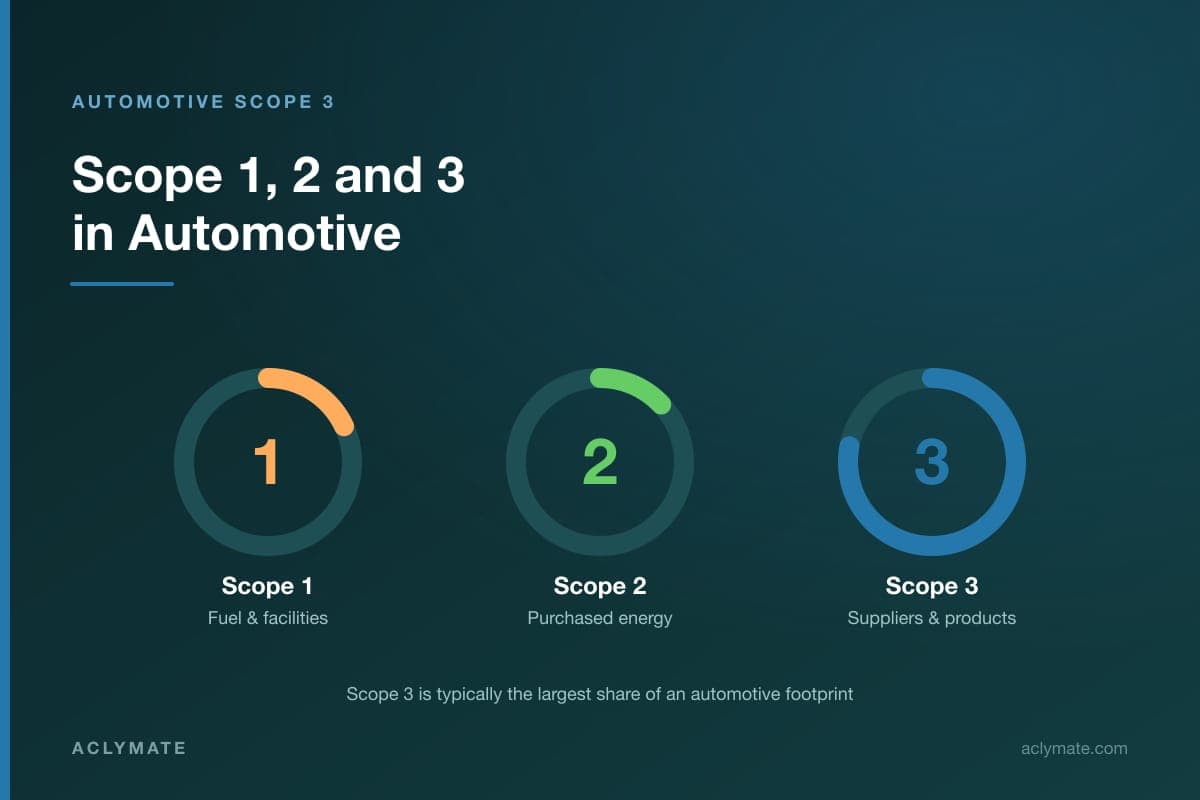
Learn how automotive companies measure Scope 3 emissions, collect supplier data, calculate product footprints, and meet customer reporting requirements.
Read Article
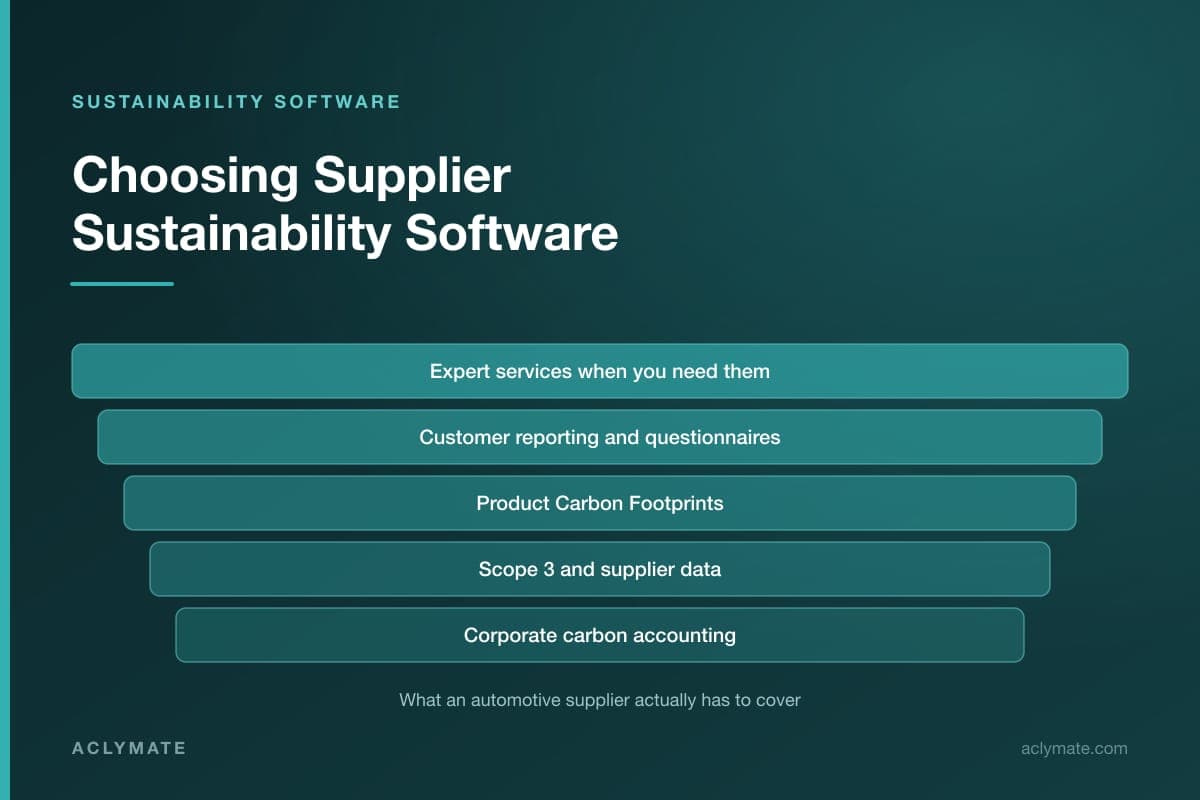
Learn how to choose automotive sustainability software for carbon accounting, Scope 3 supplier data, product footprints, customer reporting, and sustainability management.
Read Article
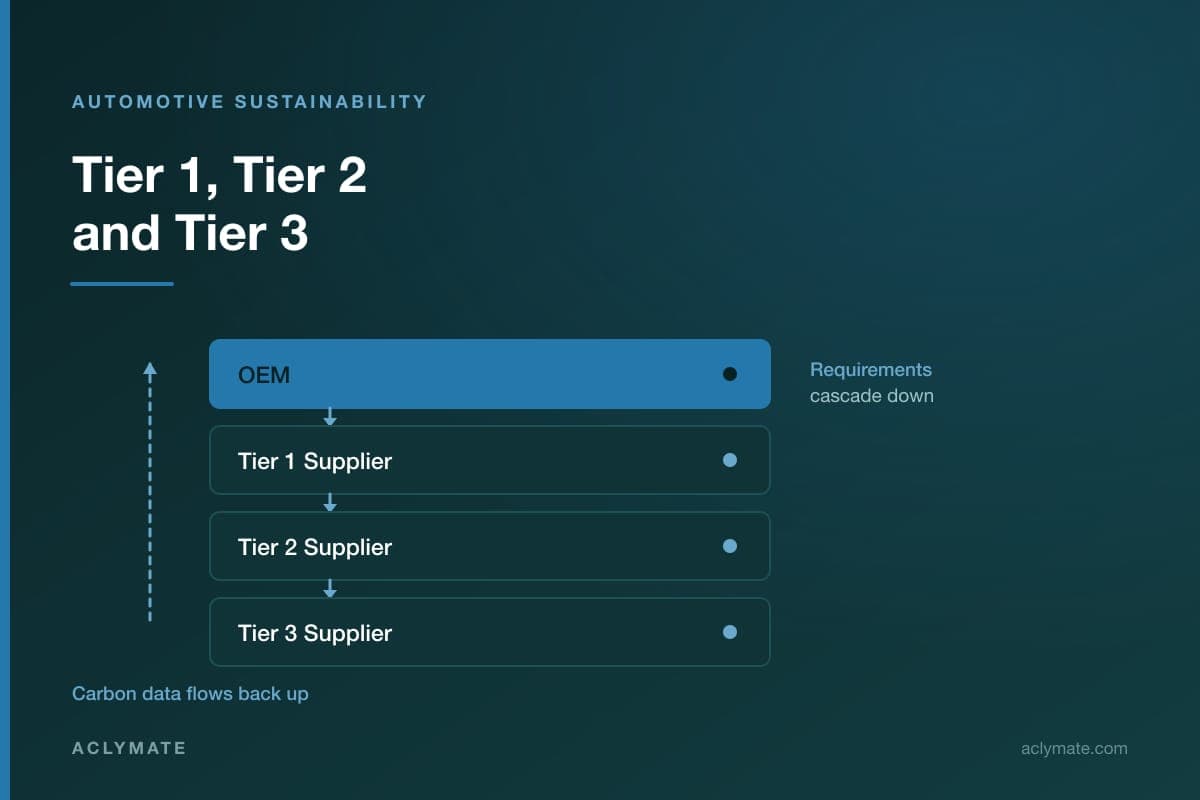
A practical sustainability guide for automotive suppliers covering emissions, Scope 3, customer requests, product footprints, questionnaires, and reporting.
Read Article
Talk with a Sustainability Expert, see a demo, or start free to put the Aclymate platform and experts to work for your team.