← Back to Insights
Aclymate Team
September 8, 2026
7 min read
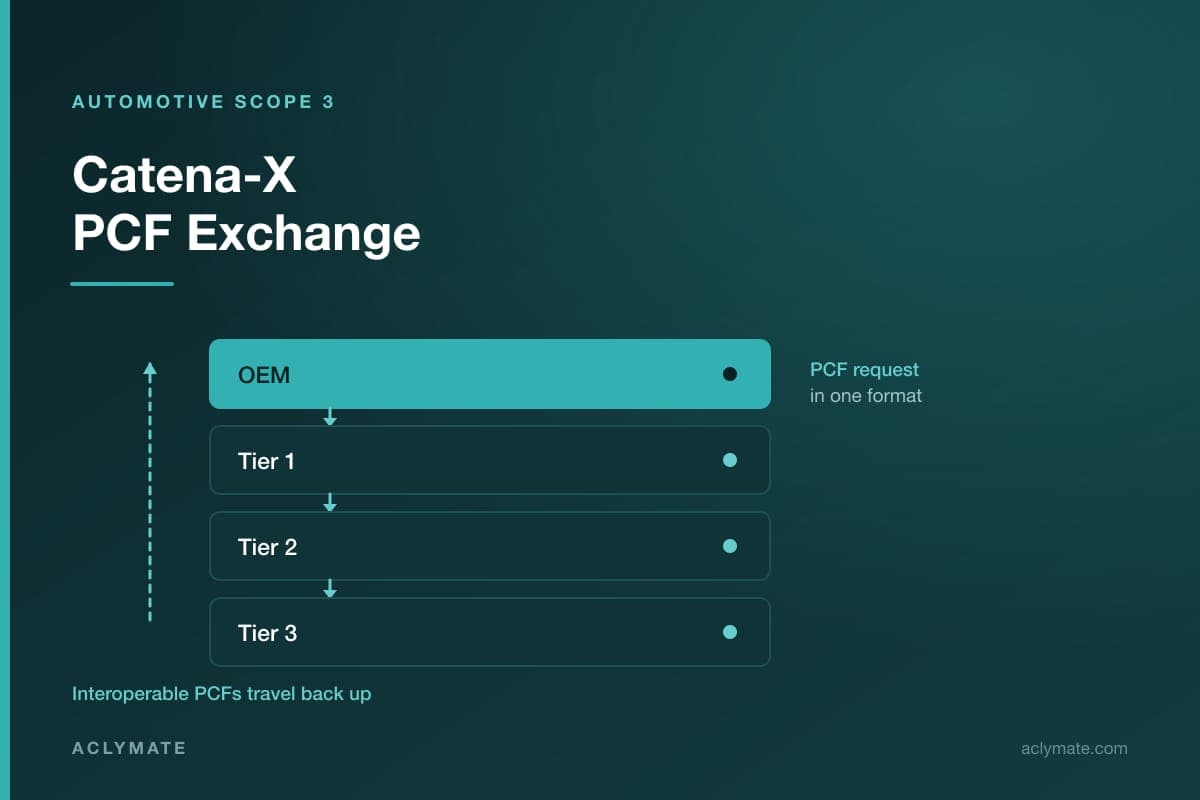
Catena-X is an automotive industry initiative building a shared way for companies across the supply chain to exchange data — and Product Carbon Footprints are one of its core use cases.
For a supplier, the practical question is narrower than the initiative itself: what will my customers actually ask me for, and what should I have ready?
This guide covers what Catena-X is trying to solve, why PCF is central to it, and what a supplier should do now — which is mostly not "join a data space."
Catena-X is a collaborative automotive data ecosystem involving OEMs, suppliers, and technology providers. Its purpose is to let companies exchange data across the supply chain without each pair of companies building a bespoke integration, and without any participant surrendering control of its data.
It covers several use cases. Product Carbon Footprint is among the most developed, because it is a problem every participant shares and none can solve alone.
Catena-X describes its PCF work as a harmonized approach for calculating, exchanging, and verifying supplier-specific Product Carbon Footprints across the automotive supply chain, with emphasis on increasing the share of supplier-specific primary data over time. Catena-X: Product Carbon Footprint
Consider what happens today when an OEM wants the carbon footprint of a vehicle.
It asks its Tier 1 suppliers. Each Tier 1 asks its Tier 2 suppliers. Each Tier 2 asks Tier 3. At every level:
The result is enormous duplicated effort producing data that is not comparable between suppliers — which defeats the purpose, because comparability is the whole point of asking.
Catena-X addresses this by standardizing two things together: how the footprint is calculated, and how it is exchanged. Standardizing only one would not work. Consistent data in incompatible formats is as unusable as inconsistent data in a common format.
The stated direction is toward primary data — footprints based on what a specific supplier actually did, rather than industry averages.
This matters because of a structural weakness in average-based data: two suppliers producing the same part with very different energy sources and efficiencies show the same calculated footprint if both are represented by the same industry average. That makes it impossible to reward a supplier that improves, or to choose between suppliers on carbon.
Primary data fixes that, but it can only come from the supplier. Which is why the framework has to reach all the way down the chain rather than stopping at Tier 1.
See Scope 3 supplier data for the buyer's side of this.
The reason a shared methodology is necessary becomes obvious once you look at where two competent analysts can legitimately differ on the same part:
Each of these is a defensible choice. Made differently by two suppliers, they produce numbers that cannot be compared — and a buyer who compares them anyway reaches a wrong conclusion.
A shared rule set removes that ambiguity. For suppliers, the practical implication is that a PCF may need to be recalculated against a customer's specified methodology rather than your own preferred one, so the underlying data needs to be held in a form that supports recalculation. See cradle-to-gate carbon footprints.
Alongside the number, the framework emphasizes describing its quality — particularly how much rests on primary data rather than estimates.
For suppliers this means tracking, per input, whether a figure is measured, supplier-provided, calculated from activity data, or estimated from averages. The primary-data share becomes a reported attribute rather than an internal note.
This is worth building into your method from the first PCF. Retrofitting data-quality labelling onto a completed spreadsheet is considerably harder than recording it as you go.
The exchange side is what distinguishes this from a methodology document.
The intent is that a PCF calculated once can move between companies in a machine-readable, consistent form — so a Tier 2 supplier can incorporate its Tier 3 supplier's footprint directly, rather than re-requesting it in a bespoke spreadsheet and re-keying it.
Two principles shape the design. Data stays under the control of the company that produced it rather than being pooled centrally. And interoperability is built on shared standards rather than a single platform every participant must adopt.
Whether a given supplier ends up connecting directly, through a service provider, or through a customer's system is an implementation question. The underlying expectation — a calculated, documented, supplier-specific PCF per part — is the same regardless.
The intended pattern is compounding rather than re-requesting:
Each tier adds only what it actually did. Nobody recalculates what somebody upstream already calculated.
The dependency this creates is worth being clear-eyed about: the chain only works if the deepest tiers participate. A Tier 2 supplier cannot produce a primary-data footprint if its own suppliers provide nothing. This is why pressure is reaching smaller suppliers, and why it will keep reaching further. See automotive supplier sustainability.
One of the more useful aspects for suppliers is the emphasis on not requiring everyone to use the same software.
A supplier should be able to calculate a PCF in whatever system suits its operations and still exchange it with customers using different systems. The standard governs the data and the method, not the tooling.
The practical criterion when evaluating software: can it export a PCF with the full set of attributes — boundary, declared unit, period, data quality, primary-data share, methodology — rather than only a number? A tool that produces a figure but cannot describe it will not be usable in a standardized exchange.
The honest answer for most small and mid-sized suppliers: not a data-space integration, at least not first.
What to do now:
The expectation typically arrives before the infrastructure does. Suppliers who can produce a documented, well-structured PCF will be in a reasonable position regardless of how the exchange mechanics settle.
What to look for, given all of the above:
See PCF software for automotive suppliers for a fuller evaluation, and IMDS and PCFs for the material-data side.
See the Automotive & Transportation page, or automotive Scope 3 emissions for the wider context.
Catena-X is a collaborative automotive data ecosystem involving OEMs, suppliers, and technology providers. It lets companies exchange data across the supply chain without building bespoke integrations for every pair of trading partners, and without participants surrendering control of their own data. Product Carbon Footprint is one of its core use cases.
It is a harmonized approach for calculating, exchanging, and verifying supplier-specific Product Carbon Footprints across the automotive supply chain, with emphasis on increasing the share of supplier-specific primary data over time. It standardizes both how a footprint is calculated and how it is exchanged, because standardizing only one would not make data usable.
Because two competent analysts can legitimately differ on boundary, declared unit, energy allocation, scrap treatment, emissions factor sources, co-product allocation, and electricity accounting. Each choice is defensible, but made differently by two suppliers they produce numbers that cannot be compared — and a buyer comparing them anyway reaches a wrong conclusion.
Usually not as a first step. The actual gate is being able to calculate a documented PCF at all, since standardized exchange of a number you cannot produce is irrelevant. Whether you eventually connect directly, through a service provider, or through a customer's system is an implementation question that comes later.
By compounding rather than re-requesting. A Tier 3 supplier calculates the footprint of what it ships, a Tier 2 incorporates that and adds its own processing and freight, a Tier 1 rolls that into a module footprint, and the OEM aggregates to a vehicle. Each tier adds only what it actually did.
Because two suppliers making the same part with very different energy sources and efficiencies show identical footprints under a shared industry average. That makes it impossible to reward a supplier that improves or to select between suppliers on carbon performance. Only primary data distinguishes them, and only the supplier can provide it.
No. The emphasis is on interoperability through shared standards rather than a single mandated platform. A supplier should be able to calculate a PCF in whatever system suits its operations and still exchange it with customers using different systems. The standard governs the data and the method, not the tooling.
A full set of attributes, not just a number: boundary, declared unit, reporting period, data quality per input, primary-data share, and methodology. A tool that produces a figure but cannot describe how it was derived will not be usable in a standardized exchange, regardless of how accurate the calculation is.
Get Aclymate's practical sustainability content delivered weekly.
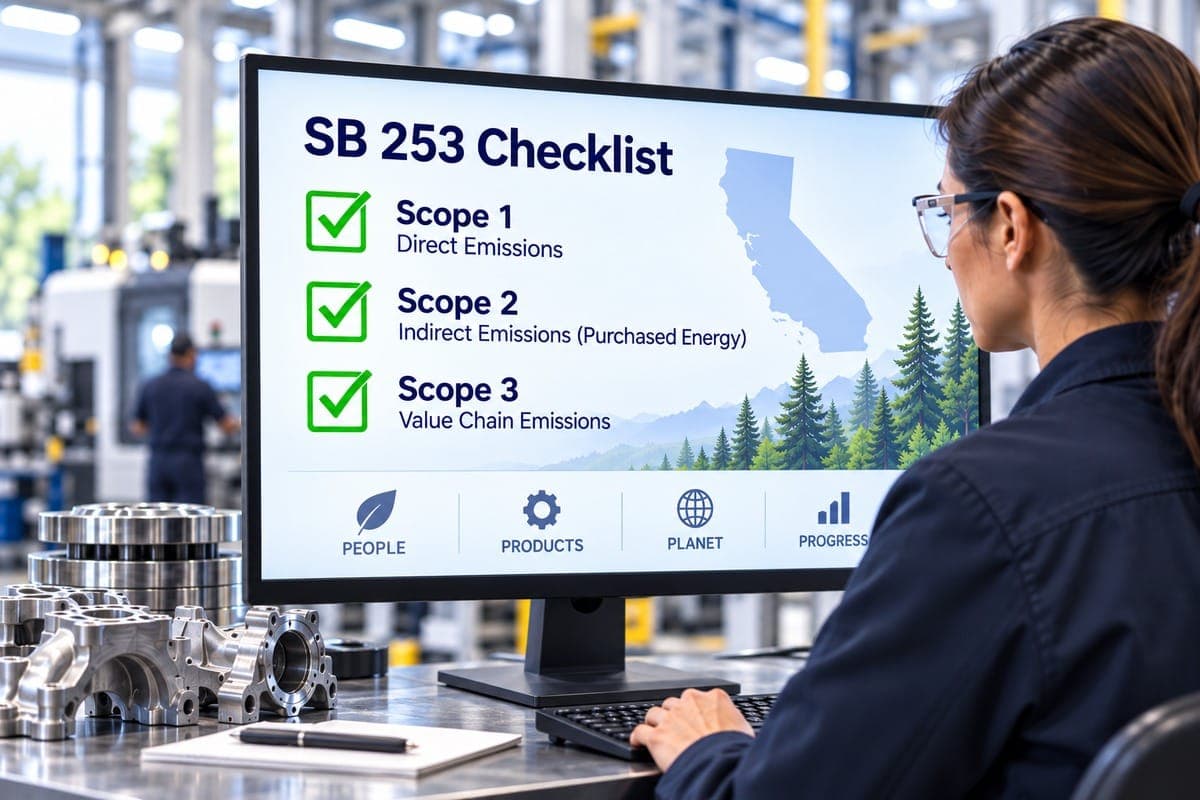
California SB 253 applies to companies over $1B in revenue — but its Scope 3 requirement reaches the automotive suppliers underneath them. What to expect and how to prepare.
Read Article
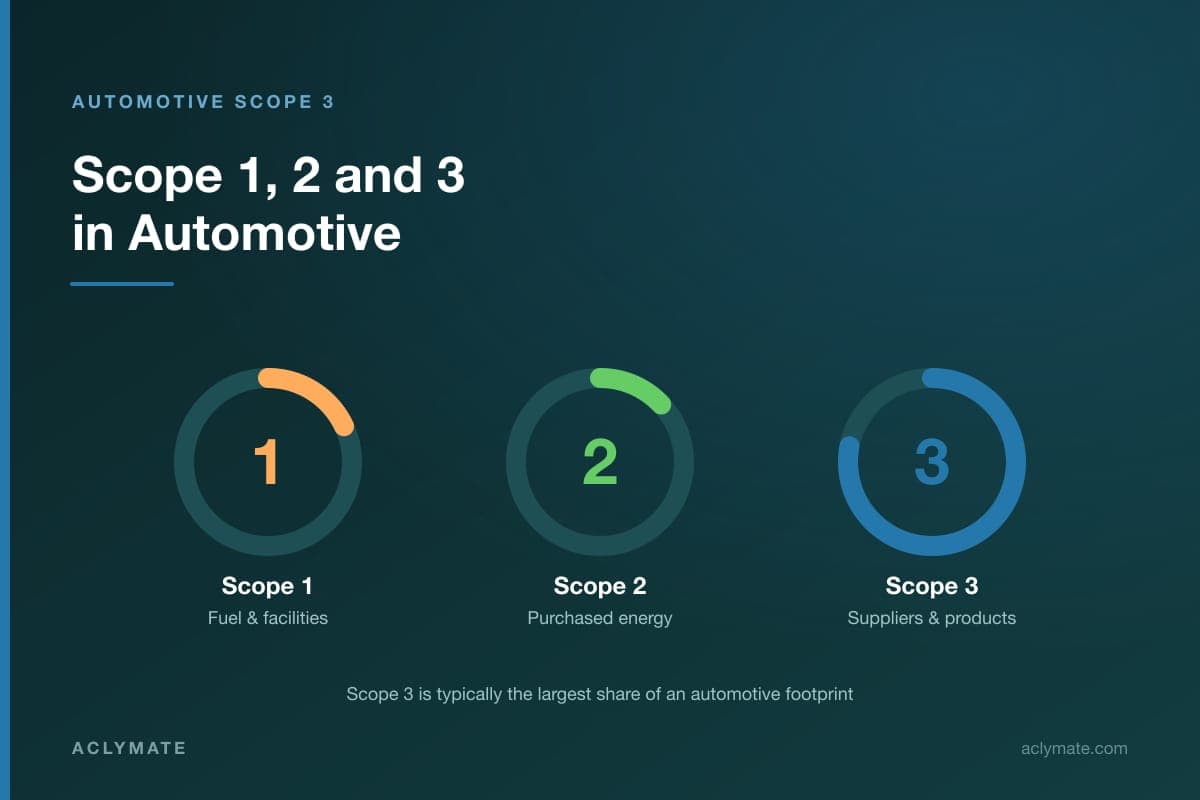
Learn how automotive companies measure Scope 3 emissions, collect supplier data, calculate product footprints, and meet customer reporting requirements.
Read Article
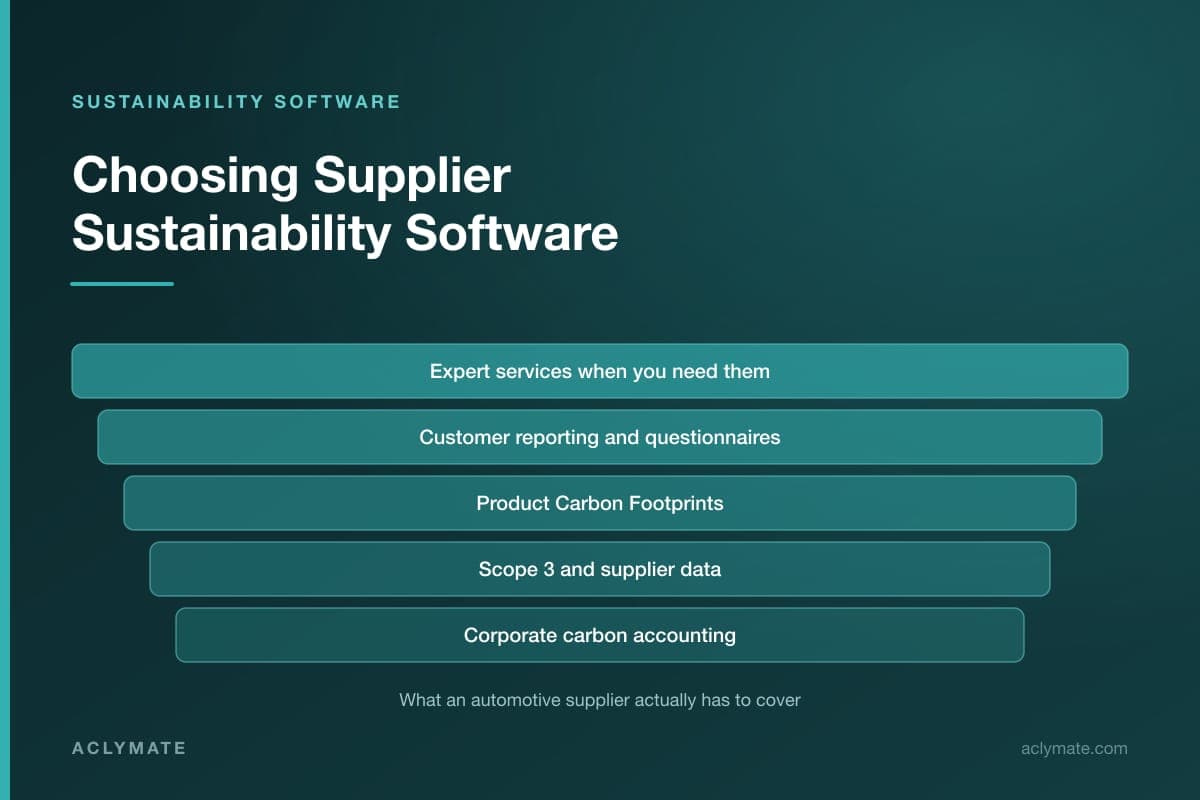
Learn how to choose automotive sustainability software for carbon accounting, Scope 3 supplier data, product footprints, customer reporting, and sustainability management.
Read Article
Talk with a Sustainability Expert, see a demo, or start free to put the Aclymate platform and experts to work for your team.