← Back to Insights
Aclymate Team
September 11, 2026
11 min read
Automotive suppliers are being asked to provide more sustainability information than ever before.
An OEM or Tier 1 customer may ask for a corporate carbon footprint, Scope 1 and 2 emissions, supplier data, a Product Carbon Footprint, EcoVadis results, a sustainability questionnaire, an emissions-reduction plan, or supporting documentation.
For a large multinational supplier with dedicated sustainability and environmental teams, these requests may be manageable.
For a 100-person machine shop, plastics manufacturer, tool-and-die company, metal fabricator, or specialty component supplier, they create a different problem: who is actually going to do all this work?
A growing group of sustainability platforms is trying to answer that question. But they approach automotive sustainability from very different directions. Some specialize in Product Carbon Footprints. Others focus on automotive compliance, supplier decarbonization, enterprise sustainability, or supplier assessments.
Aclymate takes a broader approach by combining carbon accounting software, supplier and product data, sustainability management, AI guidance, and hands-on expert services in one platform.
For a broader look at Aclymate's approach to this market, explore Automotive & Transportation sustainability solutions.
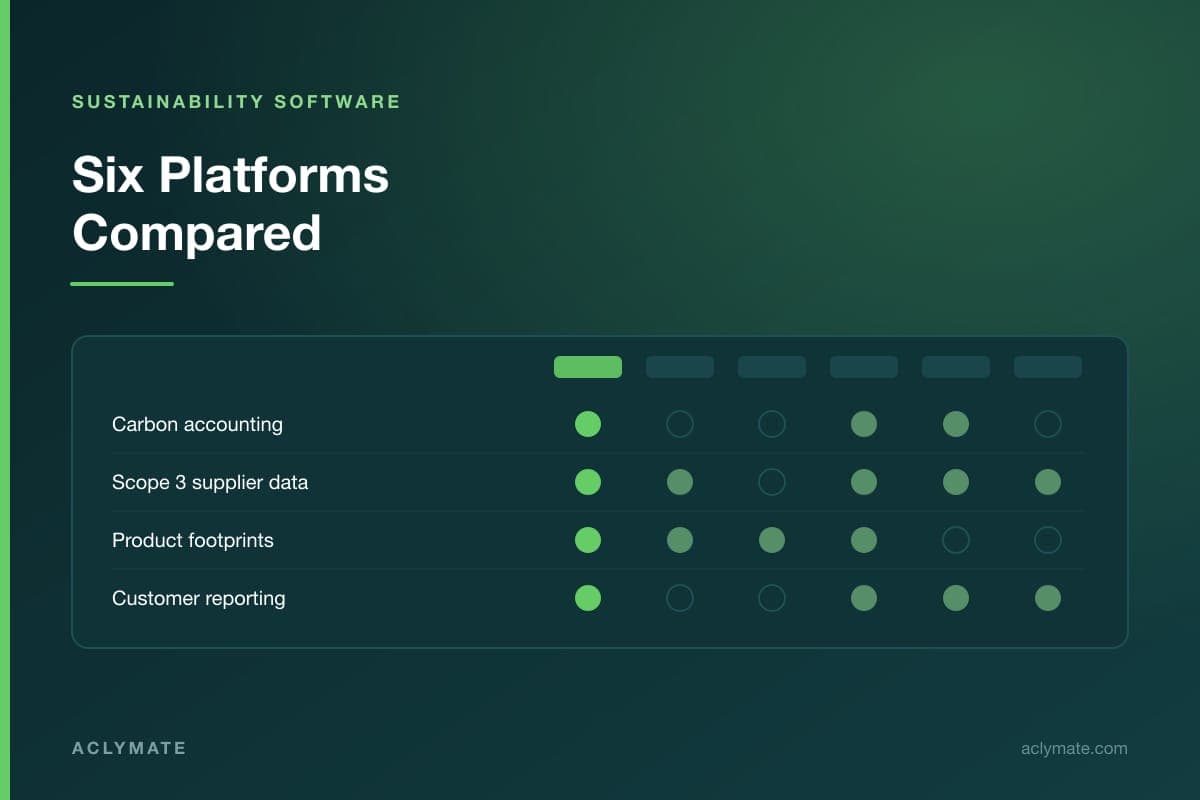
| Platform | Particularly strong in | Typical fit |
|---|---|---|
| Aclymate | Corporate + product carbon, Scope 3, supplier data, reporting, services, AI | SMB and midmarket suppliers with lean sustainability teams |
| CircularTree | PCF calculation and Catena-X exchange | Automotive suppliers focused heavily on PCF requests |
| iPoint | IMDS, automotive compliance, PCF and LCA | Automotive companies with complex product and compliance requirements |
| Manufacture 2030 | Supplier decarbonization and OEM-led programs | Large buyers engaging supplier networks |
| Sphera | Enterprise LCA, PCF, sustainability and supplier data | Large enterprises and sophisticated sustainability teams |
| EcoVadis | Supplier sustainability assessments and intelligence | Procurement organizations and suppliers completing assessments |
The most important question isn't simply which platform has the most features. It is: what sustainability problem are you trying to solve?
If you have not defined that yet, start with the buyer's guide to automotive sustainability software.
Aclymate is designed for growing companies that need to manage sustainability but may not have a large sustainability department.
Aclymate Navigator combines Scope 1, 2 and 3 carbon accounting with supplier and product data, dashboards, reporting, customer requests and ongoing sustainability management.
Unlike platforms focused primarily on one sustainability workflow, Aclymate can support a supplier across a broader range of needs:
Aclymate can also provide the people required to get the work done. Its sustainability services include Carbon Bookkeepers, Carbon Accountants, Sustainability Consultants, Sustainability Data Analysts, Program Managers and Supply Chain Sustainability Consultants. Explore Aclymate sustainability services.
That combination is particularly relevant to smaller automotive suppliers that need credible sustainability capabilities but cannot justify building a large internal sustainability team.
Aclymate also incorporates AI into its sustainability model. AI-guided assistance helps users work through sustainability data and workflows, while human experts remain available when methodology, reporting, customer requirements or program decisions require more experience.
The model is straightforward: AI when you need an immediate answer. Software when you need a repeatable process. Experts when you need help getting it done.
CircularTree is one of the most relevant competitors for automotive suppliers because it is tightly focused on Product Carbon Footprints.
Its PACIFIC offering provides PCF calculation and exchange capabilities and is Catena-X certified. CircularTree also offers AI-assisted BOM matching and PCF calculation services. Explore CircularTree Product Carbon Footprint solutions
This creates a strong proposition when the immediate problem is: my automotive customer wants a PCF and needs it exchanged through Catena-X.
Not every supplier's sustainability problem ends with a PCF.
A supplier may also need a corporate GHG inventory, Scope 3 support, customer reporting, EcoVadis assistance, sustainability reporting, reduction planning and ongoing program management.
Aclymate is designed to put these requirements into a broader sustainability program. Its Product Footprint Pack adds product-level carbon accounting to the same sustainability environment used for corporate carbon accounting and reporting.
The choice may therefore depend on the problem:
For background on the standard itself, see Catena-X Product Carbon Footprints.
iPoint brings decades of automotive product and materials expertise into sustainability.
Its automotive solutions combine areas such as IMDS, material compliance, Product Carbon Footprints, LCA and supplier data. iPoint is also positioning digital PCF exchange through Catena-X and IMDS as increasingly important for automotive suppliers. Read iPoint's PCF guidance for automotive suppliers
That makes iPoint particularly attractive for companies whose sustainability programs are deeply connected to automotive material and product-compliance processes.
iPoint may be ideal when the problem sounds like: we need sophisticated automotive product, material, IMDS and regulatory compliance infrastructure.
Aclymate's sweet spot is different. A smaller supplier may instead be saying:
For these companies, a simpler software-plus-services model can be more important than having every possible automotive compliance capability.
See IMDS and Product Carbon Footprints for how material and carbon data relate.
Manufacture 2030 is particularly important because automotive suppliers may encounter it through their customers rather than selecting it independently.
A collaborative initiative involving Manufacture 2030, Suppliers Partnership for the Environment, Ford, General Motors, Honda, DENSO, Magna and Toyota has engaged a large number of supplier manufacturing sites around more consistent Scope 3 reporting and carbon reduction. See the automotive supplier carbon collaboration
This is a major strength. Manufacture 2030 is well positioned when an OEM or large Tier 1 wants to mobilize a broad supplier base around emissions measurement and reduction.
Aclymate approaches the problem from the supplier's side.
A smaller manufacturer may be receiving different requests from several customers. Instead of treating each customer's sustainability program separately, the supplier can establish its own sustainability system for corporate emissions, supplier data, product footprints, customer reporting, evidence, and reduction programs.
Aclymate can therefore position itself as one sustainability program for all your customer requirements.
That distinction is important. Manufacture 2030 helps large organizations engage their suppliers. Aclymate helps the individual supplier build and manage its own sustainability capability.
Sphera is one of the broadest and most sophisticated platforms in this competitive set.
Its Supplier Product Carbon Footprint Calculator supports cradle-to-gate PCF calculation from BOM information and aligns with methodologies including Catena-X, PACT and ISO standards. Sphera also offers significant capabilities across enterprise sustainability, LCA, supply-chain risk and supplier engagement. Explore Sphera's Supplier PCF Calculator
For a multinational Tier 1 supplier with large EHS, compliance, procurement and sustainability organizations, Sphera's enterprise depth may make sense.
But many Tier 2 and Tier 3 suppliers don't have that organizational structure. Their question isn't necessarily which enterprise platform has the greatest depth? It may be who will actually help us get this work done?
This is where Aclymate's combination of accessible software and human services becomes particularly differentiated.
EcoVadis occupies a different position because suppliers frequently encounter it as a customer requirement.
Its automotive program helps large organizations assess supplier sustainability and gain visibility across complex multi-tier supply chains. Explore EcoVadis for automotive supply chains
For procurement organizations managing thousands of suppliers, EcoVadis' assessment network is a significant advantage.
This does not always need to be an Aclymate-versus-EcoVadis decision.
A customer might tell an automotive supplier: you need an EcoVadis assessment.
The supplier still has to gather data, establish policies, organize evidence, calculate emissions, document initiatives, and improve its sustainability program.
Aclymate can help the supplier perform that underlying work, through EcoVadis consulting and the carbon accounting behind it.
In that situation: EcoVadis is the requirement. Aclymate helps the supplier meet it.
The competitive market exists because the underlying automotive requirement is changing.
OEMs and large Tier 1 companies increasingly need better data from their suppliers to understand and reduce their own Scope 3 emissions.
Suppliers Partnership for the Environment has developed industry guidance with automakers and major automotive suppliers around carbon reporting and reduction expectations throughout the automotive value chain. See automotive supplier carbon reporting guidance
At the same time, Product Carbon Footprints are moving carbon accounting from the company level toward individual products and parts.
That is especially significant for specialty manufacturers. A machine shop may eventually need to answer both what is your company's carbon footprint? and what is the carbon footprint of Part #12345?
The second question requires product, BOM, material, supplier and manufacturing data — not merely a corporate GHG inventory. See automotive Product Carbon Footprints.
Every platform in this comparison has legitimate strengths. CircularTree is highly focused on PCFs and Catena-X. iPoint combines automotive compliance and product sustainability. Manufacture 2030 has significant OEM-led supplier engagement programs. Sphera offers sophisticated enterprise sustainability and LCA. EcoVadis brings a large supplier assessment network.
Aclymate's opportunity is to bring a wider range of sustainability needs together for companies that don't want to assemble multiple tools and consulting relationships.
Aclymate connects corporate carbon accounting, Scope 3, supplier data, Product Carbon Footprints, reporting, sustainability management, certifications and expert services. That makes it particularly relevant to SMB and midmarket automotive suppliers.
Aclymate's expert roles include Carbon Bookkeepers, Carbon Accountants, Sustainability Consultants, Sustainability Data Analysts, Sustainability Program Managers and Supply Chain Sustainability Consultants. The customer doesn't have to hire all of those roles internally.
Automotive suppliers increasingly face both corporate and product-level emissions requests. Aclymate supports both within one sustainability program rather than treating PCF as an isolated exercise.
Aclymate can help large companies collect and organize supplier emissions information. It can also help suppliers respond when customers ask for emissions, product footprints and sustainability documentation, through Supplier & Scope 3 Data Support.
This two-way model is particularly relevant in automotive because sustainability requirements cascade from OEMs through Tier 1, Tier 2 and Tier 3 suppliers.
AI can accelerate sustainability work, but some decisions still require human judgment. Aclymate's approach combines technology with carbon accounting and sustainability expertise rather than asking customers to choose between software and consulting.
That creates an operating model especially suited to lean teams: AI + software + sustainability experts. See software versus consulting for automotive suppliers.
There is no single best solution for every automotive company.
That can be particularly compelling for small and midsize automotive suppliers that need enterprise-quality sustainability capabilities without building an enterprise-size sustainability department.
Automotive sustainability is becoming a data problem, a supply-chain problem, and a customer relationship problem.
Suppliers need to understand their emissions. OEMs need better supplier data. Customers increasingly want product footprints. Procurement teams want evidence. Assessments require documentation. And smaller suppliers frequently have to address these requirements with limited internal resources.
Specialized platforms will continue to play important roles.
But automotive suppliers that want to bring corporate carbon accounting, product footprints, Scope 3 data, reporting, sustainability management, AI guidance and human expertise together should consider a broader approach.
That's the role Aclymate is building to fill: your sustainability software and team for managing the requirements coming from your customers — and building a stronger sustainability program of your own.
See the Automotive & Transportation page, or book a demo.
There is no single best platform. The right choice depends on the problem you are solving. CircularTree suits suppliers whose challenge is PCF calculation and Catena-X exchange. iPoint suits companies deeply tied to IMDS and material compliance. Sphera suits large enterprises. Aclymate suits SMB and midmarket suppliers needing breadth plus expert services.
CircularTree is tightly focused on Product Carbon Footprints, with Catena-X certified calculation and exchange through its PACIFIC offering. Aclymate covers a broader range: corporate Scope 1, 2 and 3 accounting, supplier data, product footprints, reporting, EcoVadis support and reduction planning, plus expert services. The choice depends on whether your problem ends with a PCF.
iPoint brings deep automotive material and product compliance expertise spanning IMDS, material compliance, PCFs and LCA, which suits companies with complex regulatory and product-compliance infrastructure needs. Aclymate targets a different situation: smaller suppliers who need emissions measured, footprints calculated and customer requests answered without internal sustainability expertise.
They address different sides. Manufacture 2030 is strong when a large buyer wants to mobilize a broad supplier network around emissions reporting and reduction, and suppliers often encounter it through a customer rather than choosing it. Aclymate helps the individual supplier build one sustainability program serving all of its customers.
Usually not an either-or. EcoVadis is frequently a customer requirement rather than a supplier's choice. Meeting it still requires gathering data, establishing policies, organizing evidence, calculating emissions and documenting initiatives. Aclymate helps a supplier do that underlying work. EcoVadis is the requirement; Aclymate helps the supplier meet it.
When the organization has the structure to use it — large EHS, compliance, procurement and sustainability teams, and sophisticated LCA, product sustainability and supplier-risk requirements. Many Tier 2 and Tier 3 suppliers lack that structure, and their question is less about platform depth than about who will actually do the work.
Because the underlying requirement changed. OEMs and Tier 1 companies need better supplier data to understand and reduce their own Scope 3 emissions, and Product Carbon Footprints are shifting carbon accounting from the company level to individual parts. Different vendors have approached that shift from different starting points.
It means the platform handles the repeatable calculation while people handle the judgment. Aclymate's expert roles include Carbon Bookkeepers, Carbon Accountants, Sustainability Consultants, Data Analysts, Program Managers and Supply Chain Sustainability Consultants, so a supplier does not have to hire those roles internally to produce credible sustainability data.
Get Aclymate's practical sustainability content delivered weekly.
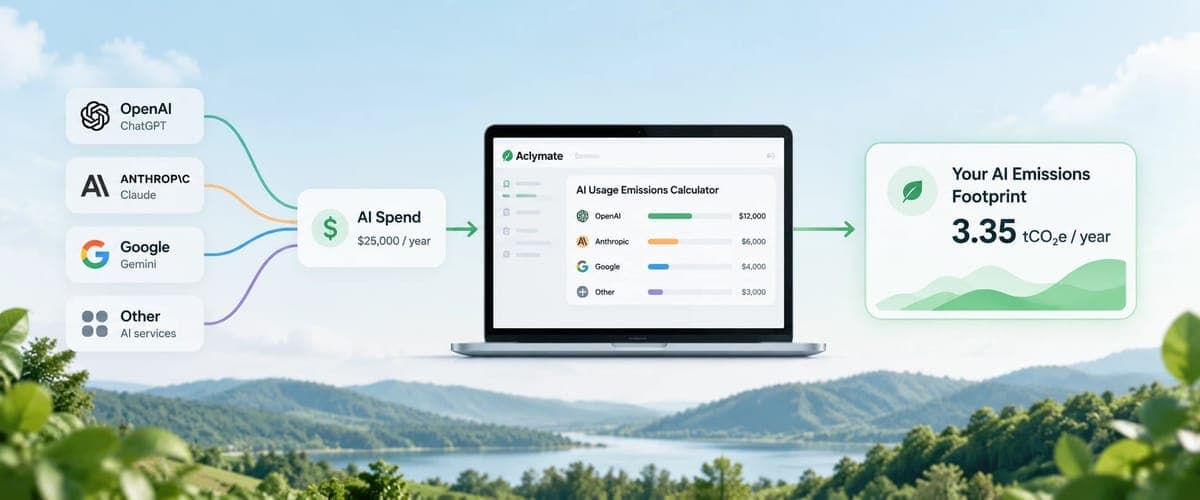
AI carbon emissions are becoming a new consideration for companies adopting ChatGPT, Claude, Gemini, Copilot and other artificial intelligence tools. Here’s how Aclymate estimates the carbon emissions from a company’s AI usage today—and how we expect the methodology to improve as AI providers release better usage and emissions data.
Read Article
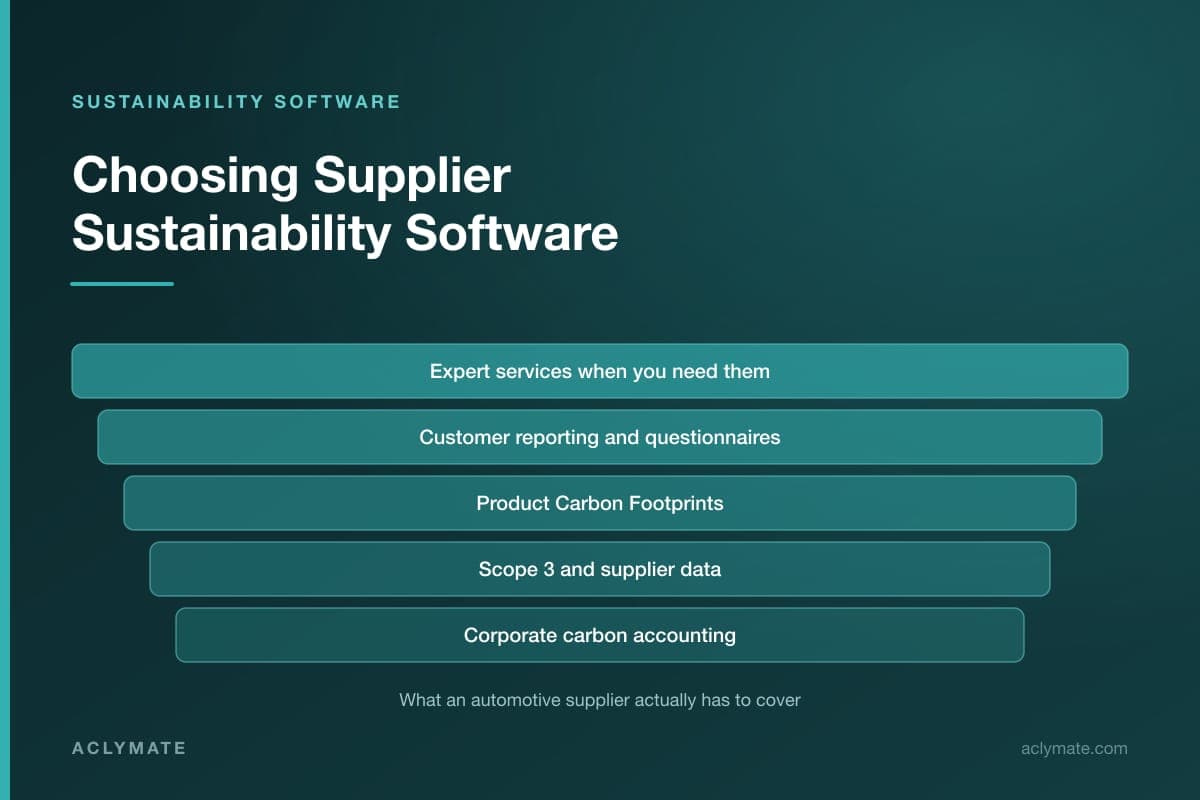
Learn how to choose automotive sustainability software for carbon accounting, Scope 3 supplier data, product footprints, customer reporting, and sustainability management.
Read Article
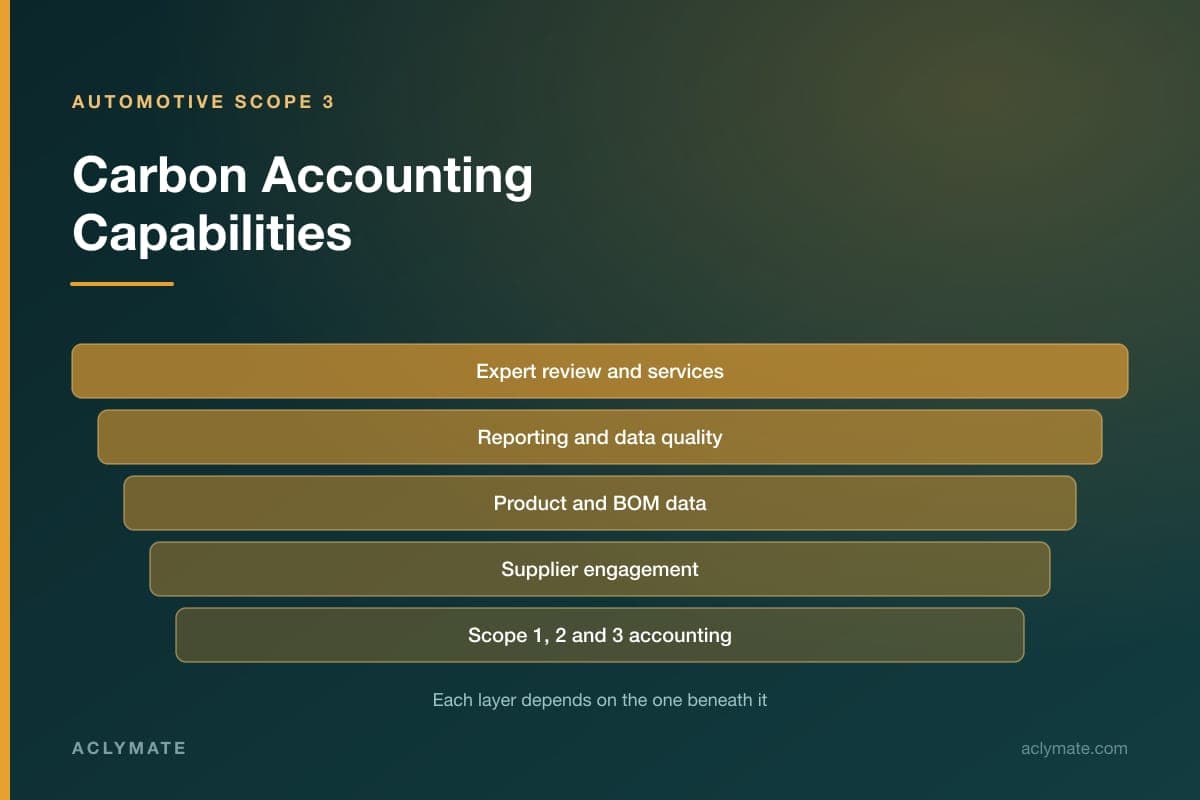
Compare the capabilities automotive companies need for carbon accounting, Scope 3 supplier data, PCFs, reporting, and sustainability management.
Read Article
Talk with a Sustainability Expert, see a demo, or start free to put the Aclymate platform and experts to work for your team.