← Back to Insights
Aclymate Team
March 13, 2026
Many companies today want to understand their carbon footprint. Customers are asking for sustainability data. Investors are demanding climate transparency. Regulations like CSRD and California climate disclosure laws are pushing companies to measure and report emissions.
But calculating a carbon footprint is not just a simple formula.
The methodology of carbon footprint measurement determines whether your results are credible, comparable, and useful for decision-making.
A strong carbon accounting methodology answers critical questions:
In this guide, we explain the methodology of carbon footprint measurement, the standards businesses should follow, and how tools like Aclymate’s Carbon Footprint Calculator simplify the process.
A carbon footprint methodology is the structured process used to calculate greenhouse gas (GHG) emissions in a consistent and transparent way.
The goal is to estimate the total greenhouse gas emissions associated with an organization, product, service, or activity and express them in carbon dioxide equivalent (CO₂e).
CO₂e converts different greenhouse gases into a common unit based on their global warming potential.
A well-designed methodology typically includes:
These steps form the backbone of widely accepted carbon accounting frameworks.
Most credible carbon footprint calculations follow globally recognized standards.
The most widely used frameworks include:
GHG Protocol Corporate Standard
The global standard for organizational carbon footprint accounting.
ISO 14064
International standard for greenhouse gas accounting and verification.
ISO 14067
Standard for product carbon footprint calculations.
PAS 2050
A methodology for product life-cycle emissions assessment.
At Aclymate, our carbon footprint calculations are based primarily on the GHG Protocol methodology, which is the most widely adopted global standard for corporate greenhouse gas accounting.
This ensures that emissions estimates produced by our platform align with frameworks used by:

The first step in any carbon footprint calculation is defining what is being measured.
Examples include:
The goal determines the system boundaries and data required.
Next, companies determine which parts of the organization are included.
Common boundary approaches include:
These boundaries determine which facilities, assets, or subsidiaries are included in the carbon inventory.
Carbon footprint methodologies categorize emissions into three scopes defined by the GHG Protocol.
Emissions from sources the company owns or controls.
Examples:
Emissions associated with purchased electricity, heating, or cooling.
Examples:
Indirect emissions that occur throughout the value chain.
Examples:
For many companies, Scope 3 emissions represent 70–90% of the total footprint.
Once emission sources are identified, companies collect activity data.
Activity data refers to measurable inputs that drive emissions.
Examples include:
The accuracy of a carbon footprint depends heavily on the quality of this data.
Activity data is converted into emissions using emission factors.
The core carbon accounting formula is:
Emissions = Activity Data × Emission Factor
Emission factors estimate the average emissions associated with a unit of activity.
Examples:
Reliable emission factors are sourced from databases such as:
Once emission factors are applied, emissions are aggregated across all sources.
The result is a total carbon footprint expressed in CO₂e.
The methodology must document:
This transparency ensures the results are credible and reproducible.
Carbon footprint methodology differs depending on what is being measured.
Measures emissions across the company’s operations.
Includes:
Typically calculated annually.
Measures emissions associated with a specific product.
Includes life-cycle stages such as:
Product footprints often follow life cycle assessment (LCA) methodologies.
Different calculation approaches are used depending on data availability.
Estimates emissions based on procurement spending.
Useful when supplier emissions data is unavailable.
Uses detailed operational data.
Examples:
More accurate but requires better data.
Combines both spend-based and activity-based data.
Most companies use a hybrid methodology to balance accuracy and practicality.
Many carbon footprint calculations fail due to methodological issues.
Common mistakes include:
A credible carbon footprint must be transparent, consistent, and repeatable.
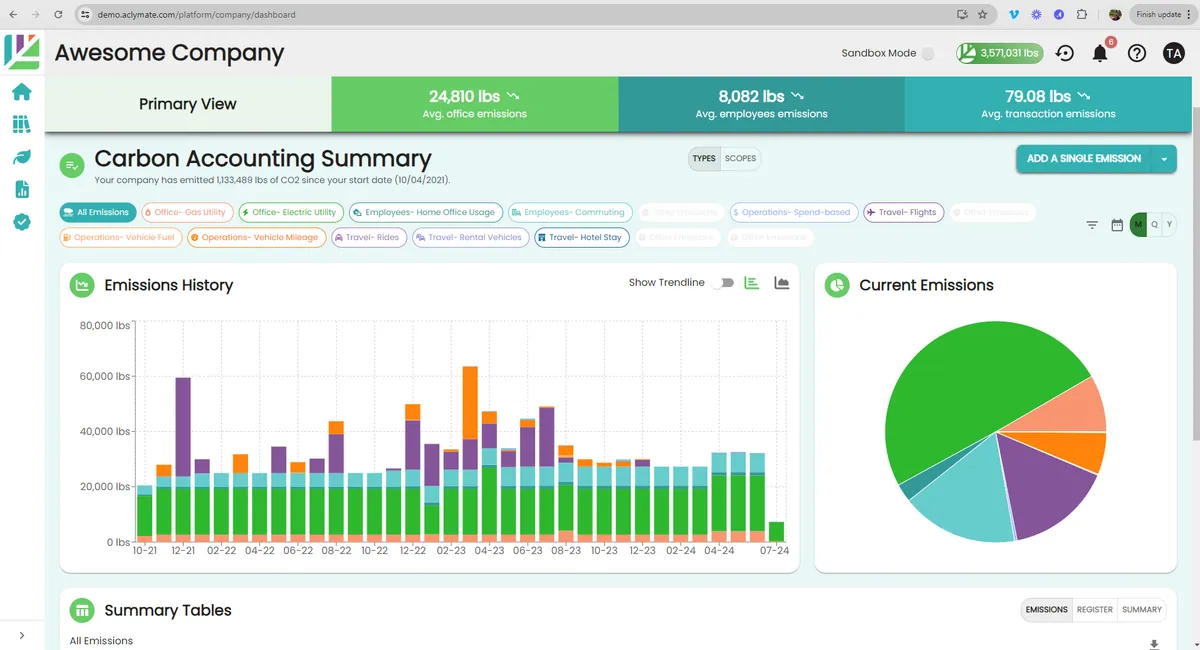
Measuring emissions can be complex, especially for companies without dedicated sustainability teams.
Aclymate’s Carbon Footprint Calculator simplifies the process by automating the core steps of carbon accounting.
Our platform helps businesses:
Instead of building spreadsheets and managing emission factors manually, companies can calculate their carbon footprint using a structured methodology built directly into the platform.
If you want to understand your organization’s carbon footprint, the easiest place to start is with a carbon footprint estimate.
Use Aclymate’s Carbon Footprint Calculator to:
Start calculating your carbon footprint today.
Carbon footprint methodology is the structured process used to calculate greenhouse gas emissions using activity data and emission factors, typically following frameworks such as the GHG Protocol or ISO standards.
The most common standards include:
These frameworks provide guidance for measuring and reporting emissions.
The basic formula is:
Emissions = Activity Data × Emission Factor
This converts operational data such as energy use or fuel consumption into carbon emissions.
Scope 1 includes direct emissions from company operations.
Scope 2 includes emissions from purchased electricity.
Scope 3 includes emissions across the supply chain and product lifecycle.
Get Aclymate's practical sustainability content delivered weekly.

Learn how to calculate an event carbon footprint in 4 steps: set the boundary, gather activity data, apply emission factors, and total it. Includes an example.
Read Article

An event carbon footprint is the total emissions from travel, lodging, venue energy, food, and waste. See which sources matter most and why.
Read Article

AI is transforming carbon credit verification through satellite monitoring, automated analysis, and anomaly detection. But can technology solve the voluntary carbon market’s credibility problem? Discover the limitations of AI verification and how businesses can evaluate carbon credits while keeping emissions reductions ahead of offsetting.
Read Article
Talk with a Sustainability Expert, see a demo, or start free to put the Aclymate platform and experts to work for your team.