← Back to Insights
Aclymate Team
September 2, 2026
7 min read
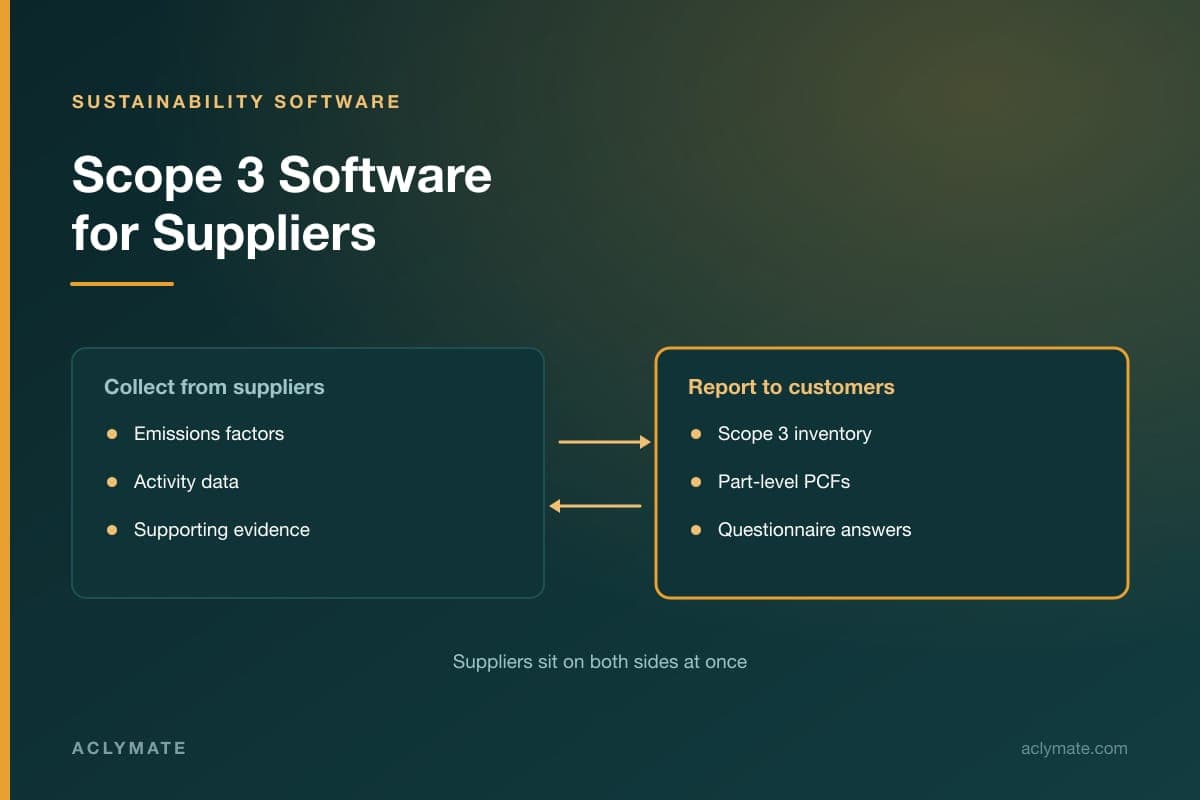
Automotive suppliers sit in an unusual position on Scope 3: they are on both sides of it at once.
Your customers want Scope 3 data from you. Meanwhile your own purchased materials and components are your Scope 3, and you need data from your suppliers to account for them — and to produce the product footprints your customers are also asking for.
That two-sided position is what distinguishes Scope 3 software for a supplier from Scope 3 software for a large buyer. This guide covers what it needs to do.
A reasonable first objection: if my customer only asked for Scope 1 and 2, why do I need Scope 3 capability?
Three reasons.
Your customer will ask. The trajectory across the industry runs from policy questions to Scope 1 and 2 to purchased goods. If your customers are OEM-facing, it is a matter of when.
Your PCFs depend on it. A Product Carbon Footprint is mostly materials and purchased components — which is to say, mostly your Scope 3, resolved to part level. The data is the same data.
Your reduction options are there. If most of your footprint is purchased materials, efficiency work in your own plant will not move the number much. Material and supplier decisions will.
Start with the calculation side.
For a supplier, the categories that matter are usually purchased goods and services, upstream freight, waste, business travel, commuting, and capital goods. Use of sold products — the largest category for an OEM — is generally not yours.
What the software needs:
The practical test: can it show you the twenty suppliers behind most of your Scope 3, so you know who to actually contact? Without that, you cannot run a prioritized program — and a mass request to every supplier produces a low response rate and unusable returns.
This is the half suppliers underestimate, because it feels like a large-company problem.
It is not. Your primary-data share — increasingly a reported figure — depends entirely on whether your suppliers give you real numbers rather than you applying averages.
What you need:
That validation step deserves emphasis. A supplier sending a cradle-to-gate figure has excluded the freight to your dock. If you use their number as-is, you lose that leg entirely. Software that stores only a value cannot catch this.
Supplier & Scope 3 Data Support covers this as a service where internal capacity does not exist.
The outbound side, and where suppliers lose the most time.
You do not report on your own schedule or in your own format. A customer asks, with their boundary, their units, their period, and a deadline.
Capabilities that help:
That last one is undervalued. Knowing exactly what you sent this customer last year, and against what boundary, turns an annual scramble into an update.
See Scope 3 reporting requirements.
This connection is the reason Scope 3 and PCF capability should not be bought separately.
The material emissions in your Scope 3 and the material emissions in a Product Carbon Footprint are the same emissions, viewed at different resolution. Your Scope 3 sees aluminum purchased annually. Your PCF sees aluminum consumed per part.
When they share a factor library and a supplier data store, two things follow: a supplier-specific factor obtained once improves both, and you can reconcile part footprints against the corporate inventory as a sanity check.
When they live in separate tools, you maintain two supplier datasets, apply factors twice, and have no way to notice when the two disagree.
See PCF software for automotive suppliers.
Scope 3 is built from data of wildly varying reliability, and being explicit about that is now part of the deliverable.
Label each line: measured, supplier-provided, calculated from activity data, or estimated from spend. Report primary-data share at inventory and category level. Track freshness.
Reporting an honest mix scores better with sophisticated customers than uniform confidence. They know what a real supplier inventory looks like, and a Scope 3 figure presented as fully measured invites scrutiny it will not survive.
Scope 3 is a data-quality program, not an annual calculation. Software should support the progression rather than just the snapshot.
That means being able to replace a spend-based line with a supplier-specific factor without rebuilding the category, restate prior years when a baseline is corrected, and show coverage improving over time — which is what a customer asking about your reduction plan actually wants to see.
One caution worth setting expectations on internally: replacing estimates with real data frequently moves the total, sometimes upward. That is the program working. It needs explaining to anyone who treated the first estimate as fixed.
Worth saying, because enterprise Scope 3 platforms are built for a different buyer.
A mid-sized supplier generally does not need supplier engagement campaign tooling for thousands of vendors, multi-entity consolidation across dozens of legal entities, procurement system integration, or assurance-grade governance workflows.
Buying those produces an expensive system that the one person responsible — who also has a full-time job — does not have time to operate. The requirement is capability that fits the operator, not the org chart of a Fortune 500.
Aclymate is built around the two-sided version of this problem, which is the position most automotive suppliers are actually in.
See automotive Scope 3 emissions for the underlying concepts, the buyer's guide, the six-platform comparison, or the Automotive & Transportation page.
Three reasons. Customers move from Scope 1 and 2 to purchased goods over time, so it is a matter of when. Product Carbon Footprints are mostly materials and purchased components, which is Scope 3 at part level. And if most of your footprint is purchased materials, your reduction options are there rather than in your own plant.
Suppliers sit on both sides at once. They must calculate and report their own Scope 3 to customers, and simultaneously collect data from their own suppliers to account for purchased materials and produce product footprints. Buyer-focused platforms address only the collection half of that.
Usually purchased goods and services, upstream freight, waste, business travel, commuting, and capital goods. Use of sold products, which is the largest category for a vehicle manufacturer, is generally not relevant to a component supplier. Confirming which categories a customer is asking about prevents a lot of unnecessary work.
Because a real inventory mixes them. Spend-based works for the long tail of minor suppliers, activity data suits major materials, and supplier-specific factors apply where you have obtained them. Software forcing one method across everything either wastes effort on trivial lines or leaves your largest inputs on crude estimates.
Because a supplier sending a cradle-to-gate figure has excluded the freight leg to your dock. Using their number as-is loses that leg entirely. Software that stores only a value rather than boundary, declared unit, and period cannot catch this, and the error propagates into both your Scope 3 and your product footprints.
Ideally yes. The material emissions in your Scope 3 and in a Product Carbon Footprint are the same emissions at different resolution. Sharing a factor library and supplier data store means a supplier-specific factor obtained once improves both, and lets you reconcile part footprints against the corporate inventory as a check.
Sometimes, and that is the program working correctly. Replacing industry averages with supplier-specific data frequently moves the total, occasionally upward. It is worth setting that expectation internally in advance, particularly with anyone who treated the first spend-based estimate as a fixed baseline.
Supplier engagement campaign tooling built for thousands of vendors, multi-entity consolidation across dozens of legal entities, deep procurement system integration, and assurance-grade governance workflows. Buying those produces an expensive system the one responsible person, who has another full-time job, does not have time to operate.
Get Aclymate's practical sustainability content delivered weekly.
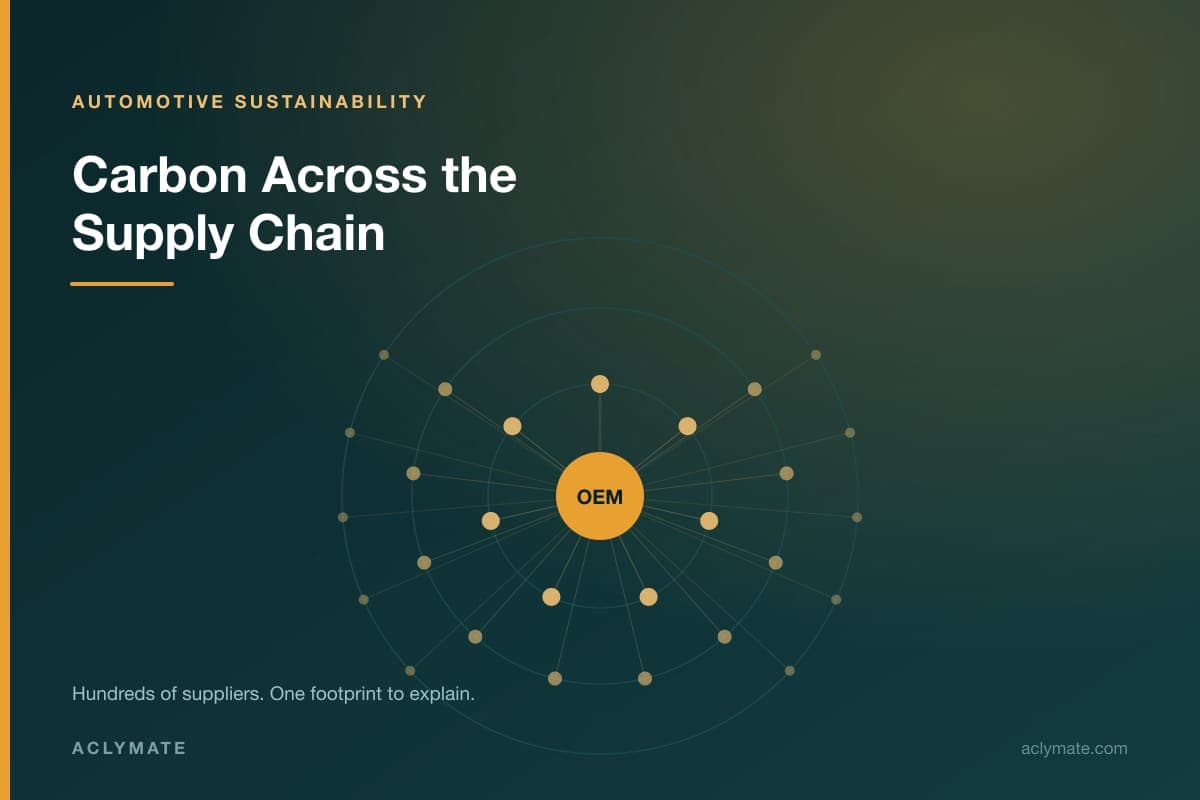
Learn how automotive companies manage supplier emissions, Scope 3 data, product footprints, sustainable sourcing, and carbon across complex supply chains.
Read Article
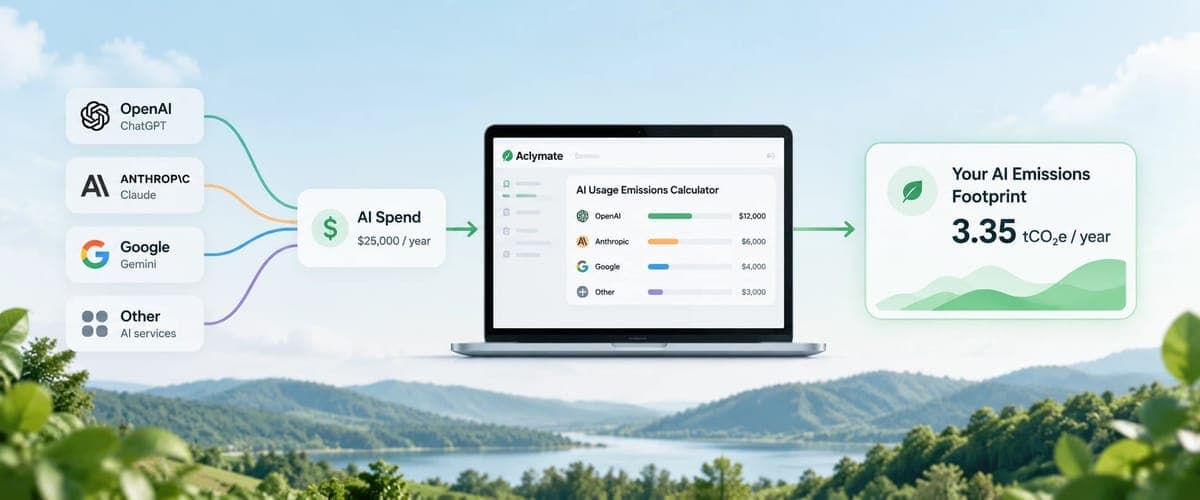
AI carbon emissions are becoming a new consideration for companies adopting ChatGPT, Claude, Gemini, Copilot and other artificial intelligence tools. Here’s how Aclymate estimates the carbon emissions from a company’s AI usage today—and how we expect the methodology to improve as AI providers release better usage and emissions data.
Read Article
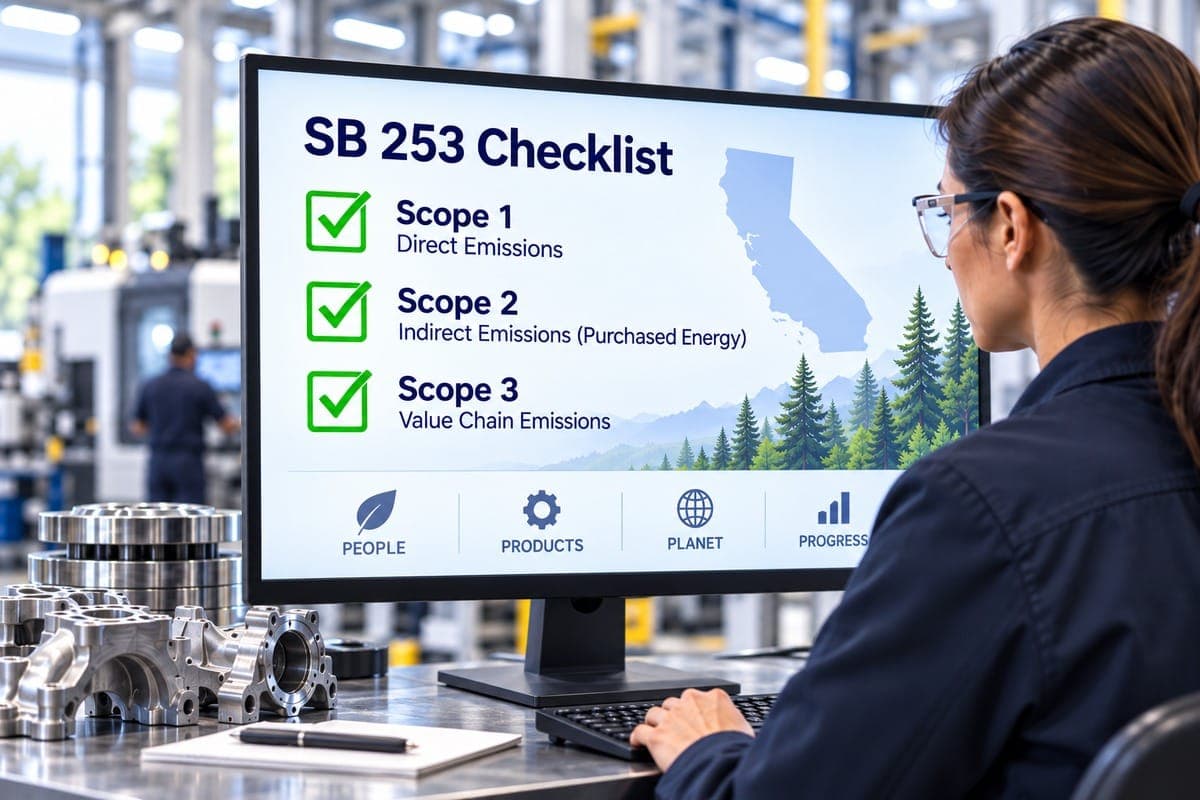
California SB 253 applies to companies over $1B in revenue — but its Scope 3 requirement reaches the automotive suppliers underneath them. What to expect and how to prepare.
Read Article
Talk with a Sustainability Expert, see a demo, or start free to put the Aclymate platform and experts to work for your team.