← Back to Insights
Aclymate Team
September 3, 2026
8 min read
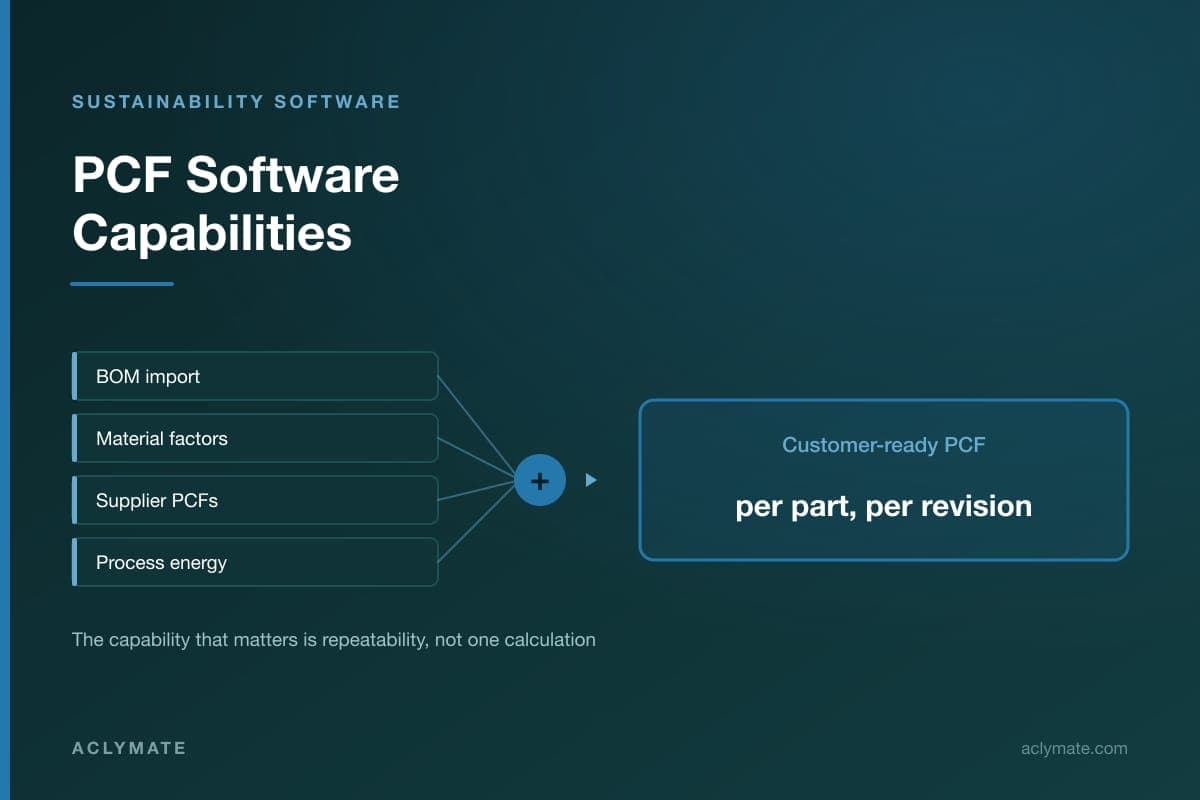
You can calculate one Product Carbon Footprint in a spreadsheet. Most suppliers do, for their first request.
The spreadsheet stops working at roughly the third part, or the first time an emissions factor updates, or the first time a customer specifies a boundary different from the one you used. That is when PCF software becomes a real requirement rather than a nice-to-have.
This guide covers what to look for, and the specific questions that separate genuinely capable PCF software from carbon accounting tools with a product feature bolted on.
Before any feature list, one question:
When an emissions factor updates, or a supplier finally sends a real number, what happens to the parts already calculated?
If the answer is that they recalculate, you have PCF software. If the answer is that someone reopens each spreadsheet, you have a calculator.
This matters because factors are revised annually, grid mixes change, and supplier data arrives continuously. A supplier with forty calculated part numbers and no propagation is facing forty rebuilds a year, indefinitely.
Every other capability below is downstream of this one.
Product footprints are built from bills of materials, and your BOMs already exist in an ERP or MRP system.
Re-keying them is where most product footprint programs quietly die. It is tolerable for three parts and impossible for three hundred.
What to look for:
That last point saves more time than it sounds like. Mapping "AL-6061-T6-BILLET" to an aluminum factor once, rather than per part, is the difference between an hour per part and a minute.
This is an automotive-specific requirement that general LCA tools sometimes handle badly.
A machined part shipping at 1.4 kg may consume a 4 kg billet. The emissions belong to the 4 kg, because that quantity was smelted, cast, and freighted. Software that works from the BOM's finished composition rather than purchased quantity will understate material emissions substantially — and materials usually dominate the total.
Check that the tool distinguishes input quantity from output quantity, and that it handles yield explicitly rather than requiring you to inflate masses by hand.
See how to calculate a PCF for an automotive part.
Cradle-to-gate is the automotive default, but customers specify their own boundaries and they are not always identical.
You need to be able to change the boundary and recalculate, rather than rebuild. A supplier answering four customers should not be maintaining four parallel models of the same part.
Also check declared unit handling — per part, per kilogram, per thousand pieces. A unit mismatch produces thousandfold errors and they are genuinely easy to miss in a spreadsheet.
See cradle-to-gate carbon footprints.
Allocating facility energy to a specific part is the most contested part of any PCF, and the part a customer is most likely to question.
Software should support multiple allocation bases — submetered, machine hours, mass processed, production volume — and record which was used, per part.
It should also handle shared facility load separately: compressed air, lighting, HVAC, process cooling. Taking total facility energy, subtracting directly allocated machine energy, and distributing the remainder on a consistent rule is a standard requirement, not an edge case.
Avoid tools that hard-code a single allocation method. You will eventually need to justify the choice, and you may need to change it if a customer's methodology specifies otherwise.
The factor library determines both accuracy and how much manual research you do.
What matters:
Purchased components carry their own footprints, and the ideal input is the supplier's own PCF.
Software should store those as first-class inputs with their attributes: boundary, declared unit, reporting period, and data quality. Storing only the number is a trap, because you cannot later check whether a supplier's cradle-to-gate figure excluded the freight leg to you.
It should also track which purchased items still lack supplier data, since that list is your supplier engagement backlog. See Scope 3 supplier data.
Customers increasingly ask not just for a footprint but for how much of it rests on primary data. Catena-X in particular emphasizes increasing supplier-specific primary data over time. Catena-X: Product Carbon Footprint
Software should label each input — measured, supplier-provided, calculated, estimated — and compute the primary-data share automatically at part level.
Retrofitting this onto a completed spreadsheet is considerably harder than recording it as you go, which is an argument for getting it right before you have forty parts rather than after.
A bare number is not a deliverable.
An export should carry part number, declared unit, boundary, reporting period and validity, kg CO2e, a breakdown by stage (materials, manufacturing, transport), primary-data share, allocation method, and factor sources with versions.
This is also the practical test of readiness for standardized exchange. A tool that produces a figure but cannot describe how it was derived will not fit a harmonized PCF exchange regardless of how accurate the arithmetic is. See Catena-X Product Carbon Footprints.
An underrated capability, and a good reason to keep corporate and product carbon in one system.
Your part footprints, summed across annual production volume plus scrap, should land in similar territory as the relevant portion of your corporate inventory. When they do not, one of the two calculations has a problem — usually energy allocation or material mass.
If corporate and product carbon live in separate tools with separate factor libraries, that check is impossible and the error goes unnoticed until a customer finds it.
Aclymate's Product Footprint Pack sits in the same environment as Navigator for exactly this reason.
The first PCF is genuinely hard, and the difficulty is rarely the software.
It is deciding which allocation basis is defensible, working out what the customer's boundary actually means, judging whether a supplier's provided figure is usable, and knowing whether the result is plausible.
For suppliers without sustainability staff, access to someone who has done this before is often more valuable than any individual feature. PCF services cover the work itself; supply chain sustainability consultants cover the interpretation.
A supplier with a handful of part numbers under request needs correctness and documentation more than scale. The priority is a defensible method and a clean export.
A supplier with dozens of part numbers across multiple customers needs propagation, BOM import, and boundary flexibility. This is where spreadsheets have already failed.
A large manufacturer additionally needs supplier PCF ingestion at scale, governance, and audit trails.
Buying for the tier above you produces a system nobody has time to run. Buying for the tier below produces a rebuild in eighteen months.
See the buyer's guide to automotive sustainability software, automotive Product Carbon Footprints, the six-platform comparison, or the Automotive & Transportation page.
What happens when an emissions factor updates or a supplier provides a real number. If existing parts recalculate automatically, you have PCF software. If someone reopens each spreadsheet, you have a calculator. Factors revise annually and supplier data arrives continuously, so a supplier with forty parts and no propagation faces forty rebuilds a year.
Because re-keying bills of materials is where most product footprint programs quietly stop. Manual entry is workable for three parts and impossible for three hundred. Look for ERP import, multi-level BOM support for assemblies, part revision handling, and material master mapping so internal material codes link to emissions factors once.
Yes, and some general LCA tools handle this badly. A machined part shipping at 1.4 kg may consume a 4 kg billet, and the emissions belong to the 4 kg. Software working from finished composition rather than purchased quantity will substantially understate material emissions, which usually dominate the total.
Because customers specify their own boundaries and they are not always identical. A supplier answering four customers should be able to change the boundary and recalculate rather than maintain four parallel models of the same part. Declared unit handling matters equally, since per-part versus per-kilogram mismatches cause thousandfold errors.
Coverage of automotive materials including aluminum alloys, steel grades, polymers, elastomers, electronics and coatings. Crucially it should distinguish production routes — primary versus recycled aluminum, blast furnace versus electric arc steel. It also needs versioning, support for custom supplier-specific factors, and regional grid factors that are kept current.
As first-class inputs with their attributes: boundary, declared unit, reporting period, and data quality. Storing only the number is a trap, because you cannot later check whether a supplier's cradle-to-gate figure excluded the freight leg to your facility. The software should also flag which purchased items still lack supplier data.
Because it catches errors. Part footprints summed across annual volume plus scrap should land in similar territory as the relevant portion of the corporate inventory. A large discrepancy usually indicates a problem in energy allocation or material mass. If the two live in separate tools with separate factors, that check is impossible.
Part number, declared unit, boundary, reporting period and validity, kg CO2e, a breakdown by materials, manufacturing and transport, primary-data share, allocation method, and factor sources with versions. A tool producing a bare figure will not fit standardized PCF exchange regardless of how accurate the arithmetic is.
Get Aclymate's practical sustainability content delivered weekly.
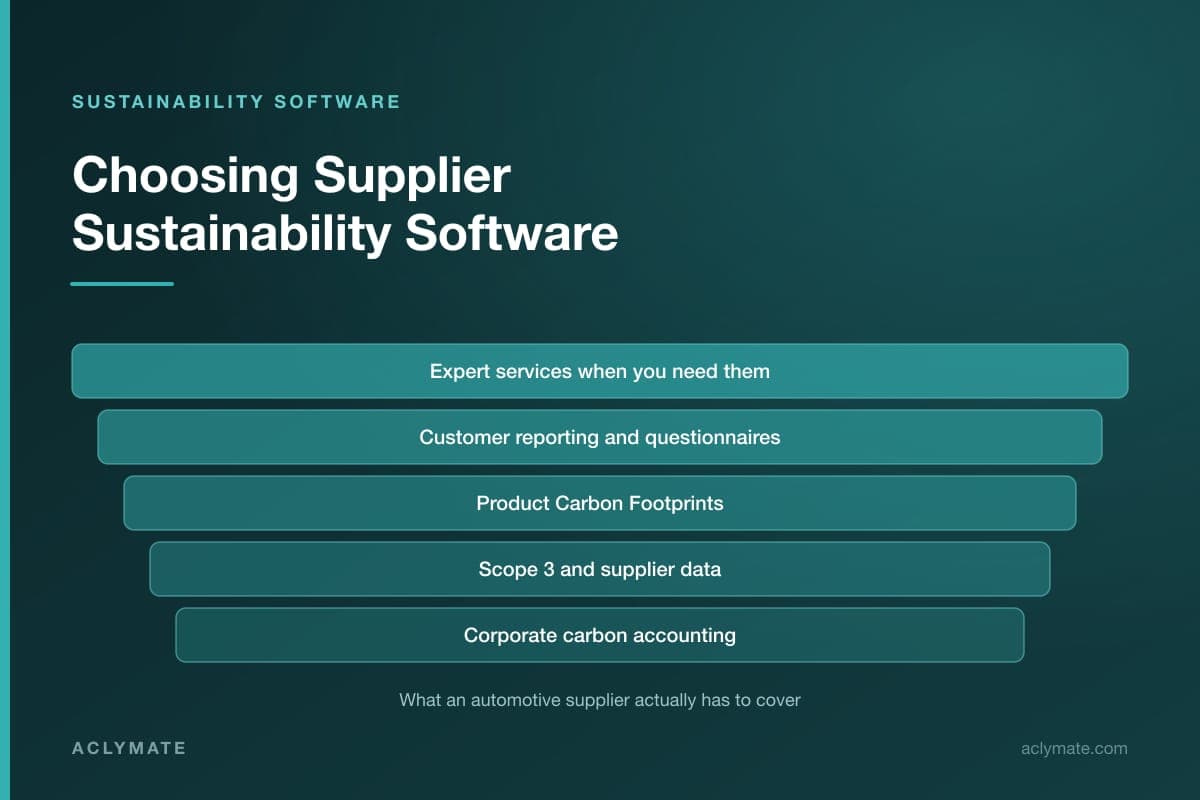
Learn how to choose automotive sustainability software for carbon accounting, Scope 3 supplier data, product footprints, customer reporting, and sustainability management.
Read Article
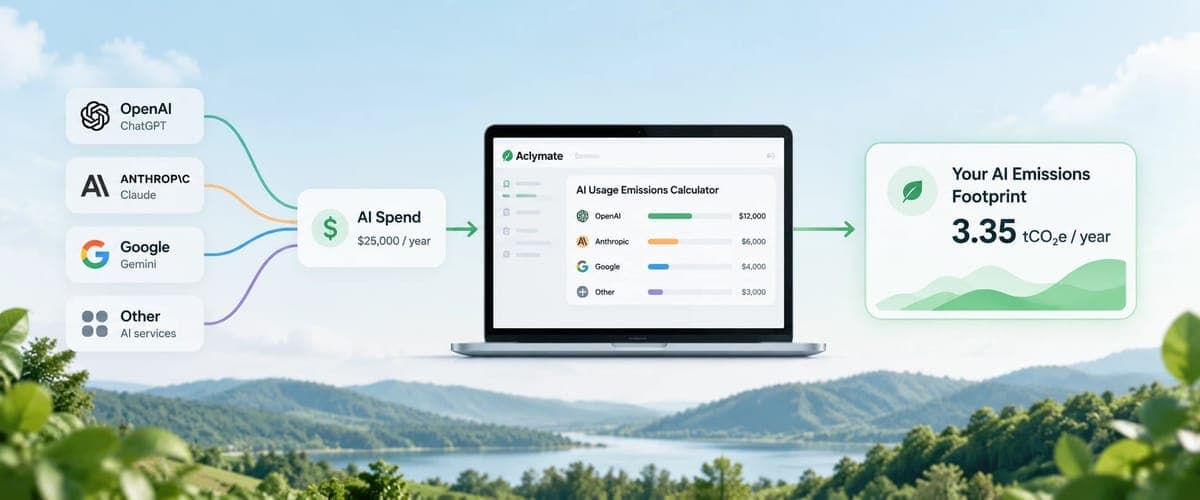
AI carbon emissions are becoming a new consideration for companies adopting ChatGPT, Claude, Gemini, Copilot and other artificial intelligence tools. Here’s how Aclymate estimates the carbon emissions from a company’s AI usage today—and how we expect the methodology to improve as AI providers release better usage and emissions data.
Read Article
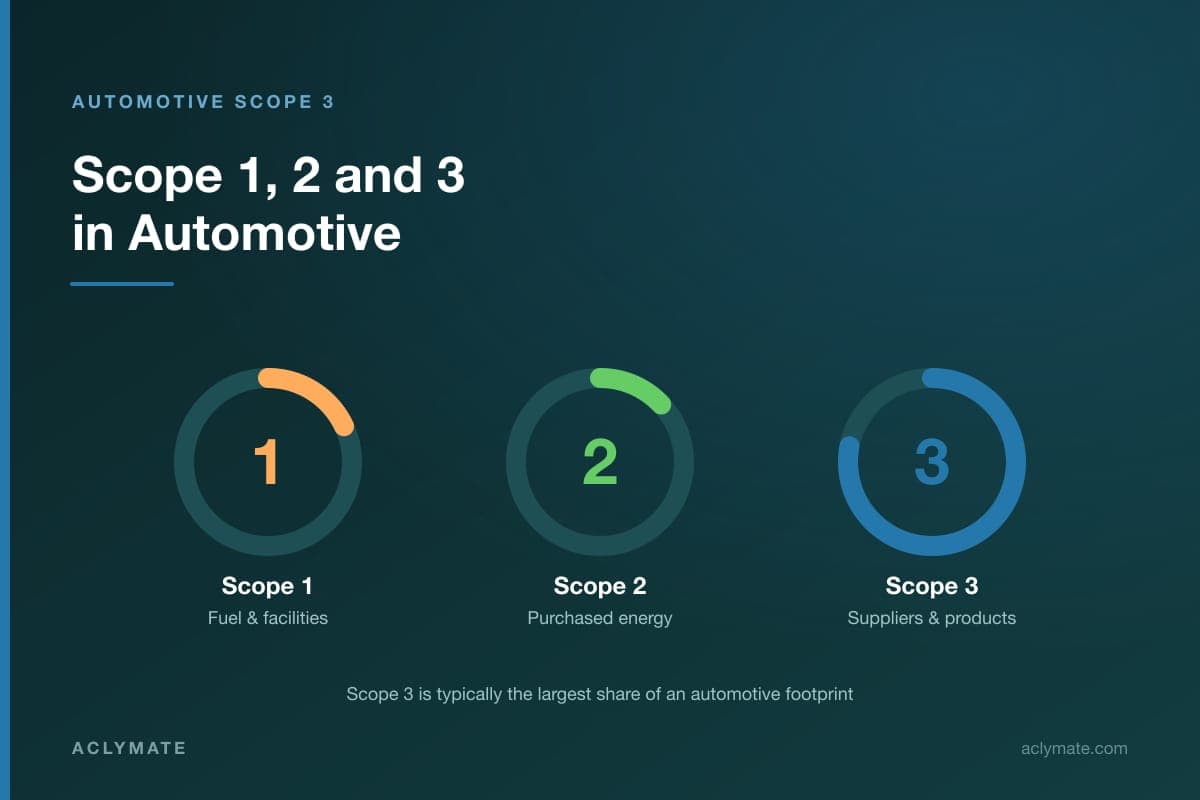
Learn how automotive companies measure Scope 3 emissions, collect supplier data, calculate product footprints, and meet customer reporting requirements.
Read Article
Talk with a Sustainability Expert, see a demo, or start free to put the Aclymate platform and experts to work for your team.