← Back to Insights
Aclymate Team
May 18, 2026
WHAT THIS GUIDE COVERS
Free online calculators are useful for awareness, not for business reporting. They do not produce defensible baselines, and most lack the data granularity companies actually need.
Spreadsheets and manual tracking work at first but break under Scope 3, audit requirements, and anything that needs to be repeatable across reporting years.
AI tools can assist with research and data interpretation but cannot connect to your financial systems, apply verified emission factors, or produce outputs any framework will accept.
Entry level paid software like Aclymate's Starter plan delivers a complete, framework aligned baseline that grows with the company.
When a growing company first starts looking into carbon accounting, the instinct is understandable: start with what is free, see how far it gets you, and evaluate paid tools later. That logic makes sense for a lot of software categories. For carbon accounting, it tends to create a specific kind of problem.
The problem is not that free tools are fraudulent or useless. Some of them are genuinely well built. The problem is that what they produce and what your customers, certifiers, or investors actually need are two different things. A number from a free calculator is not a baseline. A spreadsheet is not an audit trail. An AI summary of your emissions is not a GHG Protocol aligned inventory.
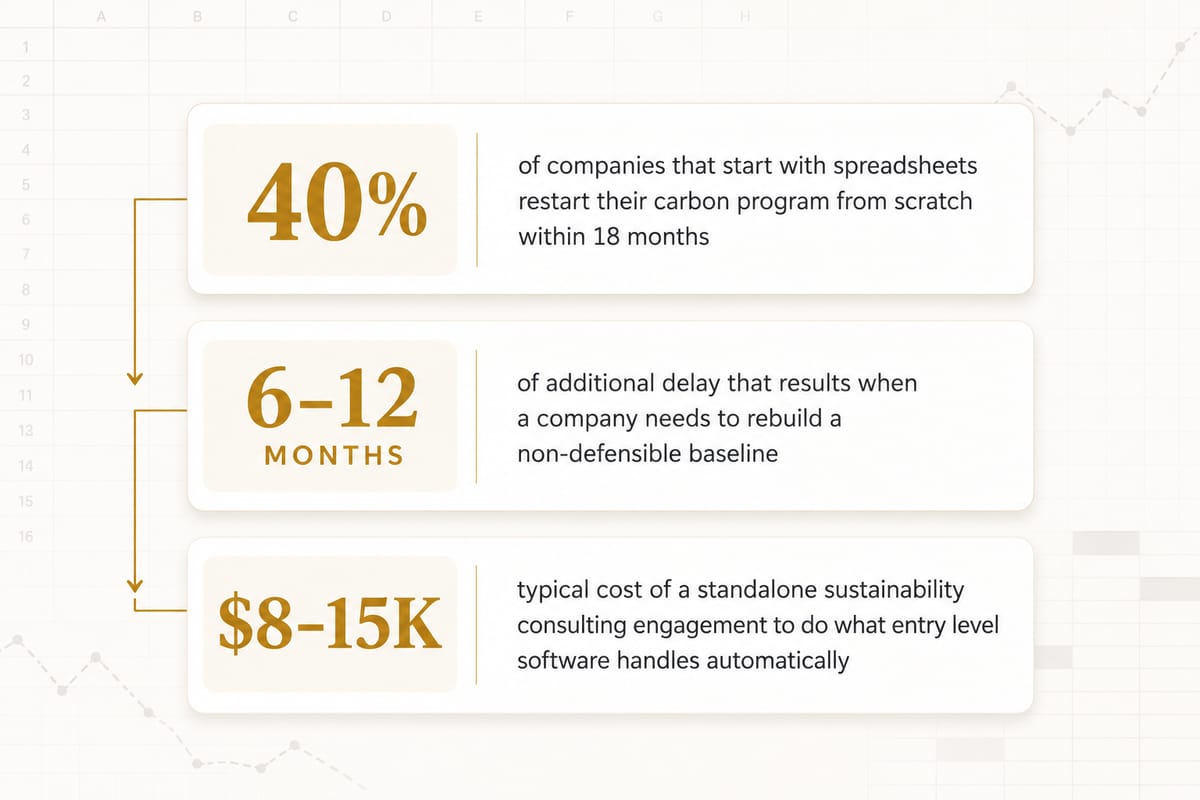
Companies discover this gap at the worst possible time: when they are in the middle of a B Corp audit, responding to a customer CDP request, or trying to set an SBTi target. At that point, the free approach has not saved money. It has delayed the real work by six to twelve months while creating a false sense of progress.
The cheapest carbon accounting approach is the one that actually gets your baseline done. A free tool you cannot use for reporting costs more than a paid tool you can.
Several reputable organizations publish free carbon footprint calculators online. The GHG Protocol offers calculation tools. The EPA provides an equivalencies calculator. Various universities and research institutions have released tools aimed at helping businesses estimate their footprint.
For a first orientation exercise, these tools have real value. They help a founding team or operations manager understand the rough order of magnitude of the company's emissions and which categories matter most. That is a useful starting conversation. It is not a sustainability program.
Most free calculators work by asking you to input annual quantities of energy consumed, miles traveled, waste generated, and similar categories. They apply generic emission factors and return an estimated total in metric tons of CO2e. The experience is fast and frictionless, which is part of the appeal.
The limitations become apparent as soon as a company tries to use the output for anything beyond internal awareness. Free calculators rarely distinguish between Scope 1, 2, and 3 emissions in a way that frameworks require. They use broad, averaged emission factors rather than location specific or supplier specific ones. They produce a point in time estimate, not a documented, reproducible methodology. And they generate no audit trail whatsoever.
When a customer asks for your CDP response, or a B Corp auditor reviews your emissions data, a number from a web calculator is not an acceptable answer. The methodology behind the number matters as much as the number itself.
WHAT THEY DO WELL
WHAT THEY CANNOT DO
Bottom line: Free calculators are a useful orientation exercise. They are not a carbon accounting program. If a customer, certifier, or investor asks for your emissions data, a calculator output will not satisfy the request.
After the calculator phase, the next step for many companies is a spreadsheet. An operations manager or sustainability-minded employee downloads a template, starts pulling data from utility bills and expense reports, and builds out what looks like a functional emissions inventory. This is a reasonable approach for the first few months. The problems emerge over time.
A well-constructed spreadsheet, using GHG Protocol guidance and up-to-date emission factors from sources like the EPA or DEFRA, can produce a technically defensible Scope 1 and 2 inventory for a simple business. That is genuinely true, and some companies do produce their first credible baseline this way.
The breakdown happens at scale and over time. Scope 3 emissions, which typically represent 70 to 90 percent of a company's total footprint, involve dozens of categories spanning purchased goods, business travel, employee commuting, and supply chain activity. Managing those categories in a spreadsheet requires significant ongoing expertise. Updating emission factors annually, reconciling data from multiple systems, and maintaining version control across reporting years is time consuming work that most mid-sized companies cannot sustain without a dedicated staff member.
The second failure mode is repeatability. A spreadsheet that one employee built and maintains is a single point of failure. When that person leaves, the institutional knowledge about data sources, calculation choices, and boundary decisions goes with them. Carbon programs need to be repeatable across years and auditable by third parties. Spreadsheets rarely satisfy either requirement without significant documentation overhead.
THE HIDDEN COST
A sustainability consultant charges $150 to $250 per hour. A mid-sized company maintaining a Scope 3 spreadsheet manually typically requires 80 to 150 hours of staff or consultant time per year to keep it audit ready. At $200 per hour, that is $16,000 to $30,000 per year in labor cost to maintain something a software platform would handle automatically.
WHERE IT WORKS
WHERE IT BREAKS DOWN
Bottom line: Spreadsheets are a viable starting point for the simplest cases. They become a liability when Scope 3 reporting is required, when staff changes, or when external verification is needed. Most companies that start here eventually migrate to software anyway, at the cost of considerable rework.
As AI tools have become more capable, a number of companies have started exploring whether ChatGPT, Claude, or similar tools can help with carbon accounting. The appeal is real: AI can research emission factors, help structure a GHG inventory, explain framework requirements, and generate draft reports. Some of this is genuinely useful.
What AI cannot do is act as the source of record for your emissions data.
AI tools can do useful supporting work in a carbon program. They can explain the difference between Scope 1, 2, and 3 emissions. They can help you identify which GHG Protocol categories apply to your business. They can draft sections of a CDP response or B Corp impact report based on data you provide. They can help interpret framework requirements that are written in dense technical language.
The limit is that AI tools have no connection to your financial systems, utility accounts, or supply chain. They cannot retrieve your actual transaction data. They cannot apply location specific emission factors to your specific energy usage. They cannot generate an output that an auditor would accept as a documented methodology, because AI generated content does not constitute a verified data source.
There is also a reliability risk. AI tools occasionally produce incorrect emission factor values or misattribute regulatory requirements. Using an AI generated emission factor in a formal disclosure without independent verification introduces error that could undermine the credibility of your entire program.
WHERE AI FITS AND WHERE IT DOES NOT
AI is a strong research and drafting assistant for sustainability work. It is not a carbon accounting system. Think of it as a very capable intern who can help you understand the landscape and prepare materials, but who should not be the source of record for your verified emissions data.
GENUINELY USEFUL FOR
CANNOT REPLACE SOFTWARE FOR
Bottom line: AI is a useful accelerator for the research and drafting phases of carbon accounting. It is not a substitute for a platform that connects to real data, applies verified emission factors, and produces outputs that frameworks and auditors will accept. Use both, not one instead of the other.
The comparison point that most growing companies underestimate is not between free tools and expensive enterprise software. It is between free tools and entry level paid platforms that cost $50 to $200 per month. That gap is where the real decision lives for most companies under 500 employees.
At the entry level price point, a purpose built carbon accounting platform delivers things that no free tool can: a connection to your actual financial data, a documented and reproducible methodology, Scope 3 coverage across multiple categories, framework aligned reporting outputs, and a data structure that survives staff changes and satisfies auditors.
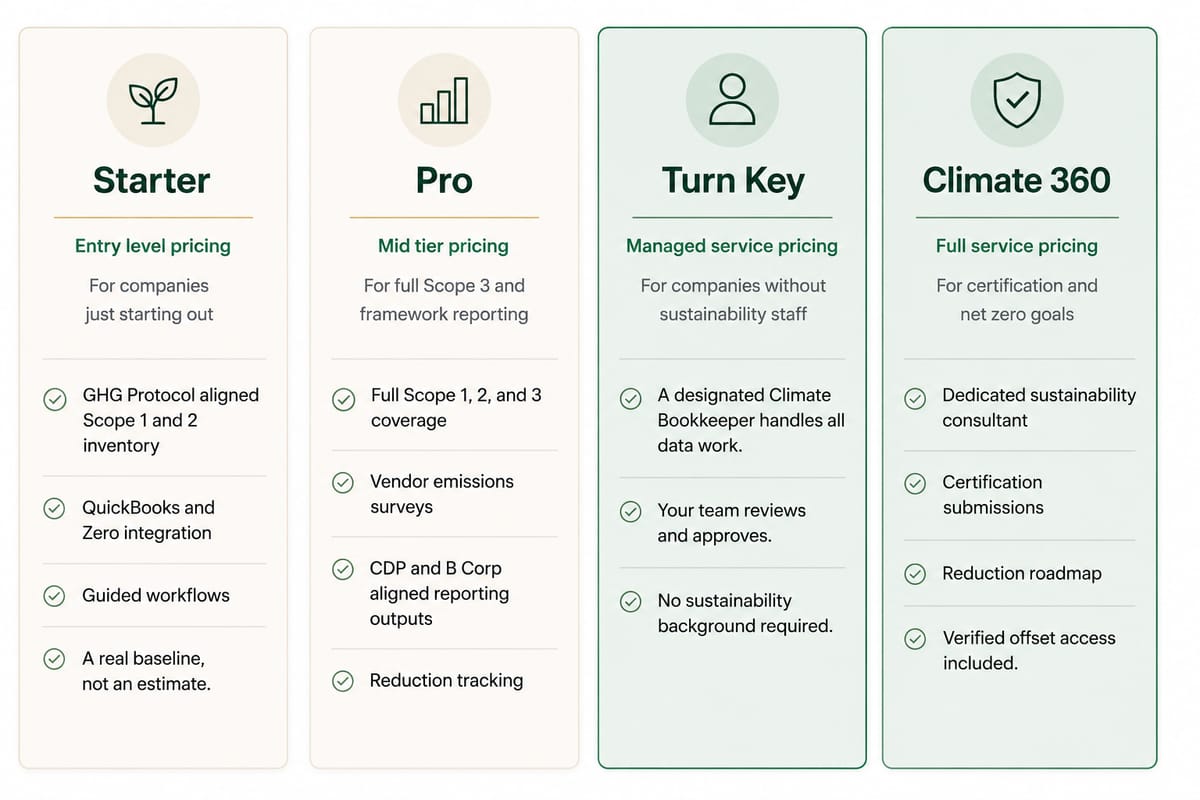
Aclymate is designed specifically for the company that is past the free calculator phase but not yet ready, or able, to pay enterprise software prices. The platform connects natively to QuickBooks and Xero, pulling transaction level spending data to calculate emissions automatically. For most small and mid-sized companies, that connection alone eliminates the majority of the manual data entry that makes spreadsheet based programs unsustainable.
What separates Aclymate from other entry level options is the breadth of what the base plans include. Even the Starter tier produces a GHG Protocol aligned Scope 1 and 2 inventory with a documented methodology. The Pro plan extends this to full Scope 3 coverage including vendor surveys, spend based estimation, and category level reporting. Framework aligned outputs for CDP, B Corp, EcoVadis, and GRI are included, not sold as add-ons.
For companies that do not want to manage the platform themselves, the Turn Key plan adds a designated Climate Bookkeeper who handles data categorization, review, and reporting preparation. This is a meaningful option for companies that need the program completed without pulling internal staff away from other priorities.
WHAT ACLYMATE DELIVERS AT ENTRY LEVEL
Bottom line: Aclymate's entry level plans cost a fraction of what a spreadsheet based program costs in staff time, and far less than discovering your free approach will not satisfy a B Corp audit or customer CDP request. For companies past the awareness phase, it is the most cost effective path to a real baseline.
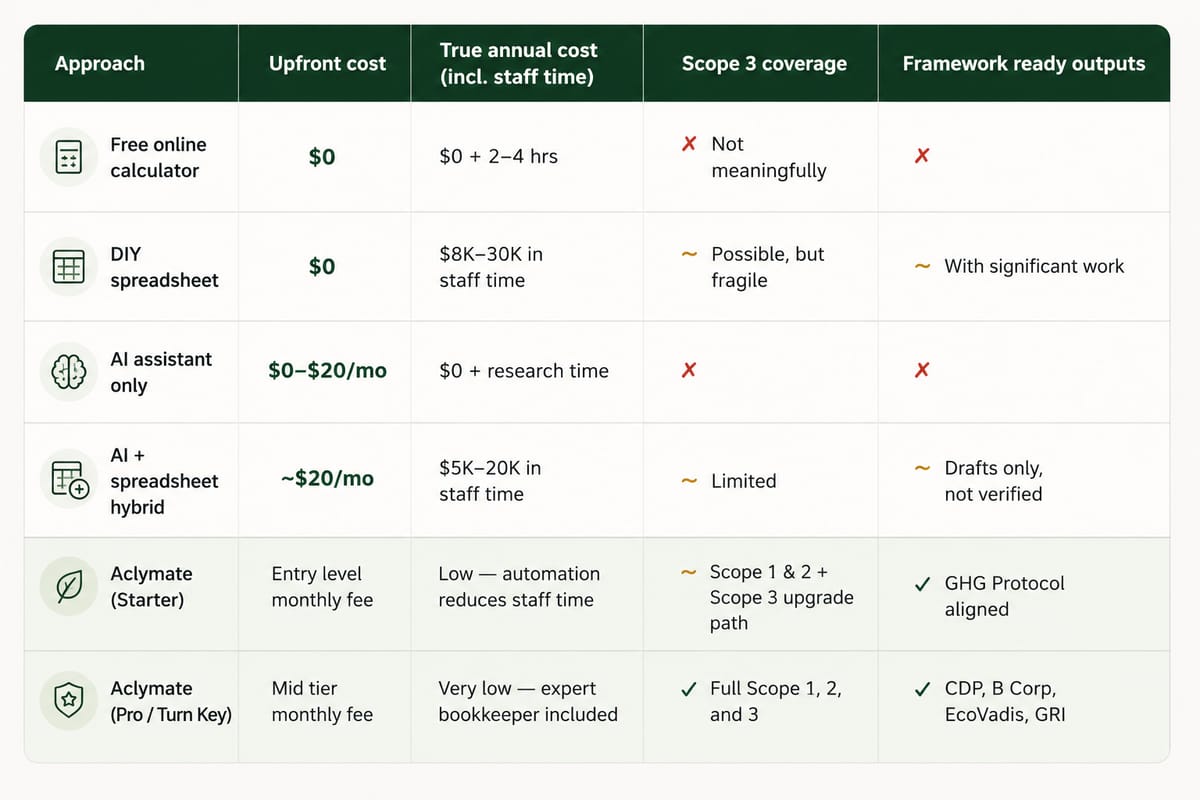
Here is how each approach stacks up across the dimensions that matter most for a growing company evaluating its options.
Not every company needs paid carbon accounting software immediately. If your program is purely internal and you have no external reporting obligations, a free calculator or basic spreadsheet can be a reasonable starting point. But there are clear signals that it is time to move.
If you answer yes to any of these, free tools will not be enough
1. A customer has asked for your carbon footprint or a sustainability questionnaire
CDP, EcoVadis, and custom supplier requests all require a documented, methodology-backed response, not an estimate.
2. You are pursuing or renewing a B Corp certification
B Corp's Impact Assessment includes emissions data requirements that a calculator output will not satisfy.
3. You want to set a reduction target
Credible reduction targets require a verified baseline. You cannot reduce against a number you cannot document.
4. You have investors or lenders asking about ESG, Sustainability, or Carbon Reporting
Investor ESG requests increasingly require Scope 3 data and documented methodology, not high-level estimates.
5. Your spreadsheet is owned by one person
If one employee leaving would create a crisis for your carbon program, the program is not sustainable. That is a signal to move to software.
6. You want to purchase carbon offsets credibly
Offset purchases require a known, verified footprint. Offsets against an undocumented estimate have no standing with certifiers.
If any of the above applies, the Aclymate Starter or Pro plan is almost certainly the most cost effective next step. The cost of the software is substantially lower than the cost of the staff time required to achieve the same outcome manually.
For many growing companies, the concern about carbon accounting software is not the cost of the software itself. It is the concern that nobody on the team knows how to use it. This is one of the most common objections, and it is worth addressing directly.
Most carbon accounting platforms were designed with the assumption that the person operating them has some sustainability background. Aclymate was explicitly designed around the opposite assumption: that the user is an operations manager, a finance director, or a founder who cares about this but has never heard of GHG Protocol before this month.
The onboarding flow starts with a readiness assessment that tells the company where it stands and what its first steps should be. The guided workflows explain what data is needed and why. The QuickBooks and Xero integrations eliminate most of the manual data gathering that requires expertise to do correctly by hand.
For companies that genuinely cannot dedicate any internal time to the program, the Turn Key plan includes a designated Climate Bookkeeper who handles the data work entirely. The company's role becomes reviewing and approving, rather than building and maintaining.
A NOTE ON THE 'WE WILL HIRE SOMEONE' PLAN
Many companies delay their carbon program until they hire a sustainability manager. The problem is that a sustainability manager hired into a company with no existing program, no data infrastructure, and no methodology documentation typically spends their first six to twelve months doing setup work that software would have handled from day one. Starting with Aclymate before the hire makes the eventual hire more productive, not redundant.
If you are starting from zero, the Aclymate Academy covers the most common frameworks and what companies in your situation typically need to measure and report. It is a useful starting point before a demo conversation.
Genuinely free tools exist, but they are calculators, not carbon accounting software. A carbon calculator gives you an estimate. Carbon accounting software gives you a documented, reproducible, audit ready inventory. The distinction matters enormously once you have an external reporting obligation. The GHG Protocol's free tools are valuable for learning, but they are not designed to serve as your system of record for business emissions.
A spreadsheet itself is free, but the labor cost of maintaining it is rarely zero. Companies that track their Scope 3 emissions manually typically spend 80 to 150 hours of staff or consultant time per year keeping their inventory current and audit ready. At any reasonable labor cost, that is far more expensive than an entry level software subscription. The spreadsheet is also structurally fragile in ways that software is not, particularly around staff turnover and audit requirements.
AI tools are genuinely useful for research, framework interpretation, and drafting. They can help you understand which GHG Protocol categories apply to your business, interpret CDP or B Corp requirements, and draft narrative sections of sustainability reports. They cannot connect to your data, apply verified emission factors, or generate outputs that any framework or auditor will accept as a documented source of record. Use AI as a research assistant and drafter, not as your accounting system.
Sustainability consultants typically charge $150 to $300 per hour. A typical first year carbon program engagement runs $8,000 to $25,000 for a mid-sized company. Aclymate's entry level plans cost a fraction of that annually, and the Turn Key plan costs substantially less than an equivalent consulting engagement while producing a repeatable, software backed program. See current Aclymate pricing here.
No. Aclymate's guided workflows are designed for users who have no prior sustainability background. If you want additional background, the Aclymate Academy covers voluntary frameworks and what they require in plain language.
Aclymate is designed to grow with the company. The Starter plan builds the data infrastructure and methodology foundation. Moving to Pro adds full Scope 3 coverage and additional framework outputs. Turn Key adds a managed service layer when the company needs more support. Climate 360 adds a dedicated consultant for certification and net zero strategy. All plan changes preserve the historical data and methodology already built, so nothing is lost or rebuilt when the company upgrades.
Yes. Aclymate maintains a running, documented inventory that can generate framework aligned outputs on demand. Companies using a spreadsheet or calculator approach typically spend three to six weeks pulling data together for each individual request. Book a demo to see how the response workflow operates in practice.
Aclymate's entry level plans give growing companies a complete, framework aligned carbon inventory without the enterprise price tag or the sustainability staff requirement.
Book a Free Demo →
See Pricing →
Get Aclymate's practical sustainability content delivered weekly.

AI is creating new opportunities for businesses, but it also comes with an environmental cost. Carbon offsets can help address some of those emissions, but businesses need to understand what they are offsetting, how offsets work, and why measuring and reducing emissions should come first.
Read Article
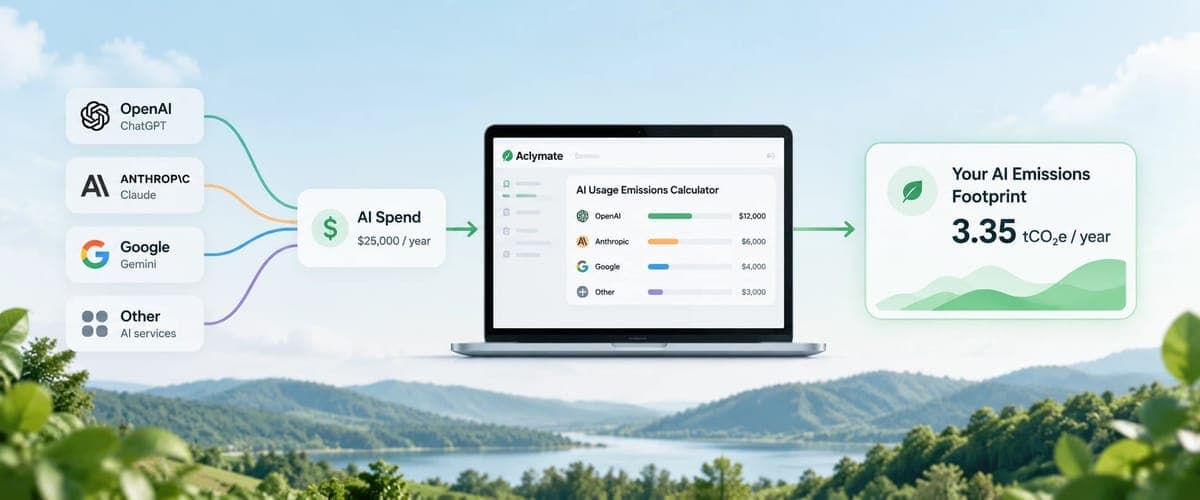
AI carbon emissions are becoming a new consideration for companies adopting ChatGPT, Claude, Gemini, Copilot and other artificial intelligence tools. Here’s how Aclymate estimates the carbon emissions from a company’s AI usage today—and how we expect the methodology to improve as AI providers release better usage and emissions data.
Read Article
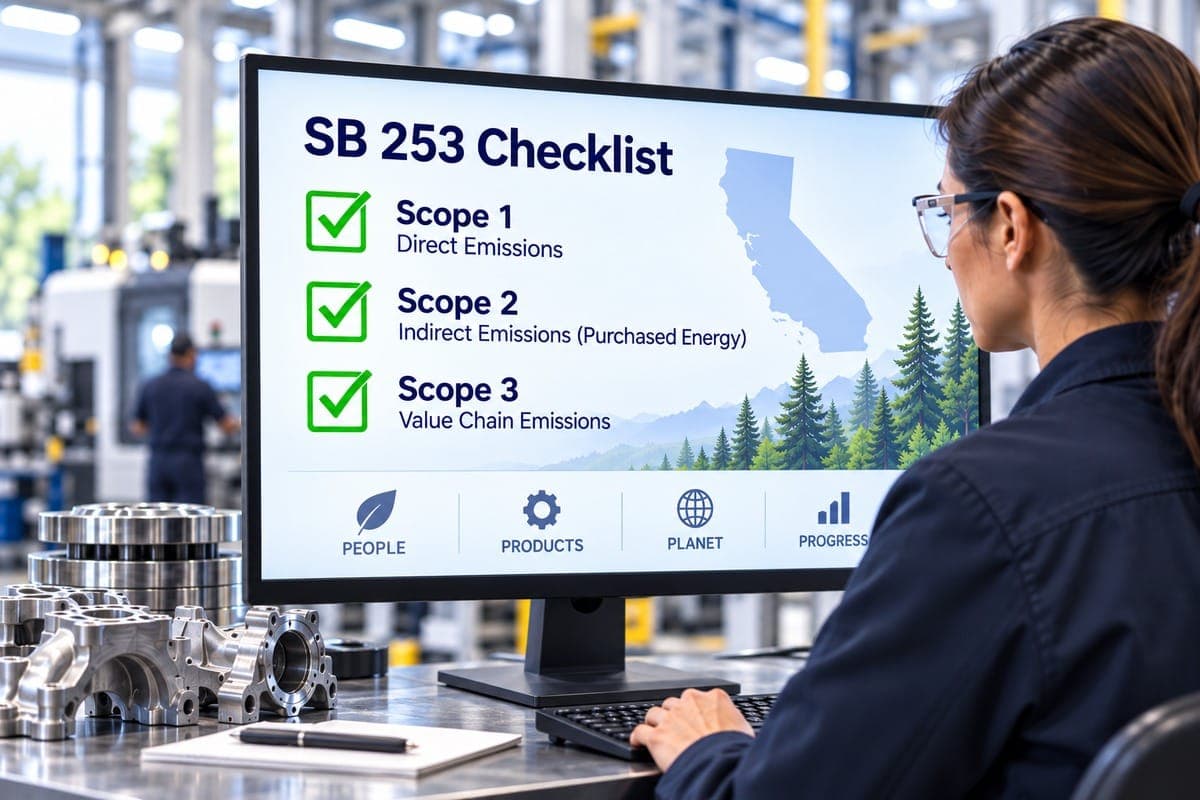
California SB 253 applies to companies over $1B in revenue — but its Scope 3 requirement reaches the automotive suppliers underneath them. What to expect and how to prepare.
Read Article
Talk with a Sustainability Expert, see a demo, or start free to put the Aclymate platform and experts to work for your team.