← Back to Insights
Bill Zujewski
September 3, 2026

Artificial intelligence has quickly moved from an emerging technology to a regular part of business operations.
Companies use AI to write and summarize content, analyze data, automate customer support, generate images and videos, write code, forecast demand, personalize customer experiences, and improve decision making.
But AI comes with an environmental cost.
Behind every AI application is physical infrastructure. Models run on servers that consume electricity, generate heat, and require cooling. Those servers operate in data centers that also use energy for networking, storage, security, and other infrastructure.
As AI adoption grows, so does interest in AI carbon emissions.
So, how much carbon emissions actually come from AI?
The short answer is: there is no single number.
AI emissions depend on the type of AI system, the amount of computing required, the hardware being used, data center efficiency, the source of electricity, and whether you are measuring a single AI request, a model's entire lifecycle, or the emissions associated with an organization's overall AI usage.
The International Energy Agency estimates that data centers consumed around 415 terawatt hours of electricity globally in 2024, representing about 1.5% of global electricity consumption. It projects data center electricity consumption to more than double to around 945 TWh by 2030, with AI an important driver of this increase. International Energy Agency: Energy Demand From AI
Understanding the numbers requires looking at where those emissions come from.
There is no universal carbon emissions figure for AI because different AI activities require different amounts of computing power.
A short text prompt is not equivalent to generating a high resolution image. Generating an image is not equivalent to generating a video. Training a large AI model is not equivalent to running a single inference.
The carbon emissions associated with AI therefore depend on several variables:
This makes simple claims such as "one AI prompt produces X grams of CO₂" difficult to generalize.
The same AI task can have a different carbon footprint depending on where and how it is processed.
A better way to think about AI emissions is to consider the energy required for computing and the carbon intensity of the electricity supplying that computing.
A simplified calculation is:
AI energy consumption × electricity carbon intensity = operational AI carbon emissions
The calculation becomes more complicated when companies want to include hardware manufacturing, infrastructure, and other lifecycle emissions.

AI itself does not release carbon dioxide.
The emissions come primarily from the infrastructure needed to develop and operate AI systems.
AI models require computing resources. Those resources consume electricity. If the electricity comes partly from fossil fuels, generating that electricity can produce greenhouse gas emissions.
There are several major sources of AI related emissions.
Training an AI model can require substantial computing resources.
During training, computers process large datasets and repeatedly adjust the model's parameters. Large models may require significant amounts of specialized computing hardware operating for extended periods.
The emissions associated with training depend on factors such as:
Training can therefore represent an important part of an AI system's environmental footprint.
However, training is only one stage of the AI lifecycle.
Once a model has been trained, it still requires computing resources every time it is used.
This process is known as inference.
When an AI system generates a response, recommendation, image, prediction, or other output, servers perform calculations to produce that result.
One individual interaction may have a relatively small footprint. But AI systems can process millions or billions of requests.
At that scale, relatively small amounts of energy per interaction can become significant when multiplied across massive usage volumes.
AI workloads run in data centers.
Data centers require electricity for more than just the processors performing calculations. Energy is also needed for:
The efficiency of a data center can therefore have a meaningful effect on the total energy required to run an AI workload.
The IEA expects electricity consumption from data centers to grow substantially through 2030, with accelerated servers, largely associated with AI, accounting for a significant share of that increase. International Energy Agency: Energy Demand From AI
AI also has an embodied carbon footprint.
The servers and specialized processors used for AI must be manufactured before they can be used.
Manufacturing electronic equipment requires raw materials, energy, transportation, and industrial processes. These activities create emissions that occur before the hardware ever runs an AI model.
For a comprehensive assessment, businesses therefore need to distinguish between operational emissions and embodied emissions.
AI computing hardware generates significant amounts of heat.
Data centers need cooling systems to maintain safe operating temperatures. Cooling can require additional electricity and, depending on the technology and location, other resources such as water.
This means that improving computing efficiency alone does not necessarily tell the entire story. The efficiency of the facility supporting that computing also matters.
One of the biggest challenges with AI carbon emissions is a lack of consistent, detailed data.
Businesses often use AI services provided by external companies. They may know how many users or requests they have, but they may not know exactly how much electricity was consumed to process those requests.
They may also lack information about:
This creates a measurement challenge.
An estimate can still be useful, but businesses should clearly document the assumptions behind it.
A precise looking number does not necessarily mean a precise measurement.
Generative AI can require significant computing resources because it creates new content rather than simply retrieving information from a database.
The environmental impact varies depending on what the system is generating.
For example, generating text, creating an image, producing audio, and generating video can involve very different computational workloads.
The length and complexity of a task can also affect resource consumption.
That does not mean every use of generative AI has a large carbon footprint. It means businesses should avoid assuming that every AI activity has the same environmental impact.
As AI becomes more integrated into everyday business workflows, the cumulative effect of usage becomes increasingly important.
Energy consumption is one of the most important factors behind AI carbon emissions.
However, AI energy consumption cannot be represented by a single number.
Different models and workloads can have dramatically different requirements.
A company's total AI energy consumption can depend on:
Number of AI requests × energy required per request
But even that simplified calculation requires reliable information about the energy associated with each workload.
At the global level, the trend is clearer.
The IEA estimates that electricity consumption from data centers could more than double between 2024 and 2030. AI is expected to be a major contributor to that increase. International Energy Agency: Energy and AI
This is why AI carbon emissions are becoming an increasingly important sustainability issue for technology companies, cloud providers, and businesses that rely heavily on AI.
For businesses, calculating AI emissions starts with understanding how AI is being used.
Create an inventory of AI tools and systems used throughout the organization.
This might include:
Identify where the AI workload is running.
Is the system operating on company owned servers, cloud infrastructure, or a third party AI platform?
The more information available about the underlying infrastructure, the better the emissions estimate can be.
Where possible, determine how much electricity the AI workload consumes.
Direct energy data is ideal.
When direct measurements are unavailable, companies may need to use estimates based on available usage information and documented assumptions.
Energy consumption can then be converted into CO₂e using an appropriate electricity emissions factor.
The emissions factor should reflect the relevant geography, electricity system, reporting period, and methodology.
This is important because one kilowatt hour of electricity does not necessarily have the same carbon footprint everywhere.
A useful carbon footprint should be transparent.
Businesses should document:
This makes the results easier to understand, reproduce, and improve over time.
AI emissions should generally be considered as part of a company's broader carbon footprint rather than treated as an entirely separate sustainability metric.
The GHG Protocol provides widely used standards for corporate greenhouse gas accounting.
Corporate emissions are generally organized into three scopes.
Scope 1 covers direct greenhouse gas emissions from sources that a company owns or controls.
For most businesses using third party AI services, the emissions generated by the external data center would not simply be classified as Scope 1.
Scope 2 covers indirect emissions associated with purchased or acquired electricity, steam, heating, and cooling consumed by the reporting company.
Scope 3 covers other indirect emissions throughout a company's value chain.
Technology services and purchased services can involve Scope 3 considerations, but the correct accounting treatment depends on the specific circumstances and applicable methodology.
The GHG Protocol explains that Scope 3 encompasses indirect emissions occurring throughout a company's value chain. GHG Protocol Corporate Standard FAQs
Businesses should therefore avoid automatically labeling all AI usage as Scope 3.
Instead, AI related emissions should be evaluated within the company's established carbon accounting boundaries and methodology.
Businesses can reduce the environmental impact of AI without necessarily abandoning the technology.
The goal is to use AI more efficiently and understand where the biggest opportunities exist.
Not every task requires the most powerful AI model available.
For simpler tasks, a smaller and more efficient model may be sufficient.
Choosing the right model for the task can help avoid unnecessary computing.
AI should provide meaningful value.
Businesses can review workflows to identify unnecessary or repetitive AI processing.
Reducing unnecessary computation can reduce energy consumption while potentially improving operational efficiency.
Companies can design workflows that minimize repeated processing.
For example, information that has already been analyzed may not need to be processed repeatedly if it can be stored and reused appropriately.
Businesses purchasing AI and cloud services can ask providers about:
Greater transparency from technology providers can make corporate carbon accounting more accurate.
AI may not be the largest source of emissions for a company.
Depending on the business, purchased goods, transportation, buildings, electricity, business travel, manufacturing, and supply chains may have significantly larger footprints.
This is why measuring AI emissions in isolation can provide an incomplete picture.
Yes.
AI has an environmental footprint, but it can also potentially help businesses reduce emissions.
AI can be used to:
The IEA identifies several potential applications for AI in the energy sector, including improving system operations, forecasting, and efficiency. International Energy Agency: Energy and AI
The important question is therefore not simply whether AI creates emissions.
Businesses should also consider what the AI is being used to accomplish and whether the benefits can outweigh its environmental costs.

Understanding AI carbon emissions is useful, but it is only one part of managing a company's overall environmental impact.
Businesses need visibility across their broader emissions inventory.
Aclymate's carbon accounting platform helps businesses measure and manage Scope 1, Scope 2, and Scope 3 emissions.
Instead of looking at AI emissions in isolation, businesses can use carbon accounting to understand how technology fits into their complete emissions profile.
That broader picture can help companies identify their largest emissions sources, improve data collection, track changes over time, and make more informed sustainability decisions.
For businesses getting started with carbon accounting, Aclymate Explorer provides a free way to estimate Scope 1, 2, and 3 emissions, identify emissions hotspots and data gaps, and begin collecting better supplier information.
Aclymate also provides practical guidance on topics including AI and Scope 3 emissions and using AI for carbon accounting.
For companies trying to understand their overall footprint, it is important to put AI into context alongside other potential emissions sources, including:
AI can be an important part of a company's technology footprint, but carbon accounting helps businesses understand whether it is actually a major emissions source and where reduction efforts can have the greatest impact.
There is no single global number that represents all AI carbon emissions. AI's footprint depends on computing demand, model type, hardware, data center efficiency, electricity sources, and the scale of AI usage. At the global level, AI is contributing to rapidly increasing data center electricity demand.
There is no universal figure. The emissions associated with an AI prompt depend on the model, prompt length, output, hardware, data center efficiency, and electricity mix. A text prompt and an image or video generation request can have very different energy requirements.
AI can have a significant carbon footprint at scale because it requires energy intensive computing infrastructure. However, the impact varies significantly between AI systems and applications.
AI models require powerful computing hardware to process large amounts of data and perform complex calculations. Data centers also require energy for cooling, networking, storage, and other infrastructure.
Generative AI has an environmental impact because it requires electricity and physical infrastructure. However, AI can also potentially help reduce emissions through applications such as energy optimization, logistics, forecasting, and resource efficiency.
Yes, although the level of accuracy depends on the data available. Businesses can estimate AI related emissions using information about computing activity, energy consumption, infrastructure, and electricity emissions factors. Where direct data is unavailable, documented estimates may be necessary.
AI usage can have value chain emissions implications, particularly when businesses purchase AI or cloud services from third parties. However, companies should determine the appropriate accounting treatment based on their organizational boundaries and recognized carbon accounting methodologies rather than automatically classifying AI emissions as Scope 3.
Companies can reduce AI related emissions by using efficient models, eliminating unnecessary workloads, optimizing workflows, choosing efficient infrastructure, considering electricity sources, and measuring AI usage within their broader carbon accounting system.
AI carbon emissions are becoming an increasingly important part of the conversation around sustainable technology.
There is no single number that answers how much carbon emissions come from AI. The footprint depends on what AI is doing, how much computing it requires, where that computing takes place, how efficient the infrastructure is, and how the electricity is generated.
For businesses, the most useful approach is not to focus on a single estimate for an individual AI interaction.
Instead, measure AI in the context of your company's broader carbon footprint.
Understanding where emissions come from allows businesses to identify meaningful reduction opportunities, improve sustainability reporting, and make better decisions about how technology is used.
AI is not going away. As adoption continues to grow, understanding its environmental impact will become an increasingly important part of responsible business management.
AI is only one piece of the emissions puzzle. To make meaningful progress, businesses need to understand their full carbon footprint.
With Aclymate's carbon accounting platform, businesses can measure Scope 1, Scope 2, and Scope 3 emissions, identify emissions hotspots, and build a clearer picture of their environmental impact.
Ready to understand your company's carbon footprint?
Explore Aclymate and start turning emissions data into actionable sustainability insights.
Get Aclymate's practical sustainability content delivered weekly.

AI is transforming carbon credit verification through satellite monitoring, automated analysis, and anomaly detection. But can technology solve the voluntary carbon market’s credibility problem? Discover the limitations of AI verification and how businesses can evaluate carbon credits while keeping emissions reductions ahead of offsetting.
Read Article

AI is creating new opportunities for businesses, but it also comes with an environmental cost. Carbon offsets can help address some of those emissions, but businesses need to understand what they are offsetting, how offsets work, and why measuring and reducing emissions should come first.
Read Article
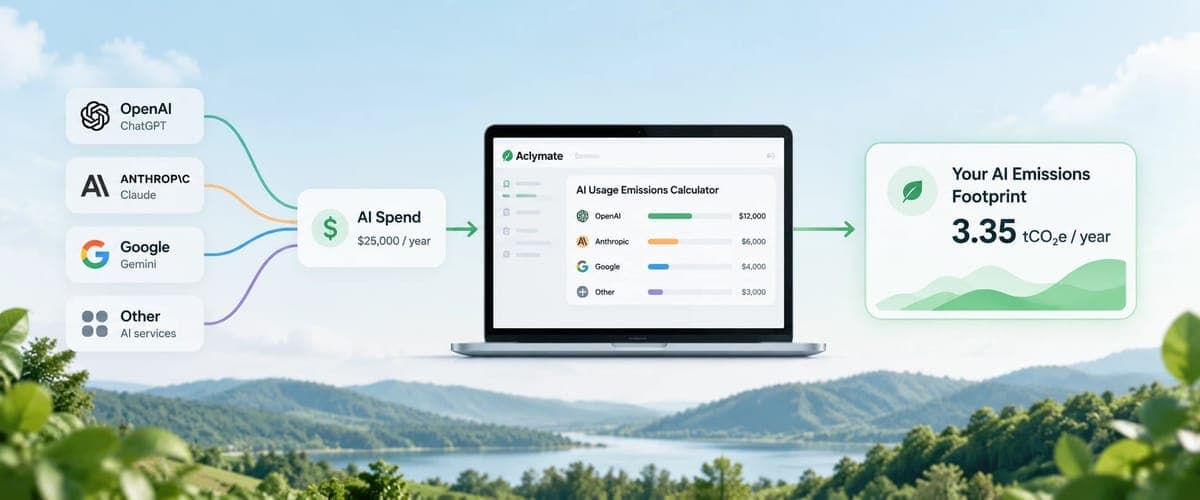
AI carbon emissions are becoming a new consideration for companies adopting ChatGPT, Claude, Gemini, Copilot and other artificial intelligence tools. Here’s how Aclymate estimates the carbon emissions from a company’s AI usage today—and how we expect the methodology to improve as AI providers release better usage and emissions data.
Read Article
Talk with a Sustainability Expert, see a demo, or start free to put the Aclymate platform and experts to work for your team.