← Back to Insights
Bill Zujewski
September 2, 2026

Artificial intelligence is becoming part of everyday business operations. Companies are using AI to analyze data, write content, automate customer service, generate images, forecast demand, write software, and make decisions faster.
But there is another side to the AI boom that businesses are beginning to pay attention to: the carbon footprint of artificial intelligence.
AI systems require computing power. That computing power runs in data centers that consume electricity, require cooling, and depend on physical infrastructure. Depending on where that electricity comes from and how efficiently the system operates, using AI can create greenhouse gas emissions.
The International Energy Agency projects that global data center electricity consumption could reach around 945 TWh by 2030, more than double its 2024 level. AI is one of the important drivers of that growth.
For businesses, the question is not whether they should stop using AI. The more useful question is:
How can we understand and manage the carbon footprint associated with our use of AI?
An AI carbon footprint is the greenhouse gas emissions associated with developing, training, operating, and using artificial intelligence systems.
These emissions can come from several parts of the AI lifecycle, including:
The resulting emissions are generally expressed as carbon dioxide equivalent, or CO₂e. CO₂e provides a common measurement for comparing different greenhouse gases based on their global warming impact.
It is important to recognize that there is no single universal "carbon cost" for an AI query. The footprint can vary substantially depending on the model, task, hardware, data center efficiency, electricity source, and other factors.
AI does not produce emissions simply because it is software.
The emissions primarily come from the physical infrastructure required to run it.
AI models operate on computers equipped with processors and accelerators that consume electricity. Those computers are generally housed in data centers, which also require electricity for networking, storage, cooling, lighting, backup systems, and other infrastructure.
The electricity itself may have a different carbon intensity depending on the local power grid.
For example, an AI workload powered largely by renewable electricity can have a substantially different emissions profile from the same workload running on a grid that relies heavily on fossil fuels.
The IEA estimates that data centers currently consume electricity from a mixture of sources including renewables, natural gas, coal, and nuclear power. Its analysis projects data center electricity generation to exceed 1,000 TWh by 2030 in its base case.
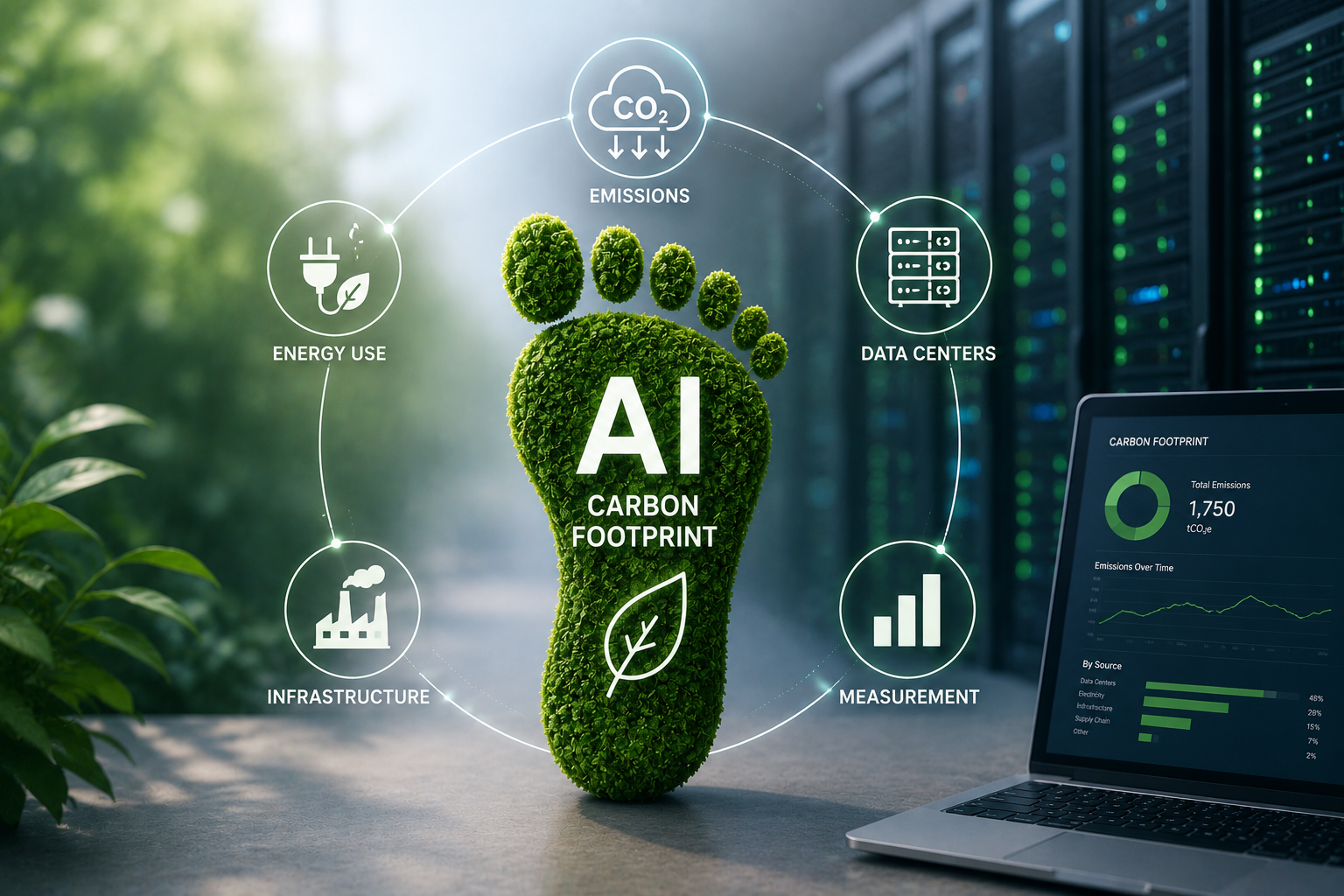
The carbon footprint of AI is not just about asking an AI chatbot a question. It is useful to think about AI emissions across the broader technology lifecycle.
Training a large AI model can require substantial computing resources.
During training, the model processes enormous amounts of data repeatedly while adjusting its parameters. This can require large numbers of specialized processors operating for extended periods.
The resulting footprint depends on factors such as:
Training is only one part of the overall footprint, however. Once a model has been developed, it can continue consuming energy every time people use it.
Inference is the process of running an already trained model to produce an output.
Every time an AI system generates an answer, image, recommendation, prediction, or other output, computing resources are required.
At an individual level, one interaction may have a relatively small footprint. At massive scale, however, millions or billions of interactions can create significant cumulative energy demand.
This is one reason AI adoption matters from a corporate sustainability perspective. A company that integrates AI into thousands of daily workflows may have a very different technology footprint from a company that uses it occasionally.
AI systems depend on data centers.
These facilities consume electricity not only for servers but also for cooling, networking, storage, backup systems, and other infrastructure.
As AI workloads become more computationally demanding, data center infrastructure is evolving to support increasingly dense computing environments.
According to the IEA, accelerated servers, which are mainly driven by AI adoption, are projected to account for almost half of the net increase in global data center electricity consumption through 2030 in its base case.
There is also an embodied carbon component.
AI requires physical hardware, including servers, processors, networking equipment, storage systems, and other components. Manufacturing those products requires raw materials, energy, transportation, and industrial processes.
For a complete technology lifecycle assessment, companies therefore need to consider both operational emissions and the emissions associated with producing the equipment.
Powerful computing systems generate heat.
Data centers therefore require cooling systems to keep equipment operating safely and efficiently. Cooling can increase the total energy demand associated with an AI workload.
The efficiency of the facility matters. Two data centers performing similar computing workloads can have different environmental impacts depending on their infrastructure and operating conditions.
There is no single number that accurately represents the carbon footprint of "AI."
The answer depends on what type of AI activity is being measured.
A simple text interaction, a high resolution image generation, and a long video generation request can require very different amounts of computing power.
Likewise, training a large model is fundamentally different from running an individual inference.
A useful AI carbon footprint calculation therefore needs to consider:
Energy consumed × carbon intensity of electricity = operational emissions
But even this simplified formula requires reliable data.
Energy consumption may depend on the hardware and workload, while carbon intensity depends on the electricity system powering the data center.
This is why businesses should be cautious about publishing a precise carbon number for AI use without understanding the methodology behind it.
For general context, the U.S. EPA Greenhouse Gas Equivalencies Calculator can translate emissions data into familiar equivalents such as vehicle miles, household electricity use, and other activities. The EPA also notes that the calculator is intended for communication and comparison rather than formal emissions inventories.
Calculating AI emissions can be challenging because companies do not always have direct access to the energy data associated with every AI workload.
A practical approach is to start by identifying the AI activities your company actually uses.
Create an inventory of where AI is being used.
For example:
If you operate your own AI infrastructure, you may have detailed electricity and hardware information.
If you use an external AI provider, you may have less visibility.
Cloud providers and AI vendors may provide sustainability information, but the level of detail varies.
This is one reason AI emissions can be difficult to calculate precisely at the company level.
Where reliable data is available, determine how much electricity is associated with the workload.
For companies using cloud infrastructure, this may involve working with cloud usage data or provider specific information.
Where direct energy data is unavailable, companies may need to use estimates or spend based approaches, while clearly documenting their assumptions.
Once energy consumption has been estimated, it can be converted into emissions using an appropriate electricity emissions factor.
The factor should reflect the relevant geography, electricity system, methodology, and reporting period whenever possible.
The same amount of electricity does not necessarily produce the same amount of CO₂e everywhere.
A defensible carbon footprint is not simply a number.
You should be able to explain:
This documentation becomes especially important when emissions data is being used for sustainability reporting, customer requests, procurement questionnaires, or climate targets.
For most businesses, AI should not be treated as a completely separate carbon accounting system.
Instead, AI related emissions should be considered within the company's broader greenhouse gas inventory.
The GHG Protocol divides corporate emissions into three scopes:
Direct emissions from sources owned or controlled by the company.
For most companies using third party AI services, the electricity used by the external data center would not simply become Scope 1 emissions.
Indirect emissions associated with purchased or acquired electricity, steam, heating, or cooling consumed by the reporting company.
Other indirect emissions occurring throughout the company's value chain.
This is where many technology related activities can become more complicated.
The GHG Protocol explains that Scope 3 covers indirect emissions throughout the value chain, including both upstream and downstream activities.
For businesses purchasing AI services from an external provider, the appropriate accounting treatment depends on the specific activity, organizational boundaries, contractual relationships, and applicable carbon accounting methodology.
The important point is that AI usage should be integrated into a company's established carbon accounting framework rather than treated as an isolated marketing metric.
AI has an environmental cost, but saying that AI is simply "bad for the environment" misses the bigger picture.
AI can increase energy demand and associated emissions.
At the same time, AI can potentially help organizations reduce emissions by:
The IEA highlights AI's potential to improve energy system operations and efficiency alongside its growing energy demand.
The sustainability question is therefore not simply whether AI uses energy.
It is whether the value created by an AI application justifies its resource use and whether companies can improve the efficiency of the technology over time.
Companies do not necessarily need to eliminate AI to reduce its environmental impact.
Instead, they can focus on using AI more efficiently.
Not every task requires the largest or most computationally intensive model.
Where appropriate, companies can use smaller or more efficient models for simpler tasks.
AI should solve a real business problem.
If a task can be completed effectively without generating additional AI workloads, using AI simply because it is available may add unnecessary resource consumption.
Well designed workflows can reduce repetitive AI interactions.
For example, instead of repeatedly asking an AI system to process the same information, a company can structure its workflow so that information is processed once and reused where appropriate.
Businesses with greater control over their infrastructure can evaluate hardware efficiency, data center efficiency, workload scheduling, and energy sourcing.
The carbon intensity of electricity matters.
Companies purchasing cloud or AI services can ask technology providers about renewable energy procurement, data center locations, energy efficiency, and emissions reporting.
The first step is understanding the baseline.
Companies should avoid setting arbitrary targets for "reducing AI emissions" before they know how AI contributes to their broader footprint.
That means starting with carbon accounting.
These terms are related but not identical.
An AI carbon footprint focuses on the greenhouse gas emissions associated with AI activities.
AI carbon accounting refers to the broader process of identifying, measuring, categorizing, documenting, and reporting those emissions within an organization's carbon accounting system.
For businesses, carbon accounting is the more useful long term approach.
A single estimate of the emissions from AI usage can be interesting. A repeatable accounting process can help a company understand trends, identify hotspots, respond to customer requests, and make better operational decisions.
Aclymate's guidance on using AI for carbon accounting makes an important distinction: AI can help organize and accelerate carbon accounting work, but it should not replace established emissions methodologies, reliable data, or expert judgment.

Understanding your AI carbon footprint is only one part of understanding your company's environmental impact.
Businesses need a broader view that includes Scope 1, Scope 2, and Scope 3 emissions.
Aclymate's carbon accounting software helps businesses measure and organize emissions across these scopes, collect sustainability data, track emissions, and create reporting outputs.
For companies just getting started, Aclymate Explorer provides a free way to estimate Scope 1, 2, and 3 emissions, identify emissions hotspots and data gaps, and begin collecting better supplier information.
This broader approach matters because AI may represent only one component of a company's overall footprint.
Depending on the business, larger emissions sources could include:
Aclymate helps businesses move from isolated sustainability estimates toward a more complete and repeatable carbon accounting process.
The platform also supports supplier and product data, which can be particularly important for companies whose largest emissions sources sit within their value chain.
For more practical guidance, see Aclymate's articles on AI and Scope 3 emissions, where carbon data comes from, and what a business carbon footprint actually means.
Yes. AI has a carbon footprint because operating AI systems requires electricity and physical infrastructure. Emissions can also be associated with manufacturing the hardware used to run AI systems.
The main sources include electricity used by computing hardware, data center cooling and infrastructure, model training, AI inference, and the manufacturing of servers and other hardware.
There is no universal number. The emissions associated with an AI query depend on factors such as the model, workload, hardware, data center efficiency, electricity source, and output type. A simple text request can have a very different footprint from an image or video generation request.
AI systems such as ChatGPT require data center computing resources and therefore have an environmental footprint. However, a reliable estimate for a specific interaction requires information about the underlying model, computing resources, electricity consumption, infrastructure efficiency, and electricity mix.
A basic approach is to estimate the electricity consumed by the AI workload and multiply it by an appropriate electricity emissions factor. A more complete assessment can also consider infrastructure, hardware manufacturing, and other lifecycle emissions.
Potentially. AI services purchased from third parties can involve value chain emissions, but the correct accounting treatment depends on the company's organizational boundaries, the nature of the service, and the applicable carbon accounting methodology. Businesses should follow recognized standards rather than automatically classifying all AI usage as Scope 3.
Yes. AI can potentially improve energy efficiency, logistics, forecasting, manufacturing, building operations, and other processes. The environmental benefit depends on the application, the emissions it helps avoid, and the energy and infrastructure required to operate the AI system.
Not necessarily. Businesses should evaluate the value and environmental impact of AI applications, use efficient technology where possible, and include material AI related emissions within their broader sustainability and carbon accounting strategy.
AI is changing how businesses work, but it is also changing the energy demands of the digital economy.
Every AI system depends on physical infrastructure, electricity, cooling, hardware, and data centers. As AI adoption grows, understanding those environmental impacts will become increasingly important.
The goal should not be to treat AI as inherently good or bad for the climate.
The goal is to measure what matters, understand where emissions come from, improve efficiency, and make better decisions with reliable data.
For businesses, that starts with a broader carbon accounting system that puts AI in context alongside Scope 1, Scope 2, and Scope 3 emissions.
You cannot manage an AI carbon footprint you cannot measure.
AI is only one part of your company's carbon footprint. The first step toward managing your emissions is understanding where they come from.
With Aclymate's carbon accounting platform, you can measure your company's Scope 1, Scope 2, and Scope 3 emissions, identify your biggest emissions sources, and build a clearer picture of your overall carbon footprint.
Ready to understand your company's emissions?
Explore Aclymate's carbon accounting platform and start turning your emissions data into actionable sustainability insights.
Get Aclymate's practical sustainability content delivered weekly.

AI is transforming carbon credit verification through satellite monitoring, automated analysis, and anomaly detection. But can technology solve the voluntary carbon market’s credibility problem? Discover the limitations of AI verification and how businesses can evaluate carbon credits while keeping emissions reductions ahead of offsetting.
Read Article

AI is creating new opportunities for businesses, but it also comes with an environmental cost. Carbon offsets can help address some of those emissions, but businesses need to understand what they are offsetting, how offsets work, and why measuring and reducing emissions should come first.
Read Article
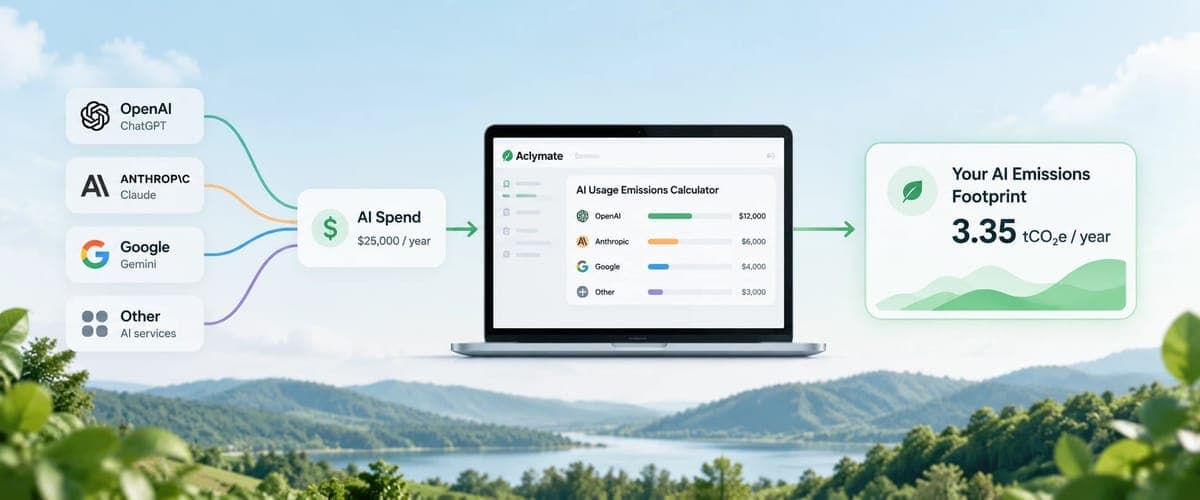
AI carbon emissions are becoming a new consideration for companies adopting ChatGPT, Claude, Gemini, Copilot and other artificial intelligence tools. Here’s how Aclymate estimates the carbon emissions from a company’s AI usage today—and how we expect the methodology to improve as AI providers release better usage and emissions data.
Read Article
Talk with a Sustainability Expert, see a demo, or start free to put the Aclymate platform and experts to work for your team.