← Back to Insights
Aclymate Team
October 20, 2025

Many companies face growing pressure to report their sustainability performance in a clear and credible way.
Investors want data that proves responsible operations, while customers expect ethical business choices. Even governments require detailed climate-related disclosures.
Sustainability reporting standards and frameworks provide the necessary structure for collecting and analyzing important ESG data. These help you achieve regulatory compliance and meet increasing expectations from different stakeholders.
This article covers the most important sustainability reporting standards and frameworks you can use to stay compliant. We'll also discuss the common challenges you may expect and how to solve them.
Sustainability reporting is the process of sharing information about your company's environmental, social, and governance (ESG) performance.
ESG reporting allows you to show how daily operations impact people and the planet. It's an effective way to communicate sustainability efforts, progress, outcomes, and risks to different stakeholders (investors, partners, government regulators, customers, and employees).
Sustainability disclosures or reports often include details on carbon emissions, energy consumption, employee well-being, and ethical business practices.
They also cover your company's sustainability goals and strategies to address climate-related risks across your entire value chain.
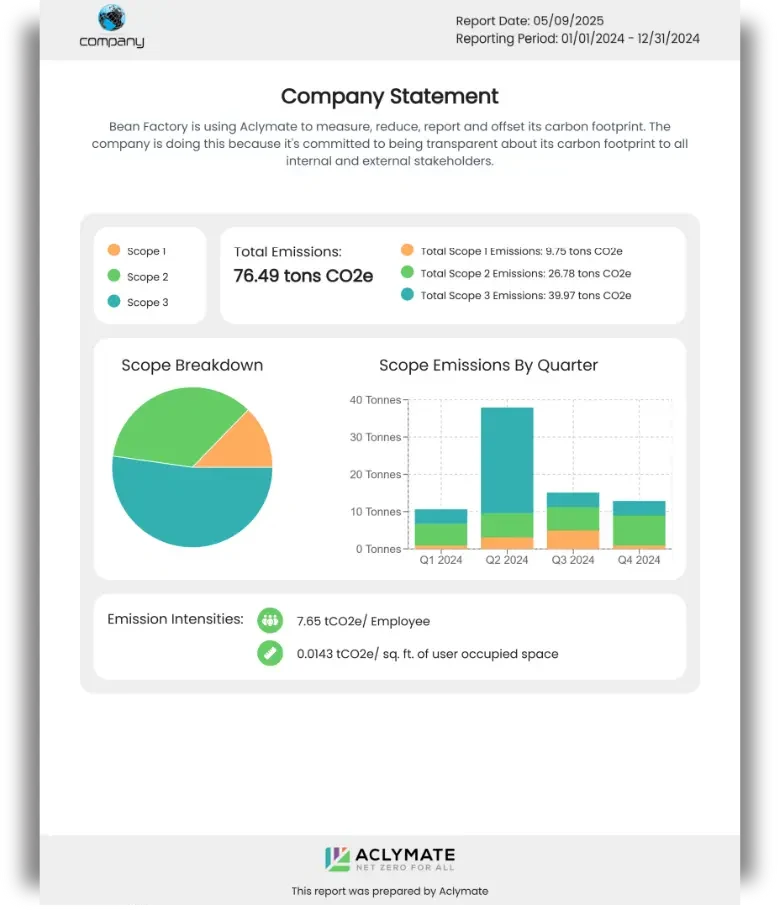
Many organizations use recognized frameworks to make their ESG reporting accurate, consistent, and credible. Below are the ten most popular sustainability reporting standards:
Purpose: Enable organizations to communicate and be accountable for their ESG impacts.
Focus areas: Environmental impact and sustainability topics, such as human rights, climate change, and supply chain practices.
Target businesses: Voluntary only for companies of all sizes and industries.
Stakeholder audience: Investors, regulators, employees, and all other stakeholders interested in transparency and environmental performance.
The Global Reporting Initiative is one of the most widely used sustainability reporting frameworks. It provides detailed guidelines that help companies report on their environmental, social, and economic performance.
The GRI standards are modular, meaning they include universal, sector-specific, and topic-specific standards that you can apply to different organizations and sustainability issues.
Companies use GRI to show measurable progress toward sustainability goals and meet stakeholder expectations.
For those seeking transparency and credibility, GRI offers structured, evidence-based reporting that aligns with global expectations.
Purpose: Help organizations measure and disclose their environmental performance to drive sustainable action and increase cost savings.
Focus areas: Climate change, water security, and deforestation risks across global supply chains.
Target businesses: Voluntary for corporations and governments committed to managing environmental impacts.
Stakeholder audience: Investors, customers, and policymakers focused on environmental accountability.
CDP is a global disclosure system that helps organizations measure, manage, and report their environmental performance.
Through detailed questionnaires, CDP reporting standards collect sustainability data on carbon emissions, energy use, water management, and deforestation.
Companies submit these disclosures annually, allowing stakeholders to assess their environmental strategy and risk management practices.
CDP reporting is unique because it connects directly to investors and supply chain partners. A strong CDP performance can improve your company’s reputation and investor confidence.
Submitted reports receive a grade from A to D-, with “A List” companies known for leadership in environmental transparency and performance.
Purpose: Help businesses disclose financially material sustainability information to investors.
Focus areas: Industry-specific ESG metrics tied to financial performance and risk management.
Target businesses: Voluntary for most companies seeking to disclose environmental risks and opportunities relevant to investors.
Stakeholder audience: Investors, analysts, and financial regulators focused on corporate sustainability performance.
The Sustainability Accounting Standards Board provides a structured approach to help companies report ESG information that affects financial value.
Unlike other general frameworks, SASB standards focus on financial materiality. This refers to the sustainability issues that are most likely to impact a company’s financial results.
SASB offers industry-specific, non-financial reporting standards across 77 sectors. It recognizes that sustainability risks vary between industries, such as manufacturing, healthcare, and finance.
SASB bridges the gap between traditional financial reporting and ESG performance. This helps you communicate how environmental or social issues could affect profitability, operations, and long-term value.
Purpose: Encourage companies to meet high standards of social and environmental performance, accountability, and transparency.
Focus areas: Governance, workers, community, environment, and customer impact.
Target businesses: Small, private companies committed to balancing profit with purpose and those seeking B Corp certification.
Stakeholder audience: Customers, employees, investors, and communities interested in ethical and sustainable business practices.
The B Corporation (B Corp) certification is a sustainability framework that evaluates how a company’s operations and business model impact society and the planet.
B Lab, a non-governmental organization, awards the B Corp Certification for organizations that meet high standards of verified accountability, performance, and transparency.
To obtain this certification, you should score at least 80 points on the B Impact Assessment (BIA) and update your assessment every three years. Multinational corporations must also meet baseline standards.
Other requirements include a revised corporate governance structure and a publicly reported company's performance against B Lab's standards.
Unlike traditional reporting frameworks, B Corp certification offers a holistic approach. It doesn't focus on a single social or environmental issue.
Purpose: Strengthen corporate transparency and provide stakeholders with better tools to evaluate corporate sustainability.
Focus areas: ESG impacts and sustainable business practices.
Target businesses: Mandatory reporting for large EU companies, small to medium-sized enterprises (SMEs), and non-EU companies with significant operations in the EU.
Stakeholder audience: Investors, regulators, policymakers, and civil society organizations who want to evaluate a company's sustainability priorities.
The Corporate Sustainability Reporting Directive (CSRD) is a major EU regulation that replaces the older Non-Financial Reporting Directive (NFRD).
It expands the number of companies (from 11,000 to 50,000) required to disclose sustainability data and defines how they should report that information.
The CSRD covers different sustainability topics, including ESG factors, biodiversity, climate change, human rights, and anti-corruption measures.
The CSRD is closely related to the European Sustainability Reporting Standards. This ensures alignment between regulatory expectations and practical reporting guidelines.
Purpose: Provide a reporting foundation for consistent and comparable sustainability disclosures across the European Union.
Focus areas: Environmental, social, and governance topics aligned with EU sustainability goals and regulations.
Target businesses: Mandatory reporting for large EU companies and listed SMEs under the Corporate Sustainability Reporting Directive.
Stakeholder audience: Investors, regulators, and other stakeholders seeking transparent and reliable ESG data.
The European Sustainability Reporting Standards is a popular sustainability reporting format in the European Union. It is developed by the European Financial Reporting Advisory Group (EFRAG).
ESRS establishes detailed requirements that help you decide what sustainability information to disclose and how to present it. The goal is to create consistent, comparable, and verifiable ESG data across all EU member states.
ESRS also introduces the concept of double materiality. It requires companies to report how social and environmental issues create climate-related financial risks and how business operations impact people and nature.
Purpose: Create a unified global baseline for sustainability and climate-related financial disclosures.
Focus areas: Sustainability-related risks and opportunities, including climate-related financial impacts, greenhouse gas (GHG) emissions, and sustainability targets.
Target businesses: Voluntary for global companies of all sizes, particularly those seeking to meet investor information needs.
Stakeholder audience: Investors and chief financial officers (CFOs) who want access to decision-useful, cost-effective sustainability data.
The International Sustainability Standards Board was established by the IFRS Foundation to ensure global consistency in sustainability reporting.
It builds on multiple frameworks, including industry-based SASB standards and the Task Force on Climate-related Financial Disclosures.
The ISSB promotes comparability across markets, which can support investor decision-making and attract capital.
This reporting standard also helps you avoid double-reporting. It ensures compliance with jurisdictional requirements while improving efficiency.
Purpose: Help companies disclose climate-related risks and opportunities for better financial decision-making.
Focus areas: Climate risks, governance, strategy, risk management, and other metrics related to climate change.
Target businesses: Voluntary for companies across all industries, but widely encouraged by regulators and investors.
Stakeholder audience: Investors, lenders, insurance underwriters, and other financial market participants.
The Financial Stability Board (FSB) established the Task Force on Climate-related Financial Disclosures to help businesses report the financial impacts of climate change.
Although it's now integrated into the International Sustainability Standards Board (ISSB), TCFD standards remain important to global sustainability reporting.
The framework centers on four elements: governance, strategy, risk management, and metrics and targets.
Companies use TCFD to explain how they identify, assess, and manage climate-related risks and opportunities.
Purpose: Drive corporate climate action by setting greenhouse gas reduction targets aligned with the Paris Agreement.
Focus areas: Science-based emission reduction goals consistent with limiting global warming to below 2°C above pre-industrial levels.
Target businesses: Voluntary for companies of all sizes and sectors committed to achieving net-zero emissions.
Stakeholder audience: Corporate leaders, investors, regulators, customers, and supply chain partners interested in verified climate commitments.
The Science-Based Targets initiative helps companies align their climate strategies with the goals of the Paris Agreement, an international treaty that aims to limit global warming.
It provides a science-backed framework for setting and validating targets to cut greenhouse gas emissions across operations and value chains.
Companies submit their targets to SBTi to ensure they meet strict criteria based on the latest climate research.
The initiative focuses on measuring, reporting, and reducing Scope 1, 2, and 3 emissions. This helps you address both direct and indirect environmental impacts.
Over 7,000 worldwide organizations have set emissions reduction targets using SBTi, making it among the most popular frameworks for setting decarbonization targets.
Purpose: Help businesses evaluate their performance on important ESG criteria.
Focus areas: Environment, labor and human rights, ethics, and sustainable procurement.
Target businesses: Voluntary for companies aiming to strengthen ESG performance and supply chain accountability.
Stakeholder audience: Customers, suppliers, investors, and procurement teams interested in ethical and sustainable business operations.
While EcoVadis is not a formal sustainability reporting framework, it plays a key role in improving sustainability performance across global supply chains.
EcoVadis provides an independent rating system that measures a company's performance across four sustainability themes. These include environmental impact, labor and human rights, ethics, and sustainable procurement.
Each company receives an EcoVadis score ranging from 0 to 100. This reflects the quality of your sustainability management system during the assessment.
The top 35%, 15%, 5%, and 1% of businesses are also awarded with medals to encourage continuous operational improvements.

Sustainability or climate reporting matters for several reasons:
Sustainability reporting improves credibility by showing how your company measures and communicates its environmental and social performance.
It helps you build stronger relationships with investors, customers, and employees who value honesty and accountability.
Meeting sustainability reporting requirements before they're required positions your brand as the leader within your industry.
It demonstrates that your company acts responsibly and contributes positively to society. This enhances corporate reputation and helps you stand out in competitive markets.
Governments and regulators are raising expectations for environmental and social transparency.
Effective sustainability reporting helps you comply with local and international standards. You can avoid non-compliance fines and legal consequences.
By collecting and reporting ESG data, you can manage risks related to operations, supply chains, and regulatory compliance. These include climate-related disruptions, resource shortages, and social issues that may affect sustainability performance.
Proactive reporting also empowers leadership teams to make informed decisions and work toward sustainable development.
Customers increasingly consider a brand’s sustainability commitments before making purchases. In fact, 72% of B2B buyers are more likely to purchase from socially responsible companies.
Transparent reporting attracts environmentally conscious buyers. At the same time, it boosts client loyalty when they see your company's progress towards ethical goals.
Employees seek companies that make a positive impact. Data shows that 64% of millennials only work for climate-conscious organizations.
Publishing sustainability reports shows your workforce that your company values fairness, diversity, and responsible operations. This builds pride, improves morale, and reduces turnover.
Sustainability reporting builds resilience by turning ESG data into actionable insights that guide future strategies.
It helps you identify weaknesses, improve efficiency, and plan ESG investments based on measurable results. This ensures your company stays competitive and future-ready.
Although sustainability reporting is important, it presents several challenges to businesses.
Aclymate solves all these challenges by supplying the sustainability reports you need in the correct format. It also supports native integrations with accounting software and utility bills, which can simplify data collection.
Plus, climate bookkeepers handle all data entry for you while making sure you comply with evolving regulations. Sign up today and let Aclymate's climate experts tackle your sustainability reporting challenges.
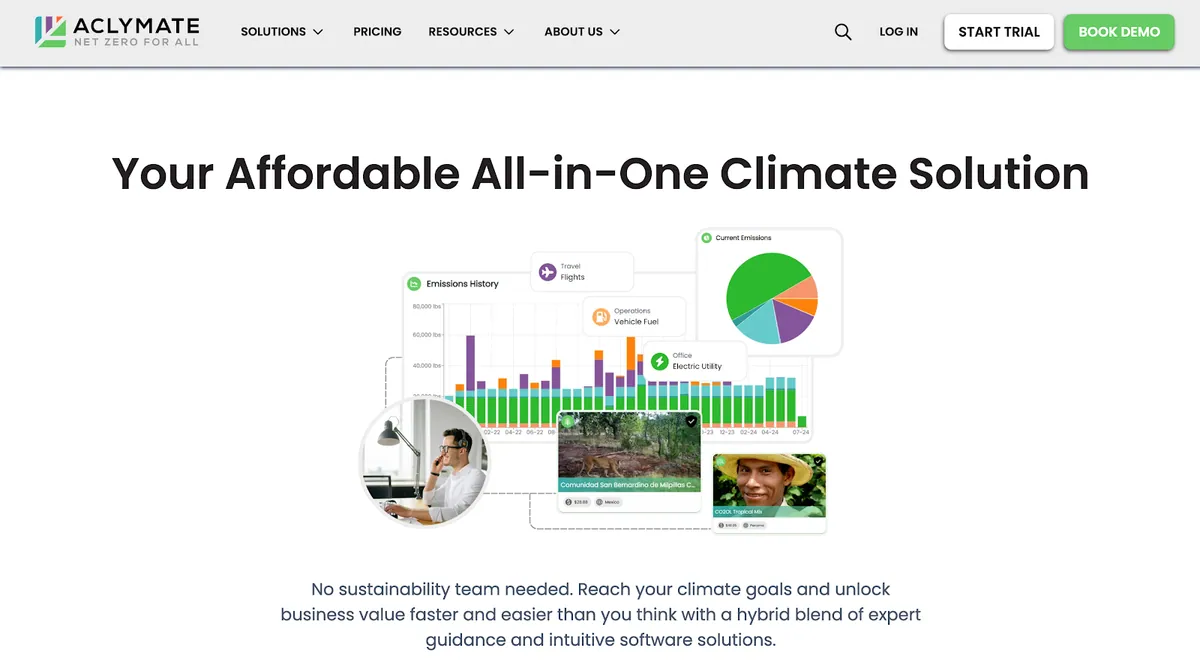
Aclymate helps you meet sustainability reporting requirements, even without dedicated ESG teams. It offers a turn-key solution that becomes your partner in measuring, reporting, and reducing carbon emissions.
The platform also features AI-powered categorization and audit-ready outputs to save time and effort during reporting.
Aclymate even aligns your disclosures with B Corp, EcoVadis, and SBTi standards. This makes it easy to obtain third-party certifications and ensure compliance with regulatory frameworks.
More than reporting and certifications, Aclymate offers a complete sustainability solution. It combines carbon accounting software, expert services, and a verified offset marketplace to help you get started with climate action.
Create an account today to enjoy a 17-day free trial, or book a demo to reach your sustainability goals faster!
Sustainability reporting is the process of sharing how your company manages corporate social, environmental, and governance issues. The goal is to give stakeholders transparency and help your company track progress toward long-term sustainability goals.
ESG reporting focuses on measurable risks and opportunities that affect a company’s financial value. It is mainly for investors and regulators.
On the other hand, sustainability reporting offers a more holistic approach. It covers a broader range of your organization's environmental and social impact, which is often used for communication with all stakeholders.
The seven principles of sustainability reporting include materiality, accuracy, clarity, comparability, stakeholder inclusiveness, reliability, and timeliness. Each one helps you build trust with stakeholders.
A sustainability report usually includes information about energy use, carbon emissions, waste management, labor rights, ethics, and governance practices. It may also describe company goals, performance metrics, and policies for improving environmental and social responsibility.
Get Aclymate's practical sustainability content delivered weekly.

AI is creating new opportunities for businesses, but it also comes with an environmental cost. Carbon offsets can help address some of those emissions, but businesses need to understand what they are offsetting, how offsets work, and why measuring and reducing emissions should come first.
Read Article
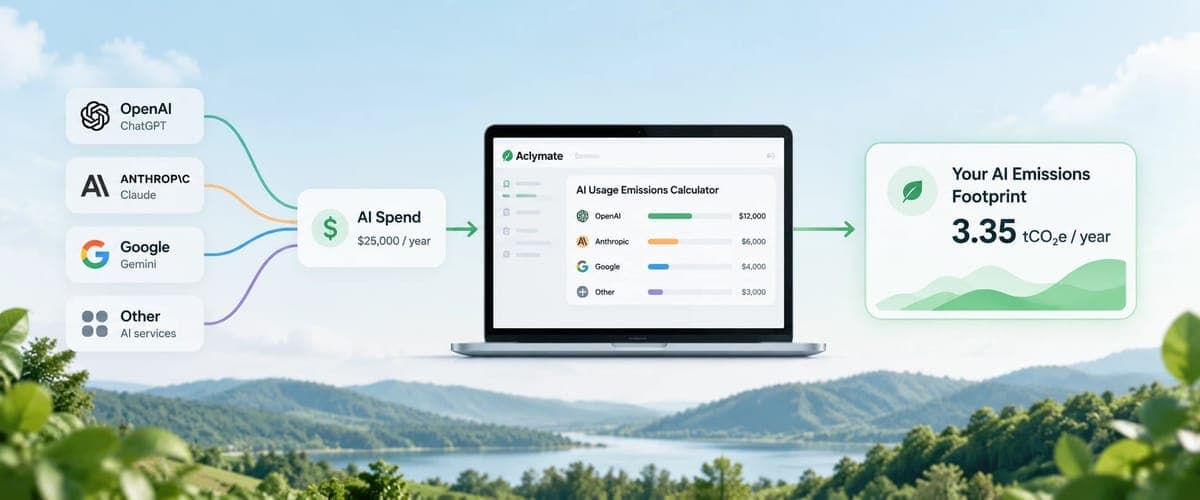
AI carbon emissions are becoming a new consideration for companies adopting ChatGPT, Claude, Gemini, Copilot and other artificial intelligence tools. Here’s how Aclymate estimates the carbon emissions from a company’s AI usage today—and how we expect the methodology to improve as AI providers release better usage and emissions data.
Read Article
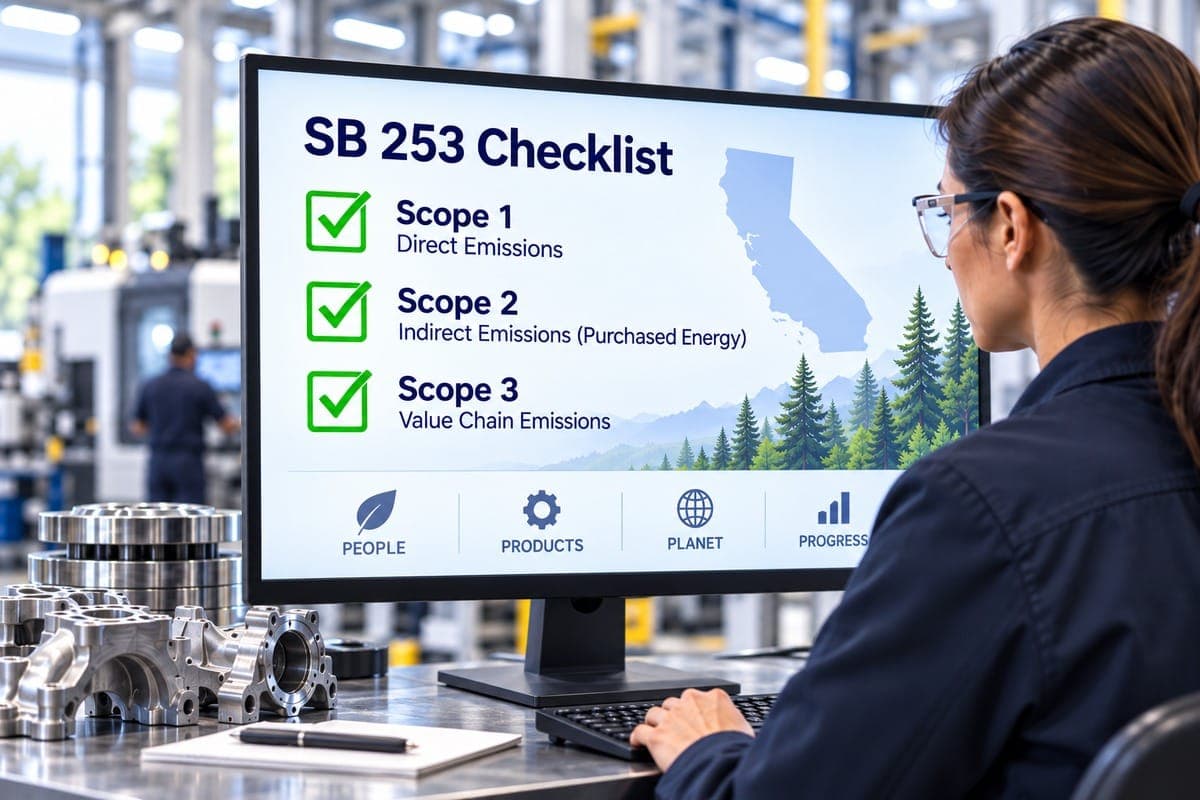
California SB 253 applies to companies over $1B in revenue — but its Scope 3 requirement reaches the automotive suppliers underneath them. What to expect and how to prepare.
Read Article
Talk with a Sustainability Expert, see a demo, or start free to put the Aclymate platform and experts to work for your team.