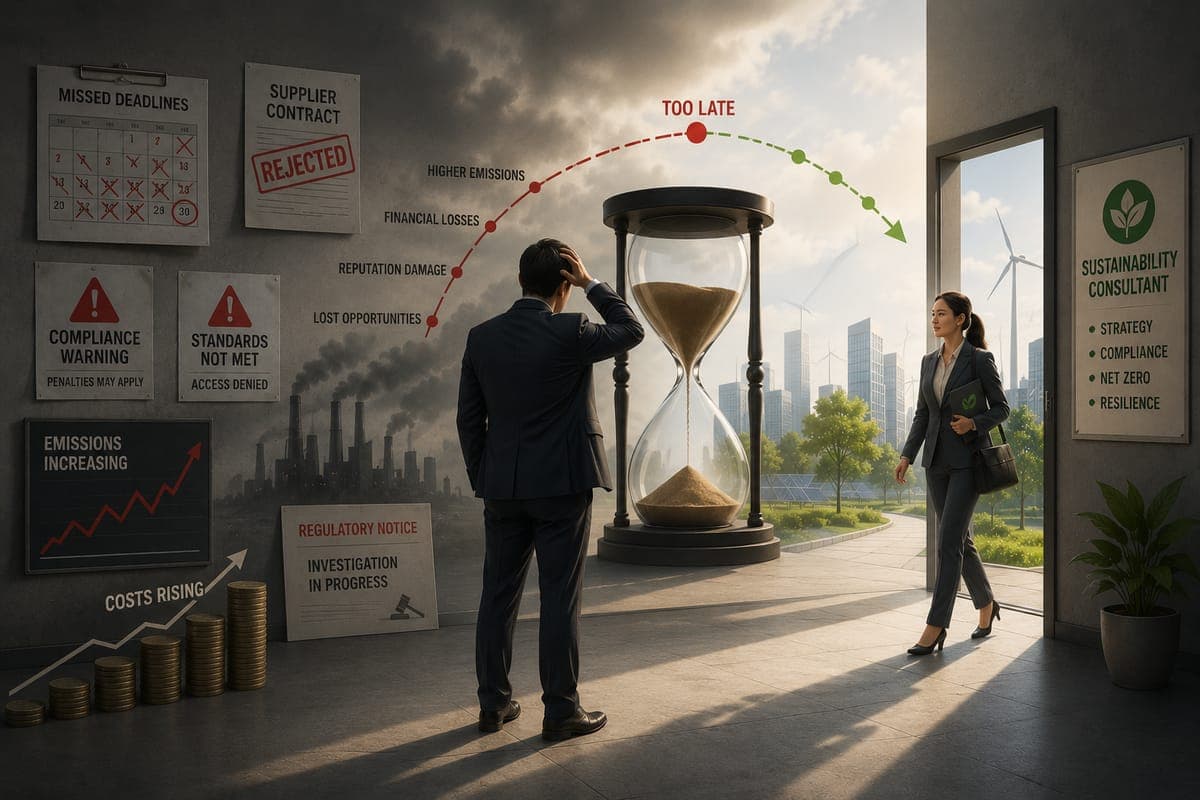
Picture this: your sales team is deep in a pitch for a Fortune 500 client. Everything looks good—until procurement sends over a supplier questionnaire that asks for your Scope 1, 2, and 3 emissions data, your net-zero roadmap, and proof of third-party verification. The due date is three weeks away.
Or: a regulator updates reporting requirements for your industry, and you're suddenly staring at a compliance gap that could delay a contract, trigger a fine, or cost you a bid you were almost certain to win.
Or: a potential enterprise customer won't move forward without a sustainability disclosure aligned to GRI or SBTi. And you have nothing to show them.
In each of these scenarios, a company that had done nothing suddenly needs to do everything—urgently. And urgency, in sustainability consulting, is extraordinarily expensive.
"Acting early on sustainability saves substantial money by avoiding last-minute compliance costs or penalties." — Leafr, How to Hire a Sustainability Consultant
It's tempting to treat sustainability reporting as a reactive obligation—something you address when a stakeholder demands it. But this framing fundamentally misunderstands what a credible sustainability program actually requires. Carbon accounting, emissions tracking, and ESG disclosures aren't things you can credibly produce in three weeks. They require months (often years) of clean, structured data.
When you wait until the last minute, two things happen simultaneously: the scope of work balloons, and your negotiating position with consultants collapses. You become a client in crisis mode, and crisis mode carries a premium.

Direct consulting fees are just one part of the equation. Late-stage sustainability work generates compounding costs across several dimensions that companies rarely anticipate when they first pick up the phone.
Credible emissions reporting—especially for Scope 3 emissions, which cover supply chain and value chain activities—requires historical data going back at least twelve months, sometimes more. If you haven't been tracking, you don't just pay for a consultant to write a report. You pay for them to reconstruct your emissions history from scratch using spend-based estimates, supplier outreach, and manual data cleaning. That's not reporting. That's archaeology. And it's billed by the hour.
Enterprise customers and regulators increasingly require Scope 3 disclosures that include your vendors' emissions. If you haven't already engaged your supply chain with structured surveys and reporting requests, doing so reactively—under deadline pressure—produces poor data quality and damaged vendor relationships. A tool like Aclymate's vendor emissions survey exists precisely to make this process proactive and ongoing, not a one-time fire drill.
Whether you're pursuing B Corp certification, SBTi validation, CDP disclosure, or ISO 14001, these processes have fixed timelines. B Corp certification alone typically takes 6–12 months. You cannot compress them by hiring a more expensive consultant. Waiting means either missing the window or presenting clients and regulators with a promise instead of a credential—and promises don't win contracts.
This is the cost that never shows up on a consulting invoice but may dwarf everything else. Enterprise procurement teams routinely eliminate suppliers who cannot demonstrate baseline ESG compliance. The contract you didn't win because you had no sustainability data is a cost that's invisible in your books but very real in your missed pipeline.

To understand why reactive sustainability work is so costly, it helps to understand what a late-stage engagement actually requires. When a consultant is brought in under deadline, they typically face three compounding challenges at once:
1 Emergency data collection
With no prior tracking infrastructure, the consultant must gather and categorize historical utility bills, travel records, supplier invoices, and operational data—often going back 12–24 months. Rushed data collection produces gaps, estimates, and assumptions that undermine the credibility of the final report.
2 Framework misalignment
Without knowing in advance which frameworks a company will need to report against—GRI, CDP, TCFD, GHG Protocol—a consultant must make fast, sometimes suboptimal choices. Rebuilding a report for a different framework later means paying twice.
3 No baseline for progress claims
Sustainability reports that demonstrate progress—the kind customers and investors actually value—require a credible prior-year baseline. Starting from zero means the first year's report can only say "here is where we are." It cannot say "here is how far we've come." That's a weak story for stakeholders who want evidence of commitment.
4 Compressed scope = compressed quality
Under tight deadlines, consultants must triage. Strategic components—supply chain engagement, science-based targets, reduction roadmaps—get deprioritized in favor of the minimum viable disclosure. The result is a report that checks a box but doesn't build a program. You're back to square one when the next deadline arrives.
The table below illustrates the structural difference between companies that build sustainability programs proactively versus those that engage consultants reactively under deadline pressure.

Beyond the hard costs of reactive consulting lies a subtler, more strategic form of loss: opportunity cost. Companies that have mature sustainability programs use them as competitive weapons. They win contracts that sustainability-naive competitors can't even bid on. They attract mission-aligned talent. They access green financing instruments at better rates. They earn certifications that signal credibility to the market segments growing fastest.
Every month a company delays building a real sustainability program is a month during which competitors are building theirs. The gap compounds quietly—and often becomes visible only when a major opportunity is lost.
"More than 46% of consumers say they're already purchasing more sustainable products, which has resulted in higher growth for products with ESG-related claims." — University of San Diego, What Is a Sustainability Consultant?
The market is not waiting for your company to get ready. Sustainability-linked procurement criteria are expanding rapidly across manufacturing, CPG, financial services, and professional services. The question is no longer whether your buyers will ask for ESG data—it's when. And "when" is increasingly "soon."

Aclymate was built specifically for the reality that most mid-sized businesses face: genuine sustainability urgency, without the budget or bandwidth for a full in-house sustainability team or a six-figure consulting retainer.
The platform combines carbon accounting software, dedicated climate bookkeepers, and sustainability consulting services in a single platform—making it possible to build a structured, audit-ready program from day one, not from the day a customer first asks for your data.
Aclymate integrates with major accounting software and utility providers to automate data collection and GHG Protocol-aligned calculations. Instead of reconstructing your emissions history under deadline, you're building it continuously—so it's always current, always credible, and always ready to share.
Through its Turn Key tier, Aclymate provides access to dedicated climate bookkeepers and sustainability consultants who handle data entry, vendor outreach, and compliance reporting. You get expert-level support at a fraction of the cost of an independent engagement—and without the scope creep that comes with reactive projects.
Whether you're working toward B Corp, SBTi, CDP, EcoVadis, or Aclymate's own Climate Wise and Climate Leader certifications, the platform structures your data and documentation to meet those requirements from the start—not as an afterthought once you've already filed for the deadline.
When a customer or regulator asks for your sustainability data, you shouldn't have to scramble. Aclymate's reporting tools generate audit-ready outputs aligned with GRI, TCFD, and other major frameworks—available on demand, not assembled in a crisis.
The companies that win on sustainability aren't the ones who hired the most expensive consultant at the last minute. They're the ones who started building before anyone asked them to.
Aclymate makes it easy to start now, with software, expert guidance, and a clear path to the certifications and disclosures your customers and regulators are already expecting.