← Back to Insights
Ariel Le
August 8, 2025

As climate change urgency intensifies, organizations are exploring practical methods to minimize environmental impact. While eliminating emissions at the source remains paramount, complete removal isn't always feasible. Carbon offsets provide an alternative strategy.
Carbon offsets enable individuals and organizations to counterbalance greenhouse gas emissions by financing environmental initiatives that either prevent carbon release or extract existing atmospheric carbon. These offsets function as tradable certificates representing one metric ton of CO₂ equivalent reduction or removal elsewhere globally.
Two offset categories exist: emissions reductions and carbon removals. Emissions reduction projects prevent atmospheric carbon entry through renewable energy adoption, methane reduction, or forest protection. Carbon removal projects extract existing atmospheric carbon through reforestation, direct air capture, or mineralization. Offsets are purchasable from government or third-party marketplaces.
Carbon offsetting complements rather than replaces emissions reduction. While the primary objective involves reducing emissions at their source, complete elimination often proves challenging. Offsets enable funding of projects that reduce, avoid, or remove greenhouse gases from the atmosphere globally.
Selecting appropriate offset projects requires understanding your purchasing motivation. Quality offsets share these characteristics:
For your business:
For broader society:
Skeptics contend that offsetting permits corporations to circumvent environmental accountability while maintaining current practices. Organizations may employ it as greenwashing—improving image without substantive action.
Additional concerns involve offset project integrity, including over-crediting, insufficient additionality and permanence, and transparency deficiencies.
These criticisms diminish through rigorous standards adoption, continuous monitoring, and robust verification. Transparency and stakeholder involvement prove essential. Sharing offsetting information openly and including relevant stakeholders in decision-making builds credibility and ensures genuine emissions reductions supporting sustainable development.
Responsibly and transparently implemented carbon offsets can facilitate low-carbon transition. Though insufficient as standalone emissions reduction solutions, they address environmental impacts from activities currently difficult to eliminate. Supporting quality offset projects enables businesses to contribute to measurable climate solutions.
Get Aclymate's practical sustainability content delivered weekly.

AI is transforming carbon credit verification through satellite monitoring, automated analysis, and anomaly detection. But can technology solve the voluntary carbon market’s credibility problem? Discover the limitations of AI verification and how businesses can evaluate carbon credits while keeping emissions reductions ahead of offsetting.
Read Article

AI is creating new opportunities for businesses, but it also comes with an environmental cost. Carbon offsets can help address some of those emissions, but businesses need to understand what they are offsetting, how offsets work, and why measuring and reducing emissions should come first.
Read Article
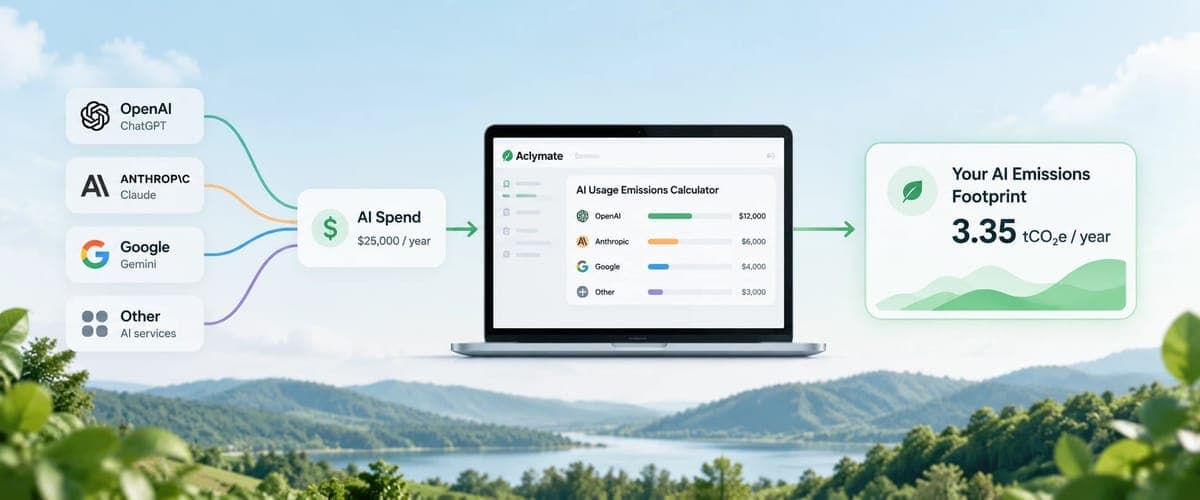
AI carbon emissions are becoming a new consideration for companies adopting ChatGPT, Claude, Gemini, Copilot and other artificial intelligence tools. Here’s how Aclymate estimates the carbon emissions from a company’s AI usage today—and how we expect the methodology to improve as AI providers release better usage and emissions data.
Read Article
Talk with a Sustainability Expert, see a demo, or start free to put the Aclymate platform and experts to work for your team.