Pellagra, Sharecropping, and the Hidden Costs of Extractive Economies

Doughnuts, extraction, climate, and disease

Mike Smith
December 29, 2025
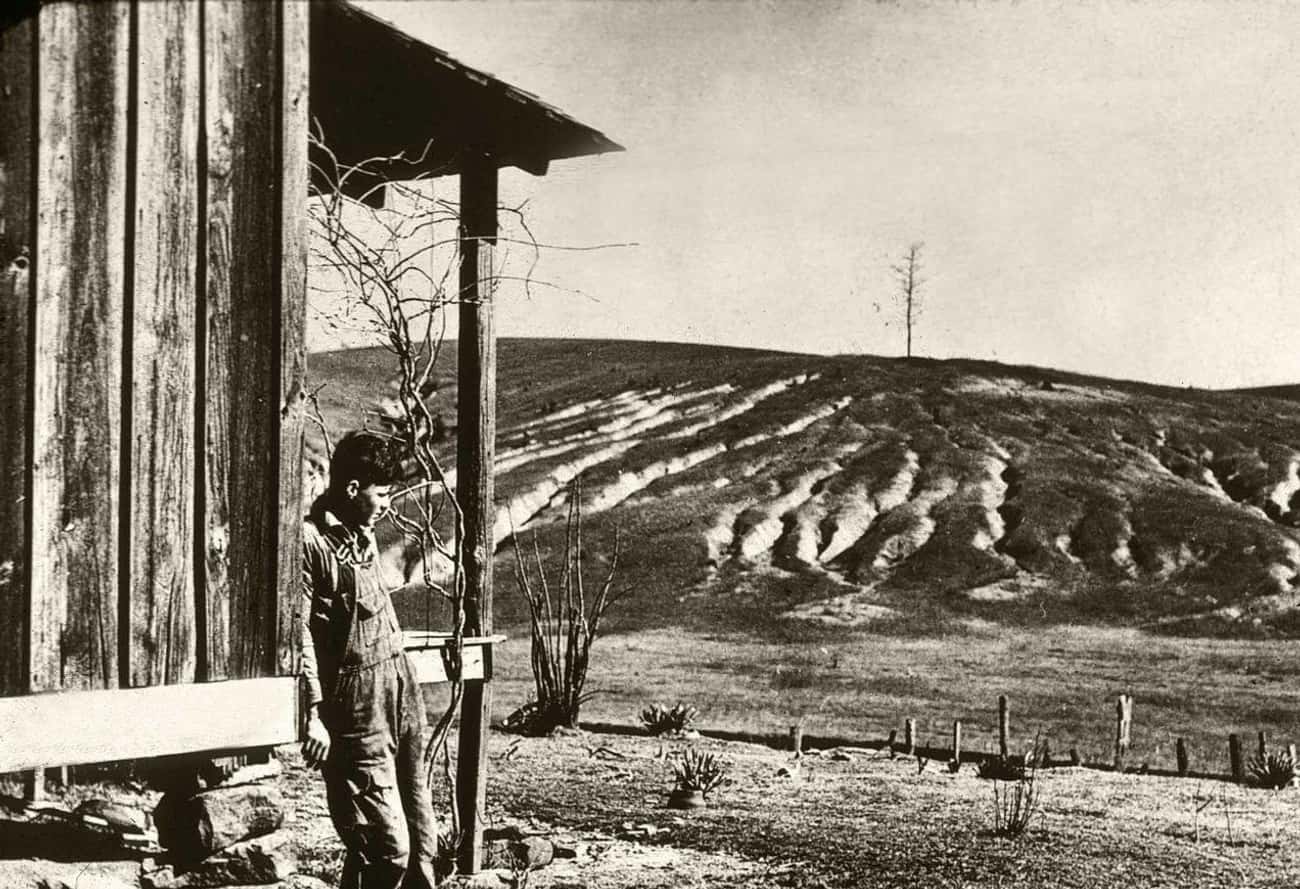
A man leaning against the porch of rough cabin looking at eroded land.

I’d like to tell you a true story about Pellagra.

If you haven’t heard of it, it isn’t the catchy name for an ED pill, but instead a terrible disease of malnutrition. Specifically, the lack of Vitamin B3 (niacin) in the diet. The symptoms start with scaly skin, but progress to diarrhea, dementia, and ultimately, death. That sequence makes pellagra heartbreaking – the people you know and love don’t just get sick… they unravel as their minds slipped before their body failed.

Pellagra has popped up a few times in history, and as with most malnutritive diseases, it is mostly associated with poverty. Hands down, the worst and most persistent outbreak was in the American South, where it lasted for generations – from 1906 until 1945.

Sharecropping and the Economics of Extraction

A clean, well dressed man in a vest and hat holding a gun and a dog, surrounded by poor field workers in a cotton field.

The reason was the particular brand of capitalism that the South ran during that time – sharecropping. A system where landowners would lease their land for a share of the produced crop from the people working the land. It seems an ok trade on its face, but the reality was that the people doing the work were forced to buy their supplies from the landowners and were denied access to education, so even in good crop years, the wealthy ended up ahead and the poor ended up breaking even at best. In bad years, their debt increased.

This system was ripe for abuse, as the Southern landowners made their money not from productive efficiency or high-margin products but from the extraction of labor and the control of credit. The crop wasn’t the goal, but instead almost a bookkeeping device.

Corn, Niacin, and Full Stomachs That Still Starved

One of the quiet abuses of the system involved food itself.

Cornmeal was cheap and filling, and it became the dietary backbone of the rural poor. But when corn is processed without an alkaline treatment - a process known as nixtamalization - the niacin it contains cannot be absorbed by the human body. Poor southerners, fed little beside cornbread, grits, and molasses, had full stomachs but severe nutritional deficiencies. The energy to work but not the nutrition to live.

Two very thing women, one sitting in a chair, the other sitting in an open door of a ramshackle house

Soil Collapse in the Deep South

A man leaning against the porch of rough cabin looking at eroded land.
Photo: Wikimedia Commons | CC BY 2.0

Sharecropping didn’t just strip people - it stripped the land.

Neither sharecroppers nor landowners had incentives to protect soil health. Sharecroppers didn’t own the land and lacked the capital to improve it. Landowners prioritized short-term extraction over long-term productivity. The result was relentless cotton monoculture, minimal crop rotation, and aggressive plowing of marginal land.

By the early 20th century, Southern soils were collapsing. Topsoil washed away. Gullies formed so deep they became impassable. While the Dust Bowl devastated the Great Plains, a parallel - less famous but equally severe - environmental disaster was unfolding across the Deep South.

It wasn’t until the New Deal, through programs like the Civilian Conservation Corps and the Soil Conservation Service, that large-scale reforestation and soil restoration began.

An Economy That Couldn’t Grow

Sharecropping was also an economic poison.

It suppressed productivity by denying workers incentives and mobility. It enforced monoculture and prevented diversification. It limited skill development, scared off outside investment, and crushed purchasing power. Local markets withered because cash rarely circulated.

If you’ve ever wondered why much of America’s produce comes from California instead of Mississippi, this history is part of the answer.

By the early 20th century, the South had become the poorest region in the United States - not because it lacked resources, but because its economic system extracted value without reinvesting in people or place.

The Disease Was Solved - The System Was Not

Two thin and bedraggled children sitting on a rough floor

By 1915, Dr. Joseph Goldberger had conclusively demonstrated that pellagra was a dietary disease, not an infection. The cure was known. The science was settled.

And yet pellagra persisted for another 25 years.

Why? Because acknowledging the cause meant acknowledging that the South’s wealthy operated a system that impoverished its labor force. Ending pellagra required changing how value was created - not just adding a vitamin.

It wasn’t ended until the greatest catastrophe humanity has ever faced – the Second World War – reset everything.

Sharecropping the World

About the same time that sharecropping was dying, the U.S. economy as a whole started moving from one focused on producing goods and commodities for export, to one more focused on becoming a consumer economy. Growth after WWII has been primarily driven by household consumption, with advertising, branding, and credit as core enablers. Everyone reading this knows this very well, because it’s the world we live in.

If you’re seeing the parallels to sharecropping – where wealth is created for a few by extracting it from the masses – you can see where this is going. Sharecropping started well before pellagra hit. It started before the environment could no longer sustain extraction. It was doing damage to the South’s economy for decades before it started starving them. Sharecropping started 50 years before the symptoms became so apparent and it took 30 years and a cataclysm before it went away.

False Choices and Type 1 Thinking

One of the things I hate most about our current discourse are the prevalence of false choices that appeal to our fractured attention with fast, categorical - Type 1 - thinking. You know what I’m talking about:

  • We must choose between taking care of people or the economy
  • Or between the climate and people
  • Or between the economy and a livable climate
An image of the cover of "Thinking, Fast and Slow" by Daniel Kahneman
Photo by Ahmed Almakhzanji on Unsplash

It’s nonsense.

And if you asked anyone of sound mind to think for a minute about the question, “Do you think an economy can survive that exhausts its environment or abuses its people?”, they’d certainly say no.

This is the obvious and basic foundation to Doughnut Economics – but it doesn’t take an economic theory to understand it. If you care about the health of the economy or of the environment or of people, then you must care about all three. You must stop buying into false choices.

Sharecropper capitalism - whether applied to land, labor, or the climate - is a suicide pact.

The Question in Front of Us

We are now roughly 70 years into a fully consumer-driven U.S. economy. Its benefits are undeniable - but so are its costs. Wealth has concentrated dramatically. Environmental damage, particularly to the climate, has accelerated. The warning signs are everywhere.

If your response to this is, “Hell yeah, let’s do socialism” or “this guy must be a commie”, then you have missed the point entirely. Categorical, Type 1 thinking won’t fix this. Definitionally, it is lazy thinking.

We all need a system built upon the triple bottom line – people, planet, & profit – and not on ideology. Capitalism, when well-managed, is the most effective distribution of resources yet devised and a backstop to freedom. But sharecropper capitalism is immensely destructive. We must chart a sensible economy that includes both the climate and human flourishing, or we’re doomed to watch all three collapse.

What is Your Response?

Are we going to wait 30 years to fix it? Do we need to a cataclysm to do so?

If the industry you work in or the business you own is not considering all of its stakeholders – workers, the environment, and owners – you probably closer to being a sharecrop landowner than you’d feel comfortable to admit.

Let me rephrase:  Are you going to wait 30 years to fix this? Do you need to a cataclysm to get started?

Something to consider when you’re considering your resolutions for the New Year.

This is the sign you've been looking for neon signage
Photo by Austin Chan on Unsplash

So what does this mean for your business - right now?

If one of your New Year’s resolutions is to stop running a “sharecropping” model with the climate-extracting value without accounting for long-term damage - then the first step is knowing your real impact.

That’s where Aclymate comes in.

Aclymate helps companies measure, manage, and report their carbon emissions with confidence, whether you’re just getting started or scaling a mature sustainability program.

Want it handled for you?
Aclymate’s Turn Key solution pairs you with a dedicated carbon bookkeeper who manages everything end-to-end - from data collection and calculations to audit-ready reports and public disclosure. It’s like having an internal sustainability team, without the consultant price tag.

Aclymate homepage

Prefer a DIY approach?
Aclymate’s sustainability management software makes carbon accounting straightforward and defensible. Automated data collection, AI-powered categorization, and audit-ready outputs mean less guesswork and more credibility.

Either way, Aclymate helps you move beyond vague intentions and into measurable action - so your business can grow without quietly undermining the people and systems it depends on.

Aclymate Is Your Partner for Climate Reporting

Book a demo to see how Aclymate’s experts and intuitive tools can help you build a business that works for people, planet, and profit.

Mike Smith
December 29, 2025

Want More?

Click below to discover more Mike's Thoughts articles.