← Back to Mike's Thoughts
Mike Smith
February 20, 2026

Indulge me as I tell you about an experience I see a lot.
An employee at a mid-sized company has been given the “opportunity” to lead sustainability at her company. She might work in compliance, or sourcing, or operations, or maybe even in HR. She’s finally carved out some time from her main job to work on sustainability. She’ll take about an hour to remember where she left off the last time she worked on this… maybe a month ago?
Next thing she knows, her browser has 10 tabs open and her desktop is littered with spreadsheets. She has a supplier email asking, “What do you mean about Scope 3?”. She’s not totally sure herself, so she skips to the next email. Marketing wants to know what to say about being sustainable. Hmm… next. Let’s go to the consultant we hired for this effort… he needs all of the Bill of Material (BOM) data to even get started. So she reaches out to her product team to get it, only to find that they have information that three years old.
Does that stress you out?
It should. But that’s the practical reality for so many people working in sustainability.
And it’s preventing them from doing anything actually productive, which causes her (and her boss) to wonder why she’s even working on this, let alone actually doing anything to make the planet healthier.
Here’s the problem: Sustainability is being run as a side project, but the expectations are enterprise-level.
That is disparity is costing you. Remember, if you fail to prepare you are preparing to fail. - H.K. Williams At the root of this problem is that sustainability, as a business need, kind of creeps up on companies in apparel. You get one question from one customer. It’s a little weird, but you dutifully dig in and answer.
Then another customer asks a more direct question. You answer it. Two points make a line.
Then a third customer asks you to provide more than an answer, but a report. Uh oh… three points make a trend.
Someone in sourcing gets assigned an additional duty. It’s cheaper than hiring someone and keeps the org chart neat. You can maybe hire a consultant if you need to support her.
You decide to swap in some recycled polyester, publish some goals in an impact report, and hope that this blows over.
But it doesn’t, because sustainability in apparel is massively dependent on your supply chain, has evolving regulations, and requires a lot of data. Marketing relies upon what you come up with, opening you up to worries on greenwashing, so you decide instead to overcorrect into greenhushing. Operations has no idea about what’s going on, so nothing gets changed.
When you finally sit down with it, you realize that you might have failed to plan on this. Sustainability isn’t a campaign, but infrastructure.
When your company sits down and decides to get serious about this, a few core problems become obvious.
· Materials and manufacturing dominate apparel emissions, so most of the problems are outside the company and in your supply chain.
· Sustainability reporting touches 10 business functions, so it requires cross-functional coordination.
· Supplier data collection becomes a prime bottleneck, because you have to collect data manually via email. 62% of companies say the same.
· You’re expected to reach deep into your supply chain by your bigger, better resourced customers, even though they aren’t.
By going it alone, you’re baking in some major hidden costs.
· Your sustainability hero is overworked. If she leaves, you’re hosed. Back to square-one. And she’s getting burned out in a system that doesn’t scale.
· Your “free” spreadsheets get messy fast. That’s because you don’t have good version control and you’re unsure which emissions factors they’re using. Forget about being able to trace SKUs and pray you don’t have to face an audit.
· Your suppliers are ambivalent or even hostile to your requests. You get it – the last thing you want to see is another survey asking the same questions, but in a different format. Your suppliers are, too.
· Exposure to greenwashing claims. Even if you keep your marketing team religiously on message, you have to prove what they’re claiming. And if your evidence requires digging into a dozen spreadsheets, who will believe it? You certainly don’t want to be lumped in with those who have made misleading claims.
· Inability to handle compliance creep. You’re facing requirements on EPRs, new restrictions on unsold goods, and assurance expectations. Is your spreadsheet system up to it? Probably not.
· Falling behind. The brand leaders for sustainability are being established right now. Those that are investing in it are gaining efficiency gains, cost reductions, and brand differentiation. Those that silo sustainability are losing those opportunities.
Get Aclymate's practical sustainability content delivered weekly.

Your company may never be required to join SBTi. But if your customers have science-based targets, their commitments can create very real expectations for you.
Read Article

Most small and mid-sized businesses know they should be doing something about sustainability. The ones that actually make progress share one thing in common: they started with a clear sequence. Here it is.
Read Article
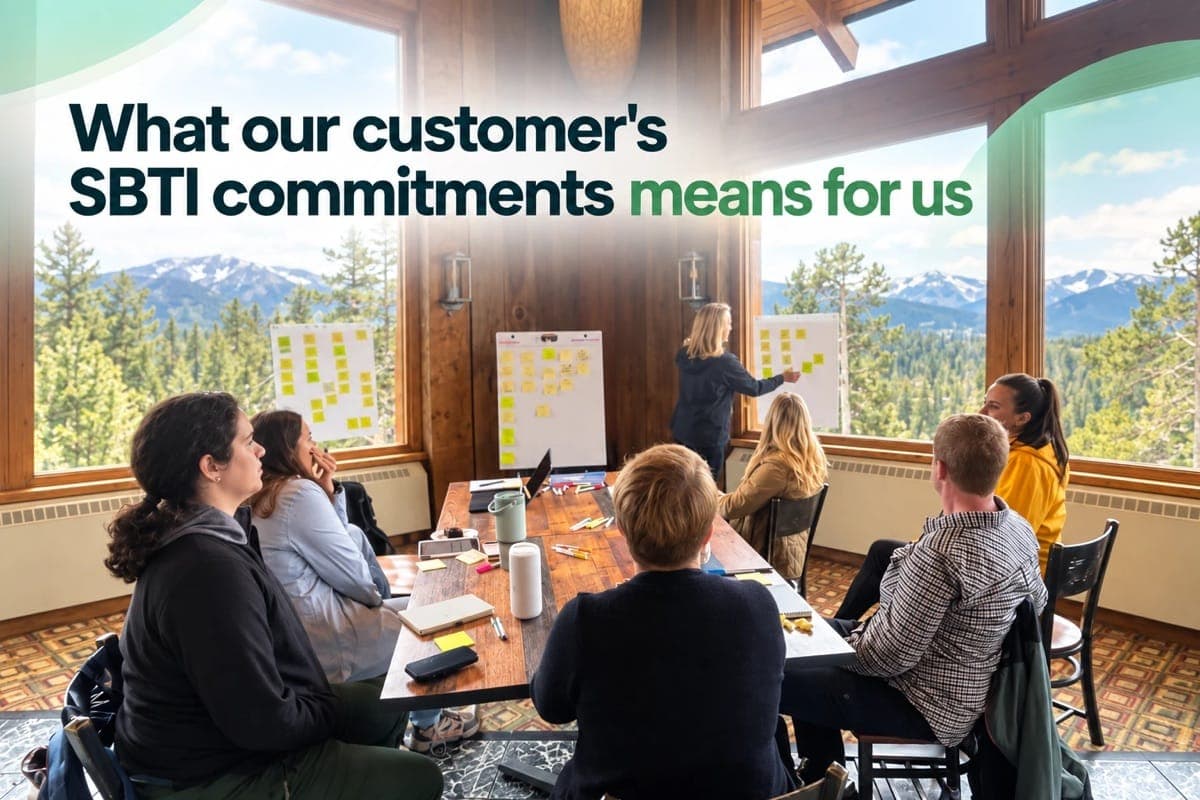
SBTi requirements are reshaping supply chains. Learn what science-based targets mean for carbon accounting, reporting, suppliers, and mid-sized companies.
Read Article
Talk with a Sustainability Expert, see a demo, or start free to put the Aclymate platform and experts to work for your team.