← Back to Insights
Aclymate Team
June 29, 2026
9 min read
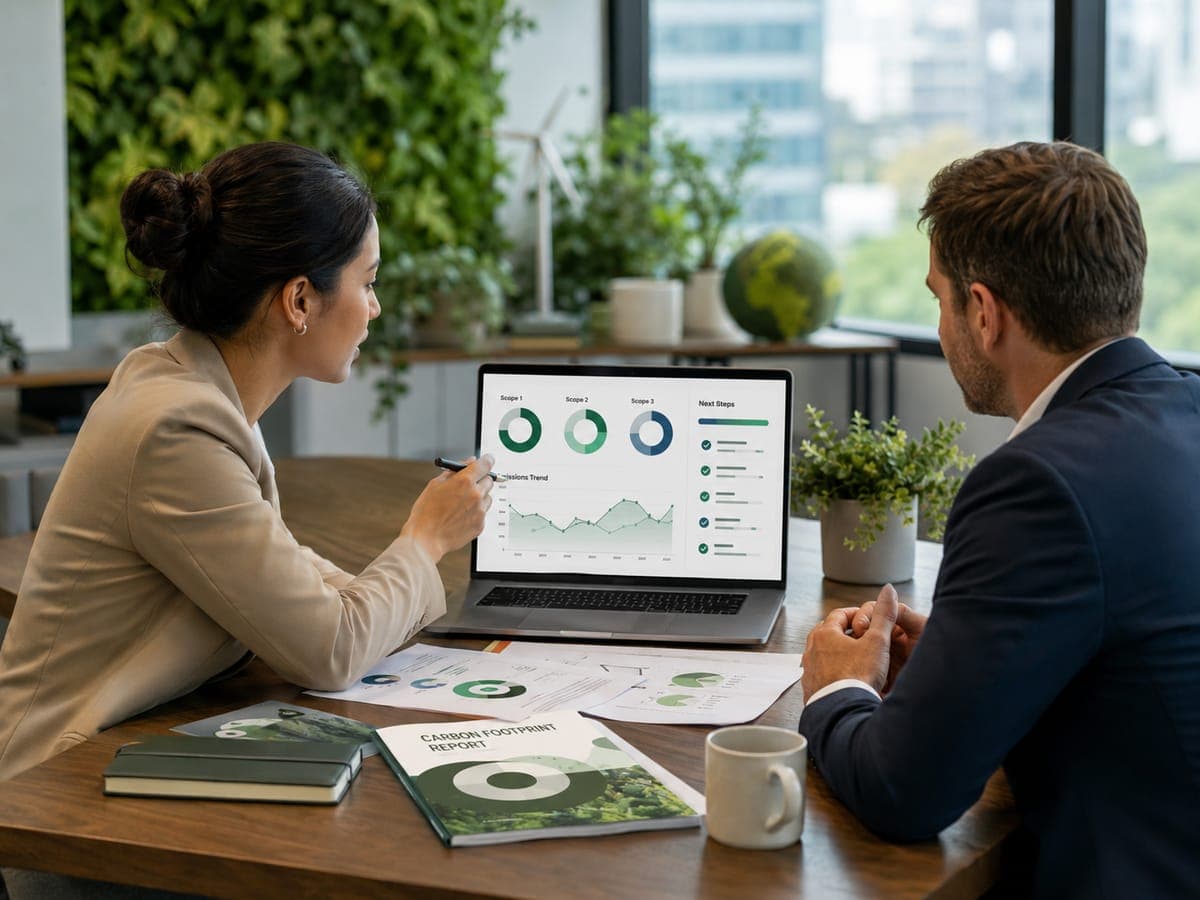
A climate consultant helps businesses understand, measure, manage, and communicate their climate impact.
For many companies, the need starts with a simple but urgent question: “What do we need to do about sustainability?” Sometimes that question comes from a customer. Sometimes it comes from an RFP, supplier questionnaire, investor request, reporting requirement, or leadership team that wants to understand the company’s carbon footprint.
A climate consultant helps answer those questions and turn them into a practical plan.
Climate consultants often support carbon accounting, emissions measurement, sustainability reporting, climate strategy, reduction planning, certifications, disclosures, and customer-facing sustainability proof.
For growing businesses, a climate consultant can be especially useful when the company needs credible sustainability support but does not have a dedicated sustainability team.
A climate consultant is an expert who helps organizations understand and manage their greenhouse gas emissions, climate risks, climate opportunities, and sustainability responsibilities.
In a business setting, climate consultants commonly help with:
A climate consultant may work with leadership, finance, operations, procurement, facilities, sales, marketing, and sustainability teams. Their role is to help the company understand where it stands, what it needs to do next, and how to communicate progress in a credible way.
A climate consultant can help a business move from confusion to clarity.
Instead of treating sustainability as a vague goal, they help translate climate work into specific data, decisions, reports, and actions.
One of the most common reasons companies hire a climate consultant is to calculate their carbon footprint.
A carbon footprint measures the greenhouse gas emissions associated with a company’s operations, energy use, purchases, suppliers, travel, transportation, products, and other business activities.
A climate consultant can help define what should be included, collect the right data, apply emissions factors, and calculate emissions across the business. The EPA describes a greenhouse gas emissions inventory as a list of emission sources and associated emissions quantified using standardized methods.
This work often includes:
A climate consultant may also use published emissions factors to convert business activity data into greenhouse gas emissions estimates.
Climate consultants often help companies understand emissions by scope.
Scope 1 emissions are direct emissions from sources a company owns or controls, such as company vehicles, fuel combustion, or onsite equipment.
Scope 2 emissions come from purchased electricity, steam, heat, or cooling.
Scope 3 emissions are indirect emissions across the company’s value chain. These can include purchased goods and services, suppliers, shipping, employee commuting, business travel, waste, product use, and other upstream or downstream activities.
The GHG Protocol Corporate Standard is one of the most widely used standards for corporate greenhouse gas accounting and reporting. It also provides guidance for Scope 2 emissions and corporate value chain Scope 3 emissions.
Scope 3 is often the hardest category for companies to measure because it depends on data from suppliers, vendors, customers, and business activities outside the company’s direct control.
A climate consultant can help organize this process and decide where better data is needed.
A climate consultant does more than calculate emissions. They can also help a company decide what to do next.
A climate strategy helps connect sustainability goals to business priorities. It may include emissions reduction initiatives, reporting milestones, customer requirements, certification goals, internal responsibilities, and timelines.
A practical climate roadmap may answer questions like:
For companies setting longer-term climate goals, a consultant may also help evaluate target-setting approaches such as science-based net-zero targets.
The best climate strategy is not just a statement of ambition. It is a practical operating plan your company can actually manage.
Many businesses need climate data for reports, customer requests, procurement requirements, certifications, or voluntary disclosures.
A climate consultant can help turn raw emissions data into reports that are understandable, credible, and useful.
This may include:
For companies without a sustainability team, reporting can be hard because the information is often spread across finance, operations, procurement, HR, facilities, and sales. A climate consultant can help gather and organize the information into a usable format.
Many companies first search for a climate consultant because a customer asks for sustainability information.
Common requests include:
These requests can create pressure, especially when sales teams need answers quickly.
A climate consultant helps companies respond with more confidence, consistency, and credibility.
Climate consultants can also help companies prepare for common sustainability certifications, assessments, and reporting frameworks.
Depending on the business, this may include support for:
The consultant’s role is often to help organize data, prepare documentation, identify gaps, and make sure claims are credible and supportable.
After a company understands its footprint, the next question is usually: “How do we reduce it?”
A climate consultant can help identify and prioritize emissions reduction opportunities, such as:
The goal is not just to make a long list of possible actions. The goal is to identify realistic actions that match the company’s business, budget, timeline, and customer expectations.
Climate work is rarely a one-time project.
Once a company creates its first carbon footprint, it usually needs to update data, track progress, respond to new requests, improve reporting, and manage new sustainability initiatives.
A climate consultant may help with ongoing program management, including:
For companies without a sustainability department, this ongoing support can be just as important as the first report.
A business may need a climate consultant when sustainability becomes important but the company does not have the expertise, data, or internal bandwidth to manage it alone.
Common signs include:
If sustainability is starting to affect sales, customer trust, reporting, or business operations, it may be time to get expert help.
Climate consultants and sustainability consultants are related, but they are not always the same.
A climate consultant usually focuses on climate-related topics such as greenhouse gas emissions, carbon accounting, climate strategy, climate risk, emissions reduction, and climate reporting.
A sustainability consultant may cover a broader range of environmental, social, and governance topics. This can include climate, waste, water, supply chain, sourcing, labor, governance, policies, reporting, and stakeholder communications.
In practice, many companies need support across both areas. For example, a company may need climate consulting for carbon accounting and emissions reduction, while also needing broader sustainability consulting for customer requirements, certifications, policies, and reporting.
A carbon accounting consultant focuses on measuring and reporting greenhouse gas emissions. Their work usually centers on data collection, emissions factors, Scope 1, 2, and 3 calculations, methodology, and reporting.
A climate consultant may include carbon accounting, but often goes beyond the numbers. They may also help with climate strategy, customer communications, disclosures, certifications, emissions reduction planning, and ongoing program management.
A simple way to think about it:
A carbon accounting consultant helps answer: “What are our emissions?”
A climate consultant helps answer: “What do our emissions mean, what should we do next, and how do we communicate progress?”
Many companies need both.
Carbon accounting software helps companies measure, organize, and report emissions data. It can make the process faster, more consistent, and easier to manage over time.
A climate consultant provides expertise, interpretation, planning, and guidance.
Software alone may not answer questions like:
A consultant alone may not give you a scalable system to track data and progress over time.
That is why many companies benefit from both software and expert support.
Aclymate gives growing businesses a practical way to manage climate and sustainability work without building a full internal sustainability department.
Instead of choosing between a consultant and software, Aclymate combines both.
With Aclymate, you can get:
Aclymate is built for lean teams that need to measure emissions, respond to customer requests, create credible proof, and keep moving.
Aclymate helps growing businesses measure emissions, respond to customer requests, prepare reports, build climate roadmaps, and create credible sustainability proof.
Get the expert support, software, and hands-on help you need to move forward with confidence.
Talk to a Climate Expert
A climate consultant helps businesses measure emissions, build climate strategies, prepare sustainability reports, respond to customer requests, and manage climate-related risks, opportunities, and requirements.
The main role of a climate consultant is to help a company understand its climate impact and decide what to do next. This often includes carbon accounting, emissions reduction planning, reporting, certifications, and customer-facing sustainability proof.
Yes. Many climate consultants help businesses calculate their carbon footprint by collecting activity data, applying emissions factors, measuring Scope 1, 2, and 3 emissions, and preparing a carbon footprint report.
Yes. Climate consultants often help companies measure and manage Scope 3 emissions, including supplier data, purchasing, transportation, business travel, employee commuting, waste, products, and other value chain activities.
A climate consultant usually focuses on greenhouse gas emissions, carbon accounting, climate strategy, and emissions reduction. A sustainability consultant may cover broader environmental, social, and governance topics.
A carbon accountant focuses on measuring and reporting emissions. A climate consultant may also support strategy, reductions, customer communications, certifications, disclosures, and ongoing sustainability program management.
Your business may need a climate consultant if customers are asking for emissions data, you need a carbon footprint, you are preparing for a sustainability assessment, or you do not have the internal expertise to manage climate and carbon accounting work.
Many businesses need both. Software helps organize and calculate emissions data. A consultant helps interpret the data, build a plan, prepare reports, and guide credible next steps.
Yes. Aclymate combines carbon accounting software, climate consulting, reporting support, certification support, and hands-on sustainability program management for growing businesses.
Get Aclymate's practical sustainability content delivered weekly.
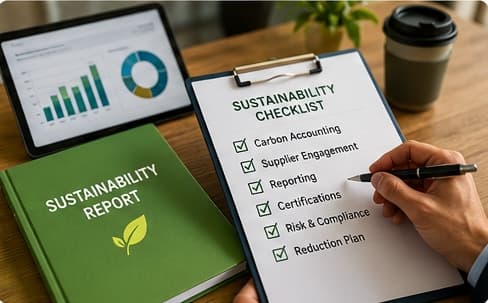
Learn what a CDP consultant does, what support businesses need for CDP reporting, and how Aclymate helps with emissions data, climate strategy, and documentation.
Read Article
Learn how Product Carbon Footprint data is evolving within IMDS and what automotive suppliers should know about PCF reporting.
Read Article
Learn what automotive sustainability reporting includes, what customers request from suppliers, and how to organize emissions and product data.
Read Article
Talk with a Sustainability Expert, see a demo, or start free to put the Aclymate platform and experts to work for your team.