← Back to Insights
Aclymate Team
June 29, 2026
10 min read
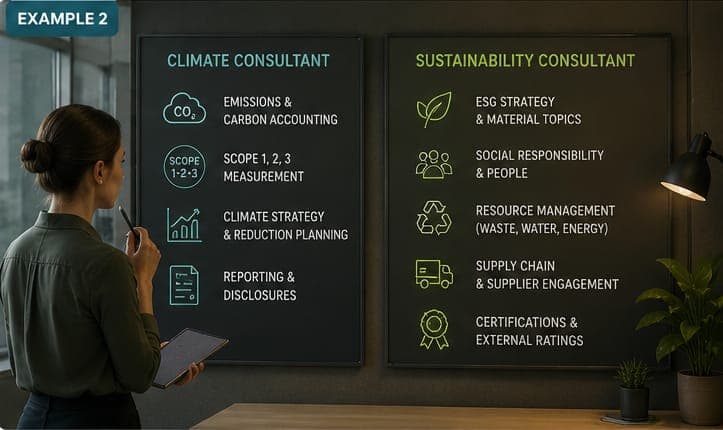
A climate consultant and a sustainability consultant both help companies manage environmental and business impact, but they do not always focus on the same work.
A climate consultant usually focuses on climate-related topics such as greenhouse gas emissions, carbon accounting, Scope 1, 2, and 3 measurement, climate strategy, emissions reduction, climate reporting, and carbon-related customer requests.
A sustainability consultant often works more broadly across environmental, social, and governance topics. This can include climate, energy, waste, water, supply chain, labor practices, governance, certifications, reporting, claims, customer requests, and sustainability program management.
For many growing businesses, the difference matters because the company may not know what kind of help it needs.
If a customer is asking for emissions data, Scope 3 information, CDP responses, or a carbon footprint, the company may need climate consulting. If the company needs a broader sustainability program, customer proof, supplier policies, reporting, certifications, and operational improvements, it may need sustainability consulting.
In practice, many companies need both.
That is why Aclymate combines climate consulting, sustainability consulting, carbon accounting software, reporting support, certification support, and program management in one solution.
| Category | Climate Consultant | Sustainability Consultant |
|---|---|---|
| Main Focus | Climate impact, greenhouse gas emissions, and carbon strategy | Broader sustainability performance across environmental, social, governance, and operational topics |
| Common Work | Carbon accounting, Scope 1, 2, and 3 emissions, climate roadmap, emissions reduction, CDP support | Sustainability strategy, reporting, customer requests, supplier policies, certifications, ESG questionnaires, program management |
| Data Focus | Emissions, energy, fuel, travel, shipping, supplier, purchasing, and value chain data | Emissions plus waste, water, energy, procurement, policies, social practices, governance, suppliers, and reporting data |
| Typical Trigger | Customer asks for carbon footprint, Scope 3 data, climate plan, or CDP disclosure | Company needs broader sustainability help, ESG responses, reporting, policies, certifications, or customer proof |
| Best Fit | Companies that need help measuring, managing, and reducing climate impact | Companies that need a broader sustainability program or support across multiple sustainability topics |
| Where They Overlap | Carbon accounting, climate strategy, reporting, customer requests, supplier data, emissions reduction | Carbon accounting, climate strategy, reporting, customer requests, supplier data, emissions reduction |
A climate consultant helps companies understand, measure, manage, and communicate climate-related impact.
In business, that often means helping with greenhouse gas emissions, carbon accounting, Scope 1, 2, and 3 emissions, climate strategy, emissions reduction, reporting, disclosures, and customer requests.
Climate consultants may help companies:
The GHG Protocol Corporate Standard is one of the most widely used standards for corporate greenhouse gas accounting and reporting. Climate consultants often help companies organize their emissions work around standards like this.
A climate consultant is usually the right fit when the company’s biggest need is carbon, emissions, climate disclosure, or climate strategy.
A sustainability consultant helps companies improve sustainability performance and manage sustainability-related business requirements.
Sustainability is broader than climate. The EPA describes sustainability as creating and maintaining conditions where humans and nature can exist in productive harmony to support present and future generations.
In a business setting, sustainability consulting may include:
A sustainability consultant is usually the right fit when a company needs broader support across sustainability topics, not just climate or carbon.
The main difference between a climate consultant and a sustainability consultant is focus.
A climate consultant focuses on climate impact.
That usually means:
A sustainability consultant focuses on broader sustainability performance.
That may include:
Climate is usually one part of sustainability.
For some companies, climate is the urgent issue because customers are asking for emissions data. For others, sustainability is broader and includes policies, suppliers, certifications, reporting, claims, operations, and communications.
Carbon accounting is usually more central to climate consulting.
A climate consultant may spend significant time helping a company measure:
The GHG Protocol Corporate Value Chain Scope 3 Standard helps companies assess value chain emissions and identify where to focus reduction activities.
A sustainability consultant may also support carbon accounting, but they may use that emissions data as part of a broader program that includes reporting, policies, supplier engagement, certifications, and customer communications.
A simple way to think about it:
A climate consultant helps answer: “What are our emissions and how do we reduce them?”
A sustainability consultant helps answer: “How does emissions data fit into our broader sustainability program?”
Scope 3 emissions are often where climate consulting and sustainability consulting overlap.
Scope 3 emissions are indirect emissions across the value chain. These may include suppliers, purchased goods and services, transportation, distribution, business travel, employee commuting, waste, product use, and end-of-life impacts.
A climate consultant may focus on calculating Scope 3 emissions, choosing methodology, applying emissions factors, and improving data quality.
A sustainability consultant may focus on supplier engagement, procurement policies, supplier questionnaires, responsible sourcing, and customer proof.
Both types of consultants may be needed because Scope 3 is both a carbon accounting challenge and a supplier management challenge.
For example:
A strong sustainability program connects all of those pieces.
Both climate consultants and sustainability consultants may help with reporting, but the reporting focus can be different.
A climate consultant may focus on climate-related reporting and disclosure, such as:
CDP states that improving corporate awareness through measurement and disclosure is important to managing carbon and climate change risk. Its climate questionnaire asks companies to disclose information about climate risks, opportunities, and related management practices: CDP climate disclosure.
A sustainability consultant may support broader reporting, such as:
For more formal reporting, the GRI Standards help organizations report on impacts on the economy, environment, and people.
In many companies, these reporting needs overlap. The same emissions data may support a carbon footprint report, a CDP response, a customer questionnaire, a sustainability report, and a sales proof package.
Climate strategy and sustainability strategy are related, but not identical.
A climate strategy usually focuses on:
For companies setting long-term climate goals, the SBTi Corporate Net-Zero Standard provides guidance for setting science-based net-zero targets.
A sustainability strategy may include climate strategy, but also broader priorities such as:
A climate consultant helps companies decide what to do about climate impact.
A sustainability consultant helps companies decide how to manage sustainability across the business.
Sustainability consultants may also help companies prepare for environmental management systems, certifications, and third-party assessments.
This can include:
ISO 14001 is an internationally recognized environmental management standard. ISO explains that ISO 14001 provides an environmental management foundation that supports climate action, greenhouse gas initiatives, and sustainability commitments.
A climate consultant may support the climate-related parts of these efforts, such as emissions data, climate goals, and carbon documentation.
A sustainability consultant may support the broader system, including policies, procedures, documentation, management processes, supplier engagement, and reporting.
Climate consultants and sustainability consultants often work on the same business problems from different angles.
They may both help with:
For growing companies, the titles matter less than the outcome.
The company needs someone who can help answer customer requests, organize data, measure emissions, prepare reports, identify gaps, and create a realistic plan.
That is why a combined software-plus-services model can be more useful than choosing one narrow type of consultant.
The right choice depends on what problem you are trying to solve.
Many growing companies fall into the third category.
Growing businesses often need both climate consulting and sustainability consulting because customer requirements rarely fit into one category.
A customer may ask for emissions data, supplier policies, sustainability certifications, Scope 3 information, climate goals, and reporting proof all at once.
That means the company needs help with:
A climate consultant can help with the emissions and climate strategy.
A sustainability consultant can help connect that work to broader customer, supplier, reporting, and program needs.
But hiring separate consultants can create complexity. The company may still need software, data organization, reporting workflows, and someone to keep everything moving.
That is why Aclymate One is built to combine the people, platform, and process needed to manage the work in one place.
Aclymate helps growing businesses get both climate consulting and sustainability consulting support without building a full internal sustainability department.
With Aclymate, you can get:
Aclymate One can act as your outsourced sustainability department or extend the team you already have.
That means your company can get help measuring emissions, responding to customers, preparing reports, organizing proof, managing certifications, and keeping sustainability work moving.
CTA: See Aclymate OneSecondary CTA: Talk to an Expert
Aclymate helps growing businesses measure emissions, respond to customer requests, prepare reports, support certifications, and manage sustainability progress.
Get the software, experts, and hands-on support you need without building a full sustainability department.
See Aclymate OneTalk to an Expert
A climate consultant usually focuses on greenhouse gas emissions, carbon accounting, climate strategy, emissions reduction, and climate reporting. A sustainability consultant usually works more broadly across environmental, social, governance, operational, reporting, supplier, certification, and customer sustainability topics.
Not always. Climate consulting is usually more focused on emissions and climate-related work. Sustainability consulting is usually broader and may include climate as one part of a larger sustainability program.
A climate consultant or carbon accounting consultant is usually the best fit for carbon accounting. However, a sustainability consultant may also support carbon accounting as part of a broader sustainability program.
A sustainability consultant is usually a better fit for broad ESG reporting. A climate consultant may support the climate and emissions portions of the report.
A climate consultant is often useful for CDP because CDP climate disclosure requires emissions data, climate risks, governance, targets, and climate strategy. A sustainability consultant may also help coordinate the broader reporting process.
A sustainability consultant is often useful for EcoVadis because EcoVadis covers broader topics such as Environment, Labor and Human Rights, Ethics, and Sustainable Procurement. A climate consultant may support the environmental and emissions-related sections.
Yes. Aclymate provides climate consulting, sustainability consulting, carbon accounting support, reporting support, certification support, and program management in one solution.
Yes. Aclymate combines software and expert support to help growing businesses measure emissions, respond to customer requests, prepare reports, support certifications, and manage sustainability progress over time.
Get Aclymate's practical sustainability content delivered weekly.
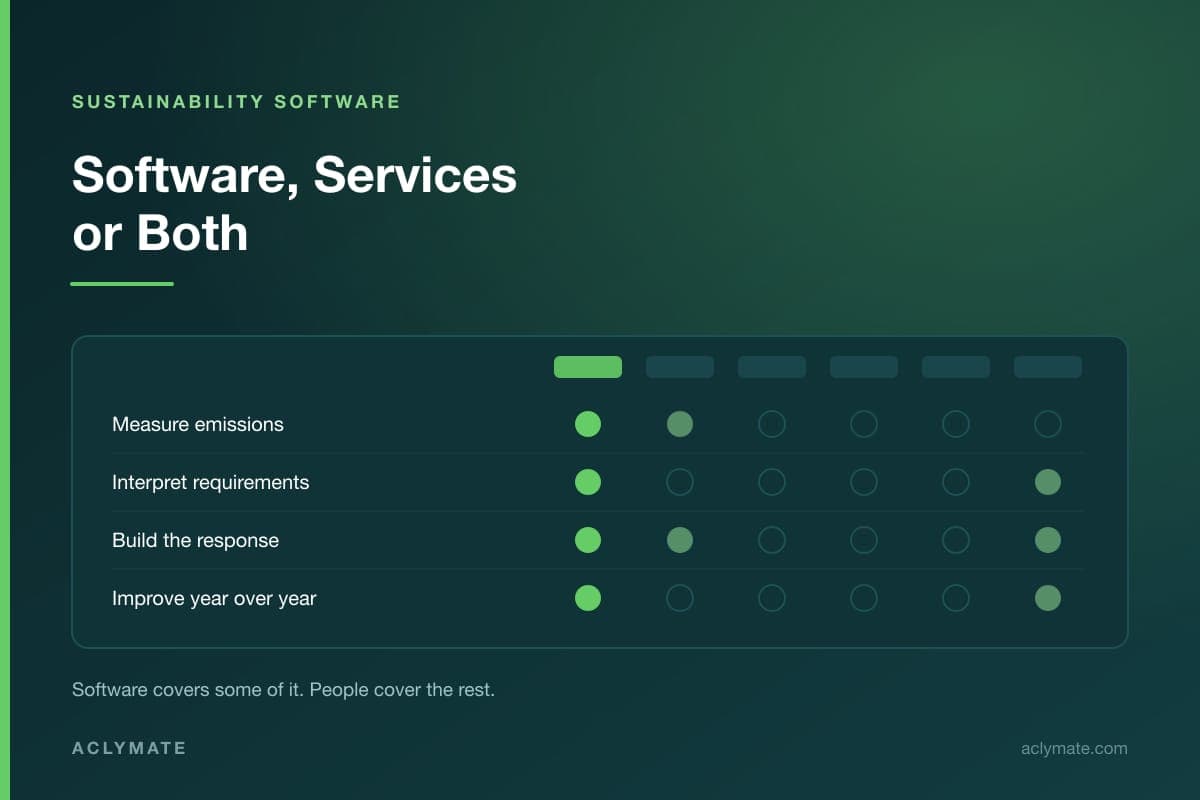
Compare sustainability software and consulting for automotive suppliers and learn when combining technology, AI, and expert support delivers the best results.
Read Article
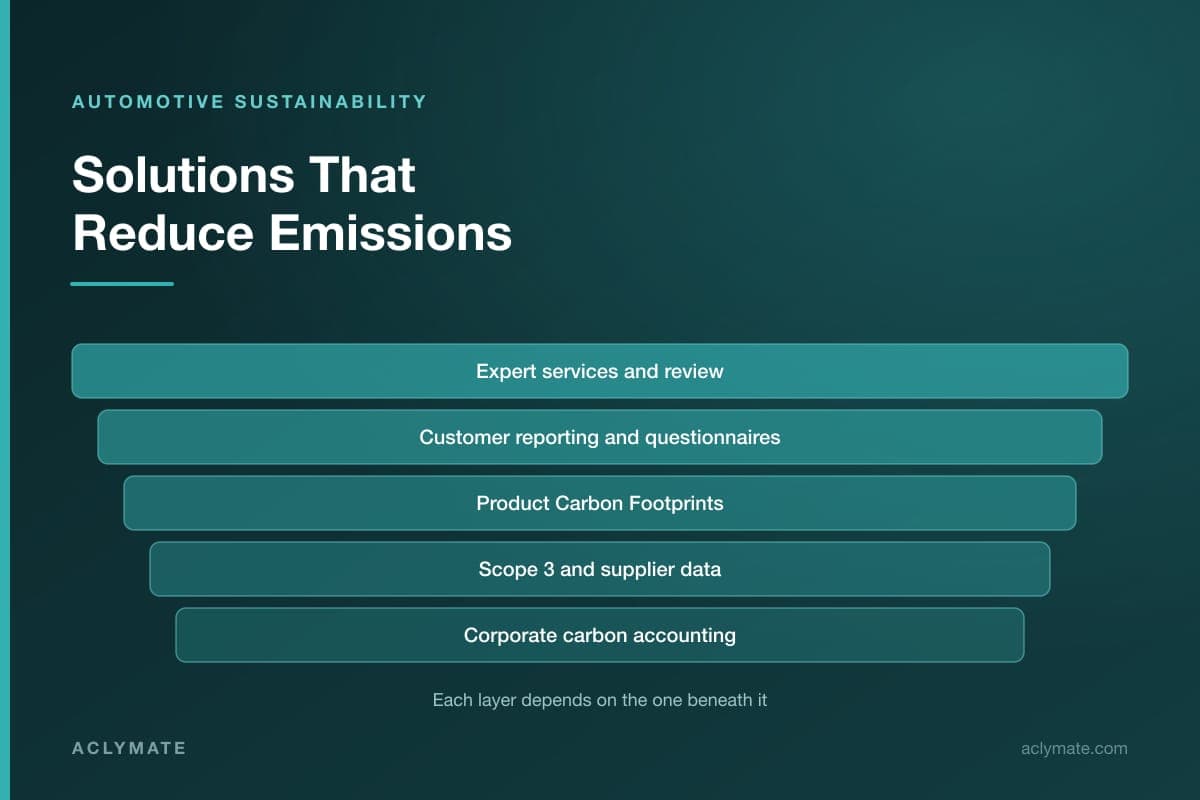
Explore practical automotive sustainability solutions for carbon accounting, Scope 3, supplier data, product footprints, reporting, and emissions reduction.
Read Article
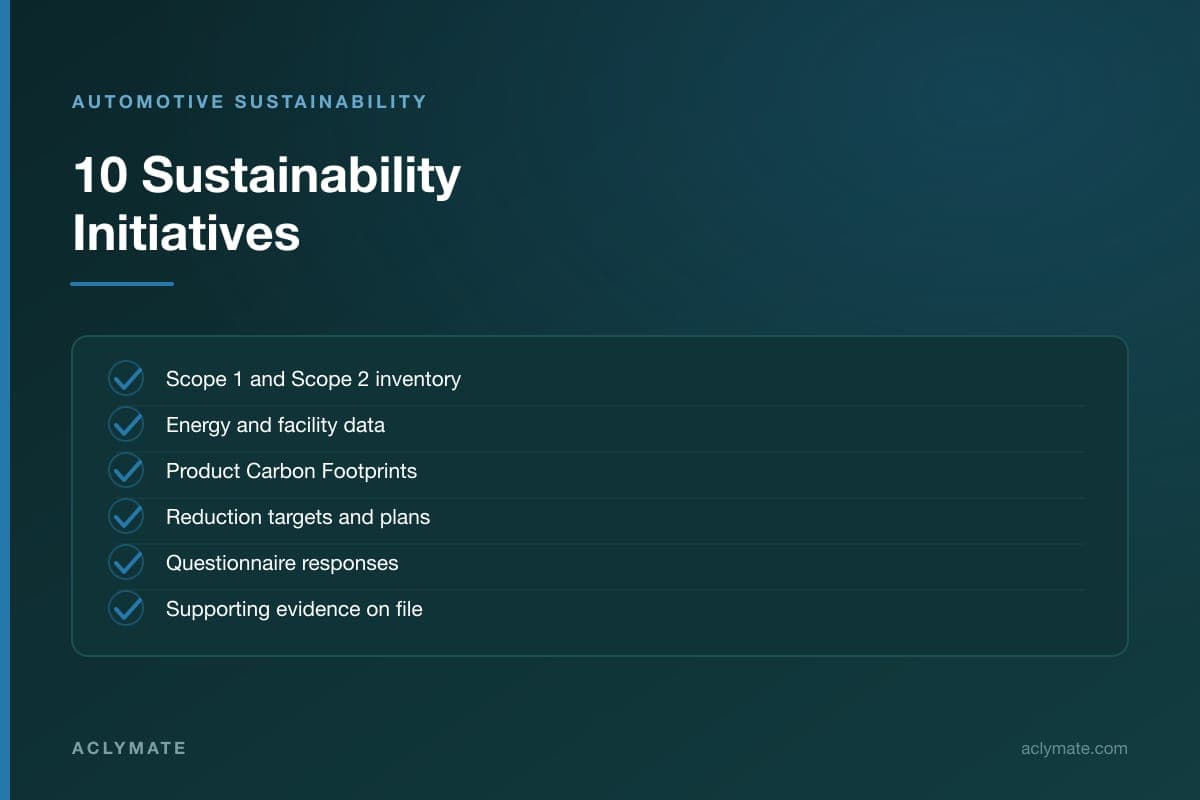
Explore automotive sustainability initiatives for reducing emissions, improving supplier performance, measuring product footprints, and meeting environmental goals.
Read Article
Talk with a Sustainability Expert, see a demo, or start free to put the Aclymate platform and experts to work for your team.