← Back to Insights
Aclymate Team
June 29, 2026
11 min read
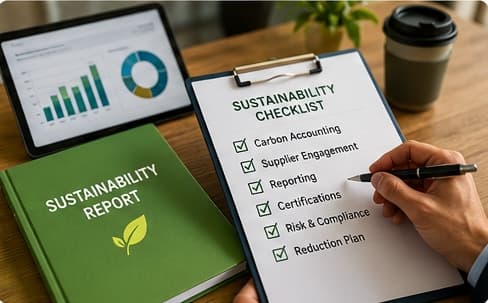
A CDP consultant helps companies prepare for environmental disclosure through CDP by organizing emissions data, climate strategy information, risk and opportunity details, governance information, targets, documentation, and supporting evidence.
For many businesses, CDP starts with a request from a customer, investor, procurement team, or supply chain partner. A company may be asked to disclose climate-related information even if it does not have a full sustainability team, mature carbon accounting process, or formal climate strategy.
That can make CDP feel overwhelming.
A CDP consultant helps make the process more manageable by explaining what is being asked, identifying data gaps, organizing the right information, and helping the company prepare a more complete and credible response.
CDP support is often especially useful when a company needs to report Scope 1, Scope 2, and Scope 3 emissions, explain climate-related risks and opportunities, document governance, describe targets, or respond to customer-driven disclosure requests.
CDP is a global environmental disclosure system used by companies, investors, cities, states, regions, and other organizations to disclose environmental information.
CDP describes itself as the world’s independent environmental disclosure system and says its platform helps organizations turn environmental data into action: CDP overview.
Companies often disclose through CDP because investors, customers, or supply chain partners request it. CDP’s corporate questionnaire is designed to help companies assess environmental risks, impacts, and opportunities across their operations, supply chain, products, services, and financial decisions: CDP Question Bank.
CDP disclosure can cover topics such as:
For many companies, CDP is not just a reporting exercise. It is a way to organize environmental data, respond to customer and investor expectations, and show progress over time.
A CDP consultant helps companies prepare, complete, and improve their CDP disclosure.
This may include:
The goal is not to create a generic sustainability statement. The goal is to help the company provide accurate, consistent, and supportable information that reflects its climate and environmental management practices.
CDP can be challenging because it brings together information from many parts of the business.
A company may need input from finance, operations, procurement, facilities, legal, risk, HR, sustainability, executive leadership, sales, and supply chain teams.
A CDP consultant can help create structure around the process.
CDP responses often require more than emissions numbers.
Companies may need information about:
That information is rarely owned by one person.
A consultant can help identify who needs to contribute, what data is required, and how to coordinate the response.
CDP climate disclosure often depends heavily on carbon accounting.
Companies may need to provide:
The GHG Protocol Corporate Standard is one of the most widely used standards for corporate greenhouse gas accounting and reporting. It includes Scope 2 guidance and Scope 3 value-chain guidance that companies often use to organize emissions reporting.
If the company has not already created a carbon footprint, CDP can expose major data gaps.
A CDP consultant with carbon accounting experience can help organize emissions data, document assumptions, and prepare a more consistent response.
Scope 3 emissions are often one of the hardest parts of CDP disclosure.
Scope 3 includes value chain emissions such as:
Many companies do not have perfect Scope 3 data. That does not always mean they cannot start, but they need a clear method, reasonable assumptions, and a plan to improve data quality over time.
The GHG Protocol Corporate Value Chain Scope 3 Standard provides a methodology that companies can use to account for and report Scope 3 emissions globally.
A CDP consultant can help decide which categories apply, where estimates are acceptable, where supplier data is needed, and how to document the approach.
CDP disclosure is not only about emissions.
Companies may also need to explain how they identify, assess, and respond to climate-related risks and opportunities.
This can include risks and opportunities related to:
CDP says its climate change questionnaire is designed to improve corporate awareness through measurement and disclosure, which CDP views as essential to managing carbon and climate change risk: CDP Climate Change Question Bank.
A CDP consultant can help your company document the process for evaluating climate-related risks and opportunities and explain how those issues affect the business.
This is especially useful for companies that have climate-related information informally discussed by leadership but not yet documented in a structured way.
CDP often asks how climate issues are governed inside the company.
This may include:
Many growing businesses have some informal ownership but not a formal governance structure.
A CDP consultant can help translate what actually happens inside the company into a clearer governance response and identify gaps to improve over time.
CDP may ask companies to report emissions targets, climate goals, reduction initiatives, and progress.
A company may need to explain:
A CDP consultant can help review current goals, identify missing information, and connect targets to practical reduction initiatives.
The right CDP support depends on why you are disclosing, how mature your data is, and what the requester expects.
First-time CDP disclosure can feel complex because companies may not know what data is needed or who owns it.
Useful support may include:
CDP’s disclosure guide outlines steps for companies to disclose, including registering, accessing the portal, and responding to the questionnaire: How to disclose through CDP.
The goal is to create a credible first response and identify what needs to improve for future reporting cycles.
Many companies receive CDP requests because a customer wants supplier climate information.
In that situation, speed and consistency matter.
Useful support may include:
CDP’s 2026 disclosure page says its annual “Letter to the Board” is a formal invitation to disclose environmental information on behalf of investors through the corporate questionnaire, and that in 2026 more than 540 financial institutions with over $110 trillion in assets are requesting more than 43,000 organizations to disclose data: CDP Disclosure 2026.
This is especially important when CDP disclosure is connected to supplier approval, RFPs, customer retention, or procurement scoring.
If your company already submits CDP responses, consulting support may focus on improvement.
Useful support may include:
CDP’s scores page explains that the market increasingly demands comprehensive environmental information and uses CDP data to inform decision-making: CDP scores and A Lists.
The goal is to move from annual scramble to repeatable reporting.
A CDP consultant focuses specifically on CDP disclosure, questionnaire responses, evidence, reporting structure, and improvement planning.
A climate consultant focuses more broadly on greenhouse gas emissions, climate strategy, climate risks, emissions reduction, and climate-related reporting.
The two roles often overlap because CDP disclosure requires strong climate data and strategy.
A climate consultant can support CDP by helping with:
A sustainability consultant may help with broader ESG, reporting, policies, certifications, supplier sustainability, stakeholder communications, and sustainability program management.
A CDP consultant is focused on the CDP disclosure process.
The roles can overlap because CDP often requires information about environmental strategy, governance, operations, supply chain, emissions, and targets.
A sustainability consultant with CDP experience can help make sure CDP disclosure is connected to the company’s broader sustainability program, not treated as a one-time reporting task.
A carbon accounting consultant helps measure greenhouse gas emissions. A CDP consultant helps translate emissions data and climate management practices into a CDP response.
Carbon accounting support may include:
CDP support may include those items plus climate governance, risk management, strategy, targets, supplier engagement, and disclosure quality.
Many companies need both carbon accounting and CDP response support.
Companies often struggle with CDP because key information is missing, informal, or spread across departments.
Common gaps include:
A CDP consultant can help identify these gaps and create a plan to close them over time.
Aclymate provides CDP consulting as part of our broader certification and sustainability claims support.
For Aclymate One customers, that means access to expert guidance for CDP response support, emissions data readiness, documentation organization, and improvement planning. Instead of trying to complete a CDP disclosure alone, your team can work with Aclymate to understand what is being asked, organize the right information, and identify ways to strengthen your response over time.
Aclymate One customers can get help with:
Aclymate cannot guarantee a specific CDP score, but we can help your team prepare a stronger, better-supported response and build the sustainability practices, data, and documentation needed to improve over time.
This support is connected to Aclymate’s certification and claims support services, which help companies organize data and documentation for third-party certification readiness, customer sustainability requests, supplier sustainability requests, RFP proof requirements, and reporting requests such as CDP.
CTA: Get CDP SupportSecondary CTA: See Aclymate One
Aclymate helps growing businesses organize sustainability data, measure emissions, prepare reports, and respond to customer or stakeholder disclosure requests.
With Aclymate, companies can get help with:
Aclymate is especially useful for companies that need CDP support because a customer, investor, or supply chain partner asked for climate disclosure, but they do not have a full internal sustainability team.
Instead of treating CDP as a one-time questionnaire, Aclymate helps companies build a more credible and repeatable sustainability program.
CTA: Get CDP SupportSecondary CTA: See Aclymate One
Aclymate helps growing businesses organize emissions data, prepare reports, respond to customer requests, and build credible proof for CDP and other sustainability disclosures.
Get software, expert support, and hands-on sustainability help in one solution.
Get CDP SupportSee Aclymate One
A CDP consultant helps companies prepare for CDP disclosure by organizing emissions data, reviewing the questionnaire, identifying gaps, supporting response preparation, and helping improve documentation, strategy, governance, and reporting quality.
CDP is a global environmental disclosure system used by companies and other organizations to disclose environmental information, including climate-related data, emissions, risks, opportunities, governance, targets, and progress.
Companies often need CDP support because the disclosure can require detailed emissions data, climate strategy information, governance details, risk and opportunity analysis, Scope 3 information, supplier engagement data, and supporting documentation from multiple departments.
A consultant cannot guarantee a specific score, but they can help identify gaps, organize stronger data, improve response quality, and build a more repeatable disclosure process over time.
CDP climate disclosure usually depends heavily on carbon accounting because companies may need to report Scope 1, Scope 2, and Scope 3 emissions, energy use, emissions methodology, targets, and reduction activities.
A carbon accounting consultant helps calculate greenhouse gas emissions. A CDP consultant helps use emissions data, climate strategy, governance information, risk analysis, and supporting documentation to prepare a CDP response.
A CDP consultant focuses specifically on CDP disclosure and response support. A sustainability consultant may support broader sustainability strategy, ESG reporting, customer requests, certifications, policies, and program management.
Yes. Aclymate provides CDP consulting as part of its certification and claims support services. Aclymate One customers can access CDP response guidance, carbon accounting support, Scope 1, 2, and 3 emissions documentation, evidence organization, gap identification, and improvement planning.
Yes. Aclymate can help your team organize emissions data, prepare stronger documentation, identify gaps, and improve sustainability practices over time. Aclymate cannot guarantee a specific CDP score, but it can provide guidance designed to improve disclosure readiness and response quality.
Yes. Aclymate helps companies organize emissions data, prepare sustainability reports, respond to customer requests, document climate strategy, and build the proof needed to support CDP disclosure and ongoing sustainability work.
Yes. Aclymate One customers can access expert support for CDP response guidance, emissions data, documentation, gap identification, and sustainability program improvement.
Get Aclymate's practical sustainability content delivered weekly.

Learn what a climate consultant does, when businesses need one, and how climate consulting helps with carbon accounting, reporting, strategy, and customer requests.
Read Article
Learn how Product Carbon Footprint data is evolving within IMDS and what automotive suppliers should know about PCF reporting.
Read Article
Learn what automotive sustainability reporting includes, what customers request from suppliers, and how to organize emissions and product data.
Read Article
Talk with a Sustainability Expert, see a demo, or start free to put the Aclymate platform and experts to work for your team.