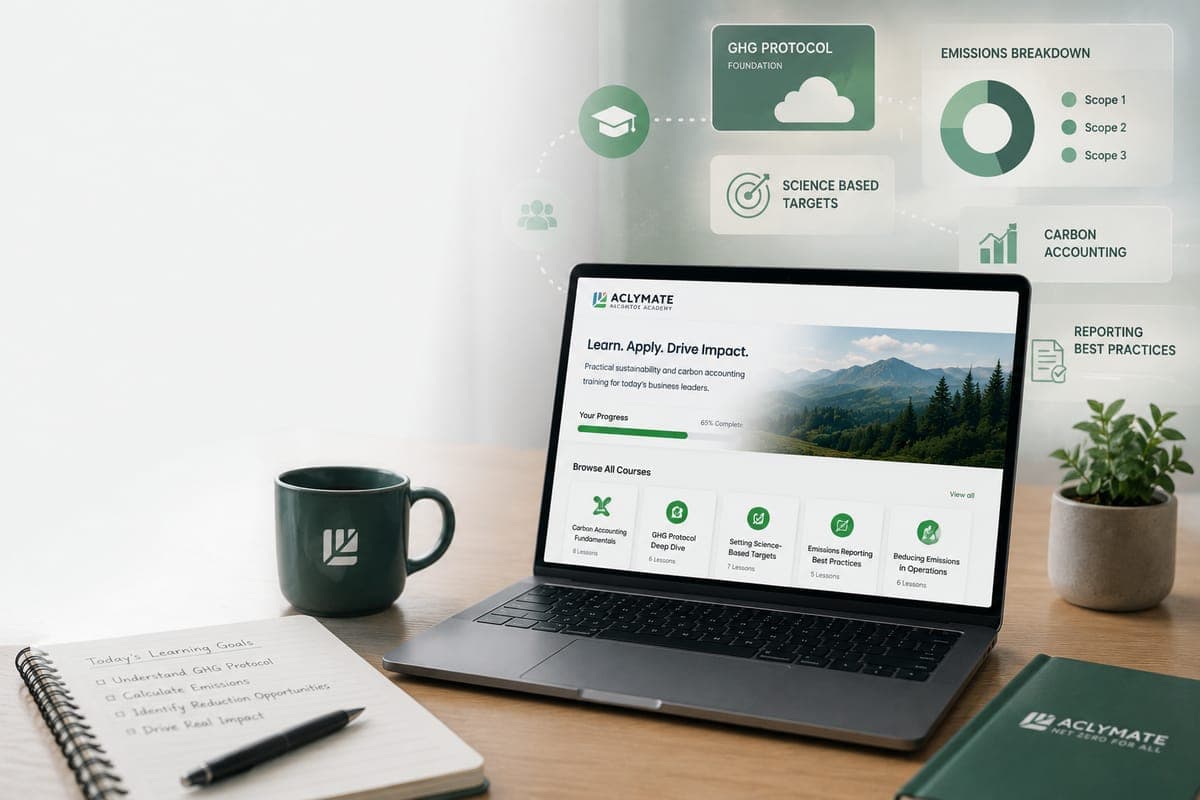
Aclymate Academy's flagship course gives lean teams a shared sustainability vocabulary, practical carbon accounting fundamentals, and a foundation for credible reporting and reduction work.
Self-paced 10-chapter course
Built for teams without a sustainability background
Plain language, no jargon
Final exam + completion certificate
Pairs with Aclymate Navigator and expert services
A self-paced course that builds the shared vocabulary lean teams need to do credible sustainability work — covering measurement fundamentals, the three scopes, reporting frameworks, and what to do next.
Operations, finance, marketing, HR, and ESG-by-default leaders taking on sustainability work for the first time.
Cross-functional teams that need to talk about carbon accounting, reporting, and proof using the same language.
Companies whose sustainability work has outgrown ad-hoc effort and needs a foundation.
Plain-language definitions and how the scopes relate to each other in your business.
Methodology, data sources, and how to start measuring with the data you already have.
Customer questionnaires, CDP, EcoVadis, CSRD-related pressure, and how to think about each.
How to move from understanding to action — and how Aclymate supports lean teams along the way.
Move through chapters at your team's pace — no scheduled sessions required.
Sustainability concepts explained without jargon, by Aclymate's sustainability experts.
Test your understanding at the end of the course with a knowledge check.
Designed for cross-functional teams to take together and build shared vocabulary.
The Language of Climate walks lean teams through carbon accounting fundamentals in order — and finishes with a knowledge-check final exam.
Introduction: Why Your Business Should Care About Carbon
Climate Measurement Fundamentals
Carbon Accounting Basics
Scope 1
Scope 2
Scope 3
The Relationships of Scopes
Reporting Frameworks
Next Steps
Final Exam
The Language of Climate was created by Aclymate's sustainability and carbon accounting experts — the same team that delivers Carbon Bookkeeping, certification readiness, and customer reporting support every day.
Aclymate Academy is a self-paced sustainability education program — beginning with The Language of Climate course — that helps teams build shared sustainability vocabulary and practical understanding.
10 chapters: Introduction (why business should care about carbon), Climate Measurement Fundamentals, Carbon Accounting Basics, Scope 1, Scope 2, Scope 3, The Relationships of Scopes, Reporting Frameworks, Next Steps, and a Final Exam.
Operations, finance, marketing, HR, and sustainability owners — especially at companies without a dedicated sustainability team.
The course is self-paced. Teams typically complete it across a few sessions, depending on how much time they spend on each chapter.
Yes — completing the course and final exam earns an Aclymate Academy completion certificate.
Enroll in the course, or talk with a Sustainability Expert about pairing Aclymate Academy with the Aclymate platform and team.