← Back to Insights
Bill Zujewski
October 16, 2026

An event carbon footprint is the total greenhouse gas emissions an event causes, from the moment attendees leave home to the moment the last load of waste leaves the venue.
It is measured in metric tons of carbon dioxide equivalent (tCO2e) and usually covers attendee and staff travel, hotel stays, venue energy, food and beverage, materials, and waste.
For most in-person events, one source dominates: travel. Getting people to and from the venue — especially by air — routinely accounts for the majority of the total. Food, lodging, and venue energy follow, while waste and printed materials are smaller but highly visible.
That ranking matters. If you plan to cut your event's emissions, the biggest gains rarely come from banning plastic straws. They come from where people travel from, how they get there, and how long they stay.
This guide explains what an event carbon footprint includes, which emission sources matter most, how to measure them, and how to reduce them.
Event emissions follow the same three-scope framework used for corporate carbon accounting, set out by the GHG Protocol. Understanding the scopes tells you which emissions you control directly and which you influence.
Scope 3 is where events live. Projet Celsius, a French carbon consultancy, estimates that indirect emissions make up 85–95% of a typical event's footprint. The GHG Protocol's Corporate Value Chain (Scope 3) Standard defines 15 categories for these emissions; for events, the most relevant are business travel, employee commuting, purchased goods and services, and waste generated in operations.
If your company hosts or attends events, those emissions belong in its own inventory too. Aclymate's overview of carbon accounting for growing companies explains how event activity fits into a full Scope 1, 2, and 3 footprint.
Travel is the largest source of event emissions by a wide margin, followed by food, lodging, materials, and venue energy. The table below shows typical shares for an in-person business event, based on Projet Celsius's analysis of event inventories using French ADEME emission factors.
| Emission source | Typical share of total | Scope | What drives it |
| Attendee and staff travel | 65–85% | 3 | Distance, number of flights, long-haul vs. short-haul |
| Food and beverage | 5–15% | 3 | Share of meat (especially beef), food waste |
| Lodging | 3–10% | 3 | Number of hotel nights, hotel energy mix |
| Materials and production | 3–10% | 3 | Booth builds, signage, printing, swag, freight |
| Venue energy | 2–8% | 1 and 2 | Event length, HVAC, lighting, AV, local grid |
| Digital and streaming | 0.5–3% | 3 | Streaming hours and resolution (higher for hybrid) |
| Waste | 0.5–2% | 3 | Landfill vs. compost and recycling, single-use items |
Shares vary by event type. A local seminar where most people drive in looks very different from an international conference where most people fly. Use these ranges to prioritize, then replace them with your own data.
Attendee travel usually makes up most of an event's footprint, and air travel makes up most of that. Projet Celsius estimates that one participant on a long-haul flight can emit as much as several hundred participants arriving by high-speed train.
This is why venue choice and format matter more than any on-site decision. An event in a city most attendees can reach by rail or car will almost always beat one that requires flights. Count staff, speakers, and exhibitors too — they often travel farthest.
Hotel stays add emissions for every room, every night. The key drivers are the number of nights and the hotel's energy source. Multi-day events and attendees arriving a day early raise this number quickly. Partner hotels within walking distance of the venue also cut local transport.
Electricity, heating, and cooling for the venue are your Scope 1 and 2 emissions. They are often a single-digit percentage of the total, but they are the easiest to measure — ask the venue for metered kilowatt-hours. A venue on a clean grid or with renewable energy contracts can shrink this line further. The U.S. EPA's GHG Emission Factors Hub publishes the default factors most U.S. organizations use to convert energy use into emissions.
Catering is usually the second-largest source. Its footprint depends mostly on what is served. Projet Celsius puts a beef-based meal at roughly 5–7 kg CO2e, versus 0.8–1.5 kg for a vegetarian meal. Across hundreds of attendees and several meals, that gap adds up to tonnes. Overordering — and the food waste it creates — adds even more.
Signage, badges, printed programs, swag, booth builds, and the waste they become are what attendees notice. Together they rarely exceed about 10% of the total. They are still worth managing for credibility and cost, but they should not crowd out travel and food in your plan.
You measure an event carbon footprint by multiplying activity data — miles traveled, hotel nights, kilowatt-hours, meals served, kilograms of waste — by emission factors, then adding the results. Most of the work is collecting good data.
Not sure where to start? Aclymate's free Explorer tool estimates a company footprint across Scopes 1, 2, and 3 and highlights data gaps — a useful first step before you dig into event-level detail.
The most effective reductions are decided months before the event, when you choose the format, location, and audience. Work through these in order of impact:
Be careful with claims. Calling an event "carbon neutral" based on offsets alone is increasingly scrutinized, and the EU has moved to ban offset-based neutrality claims. A published footprint plus a reduction target is more credible. For a broader management framework, ISO 20121 is the international standard for event sustainability management, and the Net Zero Carbon Events initiative brings venues, organizers, and suppliers together around a shared roadmap to net zero.

Aclymate helps lean teams turn event activity — travel, hotel stays, venue energy, catering, and materials — into a credible, organized carbon footprint without hiring a sustainability department. Events are rarely a standalone problem. They show up in your company's Scope 3 inventory, in customer sustainability questionnaires, and in the claims your marketing team wants to make. Aclymate connects all three.
Companies in event-heavy industries already use this approach. Branded merchandise distributor Whitestone, for example, built a measurable sustainability program with Aclymate, measuring a 4,053 tCO2e annual footprint and earning Climate Leader certification to answer customer sustainability requests with confidence.
An event carbon footprint is the total greenhouse gas emissions caused by planning and running an event, measured in tonnes of CO2 equivalent (tCO2e). It typically includes attendee and staff travel, lodging, venue energy, food and beverage, materials, and waste.
Travel. Getting attendees, staff, and speakers to and from the event typically accounts for about 65–85% of an in-person event's footprint, and air travel drives most of that.
It depends mostly on how far people travel. Projet Celsius estimates a 500–800-person national conference at roughly 80–200 tCO2e, while an international conference dominated by flights can exceed 500 tCO2e.
Yes. Excluding attendee travel removes the largest share of emissions and makes the result hard to compare with other events. Report it, and separate the emissions you control directly from those you influence.
No, but they are far lower. Streaming, devices, and data hosting still create emissions, though usually a small fraction of what in-person travel would produce.
Organizers can offset residual emissions, but offset-only "carbon neutral" claims face growing regulatory scrutiny. A published footprint, real reductions, and transparent offsetting of what remains is the more defensible approach.
Your next event's footprint is mostly decided before the first registration opens. Measure it now, and you can cut it where it counts — travel, food, and lodging — instead of guessing.
Ready to see your numbers? Start free with Aclymate to estimate your footprint, or book a demo to see how Aclymate's software and experts can measure, reduce, and report your event and company emissions — without adding headcount.
Get Aclymate's practical sustainability content delivered weekly.

AI is transforming carbon credit verification through satellite monitoring, automated analysis, and anomaly detection. But can technology solve the voluntary carbon market’s credibility problem? Discover the limitations of AI verification and how businesses can evaluate carbon credits while keeping emissions reductions ahead of offsetting.
Read Article

AI is creating new opportunities for businesses, but it also comes with an environmental cost. Carbon offsets can help address some of those emissions, but businesses need to understand what they are offsetting, how offsets work, and why measuring and reducing emissions should come first.
Read Article
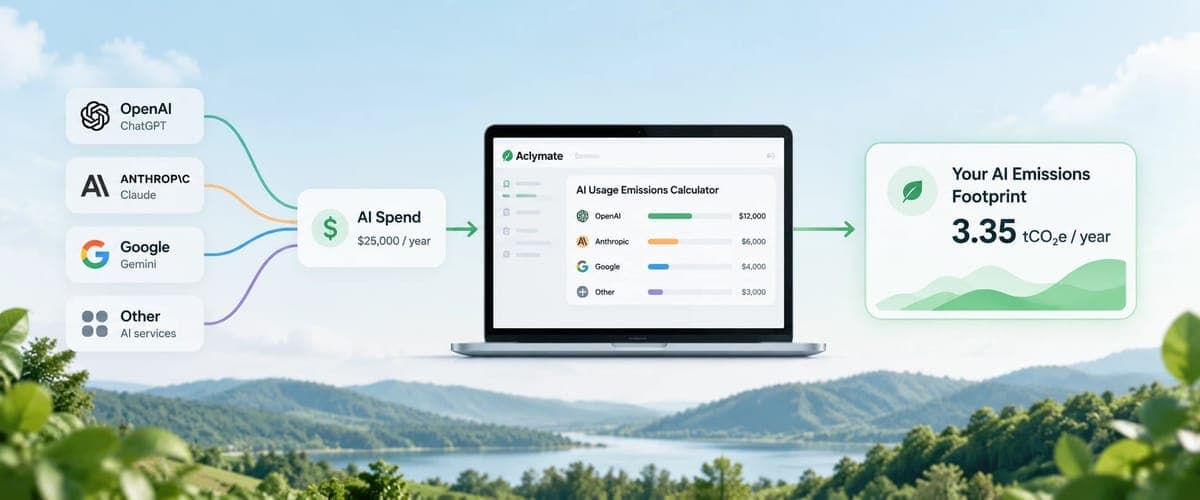
AI carbon emissions are becoming a new consideration for companies adopting ChatGPT, Claude, Gemini, Copilot and other artificial intelligence tools. Here’s how Aclymate estimates the carbon emissions from a company’s AI usage today—and how we expect the methodology to improve as AI providers release better usage and emissions data.
Read Article
Talk with a Sustainability Expert, see a demo, or start free to put the Aclymate platform and experts to work for your team.