← Back to Insights
Bill Zujewski
November 5, 2026

Trade shows are where buyers increasingly ask exhibitors about sustainability, and organizers are starting to ask too. But a trade show carbon footprint looks different from a conference's. Alongside the flights, there are booths to build, exhibits to ship and floor power to run.
A trade show carbon footprint includes visitor and staff travel, booth construction and materials, exhibit freight, hotel stays and venue energy, and booth materials and freight can make up a much bigger share than at other events. Travel is still large. But for exhibitors with custom booths and heavy shipments, the exhibit itself can rival the flights.
Every source uses the same calculation:
Emissions (kg CO2e) = Activity data × Emission factor
This guide covers:
Germany's trade fair association, AUMA, published a guideline for calculating emissions at trade fairs based on the Net Zero Carbon Events methodology. It splits trade show emissions into ten categories. The illustrative example in the full guideline, a two-day exhibition in Berlin with 1,000 attendees, shows how different the mix can be:
| Category | Share of example total |
| Travel to and from the destination | 39.7% |
| Production and materials (stands, carpets, signage) | 33.0% |
| Freight and logistics | 15.2% |
| Accommodation | 4.9% |
| Energy | 4.7% |
| Local transportation | 1.8% |
| Food and beverage, waste, water and digital | Under 1% combined |
AUMA notes the example is simplified, so these shares aren't benchmarks. But the pattern is clear: booth materials and freight together made up almost half the total, more than travel.
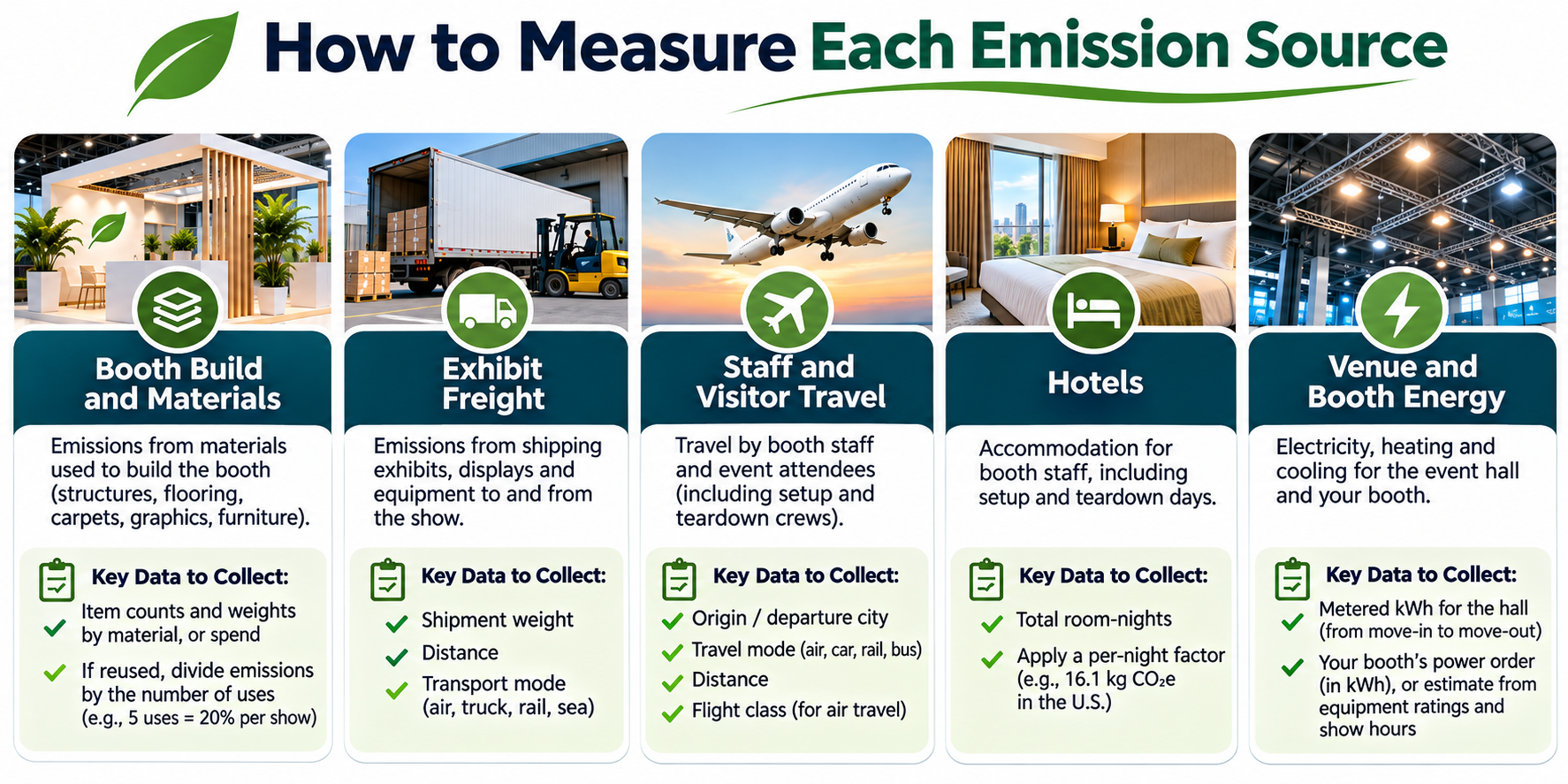
How to measure each source
Booth emissions come from the materials used to make the stand: structures, flooring, carpets, graphics and furniture. AUMA counts these under production and materials, from raw materials up to the point of sale.
Freight covers shipping exhibits, displays and equipment to the venue and back.
A trade show has many parties, and AUMA notes that responsibility "varies depending on the organizations involved." A typical split looks like this:
| Party | Usually measures |
| Organizer | Visitor travel, hall energy, organizer-run catering, shared signage, waste |
| Exhibitor | Booth materials, exhibit freight, staff travel and hotels, booth power |
| Venue | Building energy, water and waste data, often shared with organizers |
Agree the split in advance. Otherwise, the same booth power or waste may be counted by both the organizer and the exhibitor, or by neither.
Here's the footprint for a mid-sized exhibitor at a three-day show in Las Vegas. All inputs are illustrative. Emission factors come from the EPA Hub 2025, including the eGRID WECC Southwest factor for booth power (about 0.337 kg CO2e per kWh), and a U.S. hotel factor of 16.1 kg CO2e per room-night. Booth materials aren't included, because they depend heavily on the build.
| Source | Activity data | Emissions (kg CO2e) | Share |
| Staff flights | 8 staff × 1,800 mi round trip, medium haul | 1,873 | 56.1% |
| Exhibit freight (truck) | 2 short tons × 1,000 mi each way | 750 | 22.4% |
| Hotels | 32 room-nights (8 staff × 4 nights) | 515 | 15.4% |
| Booth power | 600 kWh | 202 | 6.1% |
| Total | 3,341 (≈ 3.3 t) | 100% |
Two decisions change this exhibitor's footprint the most:
If the booth is a custom one-off build, its materials could add significantly more. In AUMA's example, production and materials made up a third of the show's emissions.

Aclymate helps trade show teams measure every source, from booth to freight, inside their company's full footprint.
Branded merchandise distributor Whitestone used Aclymate to measure a 4,053 tCO2e annual footprint and earn Climate Leader certification.
It's the total greenhouse gas emissions from a trade show, including visitor and staff travel, booth materials, exhibit freight, hotel stays and venue energy. It's measured in kilograms or tonnes of CO2e.
Travel is usually the largest single source, but booth materials and freight can be close behind. In AUMA's illustrative example, travel was about 40%, and production, materials and freight together were about 48%.
Multiply each shipment's weight by its distance and a mode-specific emission factor, for the trip to the show and back. Air freight's EPA factor is nearly six times that of trucking per ton-mile.
Divide the booth's total emissions by the number of shows you plan to use it for. A booth used at five shows carries 20% of its emissions at each one.
Both, for different sources. Organizers usually measure visitor travel and hall energy. Exhibitors measure their own booth materials, freight, staff travel and hotels. Agree the split in advance to avoid double counting.
Reuse modular booths, ship by ground instead of air, send fewer staff, choose fewer, better-targeted shows, and reduce booth power. In our example, switching freight from air to truck cut the total by more than half.
A trade show footprint is more than flights. Measure your booth, freight, travel and hotels together, and the biggest cuts become obvious.
Ready to measure your trade show footprint? Start free with Aclymate Explorer to get a baseline in minutes, or book a demo to see how Aclymate's software and experts can measure, reduce and report your event and company emissions without adding headcount.
Get Aclymate's practical sustainability content delivered weekly.

How companies measure emissions from meetings, retreats, offsites, and launches, and fold event data into their GHG inventory without double counting.
Read Article

A practical guide for conference teams: what data to collect from registration, hotels, the venue, and caterers to estimate your conference's emissions.
Read Article

A workflow for estimating event emissions before the event, collecting real data during it, and updating your footprint afterward for accurate reporting.
Read Article
Talk with a Sustainability Expert, see a demo, or start free to put the Aclymate platform and experts to work for your team.