← Back to Insights
Bill Zujewski
November 2, 2026

A conference carbon footprint calculator is only as good as the data you feed it. Most conference teams have that data already, scattered across the registration platform, hotel reports, venue invoices and catering orders. The work is knowing what to ask for and when.
A conference carbon footprint calculator estimates emissions by multiplying four kinds of activity data — attendee travel, hotel room-nights, venue energy and meals — by their emission factors. Registration gives you travel, hotels give you room-nights, the venue gives you kilowatt-hours, and caterers give you meal counts.
The calculation for every source is the same:
Emissions (kg CO2e) = Activity data × Emission factor
This guide covers:
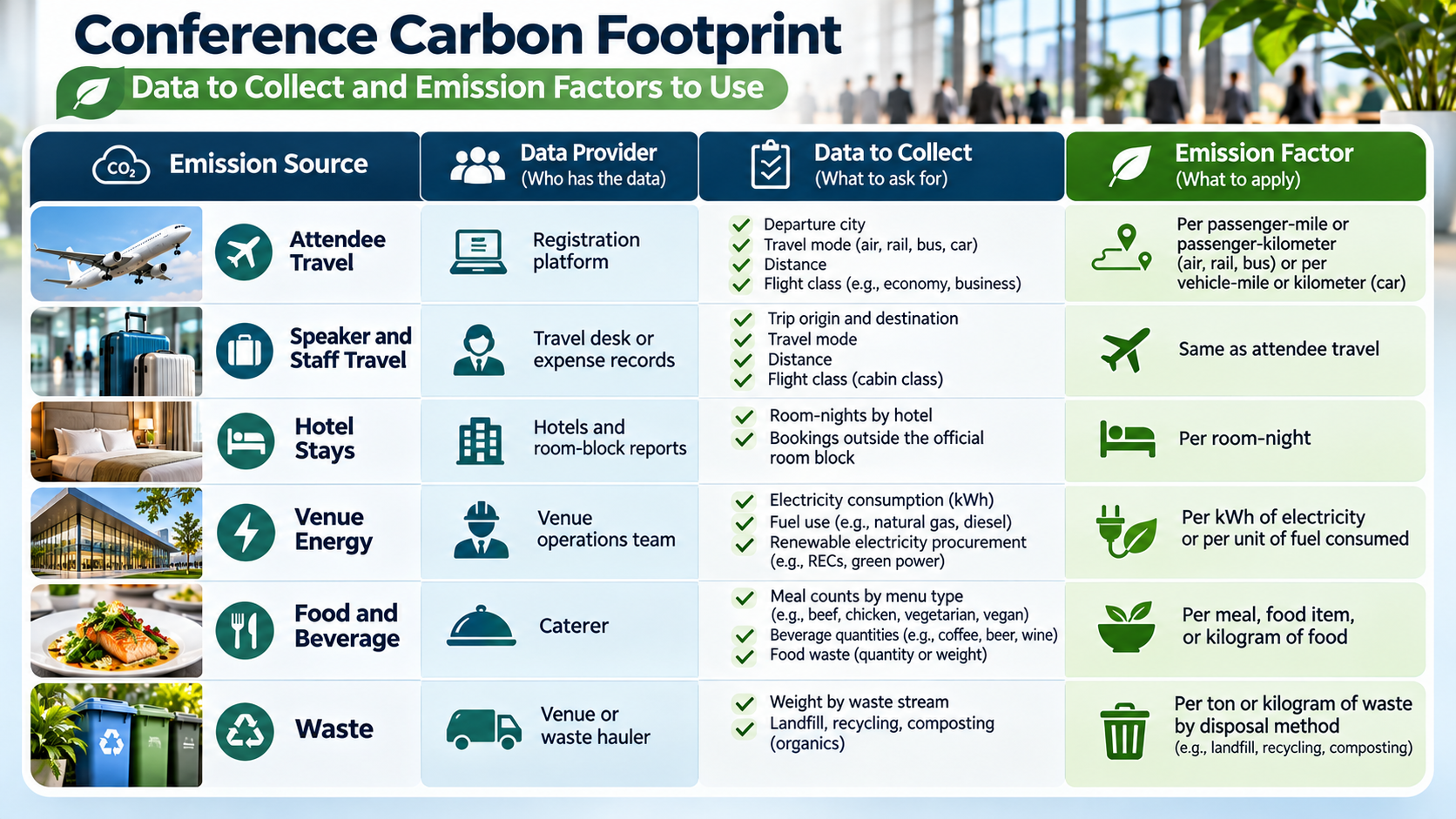
In the U.S., the EPA GHG Emission Factors Hub has standard factors for travel, grid electricity and waste.
Attendee travel is usually the largest part of a conference footprint, so registration is your most valuable data source. The Net Zero Carbon Events travel and accommodation guidance recommends asking for departure origins and travel methods at registration. It notes that even the origin airport and flight class "can lead to relatively accurate estimations."
Add these questions to your registration form:
Make the questions optional but easy. Short dropdowns get far better response rates than open text fields.
Hotel emissions are room-nights multiplied by a per-night emission factor. A commonly used U.S. average from the UK government's conversion factors is 16.1 kg CO2e per room-night.
Ask each hotel in your block for:
Don't forget attendees who book outside the block. A registration question about hotel nights can help fill that gap.
Venue energy covers electricity, heating, cooling and any generator fuel. Ask the venue for:
If your conference shares a venue with other events and there's no sub-metering, ask the venue to split energy use by floor area and days.
Food emissions depend mostly on what's served, not how many people ate. Ask your caterer for:
Projet Celsius, citing France's ADEME database, puts a beef-based meal at 6.29 kg CO2e and a vegetarian meal at 0.51 kg. That 12-to-1 gap is why menu mix matters more than headcount.
You'll rarely get complete data. The Net Zero Carbon Events methodology admits that covering 100% of an event with real data "is rarely possible or feasible." Fill gaps in a way you can explain:
Here's how the data comes together for a two-day conference with 400 attendees. All inputs are illustrative. Emission factors come from the EPA Hub 2025, including the eGRID RFC East factor for the Philadelphia area (about 0.271 kg CO2e per kWh), plus the hotel and meal factors above.
Registration: 300 of 400 attendees (75%) answered the travel questions. Of those, 90 drove an average of 180 miles round trip, 180 flew 1,200 miles and 30 flew 5,500 miles. The calculator scales this mix up to all 400 attendees.
| Source | Activity data | Emissions (kg CO2e) | Share |
| Attendee travel | Respondents' travel (60,064 kg) scaled to 400 attendees | 80,086 | 81.2% |
| Hotel stays | 580 room-nights from block reports | 9,338 | 9.5% |
| Venue energy | 18,000 kWh metered, setup through teardown | 4,875 | 4.9% |
| Food and beverage | 600 beef-based meals + 1,000 vegetarian meals | 4,284 | 4.3% |
| Total | 98,582 (≈ 99 t) | 100% |
That's about 246 kg CO2e per attendee. Travel makes up over 80% of the total, and the 30 long-haul flyers alone account for about 27 t of the reported travel.
Two details stand out. First, the 600 beef meals produced more than seven times the emissions of the 1,000 vegetarian meals. Second, the 25% of travel that was extrapolated still adds about 20 t. That's a good reason to push for a higher response rate next time.

Aclymate gives conference teams one place to collect event data, calculate emissions and report the results.
Branded merchandise distributor Whitestone used Aclymate to measure a 4,053 tCO2e annual footprint and earn Climate Leader certification.
You need attendee departure cities and travel modes from registration, room-nights from hotels, metered kWh from the venue, and meal counts by menu type from caterers. Waste weights from the venue or hauler make the estimate more complete.
Ask for departure city, main travel mode, and, for flyers, origin airport and cabin class. Ask drivers whether they're sharing a ride. Keep the questions short and use dropdowns.
Multiply total room-nights by a per-night emission factor. Use the hotel's own HCMI figure if it has one, or a location-specific average such as 16.1 kg CO2e per room-night for the U.S.
Apply the travel mix of the attendees who did respond to those who didn't, and label it as an extrapolation. Report your response rate alongside the result.
Multiply meal counts by emission factors for each menu type. A beef-based meal produces about 6.29 kg CO2e and a vegetarian meal about 0.51 kg, according to Projet Celsius, so get counts by menu type rather than one total.
In the U.S., the EPA GHG Emission Factors Hub covers travel, electricity, fuel and waste. Use regional grid factors for venue electricity and hotel-specific or country-level factors for room-nights.
The best conference carbon numbers start at registration and end with supplier reports. Ask for the right data from the start, and the calculation becomes the easy part.
Ready to calculate your conference footprint? Start free with Aclymate Explorer to get a baseline in minutes, or book a demo to see how Aclymate's software and experts can measure, reduce and report your event and company emissions without adding headcount.
Get Aclymate's practical sustainability content delivered weekly.

How companies measure emissions from meetings, retreats, offsites, and launches, and fold event data into their GHG inventory without double counting.
Read Article

A workflow for estimating event emissions before the event, collecting real data during it, and updating your footprint afterward for accurate reporting.
Read Article

Most conference emissions come from attendee travel and hotel stays. Learn where a conference footprint comes from and how organizers measure it.
Read Article
Talk with a Sustainability Expert, see a demo, or start free to put the Aclymate platform and experts to work for your team.