← Back to Insights
Bill Zujewski
November 2, 2026

Sales kickoffs, leadership retreats, product launches and team offsites add up. For many companies, they're one of the biggest drivers of business travel emissions. And customers sending sustainability questionnaires increasingly expect those emissions to show up in your footprint.
A corporate event carbon footprint is the emissions from a company's internal and external events, mainly employee travel, hotel stays, venues and catering, measured and then folded into the company's greenhouse gas inventory under the right Scope 3 categories. The measurement is straightforward. The tricky part is adding it to your inventory without counting the same flights twice.
The core calculation is the same for every event:
Emissions (kg CO2e) = Activity data × Emission factor
This guide covers:
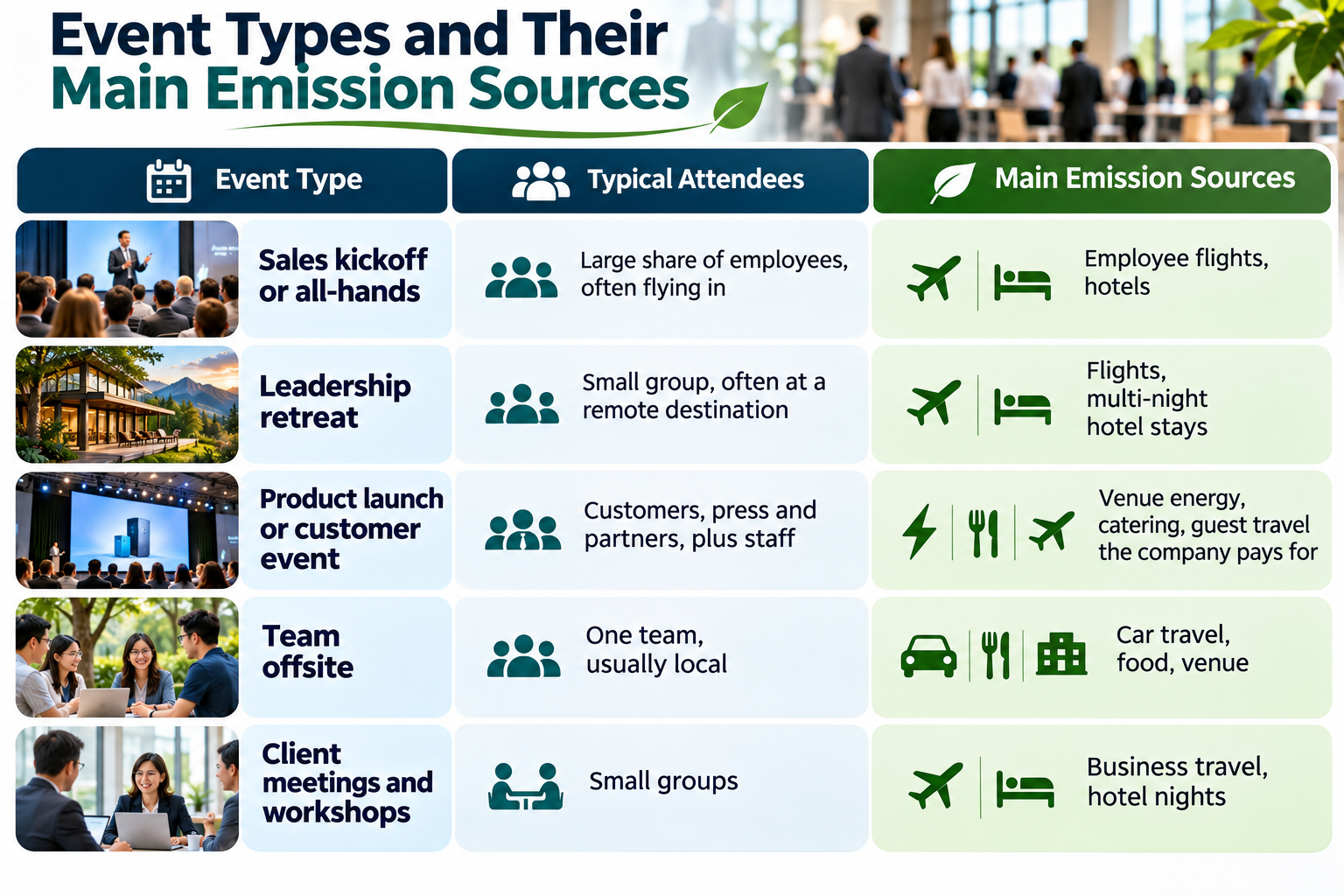
For events where employees fly in, travel and hotels will dominate. For local events, venue energy and catering make up a bigger share. For more on how event emissions break down, see our guide to what makes up an event carbon footprint.
Corporate events aren't a separate category in a company's footprint. Under the GHG Protocol Corporate Standard, their emissions fall into categories you're already reporting.
| Event emission source | Where it belongs in your inventory |
| Employee flights, rail, rental cars, rideshare | Scope 3, Category 6: Business travel |
| Employee hotel stays | Category 6: Business travel (optional under the GHG Protocol, but commonly included) |
| Events held in your own offices | Scope 1 and 2, already in your facility energy |
| Venue rental, catering, AV, event agency fees | Scope 3, Category 1: Purchased goods and services |
| Swag, printed materials, signage | Category 1: Purchased goods and services |
| Travel and hotels you pay for on behalf of customers, press or partners | Not Category 6, which covers employees only. Many companies report it under Category 1; document your choice |
The GHG Protocol's Scope 3 Calculation Guidance defines business travel as the "transportation of employees for business-related activities." It allows three calculation methods: fuel-based, distance-based and spend-based. It also lets companies "optionally include emissions from business travelers staying in hotels."
Double counting happens when the same activity enters your inventory twice, usually once through travel data and once through spend data. Watch for these four traps:
The simplest rule is to pick one data source per activity and tag it, rather than calculating each event in isolation and adding it on top.
Here's a sample year for a U.S. company with four kinds of events. All inputs are illustrative. Emission factors come from the EPA Hub 2025, a U.S. hotel factor of 16.1 kg CO2e per room-night, and an average meal factor of 2.04 kg CO2e from Projet Celsius.
| Event | Key inputs | Emissions (kg CO2e) |
| Sales kickoff | 200 employees fly 1,500 mi, 50 drive 100 mi; 500 room-nights; 8,000 kWh; 1,000 meals | 53,427 |
| Leadership retreat | 30 people fly 2,000 mi; 90 room-nights; 270 meals | 9,806 |
| Product launch | 40 press flown in 1,000 mi with 40 room-nights; 60 staff drive locally; 6,000 kWh; 400 meals | 9,311 |
| Team offsites (6 per year) | 5 carpools × 60 mi each; 180 meals | 905 |
| Total | 73,449 (≈ 73 t) |
Mapped to the inventory, the events break down like this:
| Inventory category | Event emissions (kg CO2e) | Share |
| Category 6: Employee travel and hotels | 58,904 | 80.2% |
| Category 1: Venues, catering, and paid guest travel and hotels | 14,545 | 19.8% |
Two takeaways for this company:
Aclymate keeps event data inside your company's full GHG inventory, so events are measured once and counted once.
Branded merchandise distributor Whitestone used Aclymate to measure a 4,053 tCO2e annual footprint and earn Climate Leader certification.
It's the greenhouse gas emissions from a company's meetings, retreats, launches and offsites. It mainly includes employee travel, hotel stays, venue energy, catering and materials.
Employee travel and hotels go in Scope 3, Category 6 (business travel). Venues, catering, agency services and materials usually go in Category 1 (purchased goods and services). Events in your own offices are already in your Scope 1 and 2 energy.
Use one data source per activity. If your travel data already includes event flights, tag them as event travel instead of adding them again. Don't count an all-inclusive event invoice spend-based and also count its hotels activity-based.
The GHG Protocol makes them optional in Category 6, but many companies include them because they're a meaningful share of event emissions. State your choice in your inventory.
Category 6 covers employees only. If your company pays for customer, press or partner travel, many companies report it under purchased goods and services. Document the approach so it's consistent year to year.
Events where many employees fly in, such as sales kickoffs and all-hands meetings. In our example, the sales kickoff produced 73% of the year's event emissions.
Corporate events are already part of your footprint. Tag them, map them and report them as a view of your inventory, and you'll see exactly which events to change.
Ready to bring your events into your GHG inventory? Start free with Aclymate Explorer to get a baseline in minutes, or book a demo to see how Aclymate's software and experts can measure, reduce and report your emissions without adding headcount.
Get Aclymate's practical sustainability content delivered weekly.

A practical guide for conference teams: what data to collect from registration, hotels, the venue, and caterers to estimate your conference's emissions.
Read Article

A workflow for estimating event emissions before the event, collecting real data during it, and updating your footprint afterward for accurate reporting.
Read Article

Most conference emissions come from attendee travel and hotel stays. Learn where a conference footprint comes from and how organizers measure it.
Read Article
Talk with a Sustainability Expert, see a demo, or start free to put the Aclymate platform and experts to work for your team.