← Back to Insights
Aclymate Team
May 22, 2026

You already know your business needs to get serious about carbon reporting. Maybe a key customer asked for your emissions data. Maybe you're preparing for investor due diligence, or you simply want to get ahead of incoming regulations like the SEC climate disclosure rules or California's SB 253. Whatever the trigger, the challenge is the same: you have no inventory, no baseline, and no clear starting point.
This guide gives you the fastest, most credible path from zero to a finished first greenhouse gas inventory for a mid-sized company without building an internal sustainability department from scratch.
Large enterprises have dedicated ESG teams, third-party auditors, and years of historical data. Startups can often claim immateriality. Mid-sized and growing businesses sit in the hardest spot: big enough to be scrutinized, but typically without the internal infrastructure to respond quickly.
The good news: you don't need to solve everything at once. A credible first inventory is achievable in weeks, not months, if you follow a structured approach.
All credible greenhouse gas reporting is built on the GHG Protocol Corporate Accounting and Reporting Standard, the globally recognized framework used by most sustainability reporting standards including GRI, CDP, and TCFD.
Under the GHG Protocol, emissions are divided into three scopes:
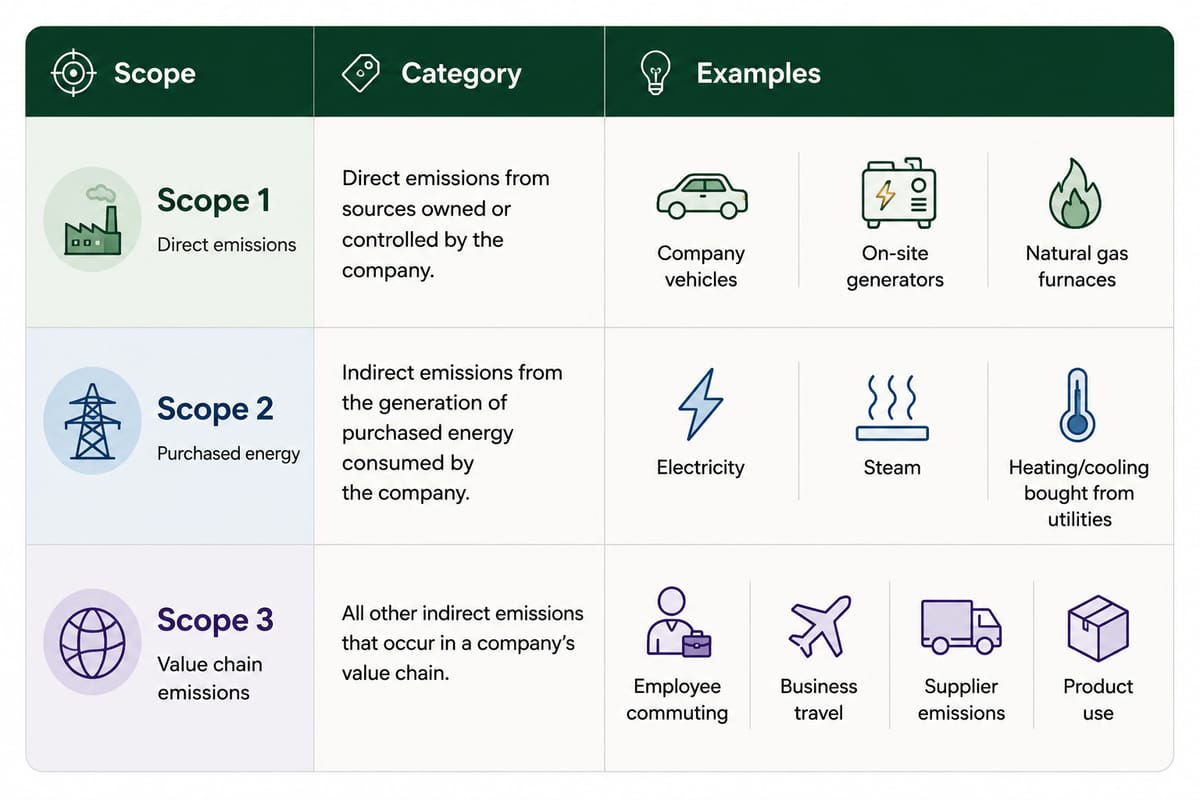
For a first inventory, most growing businesses should prioritize Scope 1 and Scope 2 as these are mandatory in nearly every reporting framework, easiest to collect, and most defensible. Scope 3 can be phased in over time as your program matures. Learn more about which scopes apply to your business.
Before collecting a single data point, you need to define what your inventory covers. This is called setting your boundaries.
Decide which legal entities, subsidiaries, and facilities are included. The GHG Protocol offers two approaches: equity share and operational control. For most growing companies, operational control is easier to apply: you report emissions from all operations you control, regardless of ownership percentage.
This is where you decide which emission sources to include. For your first inventory, a practical approach is:
Data collection is where most companies stall. Here's how to do it fast without sacrificing credibility.
For a first inventory, activity-based data (kWh consumed, liters of fuel burned, miles flown) is more accurate than spend-based estimates. If exact activity data isn't available, spend-based conversion factors from sources like the EPA's Emission Factors for Greenhouse Gas Inventories can fill the gaps.
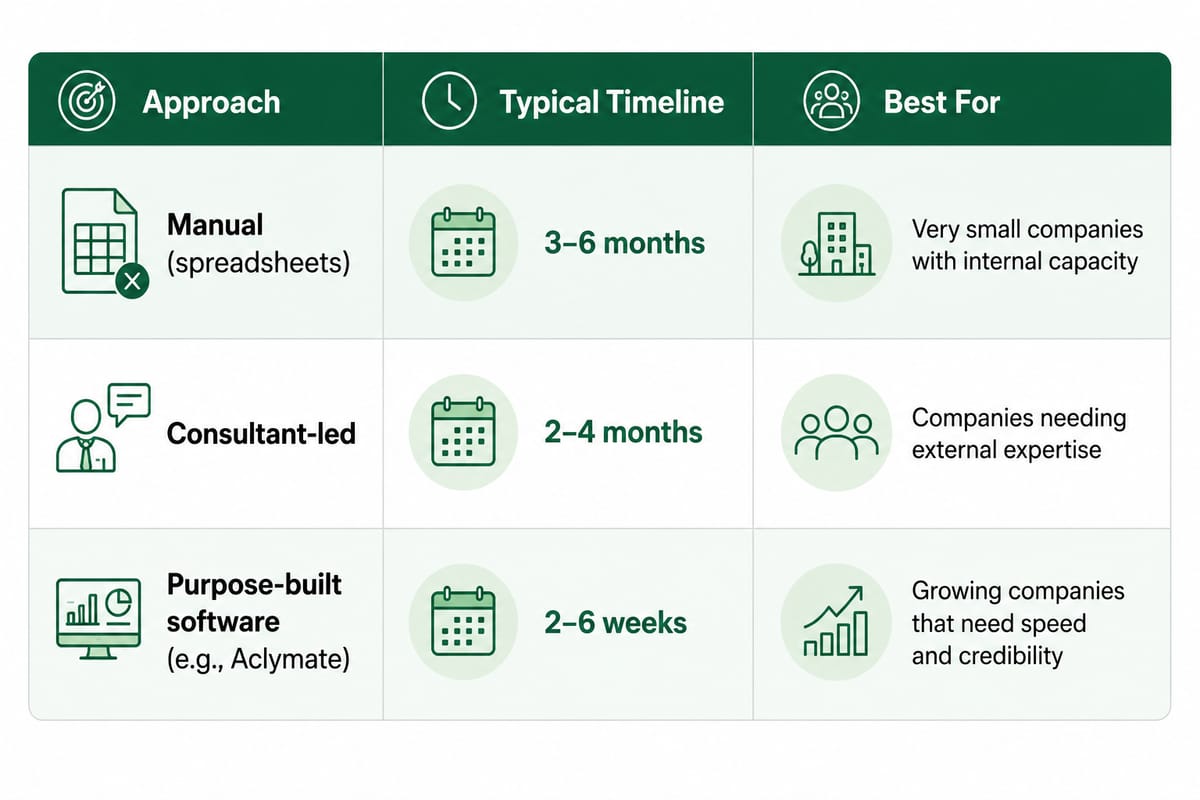
How you choose the right sustainability reporting software to meet GHG Protocol standards will significantly affect how fast you finish and how credible your results are.
Aclymate is purpose-built for growing businesses. It automates the calculation process, applies the right emission factors for your industry and geography, and generates a compliance-ready GHG report that meets GHG Protocol standards. See how Aclymate works →
Once your data is organized, the calculation step is where software earns its keep. The formula is straightforward:
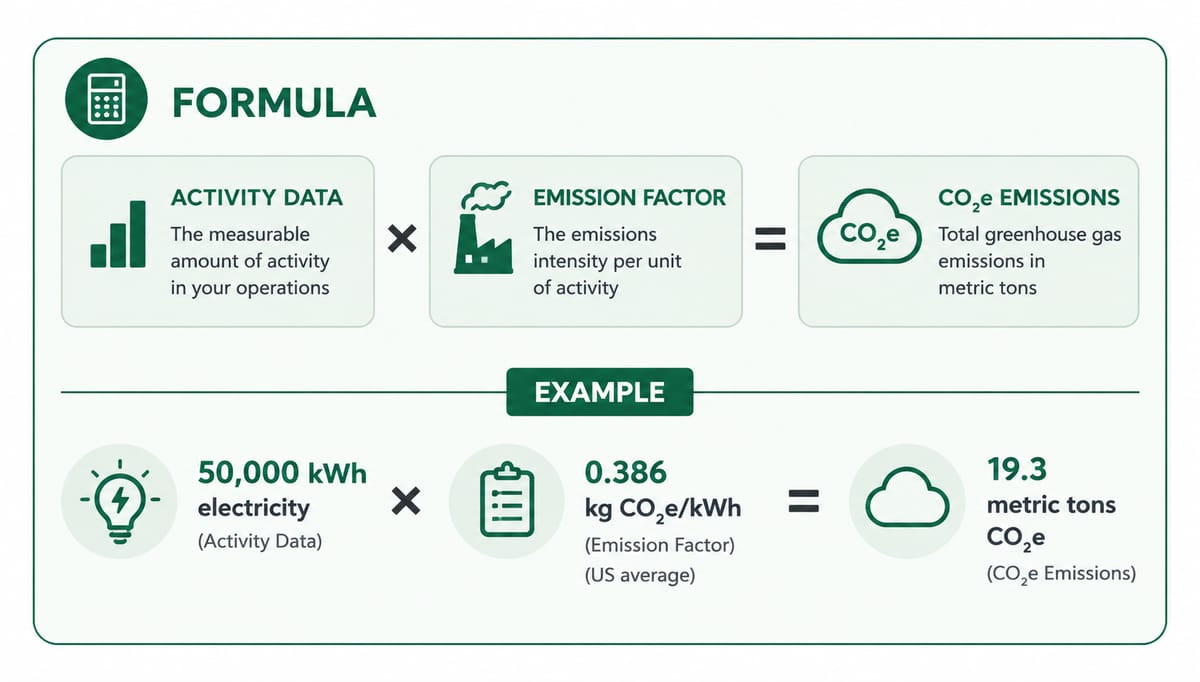
Your baseline year is the reference point against which all future reductions are measured. Choose a year where you have complete, reliable data, typically the most recent calendar year.
Emission factors vary by country, grid region, and fuel type. Using outdated or generic factors is one of the most common sources of error in first inventories. The EPA's GHG emission factors hub and the IEA electricity emission factors are the most authoritative free sources.
A sustainability report doesn't have to be a 60-page PDF with infographics and executive photography. For a first report, credibility comes from accuracy and transparency, not production value.
Different stakeholders use different frameworks. Here's a quick orientation:
Aclymate's reporting output is designed to support these frameworks. Learn how Aclymate maps to major reporting standards.
Third-party verification isn't legally required for most private companies today, but it's increasingly expected by enterprise customers, investors, and regulators. And it protects you from greenwashing risk.
For a first inventory, internal review against GHG Protocol requirements is a reasonable starting point. As your program matures, consider limited assurance from an accredited verifier.
The ISO 14064-3 standard governs third-party verification of GHG inventories and is the benchmark that most assurance providers use.
Your first inventory is a foundation, not a finish line. Once you have a verified baseline, you can:
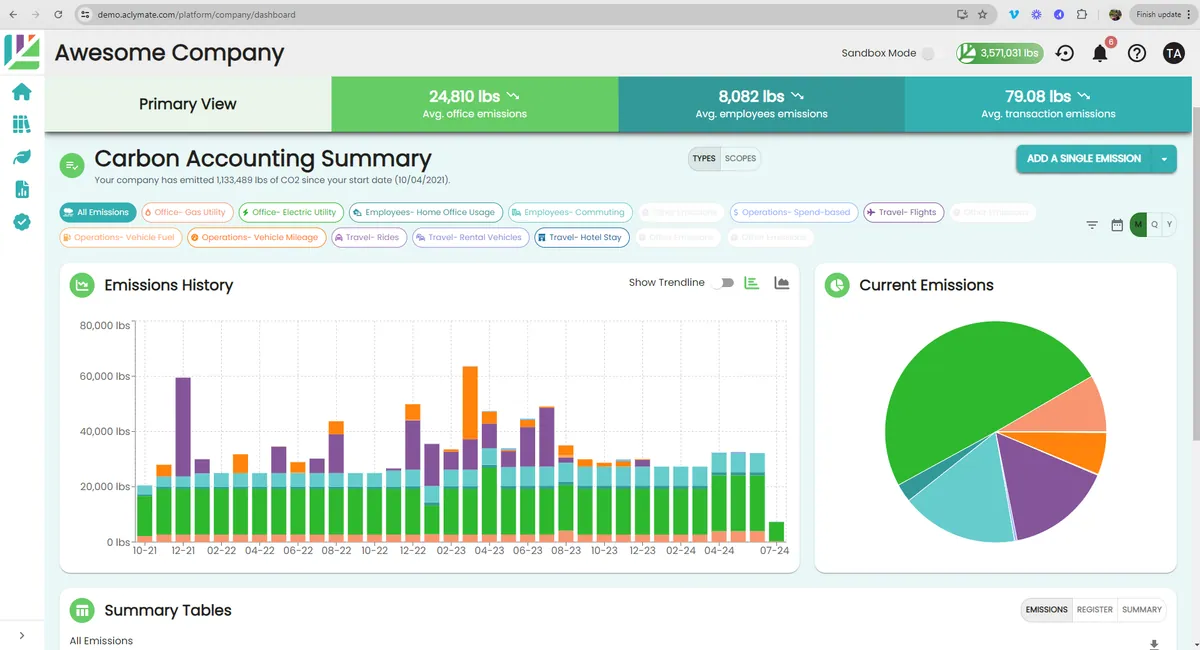
Aclymate is designed specifically for growing businesses that need a fast, credible path to their first greenhouse gas inventory and sustainability report. Our platform guides you through every step, from boundary setting to report generation, without requiring a sustainability degree or a large team.
Start your free GHG inventory with Aclymate →
Or explore our GHG accounting solutions page to learn more about how we help mid-sized companies meet reporting requirements quickly and credibly.
The fastest path is to use purpose-built sustainability software like Aclymate that automates emission factor application, data entry, and report generation. Combined with organized utility and fuel data, most growing companies can complete Scope 1 and 2 inventories in 2–6 weeks.
At minimum: 12 months of electricity and fuel consumption data, a defined organizational boundary, a chosen GHG Protocol approach, and a platform or methodology to apply emission factors and calculate totals in metric tons CO₂e.
Look for software that explicitly maps to the GHG Protocol Corporate Standard, uses up-to-date third-party emission factors (EPA, IEA, DEFRA), supports audit documentation, and produces a shareable report. Avoid generic carbon calculators and enterprise platforms built for Fortune 500 complexity.
No. While Scope 3 is increasingly expected for mature sustainability programs, most frameworks allow companies to phase it in. A credible first inventory covering Scope 1 and Scope 2 is the standard starting point for growing businesses.
Get Aclymate's practical sustainability content delivered weekly.

An event carbon footprint is the total emissions from travel, lodging, venue energy, food, and waste. See which sources matter most and why.
Read Article

AI is transforming carbon credit verification through satellite monitoring, automated analysis, and anomaly detection. But can technology solve the voluntary carbon market’s credibility problem? Discover the limitations of AI verification and how businesses can evaluate carbon credits while keeping emissions reductions ahead of offsetting.
Read Article

AI is creating new opportunities for businesses, but it also comes with an environmental cost. Carbon offsets can help address some of those emissions, but businesses need to understand what they are offsetting, how offsets work, and why measuring and reducing emissions should come first.
Read Article
Talk with a Sustainability Expert, see a demo, or start free to put the Aclymate platform and experts to work for your team.