← Back to Insights
Bill Zujewski
July 31, 2026

If you're a CEO or COO thinking about launching a sustainability program, you've probably run into the same wall most growing companies do: you don't have a sustainability team, you don't have a big budget, and you don't have time to become an expert in emissions accounting. That's a reasonable place to start from, and it's exactly why so many small and mid-sized businesses put sustainability off for another year.
AI changes the math here. Not because it can run your whole program (it can't, and you shouldn't ask it to), but because it removes the friction that used to make the first few steps feel impossible. AI is good at the unglamorous, time-consuming groundwork: organizing messy data, drafting first versions of documents, summarizing information, and generating starting points you can react to instead of staring at a blank page. That's often all a busy leadership team needs to actually get moving.
Here's what that looks like in practice.
Most companies that haven't started tracking emissions already have most of the raw data they need. It's just sitting in a dozen different places: PDF utility bills in an inbox, mileage logs in a spreadsheet, fuel receipts in accounting software, shipping data in a logistics platform.
AI tools are genuinely useful here. You can use them to pull numbers out of scanned utility bills, standardize inconsistent formats, and organize months of usage data into a clean spreadsheet in a fraction of the time it would take manually. That's a real time-saver, and it's a great first task to hand off, since it's low-risk (the source documents are still there to check against) and immediately useful.
The catch: once that data is organized, it still needs to be converted into actual emissions using consistent, recognized emissions factors. This is where a lot of "AI did our carbon footprint" projects go wrong. AI can format the data. It shouldn't be trusted to invent the conversion factors or calculate Scope 1, 2, and 3 emissions from scratch. That part needs a defined methodology, ideally one aligned with the Greenhouse Gas Protocol, which is the standard most credible carbon accounting tools and reporting frameworks are built on.
If you sell into larger companies, there's a decent chance a customer has already asked you about your supply chain's environmental impact, or will soon. Eventually, you'll likely need to ask your own suppliers the same questions.
Writing a supplier sustainability survey from scratch is tedious: what do you actually ask, in what order, and how do you make it something a vendor will actually fill out instead of ignoring? AI is a strong fit for this. You can describe your industry and supply chain, and get a solid first draft of a survey covering energy use, packaging, transportation, and existing certifications, ready for you to trim down and personalize.
This is a good example of AI doing the "80% draft" so a person only has to do the judgment call at the end: which questions actually matter for your business, and how to phrase them so suppliers respond.
Once you have even a rough picture of where your emissions are coming from (energy use, business travel, shipping, materials), the next question is usually "okay, so what do we actually do about it?"
This is one of the most useful places to bring in AI as a brainstorming partner. Describe your operations (a 40-person manufacturing company, a professional services firm with a lot of client travel, a retailer shipping direct to consumers) and ask for a list of reduction strategies ranked by feasibility and cost. You'll get a reasonable starting list: LED retrofits, remote-first meeting policies, freight consolidation, supplier switches, packaging redesign, and so on.
Treat this as a first draft of ideas, not a final plan. Some suggestions won't apply to your business, and none of them come pre-validated against your actual emissions data. But turning a blank whiteboard into a list of 15 ideas you can react to, cut, and prioritize is a real head start.
Many small and mid-sized companies don't have a written sustainability or environmental policy at all, not because they don't care, but because nobody has had the bandwidth to write one. AI is well-suited to producing a first draft: a policy covering your commitments around energy use, waste, travel, and supplier expectations, written in plain language and appropriately scoped to a company your size.
That draft still needs a human pass. Someone on your team (or your sustainability partner, if you have one) should check that the commitments in the policy are ones you can actually back up with data and action, not just aspirational language. A policy that overpromises creates exactly the kind of greenwashing risk that erodes customer trust, so treat the AI draft as a starting point for editing, not a finished document to publish.
Once you have real emissions data and a program underway, you'll likely need to communicate it in several different formats: a short summary for your website, a more detailed section for an investor update, a specific response format for a customer's sustainability questionnaire, and possibly a formal report aligned to a framework like CDP or the EU's Corporate Sustainability Reporting Directive (CSRD).
This is where AI earns its keep on the communication side. Once the underlying numbers are accurate and finalized, AI can help you repackage the same core data into a two-paragraph website blurb, a slide for a board deck, or a longer narrative report, without you rewriting everything from scratch each time. It's translation and formatting work, and AI is genuinely fast at it.
Notice the pattern across all five examples: AI is excellent at drafting, organizing, brainstorming, and summarizing. It's not a substitute for an actual emissions calculation methodology, a real data pipeline, or third-party verification. If your reduction ideas, your policy commitments, or your reported numbers aren't grounded in real measured data, you're building a program that won't hold up to a customer's questionnaire, an investor's diligence, or a regulator's review.
That's the point where it helps to have a system built specifically for this, one designed for companies without a sustainability team, that resources like the SME Climate Hub exist to support in the first place.
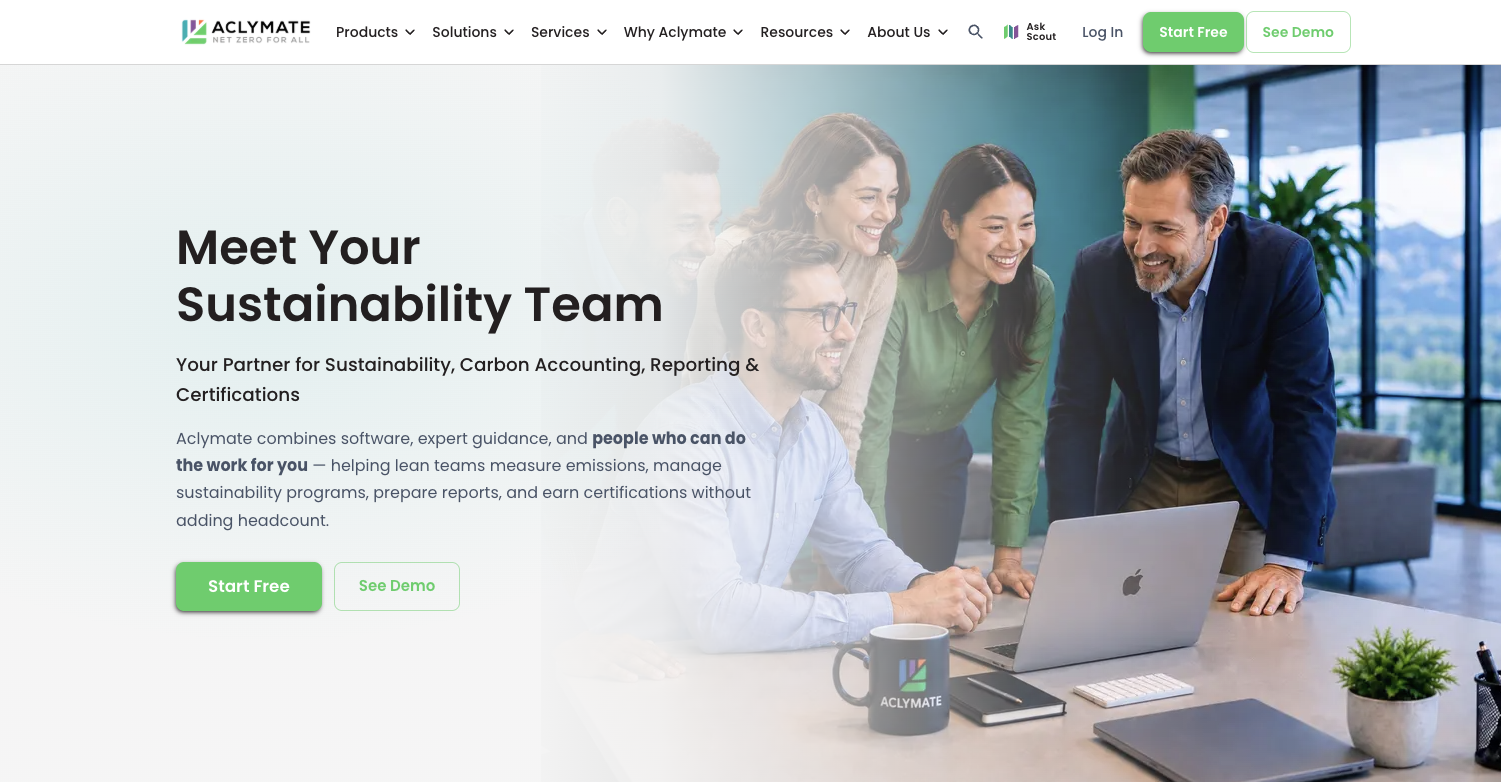
Aclymate was built for exactly this stage: the company that's ready to move past drafts and brainstorms into a real, credible sustainability program, without hiring a sustainability team to do it.
Aclymate connects directly to the accounting software, utility providers, and travel systems you're already using, so instead of manually organizing utility bills, the platform pulls the data in and calculates your Scope 1, 2, and 3 emissions using methodology aligned with the GHG Protocol. It includes tools to collect supplier and vendor sustainability data directly through the platform, and it generates reports formatted for the frameworks your customers and partners are likely to ask about, including CDP, CSRD, and EcoVadis.
Just as importantly, Aclymate pairs the software with real sustainability experts and guidance toward recognized certifications, so the reduction ideas, policies, and reports you produce are grounded in your actual data, not just a well-written first draft. You can explore the full picture on Aclymate's carbon accounting software page or see how it compares to other options for growing businesses in this guide to carbon accounting platforms for small and mid-sized companies.
You don't need a perfect plan to begin. Use AI for what it's good at: organizing your utility bills, drafting a first supplier survey, brainstorming reduction ideas, writing a first policy draft, and summarizing your numbers for different audiences. Then bring in real data and real methodology to turn those drafts into a program you can stand behind.
Ready to turn your first drafts into a real sustainability program? Book a demo with Aclymate and see how automated emissions tracking, supplier data collection, and expert support can help you go from "we should probably start" to a program you can actually report on.
Get Aclymate's practical sustainability content delivered weekly.

Learn how to calculate an event carbon footprint in 4 steps: set the boundary, gather activity data, apply emission factors, and total it. Includes an example.
Read Article

An event carbon footprint is the total emissions from travel, lodging, venue energy, food, and waste. See which sources matter most and why.
Read Article

AI is transforming carbon credit verification through satellite monitoring, automated analysis, and anomaly detection. But can technology solve the voluntary carbon market’s credibility problem? Discover the limitations of AI verification and how businesses can evaluate carbon credits while keeping emissions reductions ahead of offsetting.
Read Article
Talk with a Sustainability Expert, see a demo, or start free to put the Aclymate platform and experts to work for your team.