← Back to Insights
Bill Zujewski
July 30, 2026

Every marketing team wants a faster way to write the sustainability page, the ESG summary, or the "green" line on a product label. AI tools make that easy, almost too easy. In seconds, a generative model can produce polished copy about carbon neutrality, recyclability, or "eco-friendly" operations. But polished copy isn't the same thing as a defensible claim, and increasingly, regulators, customers, and B2B procurement teams are asking the same question: can you prove it?
AI can help you draft, summarize, and communicate sustainability information faster. What it cannot do is manufacture the underlying data, methodology, or third-party validation that makes a claim credible. That gap (between what AI can generate and what a claim actually requires to hold up) is where greenwashing risk lives.
Large language models are trained to produce fluent, confident-sounding text. They are not trained to verify emissions factors, check whether a claim meets a regulatory definition, or confirm that a number ties back to a real data source. That means an AI tool can just as easily generate an unsubstantiated claim as a substantiated one, and it will sound equally convincing either way.
This is a meaningful legal exposure, not just a branding risk. In the United States, environmental marketing claims are governed by the Federal Trade Commission's Green Guides, which require that claims like "recyclable," "carbon neutral," or "sustainable" be backed by competent and reliable evidence, not just directional intent. Regulators evaluate the net impression a claim leaves on a reasonable consumer, meaning a technically accurate but incomplete claim can still be found deceptive if it implies more than the company can support.
If an AI-written claim isn't traceable to real data, a business hasn't reduced its greenwashing risk by using AI. It has automated it.
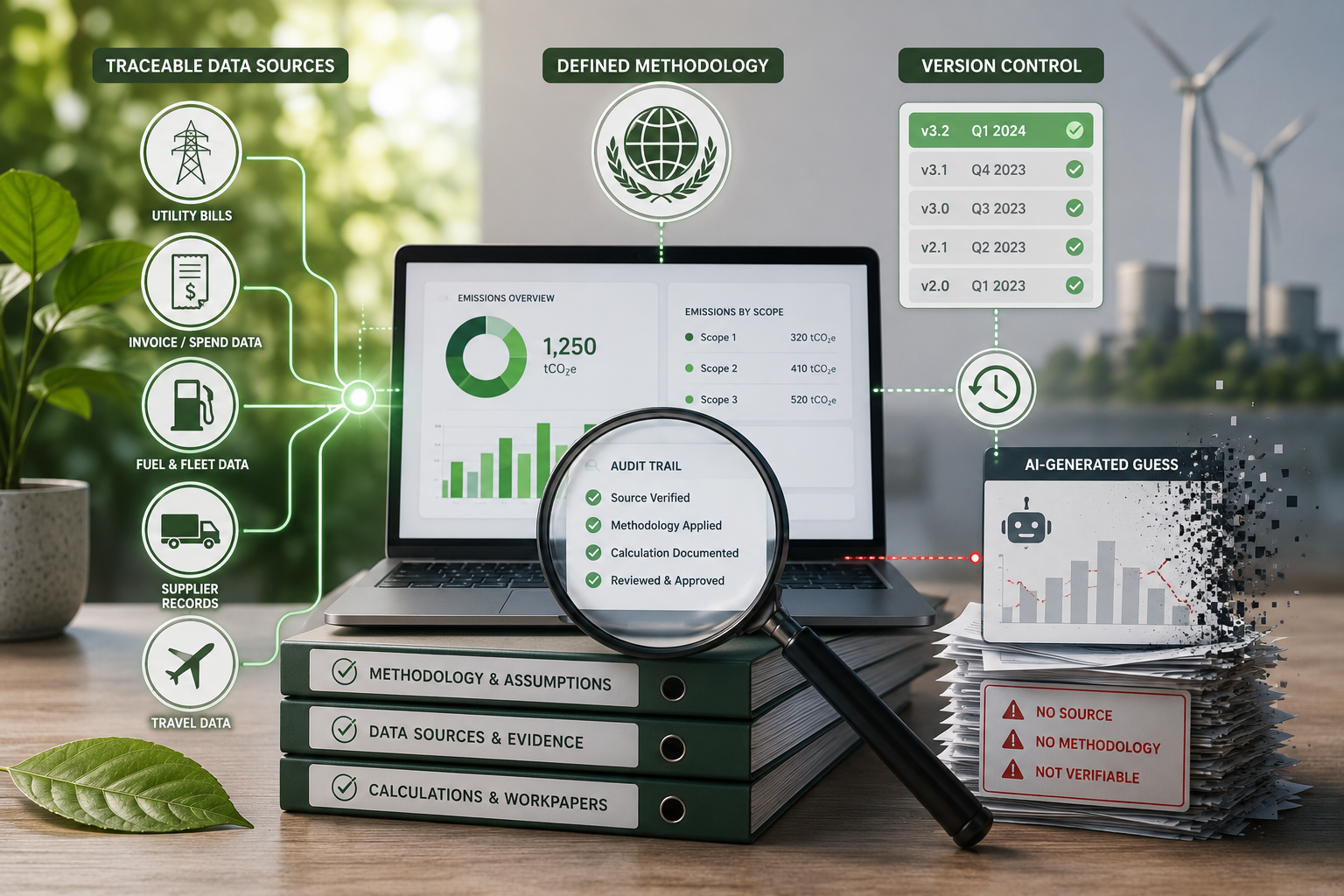
A credible sustainability claim isn't one that reads well. It's one that survives scrutiny. That's what auditability means: if a customer, journalist, regulator, or certifying body asked "show me," could you?
Auditability requires:
AI can help organize and present this information, but it cannot generate the underlying trail. That has to come from actual measurement, which is exactly why more companies are turning to purpose-built carbon accounting software instead of asking a chatbot to write their emissions numbers for them.
Every strong sustainability claim is really two things: a public-facing statement and a private paper trail that supports it. AI is very good at the first part and offers nothing for the second.
Solid documentation typically includes:
This documentation is what turns a claim from a story into a fact. It's also what companies are increasingly asked to produce directly, not just by regulators, but by customers. A growing share of enterprise RFPs and procurement questionnaires now request emissions data and supporting documentation as a condition of doing business, particularly from suppliers responding to large customers' own supply chain sustainability requests.
If documentation is your internal proof, certifications are your external proof, and they matter precisely because they aren't self-declared. A company can write anything about itself. It cannot award itself a B Corp certification, an EcoVadis rating, or a CDP disclosure score. Those require submitting real data to an independent body that evaluates it against a fixed standard.
This is the piece of credibility that AI fundamentally cannot replicate. No amount of well-written copy substitutes for a verified badge, and sophisticated buyers know the difference. Certifications aligned to frameworks like the Greenhouse Gas Protocol, CDP, or the EU's Corporate Sustainability Reporting Directive (CSRD) give customers, investors, and partners a reference point that doesn't depend on trusting your marketing department.
Consumer and B2B skepticism toward environmental marketing has been rising for years, and AI-generated content is accelerating that skepticism rather than easing it. When claims sound generic, oddly confident, or use the same phrasing that shows up across dozens of competitors' websites, buyers notice, and it erodes trust in the message even when the underlying commitment is real.
Trust is rebuilt through specificity and verification: precise numbers instead of vague adjectives, cited methodology instead of assumed authority, and third-party certification instead of self-description. AI can help you communicate that specificity clearly. It cannot generate the specificity itself.
This is exactly the gap Aclymate was built to close. Aclymate is a carbon accounting and sustainability platform designed for small and mid-sized businesses that need to make real, defensible claims without a dedicated sustainability department.
Instead of asking a business to generate emissions numbers from scratch (or worse, from an AI guess), Aclymate connects directly to the systems that already hold the data: accounting software, utility providers, and travel platforms. It calculates Scope 1, 2, and 3 emissions using methodology aligned with the GHG Protocol, and produces reports formatted for frameworks like CDP, CSRD, GRI, and EcoVadis. Every number is traceable back to a real data source, so when a customer, auditor, or certifying body asks for proof, there's an actual answer.
Aclymate also pairs the software with human expert support and guidance toward recognized certifications, because a dashboard alone isn't a sustainability program. The combination of real data, defensible methodology, expert review, and third-party certification is what makes a claim survive scrutiny instead of just reading well. You can see how the pieces fit together on Aclymate's carbon accounting software page or compare approaches in this breakdown of top carbon management platforms for growing businesses.
AI is a genuinely useful tool for communicating sustainability work: drafting reports, summarizing data, and making dense information easier to read. But it cannot verify a number, generate a data trail, or earn a certification on your behalf. Credibility still comes from measurement, documentation, and independent validation, the parts of the process AI was never built to do.
If your sustainability claims are only as strong as the copy describing them, they're not strong at all. The businesses that will earn customer trust in the years ahead are the ones that can back every claim with a real, auditable record behind it.
Ready to build sustainability claims that hold up to scrutiny? Book a demo with Aclymate to see how automated emissions tracking, expert support, and certification guidance can turn your sustainability messaging into something you can actually prove.
Get Aclymate's practical sustainability content delivered weekly.

Learn how to calculate an event carbon footprint in 4 steps: set the boundary, gather activity data, apply emission factors, and total it. Includes an example.
Read Article

An event carbon footprint is the total emissions from travel, lodging, venue energy, food, and waste. See which sources matter most and why.
Read Article

AI is transforming carbon credit verification through satellite monitoring, automated analysis, and anomaly detection. But can technology solve the voluntary carbon market’s credibility problem? Discover the limitations of AI verification and how businesses can evaluate carbon credits while keeping emissions reductions ahead of offsetting.
Read Article
Talk with a Sustainability Expert, see a demo, or start free to put the Aclymate platform and experts to work for your team.