← Back to Insights
Bill Zujewski
July 7, 2026

EHS, ESG, and sustainability software are often grouped together, but they are not the same category.
The categories overlap, especially around environmental data. But they usually serve different teams, different use cases, and different business goals.
For companies evaluating environmental management software, the most important question is not “Which category sounds best?” It is:
What problem are we actually trying to solve?
If your company needs to manage workplace safety, hazardous waste, permits, and regulatory inspections, you probably need EHS software.
If your company needs investor-grade ESG disclosures and enterprise reporting workflows, you may need ESG software.
If your company needs to measure emissions, answer customer sustainability requests, manage supplier data, support certifications, and show credible progress, you likely need sustainability management software.
| Category | Primary focus | Common users | Best for |
|---|---|---|---|
| EHS software | Environmental, health, and safety compliance | EHS leaders, operations, safety teams, compliance teams | Incidents, audits, permits, inspections, waste, workplace safety |
| ESG software | ESG data collection and disclosure | ESG teams, finance, investor relations, legal, compliance | ESG reporting, investor disclosures, ratings, governance metrics |
| Sustainability software | Sustainability program management and proof | Sustainability teams, operations, finance, sales, marketing | Carbon accounting, reporting, supplier data, certifications, reduction planning |
The three categories are related, but they are not interchangeable.
A manufacturing company with high safety risk may need EHS software. A public company preparing formal ESG disclosures may need ESG software. A mid-sized company being asked by customers for carbon data, sustainability proof, or supplier emissions information may need sustainability software.
EHS stands for Environmental, Health, and Safety.
EHS software helps companies manage operational risk, workplace safety programs, environmental compliance, and regulatory obligations. It is especially common in industries where companies must track incidents, permits, inspections, audits, chemicals, waste streams, corrective actions, and safety procedures.
Typical EHS software features include:
EHS software is often used by companies in manufacturing, energy, chemicals, construction, food production, transportation, logistics, and other operationally intensive industries.
EHS software is usually the right fit when your company needs to manage:
If the problem is operational safety or compliance, EHS software is probably the right category.
EHS software can be more than a lean sustainability team needs.
If your main challenge is calculating a carbon footprint, organizing Scope 1, 2, and 3 emissions data, answering customer sustainability requests, preparing reports, or supporting certifications, a full EHS system may be heavier than necessary.
That does not mean EHS software is bad. It simply means it was built for a different primary job.
ESG stands for Environmental, Social, and Governance.
ESG software helps companies collect, organize, and report data across environmental, social, and governance categories, especially as companies face changing climate-related disclosure requirements. It is often used by larger companies, public companies, financial institutions, and organizations with formal disclosure obligations.
Typical ESG software features include:
ESG software is often designed for formal reporting frameworks, stakeholder disclosures, and enterprise-wide data governance.
ESG software may be the right fit when your company needs to manage:
If the core problem is disclosure, governance, and investor-grade reporting, ESG software may be the right category.
ESG software can help organize reporting, but it may not solve the practical work of building a sustainability program.
Many companies do not start with a formal ESG disclosure requirement. They start with more practical questions:
For these needs, sustainability software may be a better fit than broad ESG reporting software.
Sustainability software helps companies manage the practical work of sustainability.
That often includes carbon accounting, emissions tracking, supplier data collection, reporting, reduction planning, certifications, and proof for customers, partners, and internal stakeholders.
Typical sustainability software features include:
Sustainability software is especially useful for companies that need to make sustainability credible, organized, and repeatable without building a large internal sustainability department.
Sustainability software is usually the right fit when your company needs to:
This is where many growing companies are today. They may not need a full enterprise EHS system or a massive ESG reporting platform. They need a practical way to manage sustainability work, answer external requests, and move forward.
EHS, ESG, and sustainability software overlap most clearly in environmental data.
For example, all three categories may touch:
The difference is what each system is built to do with that data.
EHS software usually asks:
Are we operating safely and complying with environmental, health, and safety requirements?
ESG software usually asks:
Can we collect and disclose ESG data accurately to stakeholders?
Sustainability software usually asks:
Can we manage sustainability progress, reduce emissions, answer requests, and prove what we are doing?
That distinction matters because choosing the wrong platform can create unnecessary complexity.
The phrase EHS vs ESG software is common because many companies are trying to understand whether they need one platform, both platforms, or something else entirely.
The simplest distinction is this:
EHS software is usually operational. ESG software is usually disclosure-oriented.
EHS software helps teams manage what is happening inside facilities and operations. It tracks incidents, audits, inspections, hazards, permits, and compliance tasks.
ESG software helps teams report company-wide ESG performance to investors, regulators, customers, boards, and ratings organizations.
A company with complex manufacturing facilities may need EHS software even if it does not have a mature ESG reporting program.
A public company with investor disclosure obligations may need ESG software even if its EHS risks are limited.
Some large companies need both.
But many mid-sized companies need neither category in its full enterprise form. They need practical sustainability software that helps them manage carbon, reporting, supplier data, and proof.
ESG and sustainability are related, but they are not identical.
ESG is often a reporting and stakeholder framework. It focuses on the environmental, social, and governance issues that may matter to investors, regulators, customers, and other external audiences.
Sustainability is often more operational and strategic. It focuses on how a company reduces environmental impact, manages resources, improves practices, responds to customer expectations, and builds long-term resilience.
In software terms:
There is overlap, but the center of gravity is different.
A company may use sustainability software to calculate emissions, collect supplier data, create reduction plans, support certifications, and generate reports. Some of that data may later feed into ESG disclosures.
EHS and sustainability software can also overlap, especially around environmental topics like energy, water, waste, and emissions.
But the primary use cases are different.
EHS software is often focused on compliance, safety, and operational risk.
Sustainability software is often focused on environmental impact, carbon accounting, customer expectations, reporting, certifications, and progress.
A company may need EHS software if it has serious safety, chemical, waste, or permitting requirements. A company may need sustainability software if it is being asked to prove its carbon footprint, climate commitments, supplier sustainability practices, or emissions reduction progress.
The question is not which category is better. The question is which category fits the work your company actually needs to do.
Use this simple decision guide.
| If your main need is... | You probably need... |
|---|---|
| Workplace safety, incidents, audits, inspections, and permits | EHS software |
| Hazardous waste, air, water, chemicals, or facility compliance | EHS software |
| Investor ESG disclosures and governance reporting | ESG software |
| Board-level ESG metrics and framework mapping | ESG software |
| Carbon accounting and emissions tracking | Sustainability software or carbon accounting software |
| Scope 3 supplier data collection | Sustainability software |
| Customer sustainability requests | Sustainability software |
| Certifications and sustainability proof | Sustainability software |
| Reduction planning and progress tracking | Sustainability software |
| A practical program without a full sustainability team | Sustainability software with expert support |
For many growing companies, the right starting point is not a massive enterprise system. It is a practical platform that helps the team organize data, answer requests, and build momentum.
Lean sustainability teams need software that makes the work easier, not software that creates another administrative burden.
Look for a platform that helps with:
Also look for software that matches your company’s stage.
A large enterprise with a full EHS department may need a highly configurable EHS system. A public company with complex disclosures may need a formal ESG reporting platform. A mid-sized company with a small sustainability team may need something more practical.
The best software is not the one with the longest feature list. It is the one that helps your team do the work it actually needs to do.
Environmental management software is a broad category. Depending on the company, it may include EHS software, ESG software, sustainability software, carbon accounting software, or some combination of these tools.
The EPA defines an Environmental Management System as a set of processes and practices that helps an organization reduce environmental impacts and improve operating efficiency.
That is why the category can be confusing.
For some buyers, environmental management means regulatory compliance: permits, waste, audits, and inspections.
For others, environmental management means sustainability performance: emissions, energy, suppliers, reduction plans, certifications, and customer reporting.
Before choosing software, companies should define which version of environmental management they need.
A good starting question is:
Are we mainly trying to manage compliance, disclosure, or sustainability progress?
For a deeper category overview, see our complete guide to environmental management software.
Aclymate is best understood as sustainability management and carbon accounting software with expert support built in.
It is designed for companies that need to manage sustainability work in a practical way, especially when they do not have a large internal sustainability department.
With Aclymate Navigator, companies can manage carbon accounting, reporting, certifications, supplier data, reduction planning, and customer-ready proof in one practical sustainability management platform.
Aclymate helps companies with:
Aclymate is not intended to replace a specialized EHS system for complex safety, hazardous materials, permitting, or facility compliance workflows.
That distinction matters.
If your company needs to manage workplace safety incidents, hazardous waste, or air and water permits, you may need an EHS platform.
If your company needs to manage carbon, sustainability reporting, customer requests, supplier data, certifications, and credible proof, Aclymate may be the better fit.
No. EHS software usually focuses on environmental, health, and safety operations, including incidents, audits, inspections, permits, and compliance. ESG software usually focuses on collecting and reporting environmental, social, and governance data for investors, regulators, customers, boards, and other stakeholders.
Not exactly. Sustainability software usually helps companies manage sustainability work, such as carbon accounting, emissions reduction, reporting, supplier data, and certifications. ESG software is often more focused on disclosure, governance, stakeholder reporting, and formal ESG frameworks.
Usually not. Sustainability software may overlap with EHS software around environmental data, but it does not typically replace specialized EHS workflows for workplace safety, hazardous materials, permits, audits, and regulatory compliance.
Some ESG platforms include carbon accounting or integrate with carbon accounting tools. But carbon accounting is often a specialized need, especially when companies must calculate Scope 1, Scope 2, and Scope 3 emissions, collect supplier data, and support reduction planning.
Many mid-sized companies need sustainability software before they need a full ESG or EHS platform. Their immediate needs are often carbon accounting, sustainability reporting, supplier data, certifications, and customer-ready proof.
Environmental management software is a broad category that can include compliance, EHS, carbon, reporting, sustainability workflows, and formal environmental management systems such as ISO 14001. Sustainability software is usually more focused on carbon accounting, emissions reduction, supplier data, reporting, certifications, and sustainability program management.
Some enterprise platforms try to cover all three areas. But many companies are better served by choosing software based on their highest-priority need. EHS, ESG, and sustainability teams often require different workflows, data models, and reporting outputs.
EHS, ESG, and sustainability software overlap, but they solve different problems.
EHS software is best for operational safety, environmental compliance, permits, audits, inspections, incidents, and regulatory risk.
ESG software is best for ESG data collection, disclosure, governance, investor reporting, and framework alignment.
Sustainability software is best for carbon accounting, emissions tracking, supplier data, reporting, certifications, reduction planning, and customer-ready proof.
For companies trying to choose the right software, the best place to start is not the category label. It is the business problem.
If your company needs to manage safety and compliance, start with EHS.
If your company needs formal ESG disclosure, start with ESG.
If your company needs to manage carbon, sustainability data, reporting, certifications, supplier requests, and credible proof, start with sustainability software.
That is the practical path forward for lean teams that need to make sustainability real without adding unnecessary complexity.
Need help figuring out which path fits your company? Talk with a Sustainability Expert.
Get Aclymate's practical sustainability content delivered weekly.

AI is transforming carbon credit verification through satellite monitoring, automated analysis, and anomaly detection. But can technology solve the voluntary carbon market’s credibility problem? Discover the limitations of AI verification and how businesses can evaluate carbon credits while keeping emissions reductions ahead of offsetting.
Read Article

AI is creating new opportunities for businesses, but it also comes with an environmental cost. Carbon offsets can help address some of those emissions, but businesses need to understand what they are offsetting, how offsets work, and why measuring and reducing emissions should come first.
Read Article
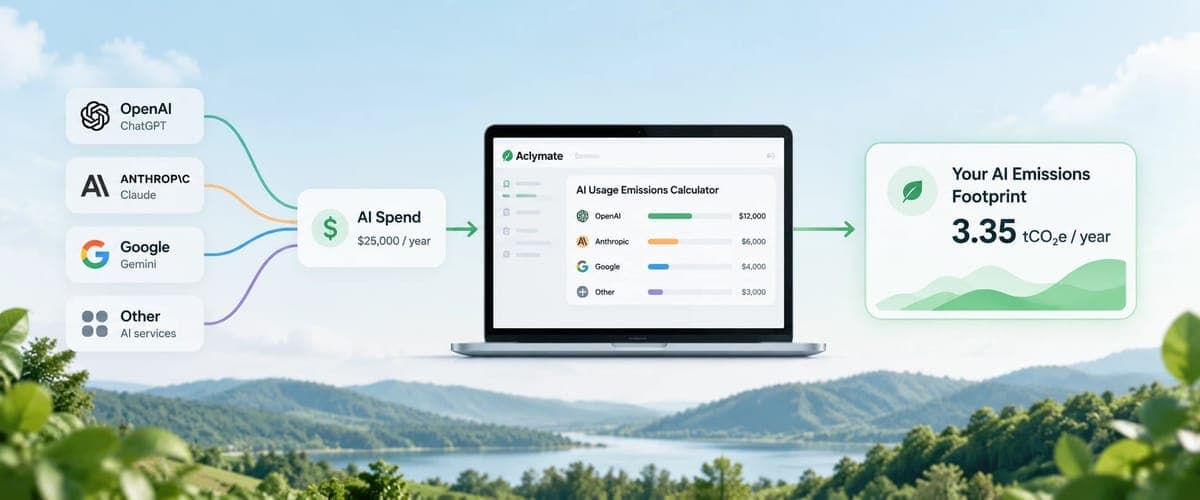
AI carbon emissions are becoming a new consideration for companies adopting ChatGPT, Claude, Gemini, Copilot and other artificial intelligence tools. Here’s how Aclymate estimates the carbon emissions from a company’s AI usage today—and how we expect the methodology to improve as AI providers release better usage and emissions data.
Read Article
Talk with a Sustainability Expert, see a demo, or start free to put the Aclymate platform and experts to work for your team.