← Back to Mike's Thoughts
Mike Smith
October 5, 2026

Welcome back to Teaching Sustainability, Aclymate's weekly series created to help small and mid-sized business leaders understand what sustainability means, why it matters, and what to do next.
Over the past several chapters, we've talked about science-based targets, regulation, reporting requirements, and the importance of making sustainability claims you can actually support.
This week, I want to connect those ideas around an organization that is becoming increasingly important in corporate sustainability: the Science Based Targets initiative, or SBTi.
Here's the most important thing to understand:
SBTi is not a government regulator.
No legislature passed a law requiring companies to participate. Companies voluntarily choose to set targets using SBTi's standards.
Yet those voluntary commitments can still have very real consequences for suppliers.
That's what makes SBTi so interesting.
The Science Based Targets initiative provides companies with standards and methodologies for setting greenhouse gas reduction targets aligned with climate science.
Thousands of companies have now committed to or established targets through SBTi. You can see participating businesses in the SBTi Target Dashboard. Aclymate
That level of adoption changes the significance of the standard.
SBTi's influence doesn't primarily come from government enforcement.
It comes from companies deciding that science-based climate targets matter.
And once enough large companies adopt a standard, it can begin influencing how they choose suppliers, structure contracts, collect data, and evaluate business partners.
When sustainability comes up, executives often ask me:
"Are we required to do this?"
That's a reasonable question.
But increasingly, I think there's a second question that may be even more important:
"What are our customers going to require from us?"
A company may be completely outside the scope of a climate regulation.
It may not have investors demanding climate disclosure.
It may have no plans to make its own SBTi commitment.
But one of its largest customers may have a science-based target.
And that customer's target can eventually affect the supplier.
Why?
Because large companies don't generate all of their emissions inside their own buildings.
Much of their footprint can sit in the supply chain.
That's Scope 3.
We covered Scope 1, Scope 2, and Scope 3 emissions earlier in this series.
Scope 1 includes direct emissions.
Scope 2 generally covers purchased energy.
Scope 3 captures emissions across the broader value chain—including purchased products, suppliers, transportation, travel, and other indirect sources.
That means one company's Scope 3 emissions are often another company's Scope 1, Scope 2, and Scope 3 emissions.
This creates a chain reaction:
The requirement moves downstream.
SBTi explicitly addresses value-chain emissions and supplier engagement within its corporate target-setting frameworks. Aclymate
This is why sustainability questions are changing.
Several years ago, a supplier might receive a sustainability questionnaire once a year.
Someone answered it.
Procurement filed it away.
Done.
Increasingly, sustainability information is being incorporated into:
CDP, for example, enables large purchasing organizations to request environmental information directly from suppliers through its Supply Chain program.
Once this information affects whether you qualify for business, sustainability stops being simply an environmental initiative.
It becomes part of sales and customer retention.
We've covered this broader shift before in Why Customers and Partners Are Asking for Sustainability Data.
None of this means regulation is irrelevant.
California's corporate climate disclosure laws are a good example.
California's SB 253 creates greenhouse gas reporting requirements for certain large companies doing business in California, while SB 261 addresses climate-related financial risk for companies meeting its applicable thresholds. The California Air Resources Board maintains the latest implementation information. Aclymate
But here is the part smaller companies should pay attention to:
You might not be regulated.
Your customer might be.
And when your customer needs information about its value chain, some of that work can arrive at your company.
The regulation belongs to them.
The data request lands with you.
I don't think every small or mid-sized company needs to immediately pursue SBTi validation.
That's not the lesson.
Instead, understand your position in the supply chain.
Start by asking:
Search the SBTi Target Dashboard.
You may be surprised by how many familiar companies are there.
A request for Scope 1, Scope 2, Scope 3, CDP information, EcoVadis documentation, or a corporate carbon footprint is a signal that your customers are becoming more sophisticated about sustainability.
If yes, treat it as a commercial issue.
Eventually, most serious sustainability requests come back to the same foundational question:
How much do you emit?
If you can't answer that yet, you're not alone.
But that's usually the place to begin.
Science-based targets require measurement.
You cannot set a meaningful emissions reduction target without understanding your starting point.
That's why carbon accounting matters.
The GHG Protocol Corporate Standard provides the widely used framework for companies to organize and calculate greenhouse gas inventories.
Your footprint becomes your baseline.
Your baseline enables a target.
Your target enables progress tracking.
And progress tracking enables credible reporting.
That's why we view carbon accounting not as a one-time exercise, but as the foundation of an ongoing sustainability program.
Aclymate helps small and mid-sized companies prepare for exactly these kinds of requests.
Aclymate Explorer gives companies a free starting point to estimate their carbon footprint and understand where their emissions come from.
For companies that need ongoing carbon accounting, reporting, supplier data, and sustainability management, Aclymate combines software with expert support so you're not left figuring everything out alone.
The goal isn't to make every business a climate expert.
It's to make sure you can respond confidently when customers start asking questions.
SBTi isn't a law.
That's precisely why companies sometimes underestimate it.
Its influence comes from market adoption.
Large companies establish science-based targets. Those targets require action across their businesses and value chains. Their suppliers become part of the solution.
That means the sustainability requirement that matters most to your company may never arrive from a regulator.
It may arrive from your biggest customer.
And the businesses that already know their emissions, understand their data, and have a repeatable sustainability process will be much better prepared when it does.
Get Aclymate's practical sustainability content delivered weekly.

Most small and mid-sized businesses know they should be doing something about sustainability. The ones that actually make progress share one thing in common: they started with a clear sequence. Here it is.
Read Article
SBTi requirements are reshaping supply chains. Learn what science-based targets mean for carbon accounting, reporting, suppliers, and mid-sized companies.
Read Article
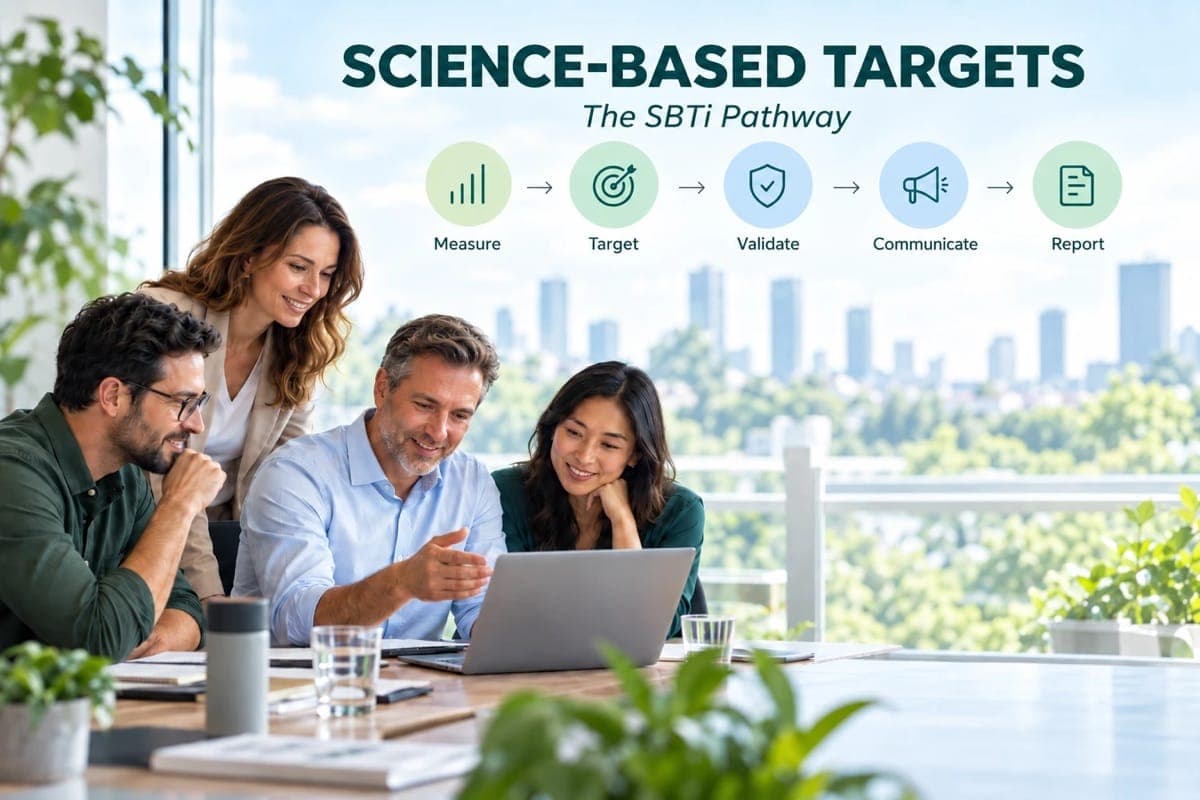
From carbon accounting to validation and annual reporting, here's what companies should expect before committing to SBTi.
Read Article
Talk with a Sustainability Expert, see a demo, or start free to put the Aclymate platform and experts to work for your team.