← Back to Insights
Aclymate Team
June 1, 2026
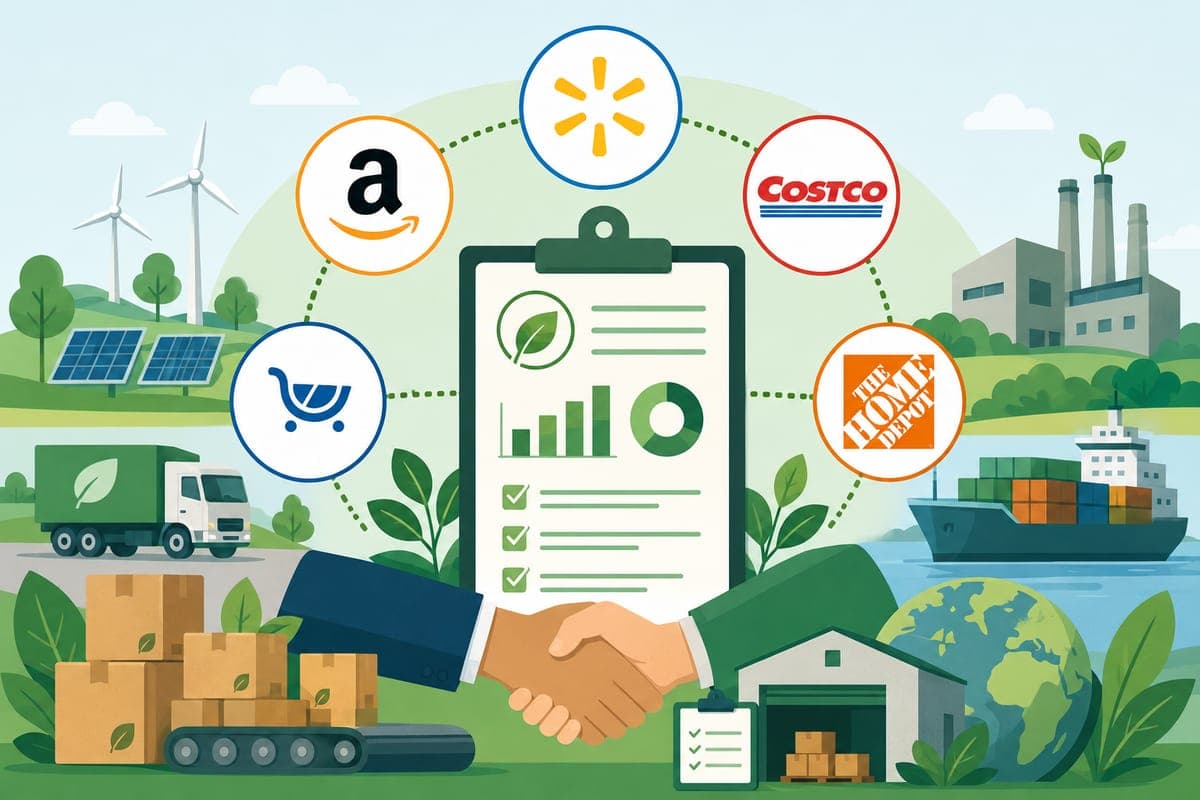
If you supply products or services to any of the five largest retailers in the United States, sustainability reporting is no longer optional. Walmart, Amazon, Costco, Kroger, and Home Depot have each made public commitments to reduce emissions across their supply chains, and they are increasingly passing those expectations to their vendor networks.
The challenge for suppliers is that each retailer has its own program, its own platform, and its own reporting expectations. What Walmart asks for through Project Gigaton looks different from what Amazon requires through its Supply Chain Standards, which looks different again from what Home Depot expects through its Responsible Sourcing framework.
This guide breaks down what each major retailer currently expects, what you need to have ready, and how to prepare without building a dedicated sustainability team. For a broader overview of how to respond to any customer sustainability request, see our guide on how to report sustainability and emissions to customers and partners.
Supply chains typically account for over 70% of a retailer's total carbon footprint. When regulators, investors, and consumers hold retailers accountable for their Scope 3 emissions, those retailers have no choice but to ask suppliers to measure, report, and reduce their own emissions.
This dynamic is accelerating because of regulatory pressure from laws like California's SB 253, the EU's Corporate Sustainability Reporting Directive (CSRD), and the SEC's climate disclosure framework, all of which require large companies to account for and disclose supply chain emissions. The result is a top-down cascade: large retailers get held accountable, and they hold their suppliers accountable in turn.
For suppliers, this means that having no emissions data is no longer a neutral position. It is a growing liability in vendor qualification, contract renewals, and RFP scoring.
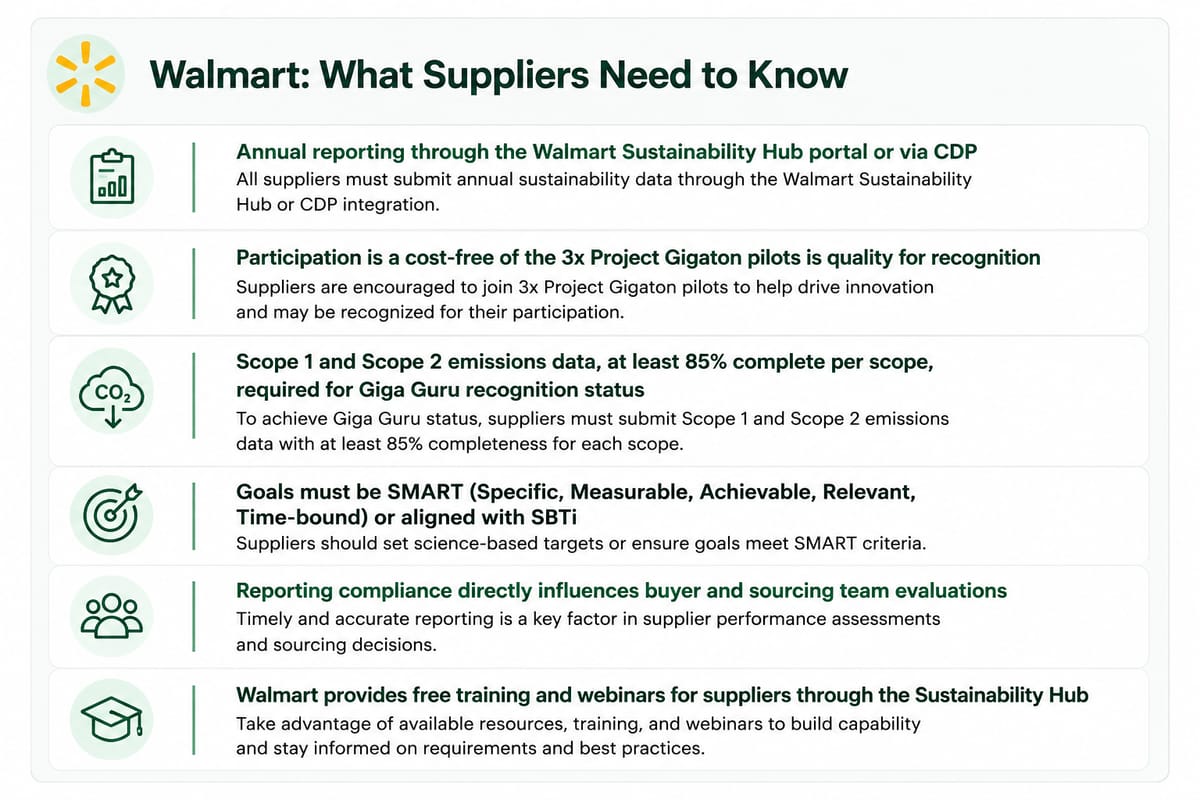
Walmart operates the most structured supplier sustainability program of any U.S. retailer. Project Gigaton, launched in 2017, was designed to engage Walmart's global supplier base in reducing or avoiding one billion metric tons of greenhouse gas emissions by 2030. That goal was surpassed six years early, and the program continues to expand.
Participating suppliers report annually through the Walmart Sustainability Hub portal, or through an integrated CDP submission. Reporting covers six focus pillars: energy, nature, waste, packaging, transportation, and product use and design.
Walmart: What Suppliers Need to Know
Walmart's buying and sourcing teams have direct visibility into each supplier's Project Gigaton participation status. Non-participating suppliers may face disadvantages during category reviews. For Giga Guru status, suppliers must also share information on which Scope 3 categories are relevant to their business. Learn more at walmartsustainabilityhub.com.
Amazon updated its Supply Chain Standards in 2024 to formally require suppliers to share carbon emissions data and set emissions reduction goals. This requirement aligns with Amazon's own commitment to reach net zero carbon by 2040 through The Climate Pledge, which Amazon co-founded in 2019.
Amazon's approach focuses on two core requirements for its supply chain: regular emissions reporting and goal-setting. Suppliers are expected to demonstrate credible progress on environmental performance, including emissions tracking, energy efficiency, and low-carbon transportation.
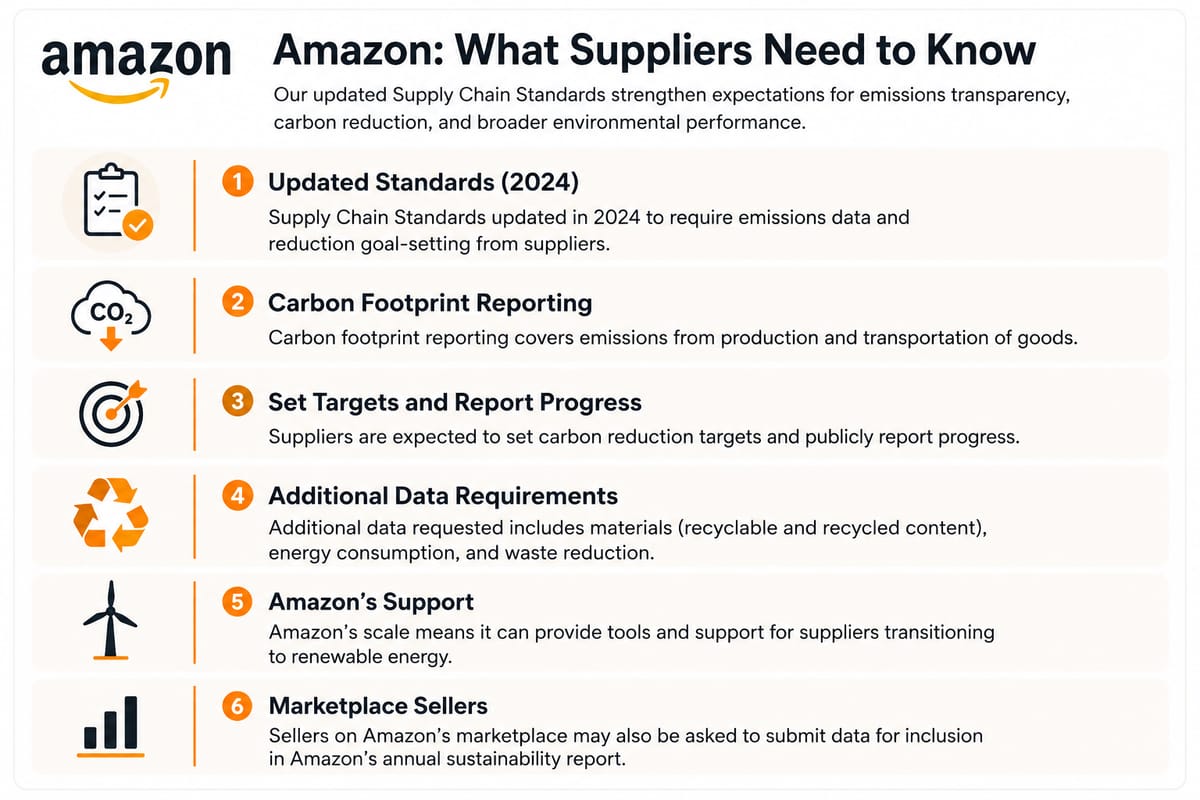
Amazon has emphasized using its scale to help suppliers access renewable energy and sustainable materials. Suppliers who proactively build emissions tracking systems will be better positioned as Amazon increases the specificity and enforcement of these requirements over time.
Costco's sustainability requirements are enforced primarily through its Supplier Code of Conduct, which mandates transparent reporting of environmental impacts including carbon emissions, water usage, and waste generation. Supplier facilities undergo annual sustainability assessments covering energy efficiency, pollution control, and waste reduction. Learn more at costco.com.
While Costco does not currently impose universal supplier-specific emissions reduction targets, the expectation to measure and report environmental performance is built into its supplier compliance framework. Suppliers are expected to maintain structured environmental datasets capable of supporting verification and external reporting.
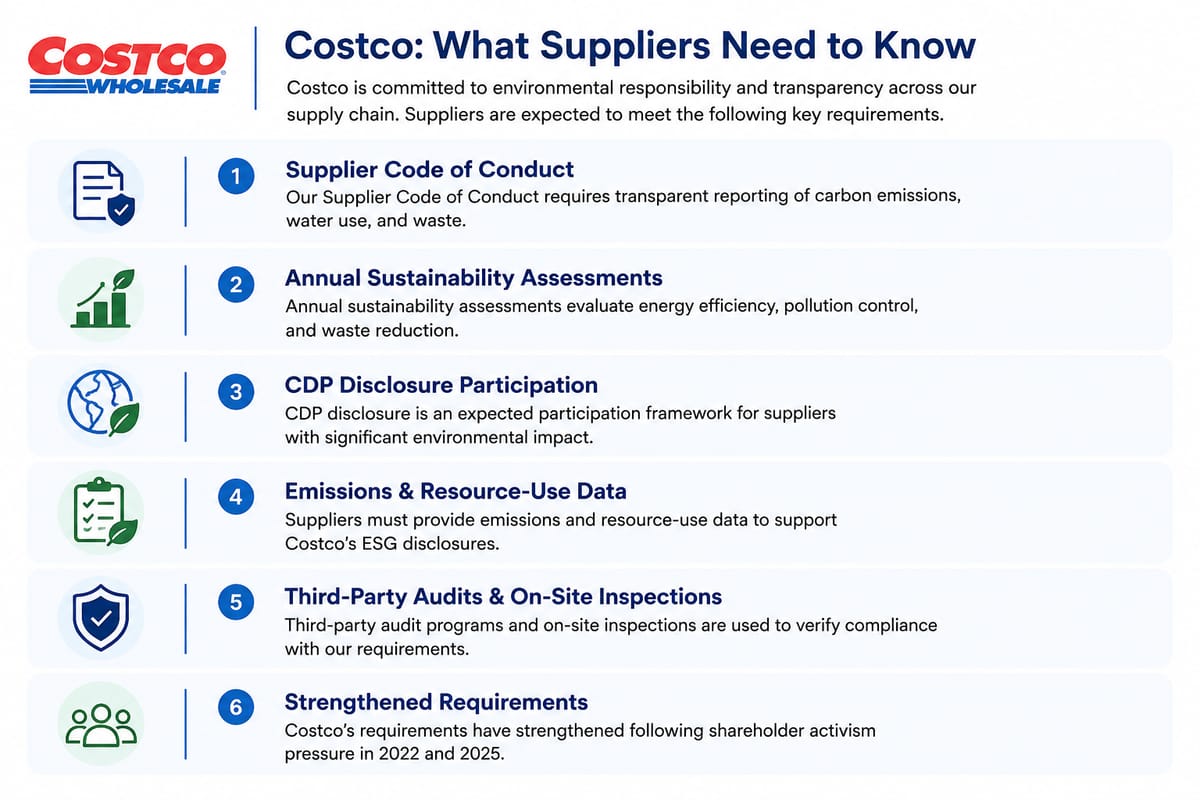
Costco's approach is evolving. Suppliers who are already tracking Scope 1 and Scope 2 emissions and maintaining clear documentation will be best positioned as requirements become more formal and specific.
Kroger's sustainability strategy is organized under its Zero Hunger | Zero Waste impact plan, which covers climate impact, responsible sourcing, waste reduction, and food access. In 2023 and 2024, Kroger provided updated guidance and resources to suppliers specifically covering greenhouse gas emissions reduction, sustainable packaging, and food waste, among other topics.
Kroger has committed to setting Science Based Targets for Scope 1, Scope 2, and Scope 3 emissions. Kroger's 2025 Responsible Business Report confirmed the completion of a full Scope 3 emissions inventory, signaling that supplier data collection is becoming a formal priority.
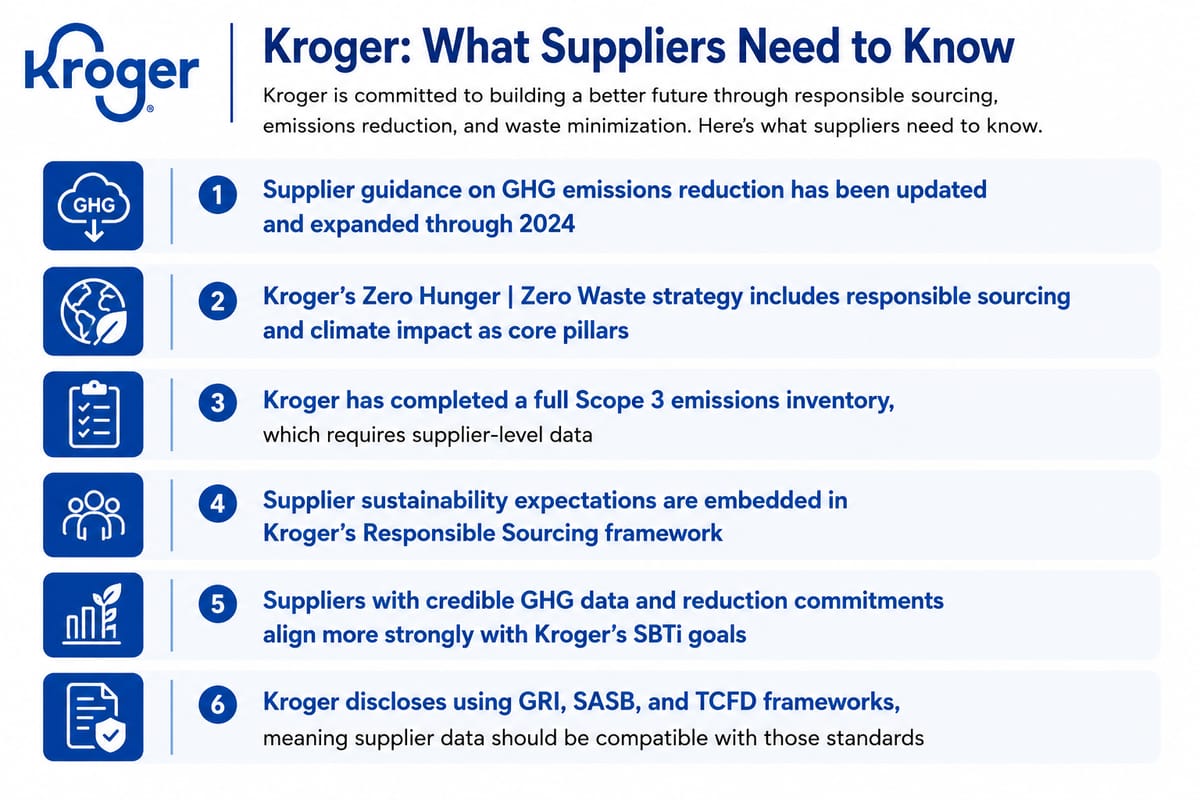
Kroger is at an earlier stage of formalizing supplier carbon requirements compared to Walmart, but the trajectory is clear. Suppliers who build GHG tracking now will be ready when Kroger's supplier expectations become more specific and binding.
Home Depot has set a science-based target to reduce its carbon emissions by 50% by 2035, and has publicly committed to motivating its top-tier strategic suppliers to have a business-relevant, publicly stated sustainability goal. Home Depot's Responsible Sourcing Standards govern supplier environmental expectations, and the company's ESG reporting references GRI, SASB, TCFD, and IFRS frameworks.
Home Depot has also committed to reducing emissions from the products it sells by 25% by 2030, a goal that directly implicates the manufacturing and operational emissions of its supplier base.
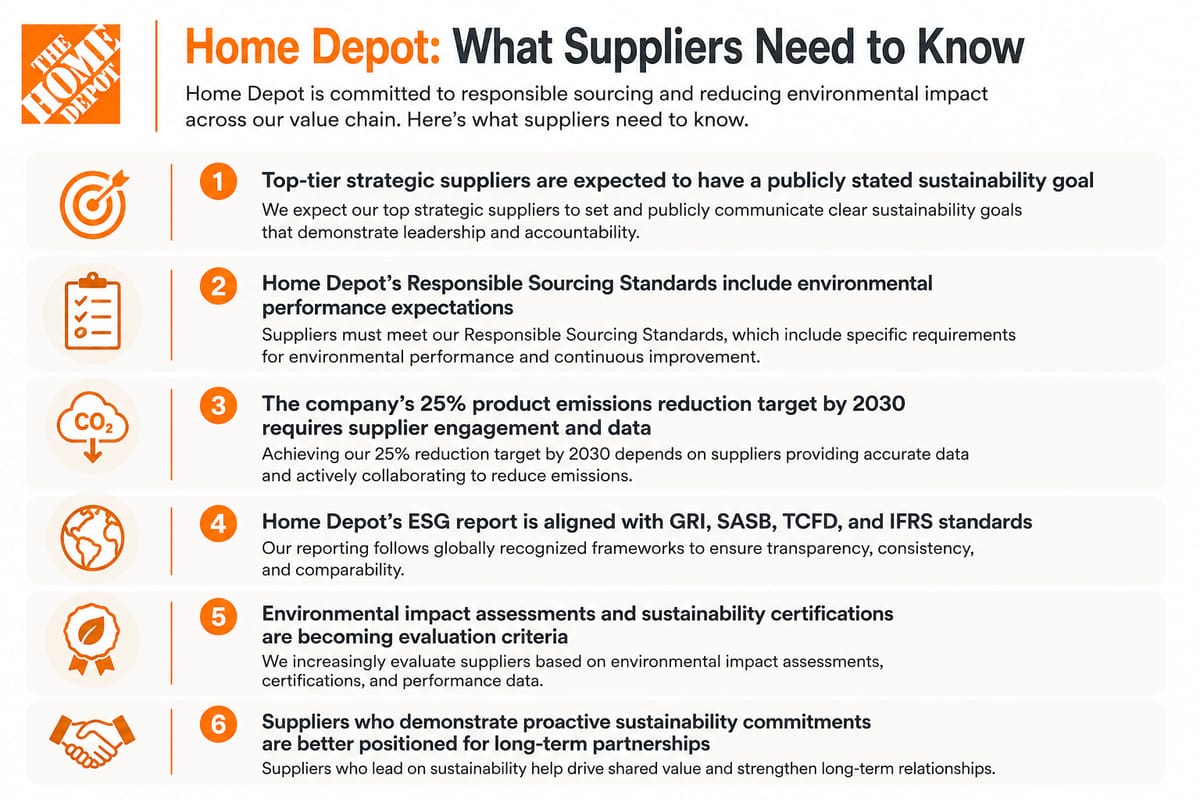
Home Depot has signaled that sustainability alignment will increasingly factor into supplier relationships. Suppliers who act now, rather than waiting for mandatory requirements, gain a competitive advantage in category reviews and contract renewals.
The table below summarizes the current state of supplier sustainability expectations across the five retailers.
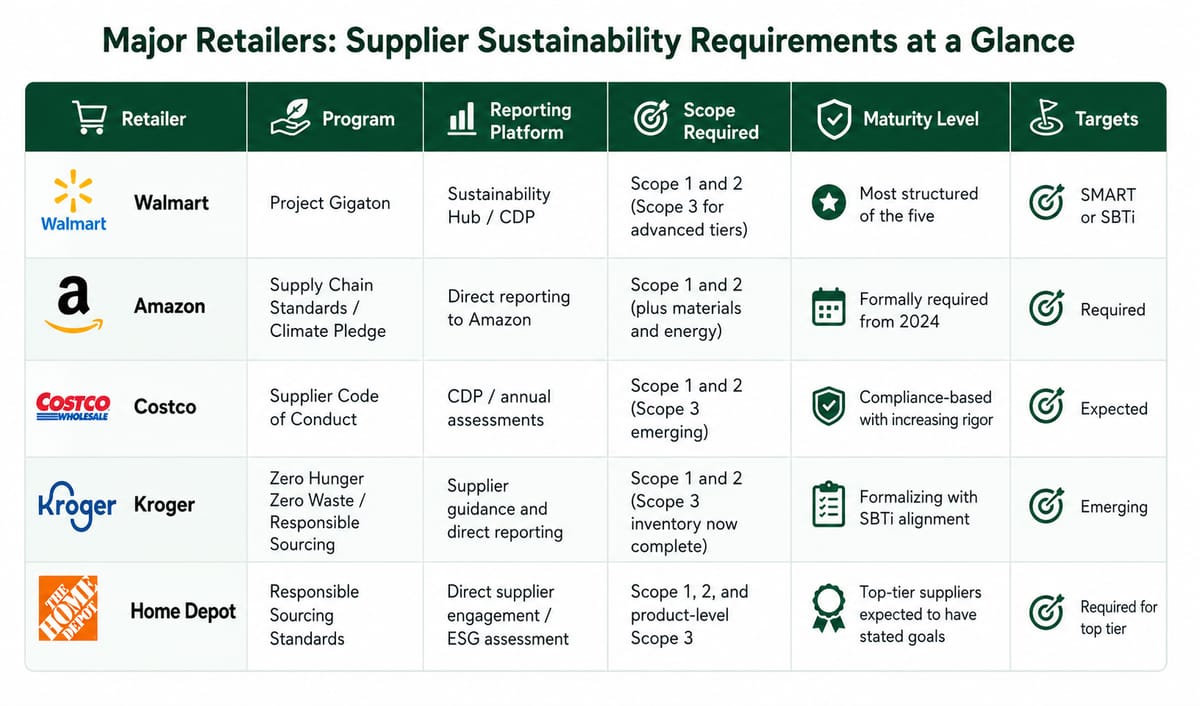
Despite the differences between programs, the foundation required for all five retailers is identical. If you build this core capability, you will be prepared to respond to any of them.
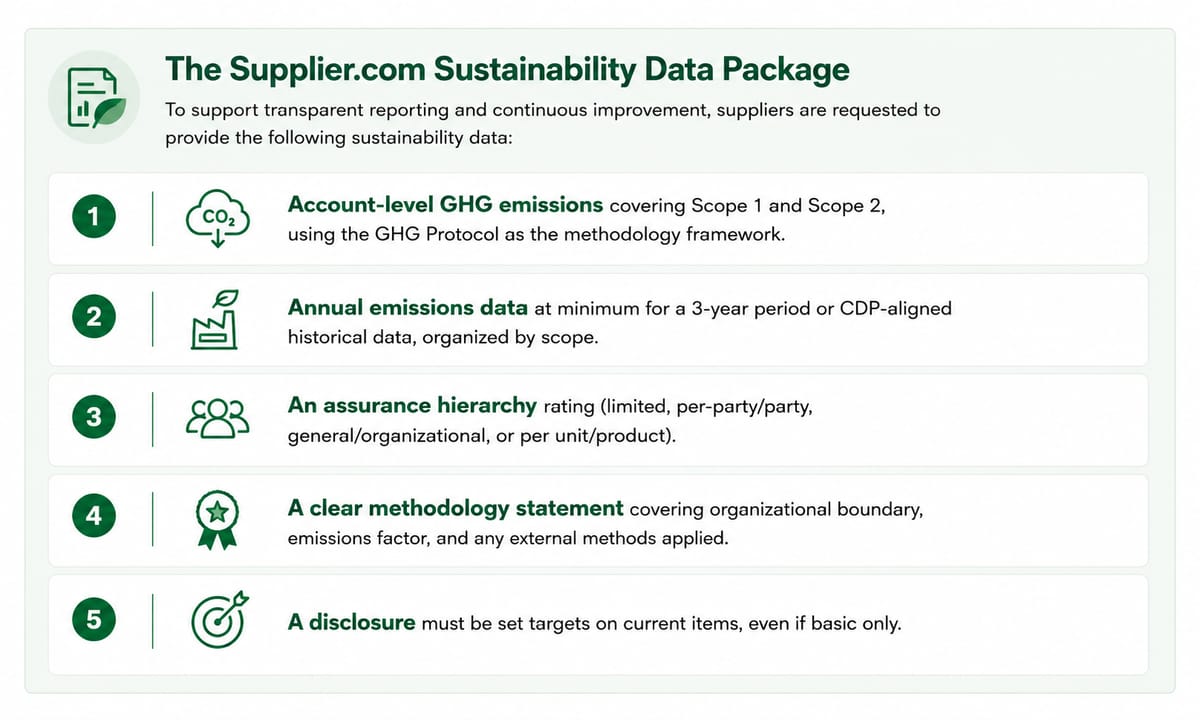
You do not need a Head of Sustainability or an external consulting firm to meet these requirements. What you need is a clear process and the right tool.
Gather 12 months of utility bills for all locations, fuel records for company-owned vehicles, and business travel data. This covers the majority of Scope 1 and Scope 2 for most suppliers.
Apply emission factors from authoritative sources like the EPA or IEA to convert your activity data into metric tons of CO2e. Purpose-built software like Aclymate automates this step and keeps emission factors current automatically.
Produce a concise sustainability report or emissions summary that you can submit to any retailer portal or procurement form. Aclymate's sustainability reporting feature generates GHG Protocol-aligned reports that are formatted for retailer and procurement team submissions.
Once you have your data, register on the platforms relevant to your retail customers:
Even a basic, directional commitment helps with all five retailers. If you want a science-based target, the Science Based Targets initiative (SBTi) provides a widely recognized framework.
Sustainability reporting is now woven into the vendor management systems of all five major retailers. Suppliers who cannot provide emissions data face:
The good news: building a credible first inventory is not a multi-year project. Most mid-sized suppliers can complete Scope 1 and Scope 2 reporting in two to six weeks with the right tool.
Aclymate is purpose-built for growing businesses and suppliers who need to respond to retailer sustainability requests quickly and credibly. Our platform automates GHG calculations, applies the correct emission factors, and generates reports you can submit directly to Walmart's Sustainability Hub, CDP, or any retailer portal.
Start your free GHG inventory with Aclymate
Or explore Aclymate's sustainability reporting solution to see how we help suppliers meet retailer expectations without a dedicated ESG team.
Each retailer has a distinct program. Walmart uses Project Gigaton and its Sustainability Hub portal. Amazon formalized supply chain emissions reporting requirements in 2024. Costco enforces requirements through its Supplier Code of Conduct and CDP participation. Kroger is expanding its Responsible Sourcing framework to include GHG data. Home Depot expects top-tier suppliers to have stated sustainability goals. All five ultimately require Scope 1 and Scope 2 emissions data aligned with GHG Protocol standards.
Collect 12 months of utility bills and fuel records for all your locations. Use a purpose-built tool like Aclymate to calculate Scope 1 and Scope 2 emissions automatically. Then generate a summary document and register on whichever retailer portal is relevant to your business. Most suppliers can complete this process in two to six weeks.
Build a GHG inventory using the GHG Protocol, prepare a concise emissions summary with methodology documentation, and submit through the retailer's preferred platform (Walmart Sustainability Hub, CDP, or direct submission).
How do I prepare for customer and supplier carbon reporting requests without hiring a sustainability team?
Assign one internal owner, use software that automates calculations and reporting, and build a standard emissions summary document you can reuse for any request. This setup typically requires fewer than 10 hours of internal effort per year after the initial inventory is complete.
Project Gigaton is Walmart's flagship supplier sustainability program. It requires participating suppliers to report annual progress toward emissions reduction or avoidance goals across six focus pillars. Supplier participation status is visible to Walmart's buying and sourcing teams, which means it influences procurement decisions. Learn more at walmartsustainabilityhub.com.
Get Aclymate's practical sustainability content delivered weekly.

Learn how to calculate an event carbon footprint in 4 steps: set the boundary, gather activity data, apply emission factors, and total it. Includes an example.
Read Article

An event carbon footprint is the total emissions from travel, lodging, venue energy, food, and waste. See which sources matter most and why.
Read Article

AI is transforming carbon credit verification through satellite monitoring, automated analysis, and anomaly detection. But can technology solve the voluntary carbon market’s credibility problem? Discover the limitations of AI verification and how businesses can evaluate carbon credits while keeping emissions reductions ahead of offsetting.
Read Article
Talk with a Sustainability Expert, see a demo, or start free to put the Aclymate platform and experts to work for your team.