← Back to Insights
Aclymate Team
May 27, 2026
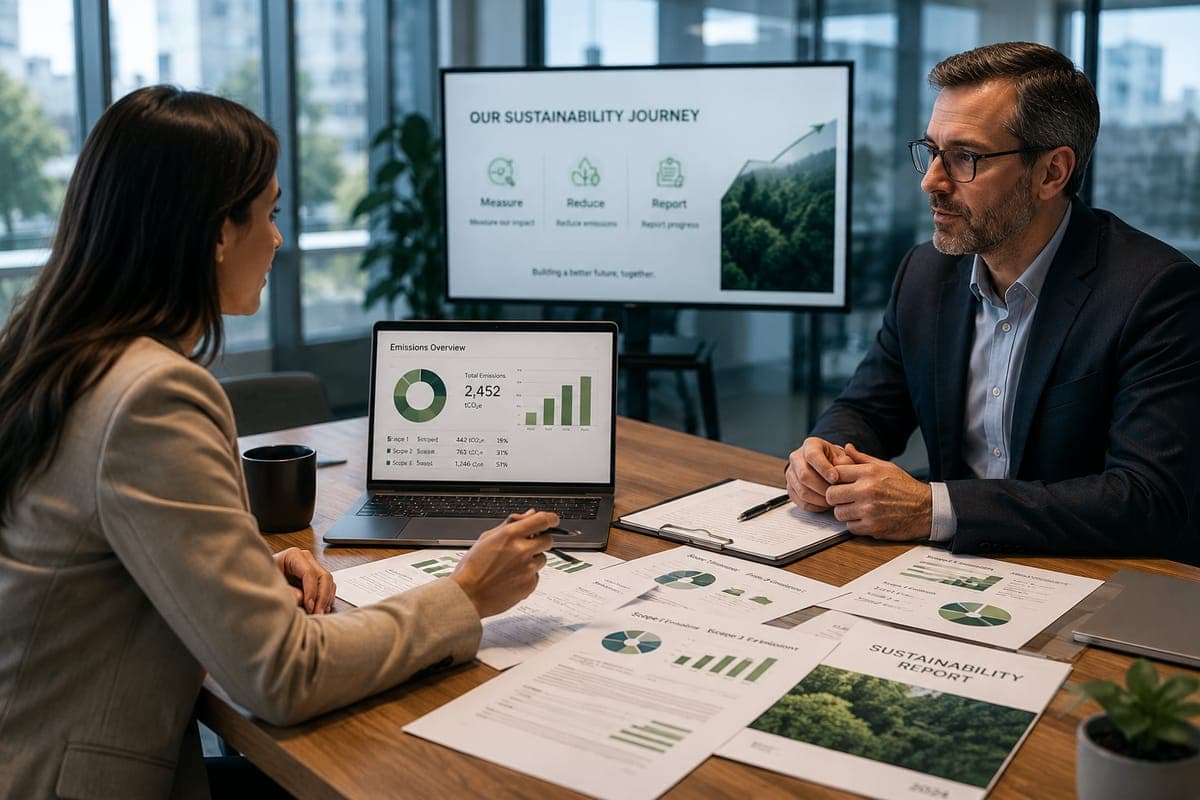
If a customer, partner, or procurement team has started asking about your carbon footprint, you are not alone. Sustainability data requests are now a routine part of vendor qualification, enterprise procurement, and supply chain due diligence across almost every industry.
The challenge is that most growing companies have never built a formal greenhouse gas inventory or sustainability report. When the first request lands in your inbox, it can feel overwhelming.
This guide gives you a clear, practical path for how to report sustainability and emissions to customers and partners, starting from scratch, without needing a dedicated sustainability team.
Sustainability reporting used to be voluntary. That is changing quickly.
Large enterprises are under increasing pressure from investors, regulators, and consumers to disclose and reduce their Scope 3 emissions. Scope 3 includes the emissions produced by suppliers and vendors across a company's value chain. That means your emissions, as their supplier or partner, count toward their sustainability goals.
Regulations like the SEC climate disclosure rules, California's SB 253 and SB 261, and the EU Corporate Sustainability Reporting Directive (CSRD) are pushing large companies to account for supply chain emissions. Those companies are passing that requirement downstream to vendors like you.
The result: sustainability questionnaires, carbon data requests, and supplier scorecards are now showing up in RFPs, annual vendor reviews, and procurement portals at companies of all sizes.
Before you can respond, you need to understand what they are actually requesting. Most sustainability data requests fall into a few common categories.
This is the most common ask. Customers want to know your Scope 1, Scope 2, and sometimes Scope 3 emissions, expressed in metric tons of carbon dioxide equivalent (tCO2e). They may ask for:
Platforms like CDP (formerly Carbon Disclosure Project), EcoVadis, and Sedex send structured questionnaires to suppliers. Enterprise buyers may also send their own internal surveys. These typically ask about:
Some customers want to know not just what your emissions are today, but what you plan to do about them. Common questions include:
More sophisticated buyers may ask whether your emissions data has been verified by a third party, or whether your company holds any sustainability certifications such as B Corp, ISO 14001, or similar.
All credible sustainability reporting starts with the GHG Protocol Corporate Accounting and Reporting Standard, the globally recognized framework used by CDP, GRI, TCFD, and most enterprise procurement teams.
Under the GHG Protocol, emissions are divided into three scopes:
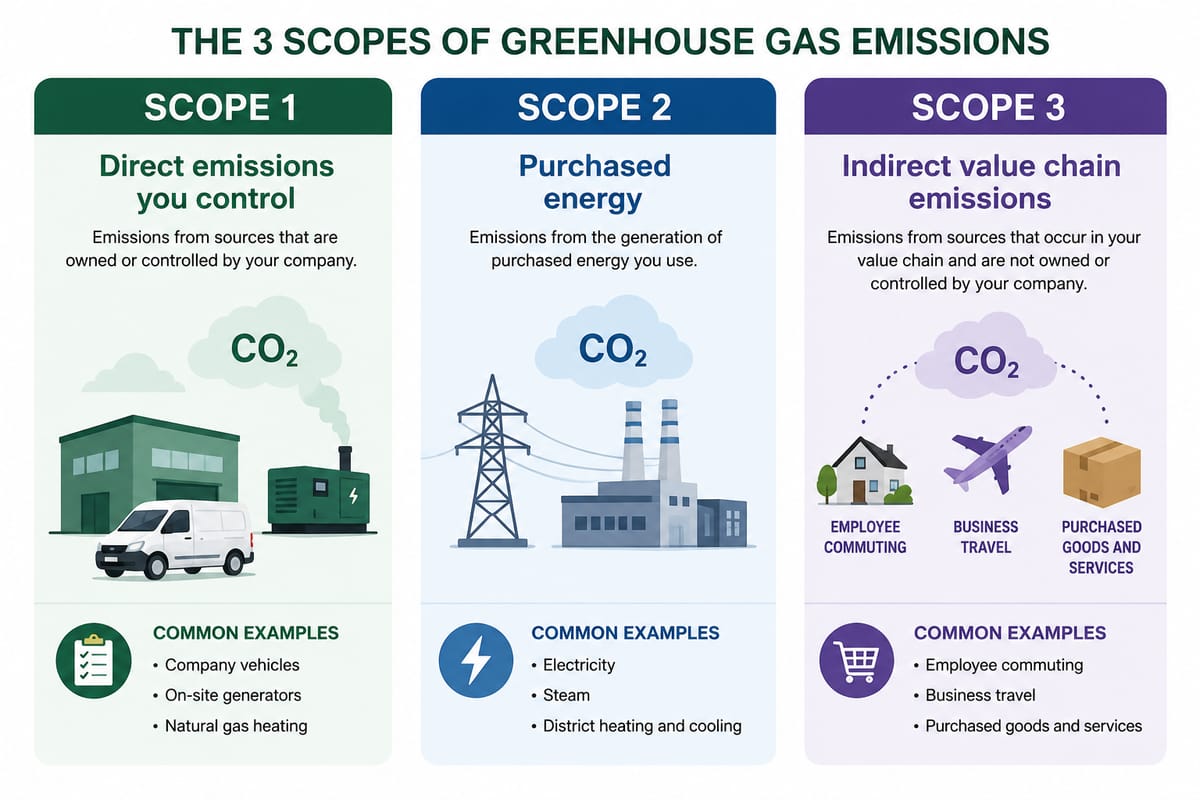
For most companies responding to customer requests, Scope 1 and Scope 2 are the baseline requirement. Scope 3 is often optional for first submissions but increasingly expected over time. Learn more about how GHG scopes apply to your business.
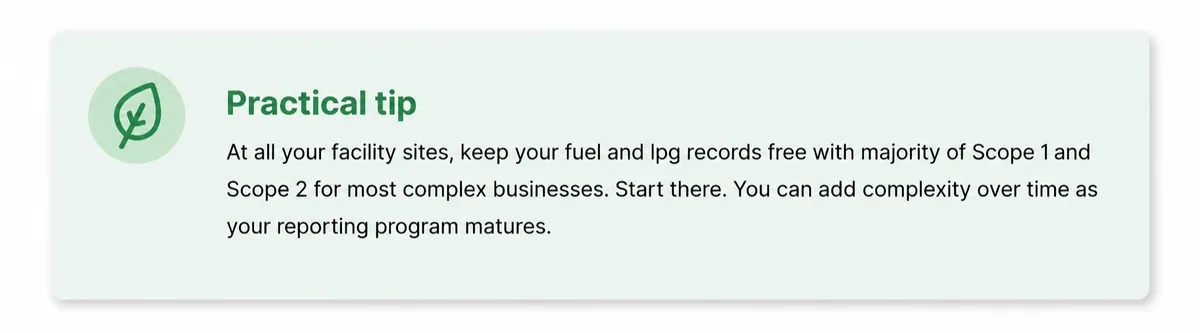
You do not need a sophisticated system to start. Most of the data required for a credible Scope 1 and Scope 2 inventory already exists in your business records.
Once you have your activity data, you need to convert it into carbon dioxide equivalent (CO2e) using published emission factors.
The basic formula is:
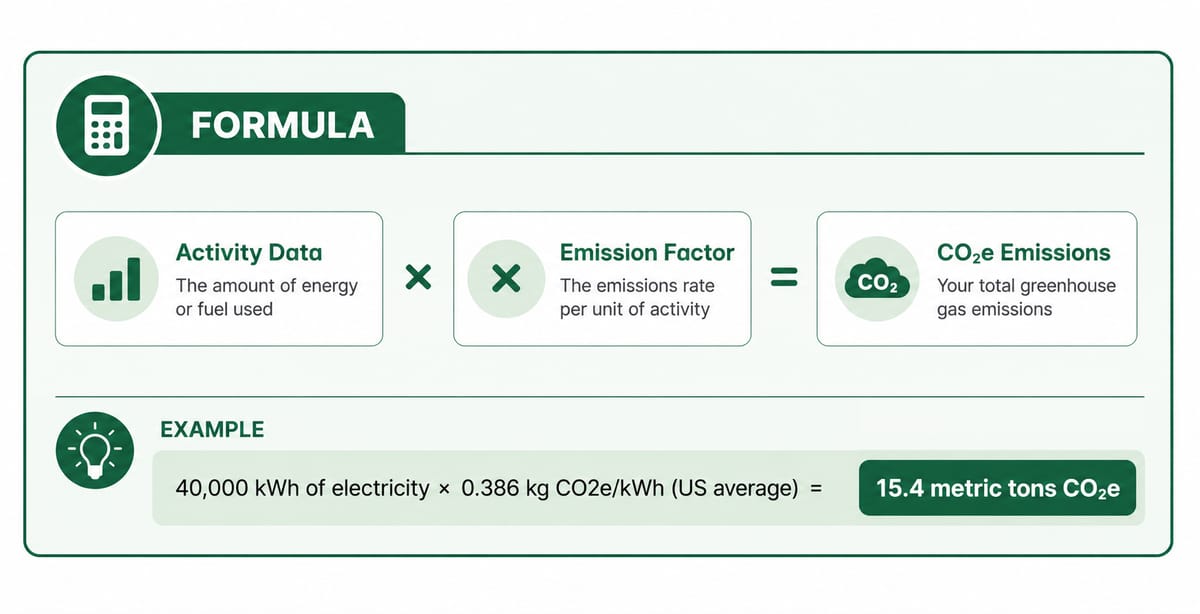
Emission factors vary by country, energy grid region, and fuel type. The most authoritative free sources are:
Doing this manually in a spreadsheet is time-consuming and error-prone. Purpose-built software like Aclymate applies the correct emission factors automatically based on your location and energy source, reducing calculation time significantly.
Once you have calculated your emissions, you need a format you can actually share with customers and partners. This does not have to be a lengthy sustainability report. For most B2B purposes, a concise emissions summary document is enough.
Aclymate generates a shareable sustainability report directly from your inventory data, formatted for customer and partner requests.
Different customers use different platforms and formats to collect sustainability data. Here is how to approach the most common ones.
CDP is the most widely used platform for corporate sustainability disclosure. Many large enterprises require their suppliers to complete a CDP Supply Chain questionnaire annually. CDP scores companies on a scale from D to A, and your score is visible to requesting customers.
To respond to CDP, you need at minimum: a GHG inventory covering Scope 1 and 2, a description of your methodology, and responses to questions about governance and targets. A complete Aclymate inventory maps directly to CDP's supplier questionnaire requirements.
EcoVadis is a supplier sustainability rating platform used by thousands of large enterprises. It assesses companies across four themes: environment, labor and human rights, ethics, and sustainable procurement. The environment section covers GHG emissions, energy consumption, and environmental management. Learn more at ecovadis.com.
Sedex focuses primarily on ethical trade and labor standards, but its SMETA audit framework includes environmental components. If a customer requires a Sedex audit, your GHG data will support the environmental section. Learn more at sedex.com.
Many enterprise buyers send their own sustainability questionnaires through procurement portals or email. These vary widely, but a prepared emissions summary document, a brief environmental policy statement, and your emissions totals in a standard format will answer the majority of questions you receive.
Customers increasingly want to know not just what your emissions are, but what you are doing to reduce them. You do not need a complex net zero strategy to give a credible answer.
A minimal but credible response includes:
If you want to commit to a scientifically rigorous target, the Science Based Targets initiative (SBTi) provides a framework for setting reduction targets aligned with a 1.5°C pathway. SBTi-aligned targets are increasingly recognized and respected by enterprise procurement teams.
Explore how Aclymate supports emissions reduction planning.
If you have received a sustainability data request and have no existing inventory, here is the fastest path to a credible response.
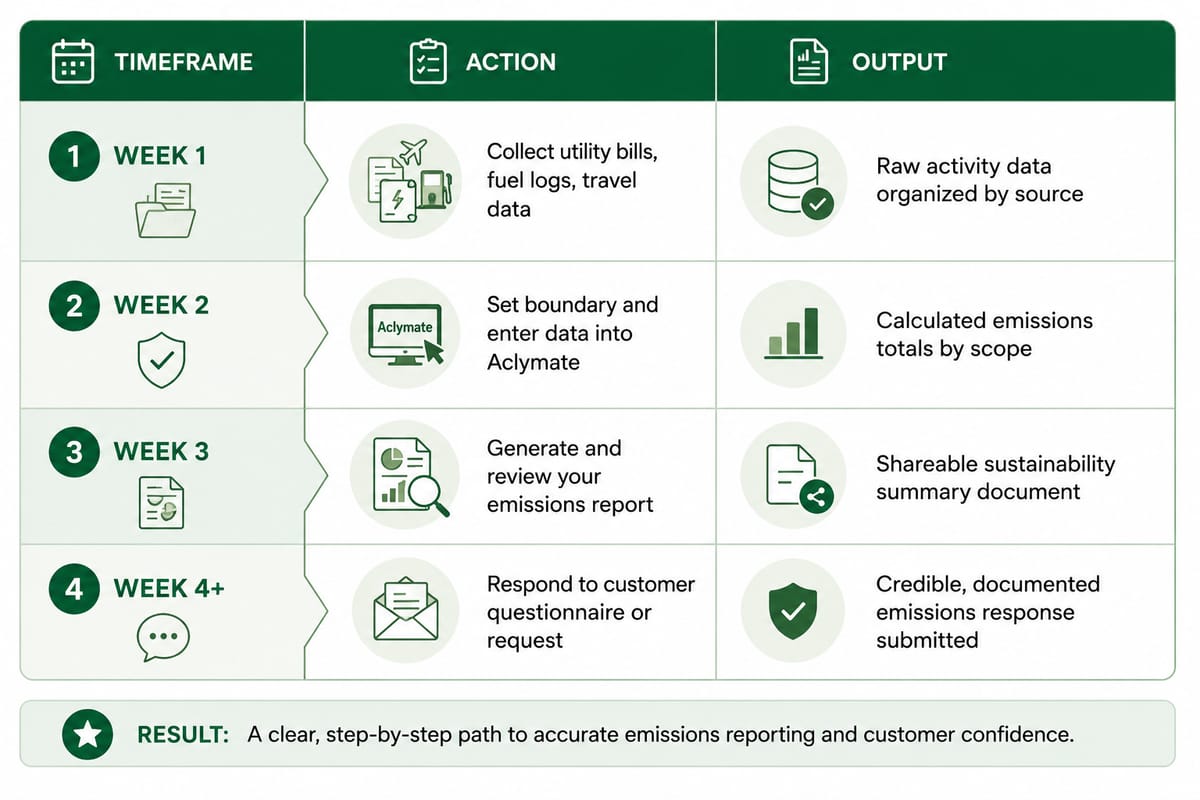
Once you have completed your inventory, this is a simple factual answer: "Our Scope 1 emissions for [year] were X metric tons CO2e. Our Scope 2 emissions were Y metric tons CO2e, calculated using location-based emission factors from [source]."
If you have used Aclymate's reporting feature, you can share a formatted PDF or summary document. If not, even a one-page emissions summary with methodology notes is a credible response for most requests.
For a first inventory, the honest answer is often no, and that is acceptable. You can say: "Our current inventory has not yet been third-party verified. We are building our baseline and plan to seek limited assurance in the next reporting cycle." Most customers will accept this from a new reporter.
If you have not yet set a formal target, be transparent: "We have established our emissions baseline and are in the process of setting a reduction target. We expect to formalize our commitment within the next 12 months." This is a far better response than having no answer at all.
Net zero is a long-term commitment that requires a defined pathway, not just an aspiration. If you are not ready to make a formal commitment, say so honestly. Customers value credibility over ambition that cannot be supported with data.
You do not need to hire a Head of Sustainability to respond to customer requests credibly. What you need is a simple, repeatable process and the right tool.
The most common setup for a growing company is:
This setup typically requires fewer than 10 hours of internal effort per year once the initial inventory is complete. See how Aclymate makes annual reporting fast and repeatable.
Failing to respond to sustainability requests is no longer a neutral option. The business risks are real.
Responding with even a basic, credible emissions summary puts you ahead of most mid-sized competitors. It signals to customers that you take the request seriously and are capable of managing it.
Aclymate helps growing companies build a credible GHG inventory and shareable sustainability report, often in just a few weeks, without needing a dedicated sustainability team. Whether you are responding to a CDP questionnaire, an enterprise procurement form, or a direct customer request, Aclymate gives you the data and documentation you need.
Start your free GHG inventory with Aclymate
Or explore Aclymate's full sustainability reporting solution to see how it maps to the requests you are receiving.
Start by building a GHG inventory covering Scope 1 and Scope 2, using the GHG Protocol as your framework. Then prepare a concise emissions summary document with your totals, methodology, and data sources. Most customers will accept this as a complete response, especially for a first submission.
Begin by collecting 12 months of utility bills and fuel data for all your locations. Use a purpose-built tool like Aclymate to calculate your emissions automatically. Your first goal is to produce a documented Scope 1 and Scope 2 total that you can share with confidence.
Assign one internal owner to collect data once per year, use software that automates calculations and reporting, and maintain a standard emissions summary document you can send on request. This process typically takes fewer than 10 hours per year after initial setup.
At minimum: 12 months of energy and fuel consumption data, a defined organizational boundary, a GHG Protocol-aligned calculation methodology, and a shareable report. To reduce emissions, you also need a baseline year, measurable targets, and a plan for the highest-impact emission sources in your operations.
Not for most requests. Third-party verification adds credibility and is increasingly valued by sophisticated buyers, but the majority of customer questionnaires and procurement requests do not require it for initial submissions. Building a verified, well-documented inventory first is the priority.
Get Aclymate's practical sustainability content delivered weekly.

Learn how to calculate an event carbon footprint in 4 steps: set the boundary, gather activity data, apply emission factors, and total it. Includes an example.
Read Article

An event carbon footprint is the total emissions from travel, lodging, venue energy, food, and waste. See which sources matter most and why.
Read Article

AI is transforming carbon credit verification through satellite monitoring, automated analysis, and anomaly detection. But can technology solve the voluntary carbon market’s credibility problem? Discover the limitations of AI verification and how businesses can evaluate carbon credits while keeping emissions reductions ahead of offsetting.
Read Article
Talk with a Sustainability Expert, see a demo, or start free to put the Aclymate platform and experts to work for your team.