← Back to Insights
Bill Zujewski
October 29, 2026

Sponsors want it in the proposal, corporate attendees need it for their own Scope 3 reporting, and more RFPs ask for it every year. A conference carbon footprint has become a standard part of running a professional event. But most organizers start measuring the wrong things first.
A conference carbon footprint is the total greenhouse gas emissions caused by a conference, and most of it comes from attendees traveling to the event and staying in hotels. The Net Zero Carbon Events measurement methodology observes that travel alone accounts for about 70–90% of an average event's emissions. Venue energy, catering and waste make up most of the rest.
This guide covers:
Every conference footprint is built from the same handful of sources. They differ hugely in size.
| Source | What it includes | Typical size | Scope |
| Attendee travel | Flights, car trips, rail and bus to and from the conference | Largest by far | 3 |
| Hotel stays | Room-nights for attendees, speakers and staff | Second-largest for multi-day events | 3 |
| Venue energy | Electricity, heating and cooling during setup, sessions and teardown | Moderate | 1 and 2 (venue) or 3 |
| Food and beverage | Meals, coffee breaks, receptions | Small to moderate, depending on menu | 3 |
| Materials and production | Signage, stage sets, printed programs, badges, swag | Small to moderate | 3 |
| Waste | Landfill, recycling and compost | Small | 3 |
| Digital | Streaming, event apps and hosting | Small, unless hybrid | 3 |
Travel dominates because conferences bring people together from far away. The longer the trips, the bigger the share. Projet Celsius, citing a 2021 Nature Communications study, puts an international, single-venue conference at about 840 kg CO2e per participant. Half of the travel emissions came from round trips longer than 10,000 km.
Every attendee who travels needs a bed, so hotel emissions scale with the number of out-of-town attendees and nights. Multi-day conferences, early arrivals and late departures all push the total up.
Venue energy, catering, materials and waste are the sources organizers control most directly. Together they're usually a minority of the total. They still matter for credibility and cost, and they're easier to measure than travel.
A conference footprint is rarely spread evenly across attendees. Long-haul flyers produce many times the emissions of local attendees, so a small group can account for a large share.
That's also why format choices matter so much. Cornell researchers found that moving a conference fully online cut its footprint by 94%. A hybrid format with at least half of attendees in person cut it to about 67% of the in-person baseline.
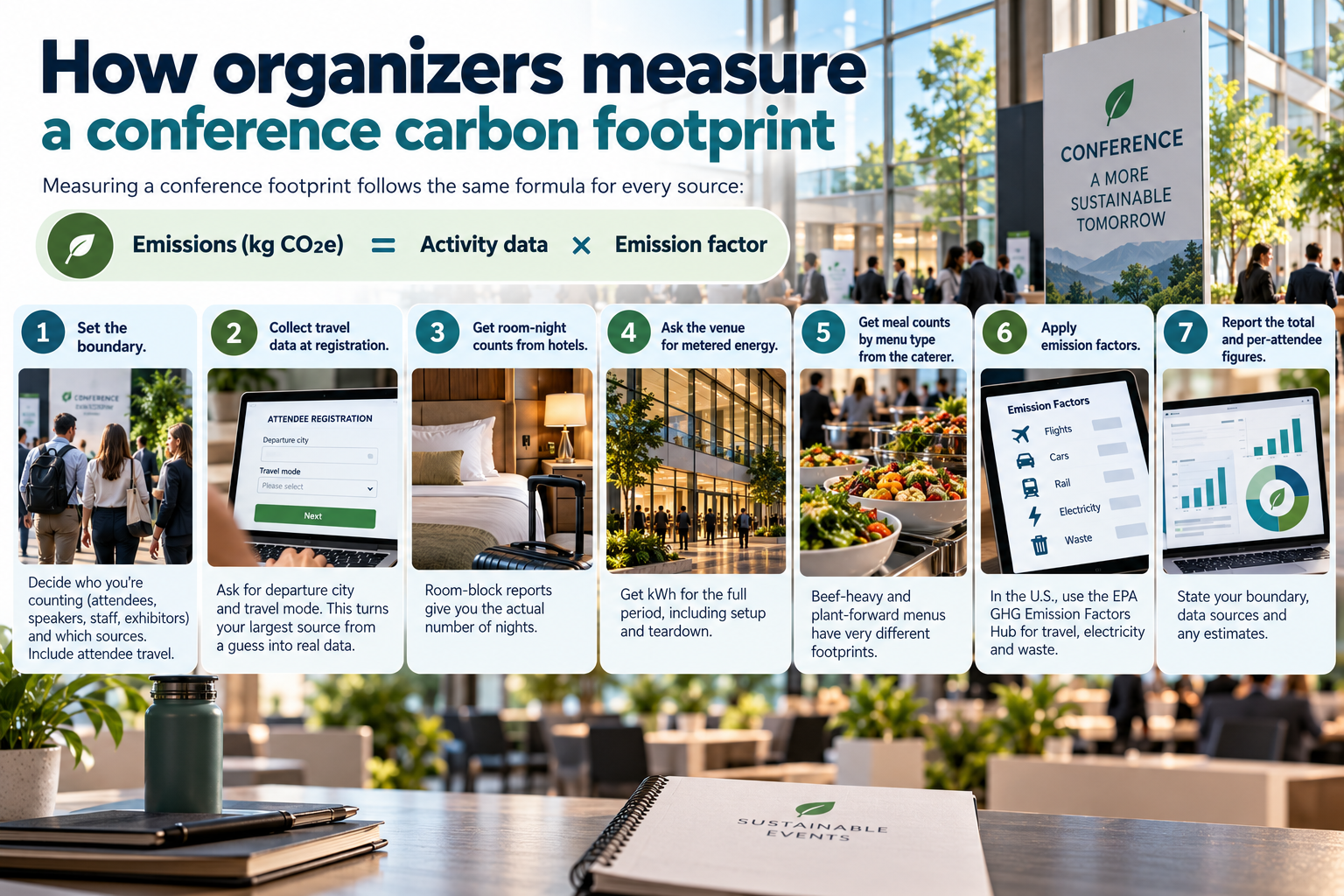
Measuring a conference footprint follows the same formula for every source:
Emissions (kg CO2e) = Activity data × Emission factor
For a broader look at event emission sources, see our guide to what makes up an event carbon footprint.
Here's a sample footprint for a U.S. conference with 500 attendees. All inputs are illustrative. Emission factors come from the EPA Hub 2025, a U.S. hotel factor of 16.1 kg CO2e per room-night, and an average meal factor of 2.04 kg CO2e from Projet Celsius.
| Source | Activity data | Emissions (kg CO2e) | Share |
| Attendee travel | 150 drive 200 mi; 300 fly 1,400 mi; 50 fly 6,000 mi (round trip) | 112,919 | 77.8% |
| Hotel stays | 1,050 room-nights (350 travelers × 3 nights) | 16,905 | 11.6% |
| Venue energy | 30,000 kWh, U.S. average grid | 10,549 | 7.3% |
| Food and beverage | 1,500 meals × 2.04 kg | 3,060 | 2.1% |
| Waste | 3 short tons to landfill | 1,740 | 1.2% |
| Total | 145,173 (≈ 145 t) | 100% |
That's about 290 kg CO2e per attendee. Travel and hotels together make up almost 90% of the footprint.
The 50 long-haul attendees, just 10% of the audience, produced about 49 t CO2e. That's 34% of the entire conference footprint, more than the venue, food, waste and hotels combined.

Aclymate gives conference organizers a repeatable way to measure every event and fold the results into their company's footprint.
Branded merchandise distributor Whitestone used Aclymate to measure a 4,053 tCO2e annual footprint and earn Climate Leader certification.
It's the total greenhouse gas emissions a conference causes, measured in kilograms or tonnes of CO2e. It includes attendee travel, hotel stays, venue energy, food and beverage, materials and waste.
Attendee travel. Net Zero Carbon Events estimates that travel accounts for about 70–90% of an average event's emissions, with flights making up most of that. Hotel stays are usually the next largest source.
It depends mostly on how far they travel. In our 500-person example, the average was about 290 kg CO2e per attendee. Projet Celsius puts international conferences at about 840 kg per participant.
Collect attendee travel data at registration, room-nights from hotels, metered energy from the venue, and meal counts from the caterer. Multiply each by its emission factor and add the results.
Yes, much lower. A Cornell study found that moving a conference fully online cut its footprint by 94%. A hybrid with at least half of attendees in person cut it by about a third.
Yes. It's the largest source, and leaving it out makes the result incomplete and hard to compare. Industry guidance recommends measuring and reporting it.
Most of your conference's footprint comes from where attendees travel from and how long they stay. Measure those first, and you'll know where to cut.
Ready to measure your conference footprint? Start free with Aclymate Explorer to get a baseline in minutes, or book a demo to see how Aclymate's software and experts can measure, reduce and report your event and company emissions without adding headcount.
Get Aclymate's practical sustainability content delivered weekly.

A workflow for estimating event emissions before the event, collecting real data during it, and updating your footprint afterward for accurate reporting.
Read Article

See how event carbon footprint calculators estimate emissions from travel, hotel nights, venue energy, and meals, and where their defaults fall short.
Read Article

Use quick event carbon estimates to compare cities, venues, formats, and menus before you commit, and set a realistic emissions budget for each event.
Read Article
Talk with a Sustainability Expert, see a demo, or start free to put the Aclymate platform and experts to work for your team.