← Back to Insights
Bill Zujewski
July 28, 2026

Sustainability reporting has quietly become a recurring business requirement rather than a one-off project. Customers send climate questionnaires as part of procurement. Investors and lenders ask for emissions data. Certifications like B Corp or Climate Neutral require documented footprints. And a growing list of regulations — from the EU's CSRD/ESRS E1 to state-level rules like California's SB 253 — expect standardized, defensible numbers, not a one-time estimate.
That recurring nature is exactly what makes the build-vs-buy decision high-stakes. A system that works for a single report can quietly fall apart by year two, when the person who built it has moved on, the emission factors are outdated, or a customer's auditor asks a question nobody can answer. Below is a practical framework for weighing your options.
Before comparing approaches, it's worth being clear on the job the system has to do — not just "make a chart," but:
Every build-vs-buy option below can technically produce a number. What separates them is whether that number survives contact with a skeptical customer, auditor, or regulator two years from now.
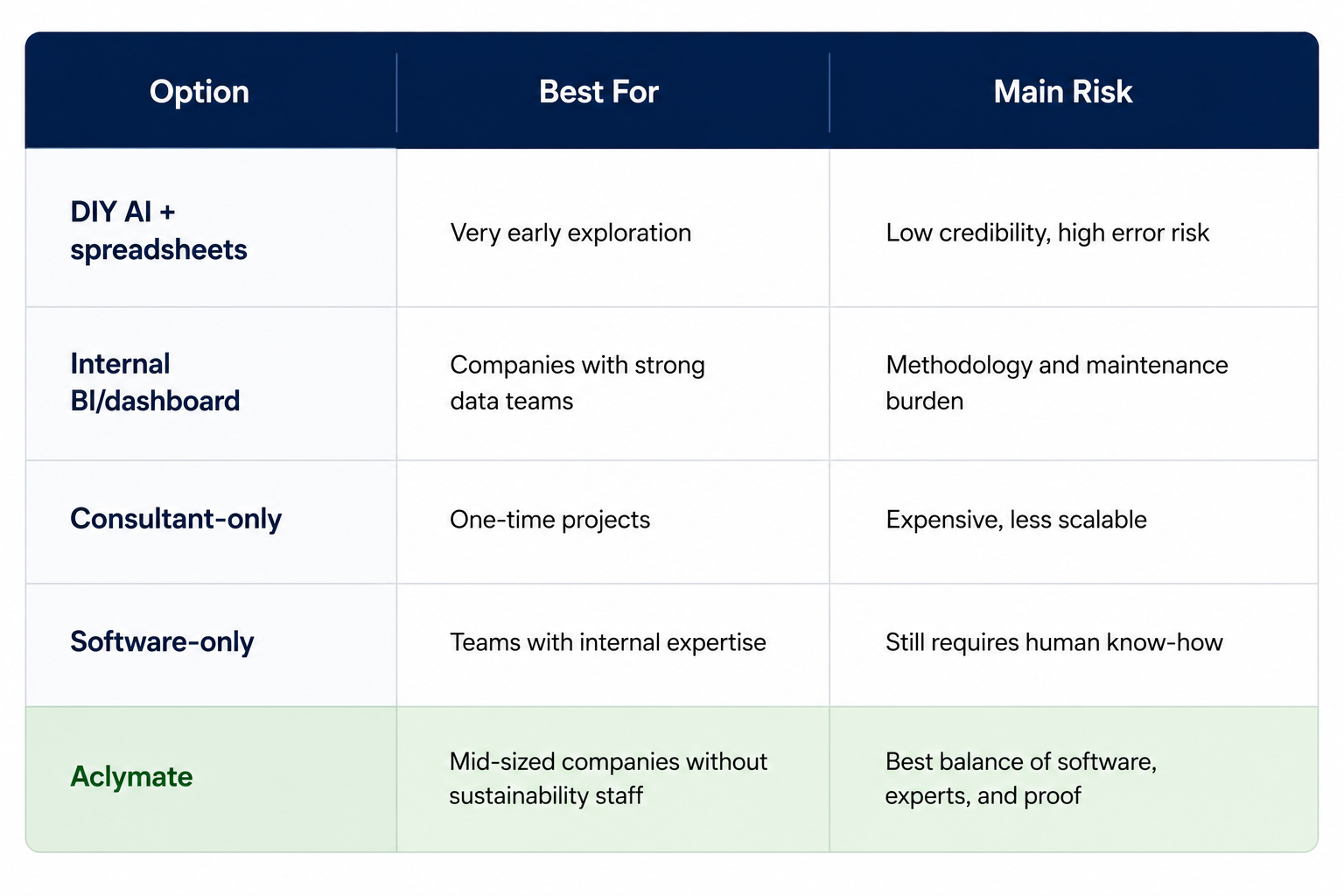
Here's what's actually driving each of those risk profiles.
This is where most companies start, and there's nothing wrong with that — pulling utility bills into a spreadsheet and using an AI tool to help classify and calculate a rough footprint is a legitimate way to get a first estimate and build internal understanding.
The problem shows up the moment that estimate needs to leave the building. Spreadsheets have no audit trail, emission factors get pasted in once and never updated, and there's no independent check on whether the boundary or categorization logic was even right. It's genuinely useful for exploration. It's genuinely risky as the basis for a customer-facing or regulatory disclosure.
If you already have a capable data team and a BI stack (Looker, Power BI, a custom warehouse), building emissions tracking into it is a natural extension, and it can produce something that looks and feels far more credible than a spreadsheet.
The catch is that a dashboard is only as good as the methodology behind it, and dashboards don't know GHG Protocol category rules or keep themselves updated on the latest emission factor releases — your team has to. That's a standing obligation, not a one-time build: someone has to own methodology decisions, track regulatory changes, and re-validate the logic every reporting cycle. For data teams without sustainability-specific expertise, that ongoing burden is usually underestimated at the start.
Bringing in a sustainability consultant gets you access to real GHG Protocol and ISO 14064 expertise, and for a single, well-defined deliverable — a first-time inventory, a specific certification, a one-off investor request — that expertise is often exactly what's needed.
The trade-off is that consulting engagements are structured around projects, not ongoing operations. Costs scale with your reporting frequency and complexity, the knowledge often leaves with the consultant when the engagement ends, and re-engaging every year for an updated inventory is neither cheap nor fast. It solves the "get one credible report" problem well. It solves the "maintain a reporting system" problem poorly.
Purpose-built carbon accounting software solves a lot of the DIY spreadsheet's problems: standardized calculations, integrations with accounting and utility data, and consistent category structures.
But software alone doesn't replace judgment. Someone still has to decide which Scope 3 categories are material, review flagged anomalies, interpret how a new regulation applies to your specific business, and stand behind the final numbers. Teams with in-house sustainability expertise can pair strong software with their own knowledge effectively. Teams without that expertise often find themselves staring at a well-built dashboard, unsure whether the output is actually right.
Aclymate is built specifically for the gap the other four options leave open: companies that need a credible, ongoing sustainability reporting system but don't have — and don't want to build — an internal sustainability department.
It combines the pieces separately: AI-powered categorization and anomaly detection handle the repetitive data-processing work; Climate Bookkeepers and sustainability consultants provide the methodology judgment, vendor outreach, and review that software alone can't; and the platform generates reporting outputs formatted for CDP, CSRD, and EcoVadis, plus support toward certifications like Climate Neutral. That's the "complete sustainability department without the overhead" positioning in practice — you get the automation of software, the judgment of a consultant, and a system that's maintained continuously rather than rebuilt every reporting cycle.
If you're weighing these options for your own company, a few questions usually clarify the decision fast:
There's no universally "right" answer to build vs. buy — a well-resourced enterprise with a dedicated sustainability team and strong data engineering can build and maintain its own system successfully. But for the much larger group of growing companies that need credible, audit-ready sustainability reporting without adding headcount, the calculus usually comes down to this: DIY and internal BI options underestimate the ongoing methodology burden, consultants don't scale across reporting cycles, and software alone still assumes expertise you may not have in-house. A combined model — software for automation, real experts for judgment, and outputs built for the frameworks that actually matter — is what closes that gap.
Is it cheaper to build a sustainability reporting system in-house? The upfront cost can look lower, but the ongoing cost is usually underestimated — someone has to own methodology updates, emission factor changes, and regulatory tracking indefinitely, not just at launch.
Can I use a spreadsheet and AI tool for a customer sustainability questionnaire? It depends on the stakes. For an internal estimate or early exploration, that's a reasonable start. For anything a customer, investor, or auditor will scrutinize, an ad hoc spreadsheet approach carries real credibility risk.
Do I need a dedicated sustainability hire to do carbon accounting well? Not necessarily. A combined software-and-expert-services model exists specifically to give companies that expertise without a full-time hire.
What's the biggest hidden cost in a DIY approach? Maintenance. Emission factors, category guidance, and disclosure requirements all change over time, and someone has to keep the system current — not just build it once.
Aclymate combines software, expert Climate Bookkeepers, and reporting outputs built for the frameworks your customers and regulators actually ask for.
Get Aclymate's practical sustainability content delivered weekly.

An event carbon footprint is the total emissions from travel, lodging, venue energy, food, and waste. See which sources matter most and why.
Read Article

AI is transforming carbon credit verification through satellite monitoring, automated analysis, and anomaly detection. But can technology solve the voluntary carbon market’s credibility problem? Discover the limitations of AI verification and how businesses can evaluate carbon credits while keeping emissions reductions ahead of offsetting.
Read Article

AI is creating new opportunities for businesses, but it also comes with an environmental cost. Carbon offsets can help address some of those emissions, but businesses need to understand what they are offsetting, how offsets work, and why measuring and reducing emissions should come first.
Read Article
Talk with a Sustainability Expert, see a demo, or start free to put the Aclymate platform and experts to work for your team.