← Back to Teaching Sustainability
Mike Smith
October 21, 2026

Welcome to Teaching Sustainability, the 20-week series from Aclymate created to help small and mid-sized business leaders understand what sustainability means, why it matters, and what to do next. Each week, we cover one practical topic, from carbon accounting and reporting to certifications and climate action, in clear, simple language designed to help you build a more resilient, credible, and competitive business.
Last chapter, we introduced the sustainability maturity model and walked through how to assess where your program actually stands across seven dimensions. This chapter addresses something that tends to happen at the transition between Levels 2 and 3: the moment when a business has enough data and enough operational clarity to put into words what it is actually trying to accomplish. That moment is when a sustainability mission statement becomes useful. And when writing one well matters.
Done poorly, a sustainability mission statement is a marketing exercise that creates more risk than it resolves. Done well, it is a decision-making tool that tells your team, your customers, and your partners what you stand for, what you are working toward, and what standard you are holding yourself to.
Walk through the websites of a hundred small and mid-sized businesses and read their sustainability statements. The same words appear over and over. "We are committed to a sustainable future." "We believe in protecting the planet for generations to come." "We are dedicated to operating responsibly and minimizing our environmental impact." These statements are not wrong. They are simply empty. They make no specific commitment, establish no measurable standard, and give no one inside or outside the business anything to hold the company accountable to.
The problem is not that these businesses don't care. Most of them do. The problem is that they reached for language before they reached for clarity. They asked "how should this sound?" before they asked "what are we actually committed to?" The result is a statement that signals good intentions while communicating nothing.
There is a second, subtler failure mode: the statement that is specific about values but vague about action. "We believe that business has a responsibility to protect the environment and to operate in a way that leaves the world better than we found it." That is a genuinely held belief. But it is not a mission statement. It is a philosophy. A philosophy does not tell anyone what to do when it comes time to choose between a cheaper supplier with no sustainability data and a more expensive one with a verified footprint.
The test of a good sustainability mission statement is not whether it sounds impressive. It is whether someone reading it could use it to make a decision.
Before writing a sustainability mission statement, it helps to understand what it is and what it is not, because these four things are frequently confused and frequently substituted for each other in ways that create muddle rather than clarity.
A mission statement describes your purpose and direction. It answers the question: what is this business fundamentally trying to accomplish on sustainability, and why? It is durable, typically remaining relevant for three to five years, and it sits above the operational details. It is the "why" and the "what we stand for."
A goal is a directional statement of intent. "We want to be a net zero business." "We aim to eliminate single-use plastics from our operations." Goals express ambition and direction without defining a specific, measurable endpoint. They are useful for internal alignment but should not be confused with targets.
A policy is an operational rule. "We require all suppliers to complete a sustainability questionnaire as part of onboarding." "We do not purchase products that cannot be recycled or composted." Policies define behavior standards, not aspirations. They are the implementation layer below the mission.
A target is a specific, measurable commitment with a defined baseline, a defined endpoint, and a defined methodology for tracking progress. "We will reduce our Scope 1 and 2 emissions by 42 percent by 2030 against our 2024 baseline, measured under the GHG Protocol." Targets are the accountability layer that gives a mission statement its teeth.
A sustainability mission statement should connect to goals, policies, and targets without trying to be all of them at once. Its job is to sit above the operational details and explain why all of those things exist. Keep it at that level, and let the goals, policies, and targets do the work of specificity below it.
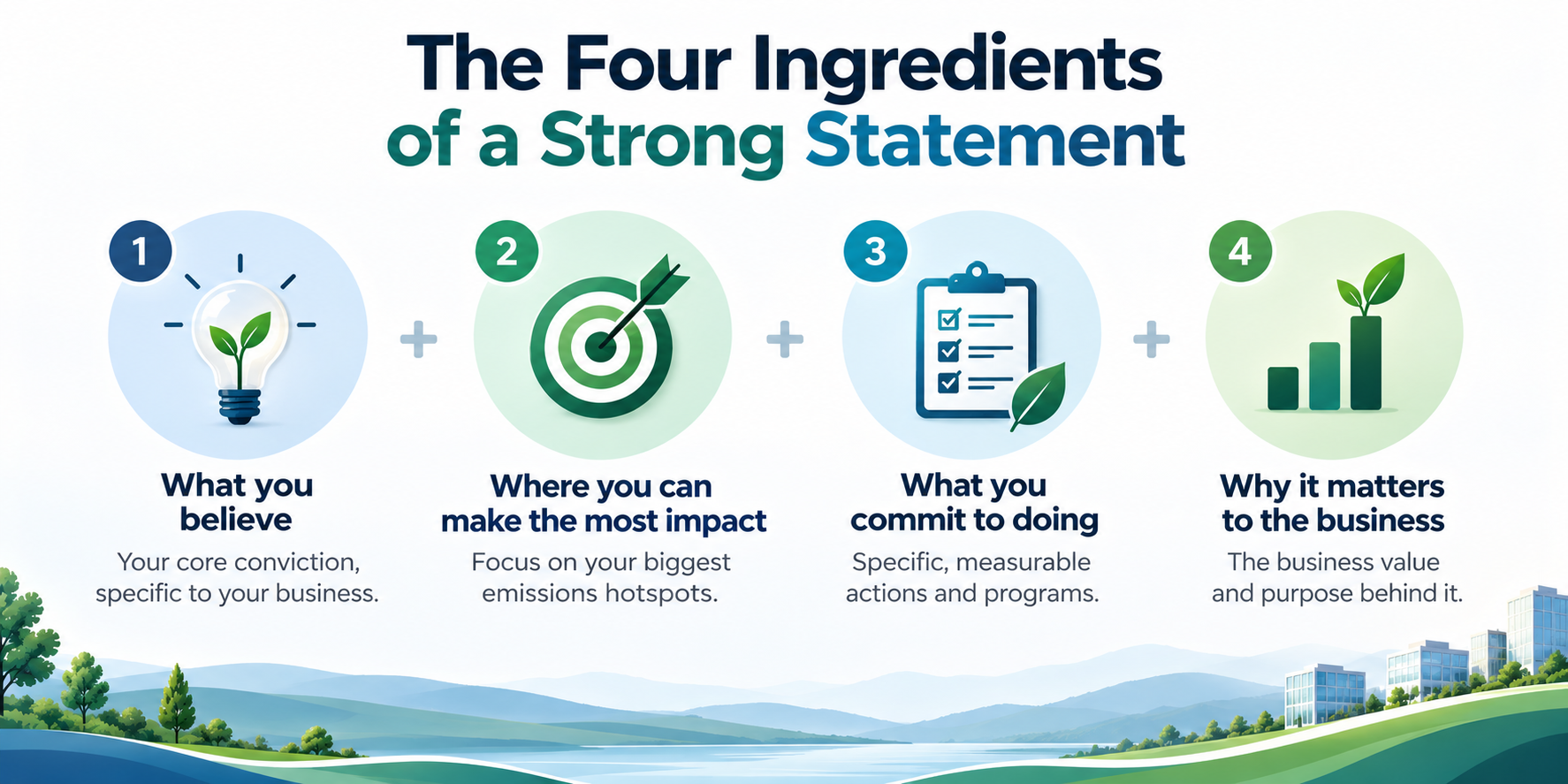
A sustainability mission statement that actually guides behavior tends to be built from four ingredients. Not all of them need to appear as explicit sentences in the final text, but all of them need to inform it.
What you believe. This is the foundational conviction that makes sustainability a genuine business priority rather than an external requirement. It should be specific to your business and your industry, not generic. A food company's belief about its relationship to the natural systems that produce its ingredients is different from a logistics company's belief about its role in driving down transportation emissions. The more specific the belief, the more credible it reads.
Where you can make the most impact. Based on your emissions inventory and hotspot analysis, where does your actual footprint lie? A manufacturer's highest-impact area is likely its production process and supply chain. A professional services firm's may be business travel and purchased services. A retailer's may be its product sourcing and logistics. A statement that is grounded in where the business actually has the most leverage is far more credible than one that gestures at environmental responsibility in the abstract.
What you commit to doing. This is the operational heart of the statement. What specific actions, programs, or standards is the business committing to? Measuring emissions annually. Reducing Scope 1 and 2 emissions against a defined target. Engaging suppliers on sustainability performance. Holding third-party certification. The commitment should be specific enough that someone could check whether you are doing it.
Why it matters to the business. The most durable sustainability mission statements connect environmental commitment to business purpose. Not because it is the right thing to do in a generic sense, but because it is the right thing for this business specifically. Because your customers depend on it. Because the natural systems your supply chain depends on are at risk. Because your employees expect it. Because the regulatory and commercial environment is moving in a direction that rewards it. A "why" that is specific to your business is what makes the statement feel genuine rather than borrowed.
The contrast between weak and strong sustainability mission statements is easier to see in examples than in principles.
Weak: "We are committed to operating in an environmentally responsible way and reducing our impact on the planet."
Why it fails: no specific commitment, no defined scope, no measurable standard, and no connection to the business. Every company in the world could publish this statement without changing anything about how they operate.
Stronger: "We measure our full carbon footprint annually under the GHG Protocol, are working toward science-based emissions targets, and hold ourselves accountable to the same environmental standards we ask of our suppliers."
Why it works: it describes specific actions (measuring, working toward targets, supplier accountability), names a recognized standard (GHG Protocol), and implies an ongoing commitment rather than a static position.
Weak: "Sustainability is at the core of everything we do. We believe in a future where business and nature can thrive together."
Why it fails: "at the core of everything we do" is a claim that requires no evidence to make and cannot be tested. "Business and nature can thrive together" is a sentiment, not a commitment.
Stronger: "As a food manufacturer, our environmental impact is inseparable from our business performance. We are reducing our Scope 1 and 2 emissions by 30 percent by 2028, engaging our top 20 suppliers on their emissions data, and pursuing B Corp certification as a measure of our broader commitment to responsible business practice."
Why it works: it grounds the commitment in the business context (food manufacturer), names specific targets (30 percent by 2028), describes a specific program (supplier engagement), and identifies a recognized external standard (B Corp).
Weak: "We're a green company that cares about the environment and is working hard to be more sustainable every day."
Why it fails: "green," "cares," and "working hard" are all meaningless without definition. "More sustainable every day" is an aspiration without a baseline, a methodology, or an endpoint.
Stronger: "We are committed to reducing our environmental impact through annual emissions measurement, verified carbon offsetting, and a clear path toward SBTi-aligned reduction targets. We report our progress publicly each year because accountability is part of the commitment."
Why it works: it describes a program (measurement, offsetting, reduction targets), references a recognized framework (SBTi), and makes accountability explicit as a value rather than treating it as optional.
The following framework is not a template to copy. It is a thinking structure to work through before you write. Answer each prompt in plain language, then use the answers to draft a statement of two to three sentences.
As a [type of business], our environmental impact is most significant in [your highest-impact areas based on your emissions inventory].
We are committed to [specific actions: measuring, reducing, certifying, reporting, engaging suppliers] and hold ourselves to [named standard or verification: GHG Protocol, SBTi, B Corp, EcoVadis, etc.].
This matters to us because [specific connection to your business purpose, your customers, your supply chain, or your long-term resilience].
Work through each prompt with your actual emissions data in front of you. The first prompt forces you to ground the statement in operational reality. The second forces you to be specific about what you are doing and what standard governs it. The third forces you to connect the commitment to business purpose rather than generic environmental sentiment.
The resulting draft will probably be imperfect. That is fine. Draft it, check it against the four ingredients, test it against the decision-making standard (could someone use this to make a choice?), and refine from there.
A sustainability mission statement is only as strong as the program behind it. The connection between the statement and the operational program needs to be explicit, maintained, and updated as the program evolves.
The practical implication is that a sustainability mission statement should be reviewed annually alongside your emissions inventory. When your inventory improves, when a target is set or validated, when a certification is achieved, or when a new program is launched, ask whether the statement still accurately reflects where the business is. If it understates the program, update it to reflect the progress. If it overstates the program, either update it to match what actually exists or accelerate the program to close the gap.
This annual review is also the mechanism that keeps the statement from becoming stale. A statement written when the business was at Level 2 of the maturity model should not still be on the website when the business reaches Level 4. The statement should grow with the program, and the program should be held accountable to the statement.
One practical test: take your current sustainability mission statement, if you have one, and check every specific claim against your emissions inventory and certification documentation. For each claim, ask whether you have documentation that substantiates it right now, not in the future, not in principle, but today. If a claim lacks supporting documentation, either remove it from the statement or build the documentation before the statement goes back on the website.
A sustainability mission statement is only as credible as the program behind it. Aclymate gives you the verified emissions data, documented methodology, and certification status that a credible statement requires. When your inventory is built on GHG Protocol methodology, organized by scope, and updated annually, every specific claim in your sustainability mission statement has something concrete to stand on.
The platform's customer-ready reporting outputs give you the documentation to share when customers or partners ask what is behind the statement. Rather than pointing to a mission statement and hoping no one asks for evidence, you can point to a statement and immediately back it up with a verified emissions report, a certification credential, and a year-over-year progress summary.
On Aclymate One, your Sustainability Consultant helps you develop sustainability communications, including your mission statement, that are both compelling and defensible. That means reviewing your current program against what the statement claims, identifying any gaps between the two, and helping you develop language that accurately represents where you are while signaling clearly where you are headed. For businesses at the stage where external communication is becoming a commercial priority, that combination of verified data and expert communications guidance is what makes the difference between a statement that builds trust and one that creates exposure.
A sustainability mission statement is not a branding exercise. It is a commitment made in public, and it will be evaluated against what your business actually does. Vague words like "green," "responsible," and "planet-friendly" are not commitments. They are placeholders, and increasingly, customers, procurement teams, and regulators treat them as such.
Write the statement your program can support today. Be specific about what you are doing, name the standard you are doing it under, and connect the commitment to why it matters to your business specifically. Then build the program that earns a stronger statement next year.
That is how a sustainability mission statement becomes something that actually guides your business rather than just decorating your website. And that is the difference between sustainability communication that builds lasting credibility and sustainability communication that eventually has to be walked back.
Get Aclymate's practical sustainability content delivered weekly.

Most businesses know they should be doing more on sustainability. Far fewer know where they actually stand. A sustainability maturity model gives you an honest picture of where you are, what's missing, and what the next stage looks like.
Read Article

If your company is considering SBTi validation, understand the people, data, cost, timeline, and ongoing obligations before you begin.
Read Article

Your company may never be required to join SBTi. But if your customers have science-based targets, their commitments can create very real expectations for you.
Read Article
Talk with a Sustainability Expert, see a demo, or start free to put the Aclymate platform and experts to work for your team.