← Back to Teaching Sustainability
Mike Smith
November 16, 2026

Welcome to Teaching Sustainability, the ongoing educational series from Aclymate created to help small and mid-sized business leaders understand what sustainability means, why it matters, and what to do next. Each week, we cover one practical topic, from carbon accounting and reporting to certifications and climate action, in clear, simple language designed to help you build a more resilient, credible, and competitive business.
Last chapter, we covered how to build a sustainability team without building a sustainability department, and how a cross-functional group with clear ownership can run a credible program. A team structure gives you coordination. It does not, on its own, give you participation. The rest of your employees, the ones who are not on the green team, are the people whose daily choices about travel, purchasing, energy use, and waste add up to a significant share of your footprint. This chapter is about how to bring them in.
The businesses that make real progress on sustainability are rarely the ones with the most polished program documents. They are the ones where employees understand why it matters, see leadership acting consistently, and have easy, meaningful ways to contribute. That is what culture is, and it is built differently than most businesses expect.
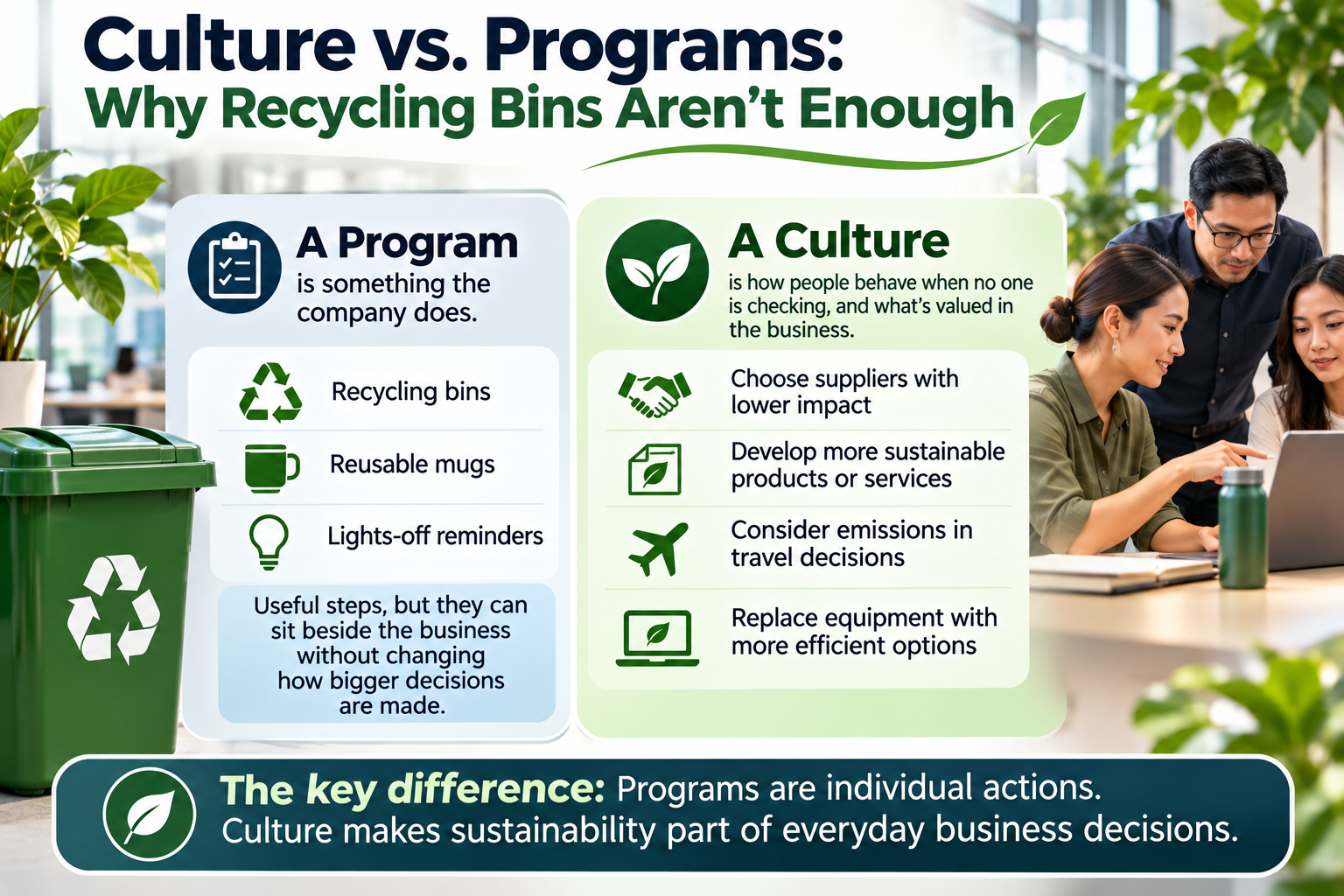
Most businesses begin their sustainability efforts with visible, easy programs: recycling bins, reusable mugs, a lights-off reminder in the break room. These are fine. They are also not culture. A program is something the company does. A culture is how people behave when no one is checking, and what they assume is normal and valued in the business.
The difference shows up in how decisions get made. In a business with a sustainability program but no culture, sustainability lives in a separate lane. Employees recycle, but the procurement team still chooses suppliers on price alone. Leadership talks about climate commitments, but travel approvals never consider emissions. The recycling bin becomes a symbol of the gap rather than evidence of commitment, because employees can see that the large decisions are being made without reference to the values the small ones are meant to express.
A sustainability culture exists when sustainability is part of how ordinary business decisions get made: which supplier to choose, which product to develop, which meeting to hold in person, which equipment to replace. It cannot be created by programs alone, because programs sit beside the business. Culture is created when sustainability moves inside it.
Employees take their cues from what leaders do, not what leaders say. If the executive team talks about sustainability at the all-hands meeting and then approves a capital plan with no emissions consideration, employees notice. If the CEO mentions the company's climate commitments in a speech and then books unnecessary flights, employees notice that too.
Leadership does not need to be perfect. It needs to be visibly consistent. Four practices make the biggest difference.
Make sustainability part of normal business decisions. Add an emissions or sustainability line to the templates leaders already use: the capital request form, the vendor selection scorecard, the product development brief. When the question appears in the standard process, it stops being an extra and becomes part of how the business thinks.
Talk about trade-offs openly. Real sustainability decisions involve costs and compromises. Leaders who acknowledge those trade-offs honestly, "this option costs more up front but reduces our Scope 2 emissions by 15 percent, and here's why we chose it," build far more trust than leaders who present sustainability as free or effortless.
Show up. The executive sponsor attending the monthly green team meeting, or opening the quarterly sustainability update, sends a signal that no communication campaign can replicate.
Connect it to the business. Employees participate more willingly when they understand how sustainability connects to customers, competitiveness, and the company's future. If your largest customers are asking for emissions data, tell employees. That is a business reason, and it is more motivating than an abstract appeal.
Most employees care about sustainability more than their employers assume. The barrier to participation is rarely lack of interest. It is a lack of a clear, low-effort way to contribute. The best engagement programs reduce friction and give people agency.
Employee idea programs. Create a simple channel, a shared form, a dedicated Slack channel, a suggestion box with a response commitment, where any employee can submit a sustainability idea. The critical element is the response. Ideas that disappear into a void teach employees that the program is performative. Commit to acknowledging every submission within a set time and to publicly reporting which ideas were adopted. Frontline employees often see waste and inefficiency that leadership never does, and some of the best reduction ideas in a business come from the people closest to the work.
Sustainability challenges. Short, time-bound challenges work well because they are specific, social, and easy to join. A four-week commuting challenge, a paper-reduction month, or a waste-diversion contest between departments gives people a defined goal and a sense of shared effort. Keep the actions simple and the measurement visible.
Green teams. A voluntary, employee-led group gives enthusiastic employees a home and a mandate. The most effective green teams have a clear charter, a small budget, an executive sponsor, and genuine authority to run initiatives. They should be distinct from the cross-functional program team described in the last chapter: the program team runs the operational program, while the green team drives engagement and culture. Rotating membership keeps energy fresh and widens participation.
Volunteer programs. Paid volunteer time for environmental projects, such as local cleanups, tree planting, or community garden work, gives employees a tangible way to act on their values and builds the connection between the company and its community. It also tends to attract and retain employees who care about these issues.
Recognition. People repeat behavior that is noticed. Recognize contributions publicly: highlight the employee whose idea cut paper use, thank the team that hit its waste-diversion goal, include sustainability contributions in performance conversations. Recognition does not need to be expensive. It needs to be sincere and specific.
Culture is transmitted through repetition, and the most reliable places for repetition are the moments every employee passes through.
Onboarding. A new employee's first weeks shape their understanding of what the company values. Include a short, concrete introduction to your sustainability commitments: what you have measured, what you are working toward, and what role employees play. Avoid abstract values language. "Here is our current footprint, here is our target, and here are three ways you can help" is far more effective than a slide about caring for the planet.
Company meetings. Give sustainability a standing, brief place on the all-hands agenda: a two-minute update on a key metric, a recent win, or a coming challenge. Consistency matters more than length. When sustainability appears in every meeting alongside financial and operational updates, it signals that it belongs in the same category of importance.
Everyday communications. Include a sustainability metric in the monthly newsletter, share progress on internal dashboards, and answer employee questions openly. Transparency builds credibility, particularly when the news is mixed.
A single company-wide target, such as "reduce emissions 30 percent by 2030," is important for strategy but difficult for any individual employee to connect to their work. Most people cannot see how their daily actions move a corporate number. Department-level goals solve this by translating the company target into terms each team can own.
The facilities team might own an energy-use reduction target. Procurement might own the percentage of spend with suppliers that have provided emissions data. Sales might own a travel-reduction goal. HR might own a commuting-survey response rate. Each goal should be specific, measurable, tied to something the department actually controls, and connected to the company-level target so that people can see how their piece fits.
Department goals also create healthy accountability and a natural opportunity for friendly comparison. When teams can see their own progress against their own goal, sustainability stops being someone else's initiative and becomes part of their own performance picture.
Employees stay engaged when they can see that their effort produces results. That requires measurement and communication. When the paper-reduction challenge ends, report the actual number of sheets saved and the cost avoided. When the energy efficiency upgrade is complete, share the measured reduction in electricity use. When the company reaches a milestone, such as completing its first full emissions inventory or earning a certification, mark it publicly and credit the people who made it happen.
Specific, measured wins are more motivating than general encouragement, and they reinforce the broader principle running through this series: claims should be backed by data. Celebrate what you can substantiate, and be honest about what has not yet worked. Employees trust programs that report setbacks candidly.
The fastest way to undermine a sustainability culture is to make employees feel judged. Guilt-based messaging, moralizing about personal choices, or public shaming of individuals who do not participate produces resentment and disengagement. People who feel lectured tend to tune out, and those who already care can become uncomfortable when the program turns self-righteous.
A few principles keep engagement positive.
Focus on collective progress, not individual blame. Emphasize what the team is achieving together rather than what individuals are failing to do.
Respect different starting points and motivations. Some employees care about climate, some about cost savings, some about community, and some just want to do good work for a company they respect. All of those motivations are valid, and a good program leaves room for each.
Make the easy choice the default. Where possible, change the system rather than relying on individual willpower: set printers to double-sided by default, make the vegetarian option the standard catering choice, install occupancy sensors. Defaults produce results without requiring anyone to feel guilty.
Invite rather than instruct. "Here's a challenge if you'd like to join" lands very differently than "everyone must do this." Voluntary participation, offered generously and recognized warmly, builds more durable engagement than mandates.
Launch one employee-driven sustainability challenge or idea program. Choose one and keep it simple. For a challenge, pick a single measurable behavior, such as commuting without a single-occupancy car, reducing printing, or eliminating single-use items, and set a four-week window. For an idea program, create one shared channel or form and commit publicly to responding to every submission within two weeks.
Name the executive who will visibly support it. Ask them to announce the launch, participate themselves, and attend the wrap-up. Visible leadership participation is the difference between a program employees try and one they ignore.
Decide in advance how you will measure and share results. Before launching, define the metric and the date on which you will report back. A challenge with no reported result teaches employees that effort does not matter.
Identify two or three employees who are already enthusiastic and ask them to help lead it. Employee-led programs consistently outperform management-led ones. Giving enthusiastic employees ownership turns them from participants into advocates.
Culture runs on visibility, and visibility requires data. Aclymate gives you the verified emissions data that makes employee engagement concrete: a clear baseline, a trend over time, and the ability to show employees exactly how the company is progressing and where their contributions fit. When you can tell a team that its energy-efficiency effort reduced emissions by a measured amount, the work stops being abstract.
The carbon accounting platform also supports the department-level goals described in this chapter, by tracking emissions and initiatives by category and owner so that each team can see its own contribution. On Aclymate One, your Sustainability Consultant can help you design an employee engagement program matched to your current maturity, develop department-level goals tied to your inventory, and build the internal communications that keep participation going. For businesses without a dedicated sustainability function, that support helps culture-building become a structured program rather than another task for an already busy team.
A sustainability culture is not built with posters, bins, or a values statement. It is built when sustainability becomes part of how ordinary decisions get made, when leaders act consistently, when participation is easy and welcome, and when people can see that their effort produces measurable results.
Start small. Launch one challenge or idea program this week, make leadership visible, measure the outcome, and celebrate it honestly. Then do it again, a little broader each time. Culture compounds in exactly the way sustainability programs do: one credible, consistent step at a time.
Get Aclymate's practical sustainability content delivered weekly.

Most small and mid-sized businesses cannot hire a dedicated sustainability team. They don't need to. The expertise required to run a credible sustainability program already exists inside your organization. The work is structuring it.
Read Article

Most sustainability mission statements fail before they're published. They're written to sound good rather than to mean something. Here's how to write one that actually guides decisions, holds up to scrutiny, and reflects what your business has genuinely committed to.
Read Article

Most businesses know they should be doing more on sustainability. Far fewer know where they actually stand. A sustainability maturity model gives you an honest picture of where you are, what's missing, and what the next stage looks like.
Read Article
Talk with a Sustainability Expert, see a demo, or start free to put the Aclymate platform and experts to work for your team.